Studio · Wood & Eco
Wood Business Cards
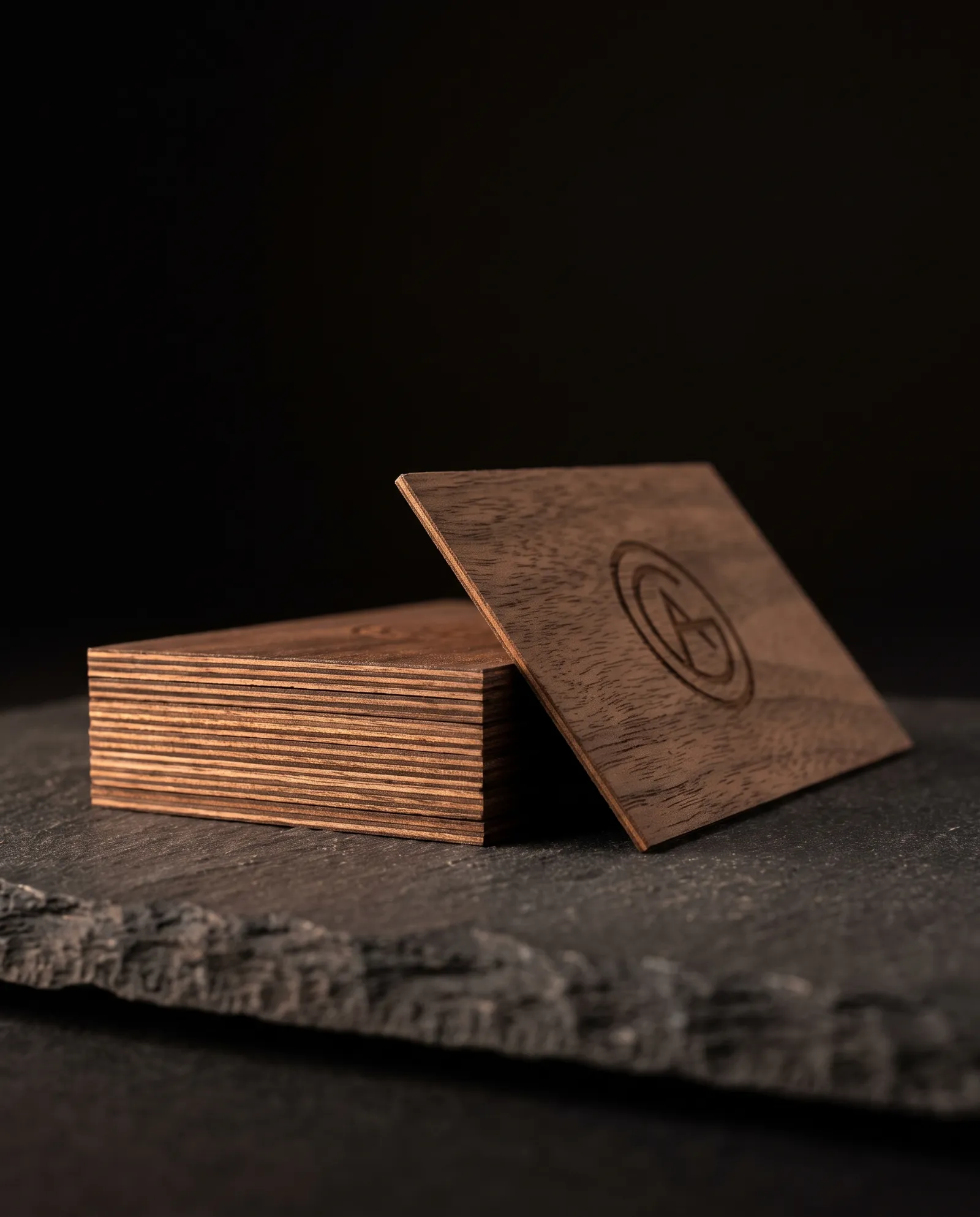
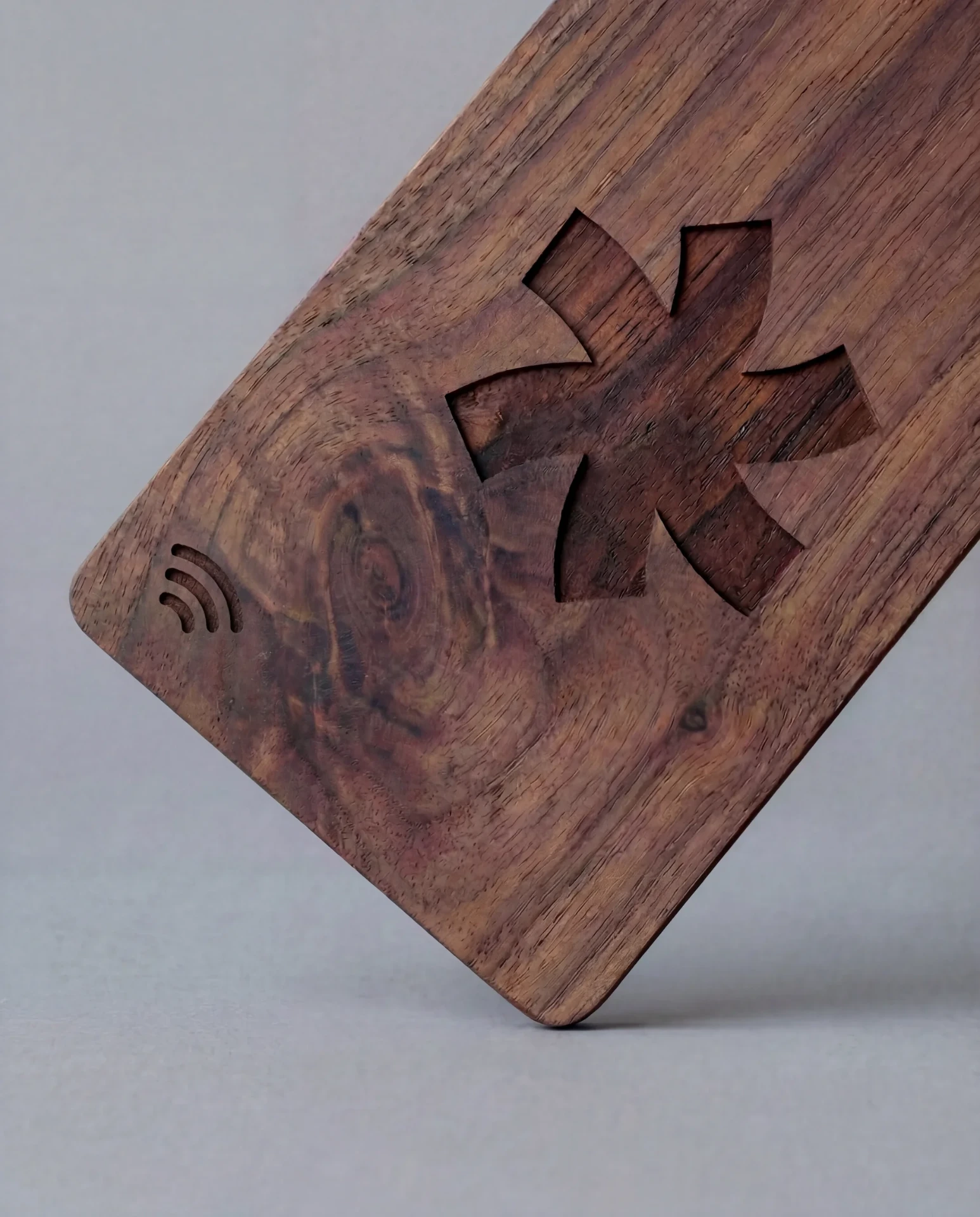
Wood business cards from Print Peppermint are cut from a thin sheet of real wood, in cherry, walnut, birch or bamboo, then laser engraved, laser cut or color printed with your design. Each card is about 0.6 mm thick, a little thinner than a credit card. No two wooden business cards in a box share the same grain, and the engraving reads a shade differently on each one. That variation is the reason to choose wood, and we'd rather show you what to expect before you order than promise you a matched set.
- From 335 US$ for 100 cards
- About 3 weeks after proof approval
- Free designer proof
- Free design proof. A designer checks your file against the wood you chose before anything is cut.
- If you're not happy, we reprint. How reprints work
- Free shipping within the continental US. On every order.
Real wood, honestly described
A wood business card is a solid sheet of walnut, maple or cherry, about 1.1–1.2 mm thick: cut from the log, sanded, and left as wood. It is not wood-look paper, not a printed grain, and not a plastic card with a photograph of wood on it. Our eight-species sample set is cut from 0.6 mm solid wood sheet, and that's the build this page describes.
Before you pick a species, four things worth knowing:
- The grain is different on every card. A knot or a dark streak lands wherever the tree put it. Across a box you get a family, not a matched set.
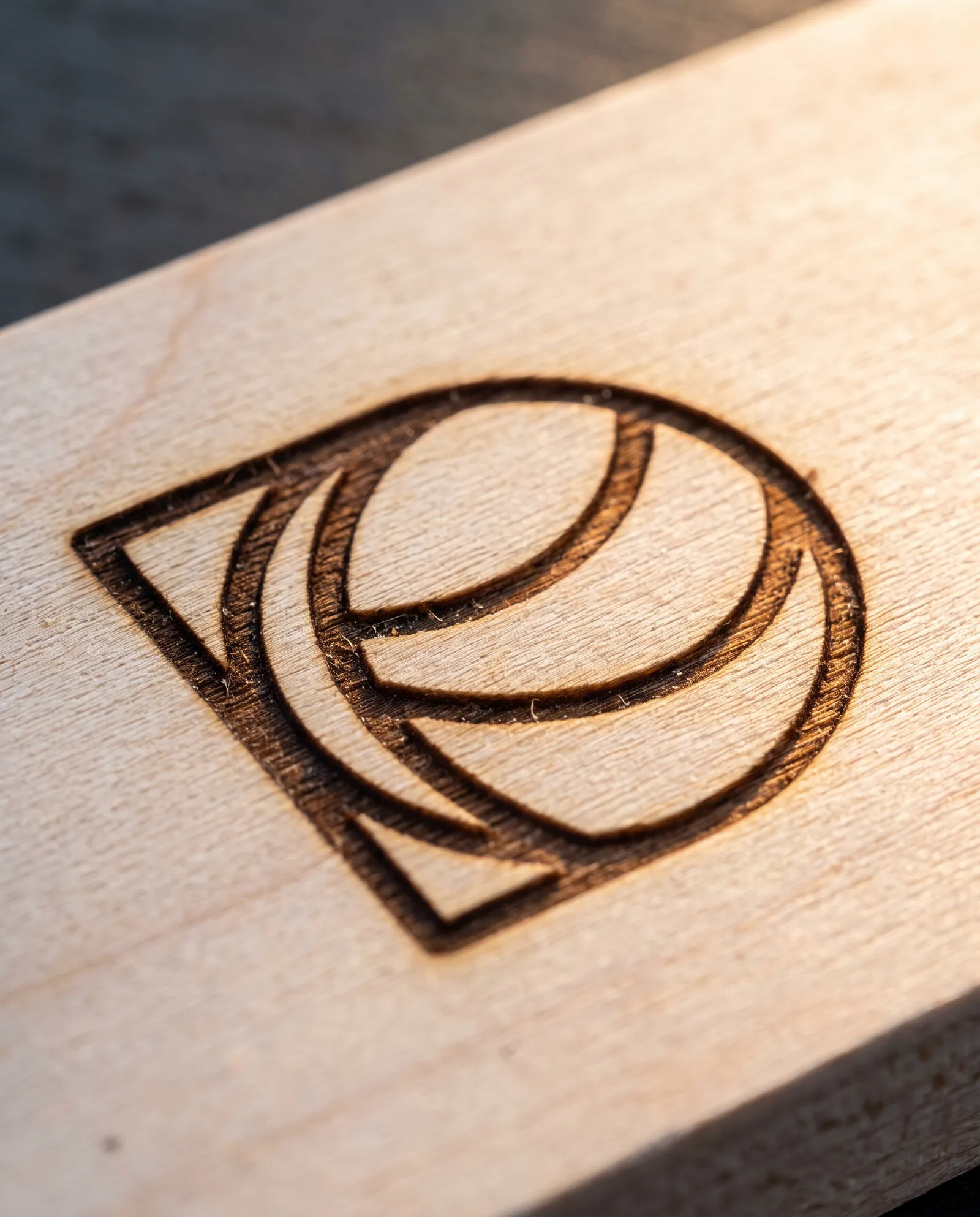
- The engraving is a burn, and burn color varies. The laser darkens the wood where it marks, so a logo engraved on pale birch reads dark brown, while the same logo on walnut is a quiet tone-on-tone. Within one card, a denser band of grain can burn slightly darker than the wood beside it.
- Paper finishes don't work on wood. Foil stamping, letterpress, spot UV and painted edges are paper processes. On wood the decoration comes from the laser: engraving, cutting through, or color printing on the surface.
- Pale colors disappear on dark wood. Printed color lets the grain show through, so a light grey or pastel reads clearly on birch and nearly vanishes on walnut.
If your logo has to land on exactly the same tone on every card, a wood card will frustrate you. Our kraft and recycled cards give a natural, uncoated feel with far more consistency. If the variation is the point, read on.
Choose your wood
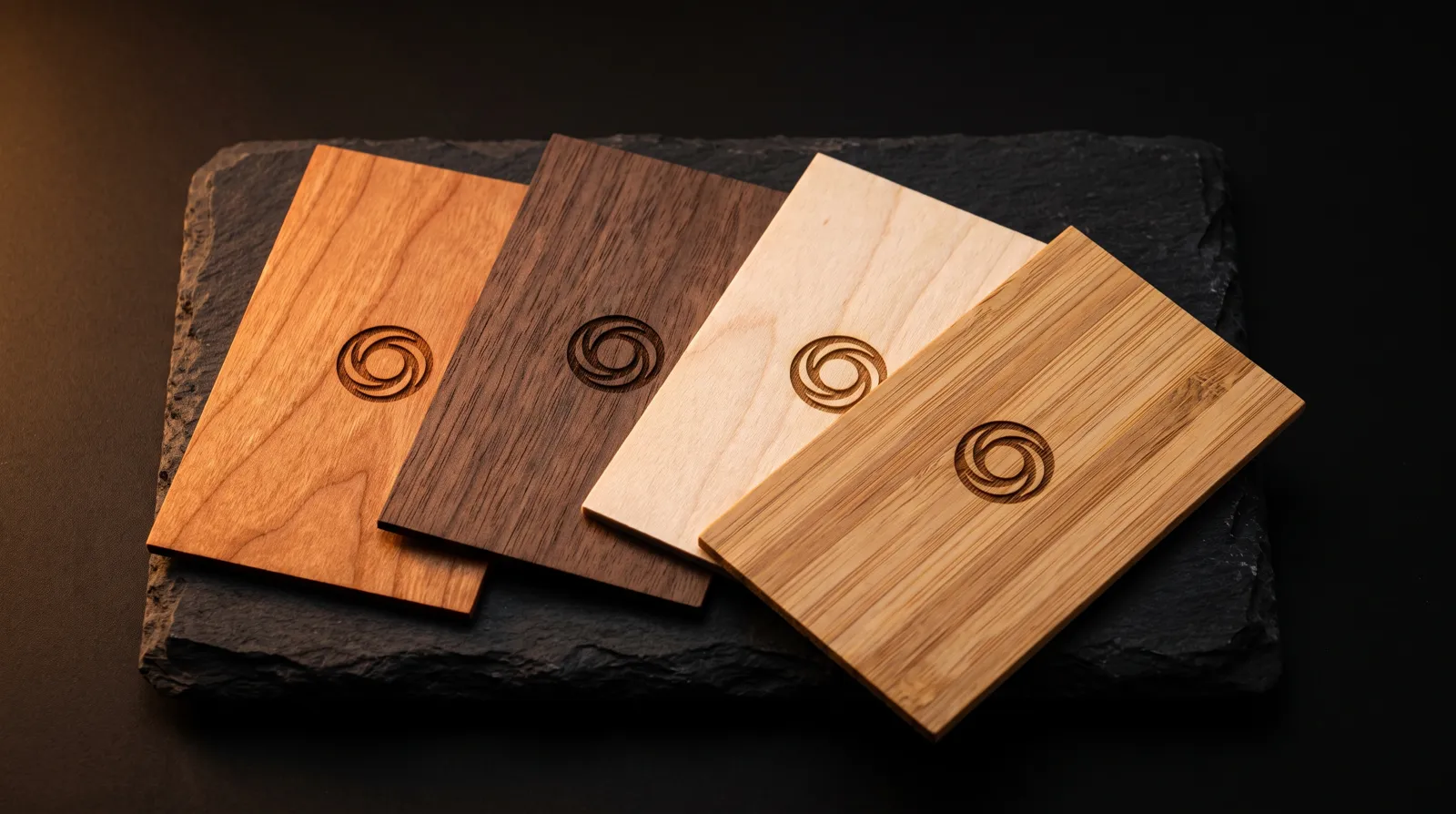
Four species are on the order form. All four engrave cleanly; what changes is the color of the card and how loudly the engraving reads against it. Cherry is our pick for most logos.
CherryOUR PICK
Warm reddish brown with a smooth, fine grain. The laser burn reads near-black, so text and line work stay legible without looking harsh. Cherry darkens gently with age and light, which suits a card someone keeps. Choose it when you want contrast and warmth in the same card.
Walnut
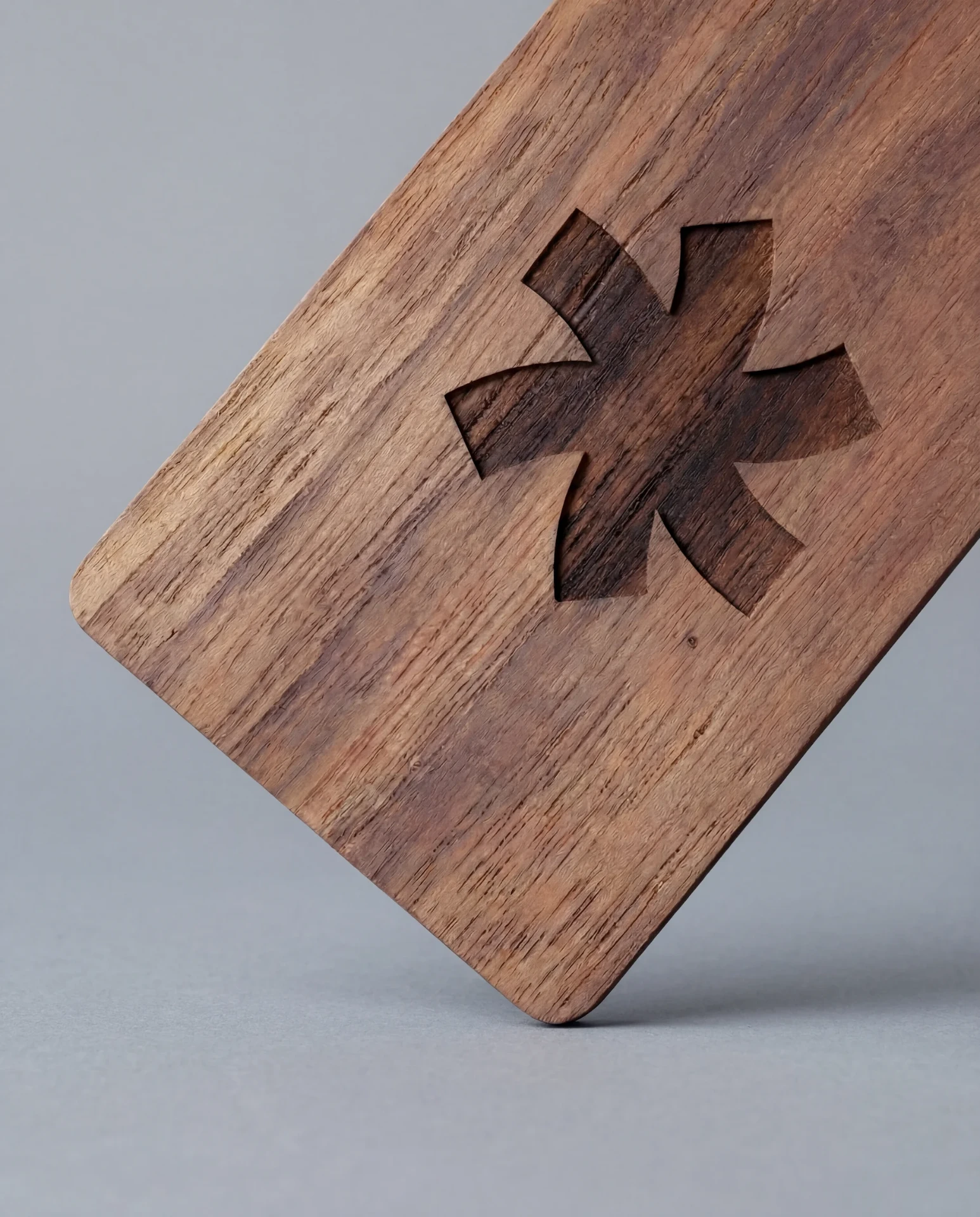
Deep chocolate brown with the most dramatic grain of the four. Engraving on walnut is subtle: a darker mark on dark wood that shows best when the card tilts toward the light. Choose walnut for a bold monogram or a short wordmark, not for small contact details.
Birch
Pale blonde and quiet, with a fine, even grain. This is where engraving reads strongest: dark brown on near-white, almost like ink. Birch is also the best ground for color printing and for an engraved QR code. Choose it when legibility matters most.
Bamboo
Golden tan with straight, parallel lines running across the card. Bamboo is technically a grass, not a tree, and it regrows fast. The engraving reads mid-brown, and the striped grain gives fine lines a slight texture. Choose bamboo for a lighter card with a sustainability story.
Our sample set also covers maple, beech, sapele and basswood. If you've seen one of those and want it, ask for a quote.
Peppermint Promise
If you're not happy, we reprint.
Free design proof
A real designer reviews your files before we print.
Free shipping in the continental US
Every order ships free.

Wood species
335 US$ for 100 cards · about 3 weeks
Enhance
Quantity
Select your quantity
If you're not happy, we reprint. How our quality promise works
Need something custom? Other sizes, papers, finishes or quantities → Get a custom quote
- Free design proof
- About 3 weeks (estimate)
- Free shipping (continental US)
Engrave, cut or print
Laser engraving is included with every wood business card and is the right choice for most designs: it marks the wood itself, so there's nothing on the surface to scuff off. Add a cut-out when your mark has a strong silhouette, and add color printing only when a brand color can't be left out.
| Option | What it looks like | Best for | Watch for |
|---|---|---|---|
| Laser engraving (included) | A burned mark sitting in the grain, dark on pale woods and tone-on-tone on walnut | Logos, names, line illustration, contact details on pale species | Gradients and photos flatten to one solid tone. Lines finer than about 0.3 mm soften, most of all on bamboo |
| Laser cut-outs (Get a price) | Shapes cut clean through, so whatever sits behind the card shows through it | A monogram, a symbol, a pattern along one edge | Cut details need 1 mm bridges, 0.8 mm slots and 1 mm between neighboring cuts to stay strong, and a 3 mm frame from the edge. Free-floating pieces (the middle of an "O") drop out unless we bridge them |
| Color printing (Get a price) | Color sitting on the wood with the grain showing through it | One brand color on birch or bamboo | Light and pastel colors fade into dark wood. Color shifts warmer on cherry and bamboo because the wood tints it |
| Engraved QR code (Get a price) | A burned, scannable QR code: no ink, nothing to wear off | A link on a card that has no NFC chip | Needs at least 2 cm square with a clear margin. It scans most reliably on birch or bamboo, where the burn is dark against pale wood; on walnut the burn sits too close to the wood's own tone to rely on. We test-scan it at proof |
Need a shape other than a rectangle? The outline itself can be laser cut. Request a custom-shape quote.
Add an NFC chip
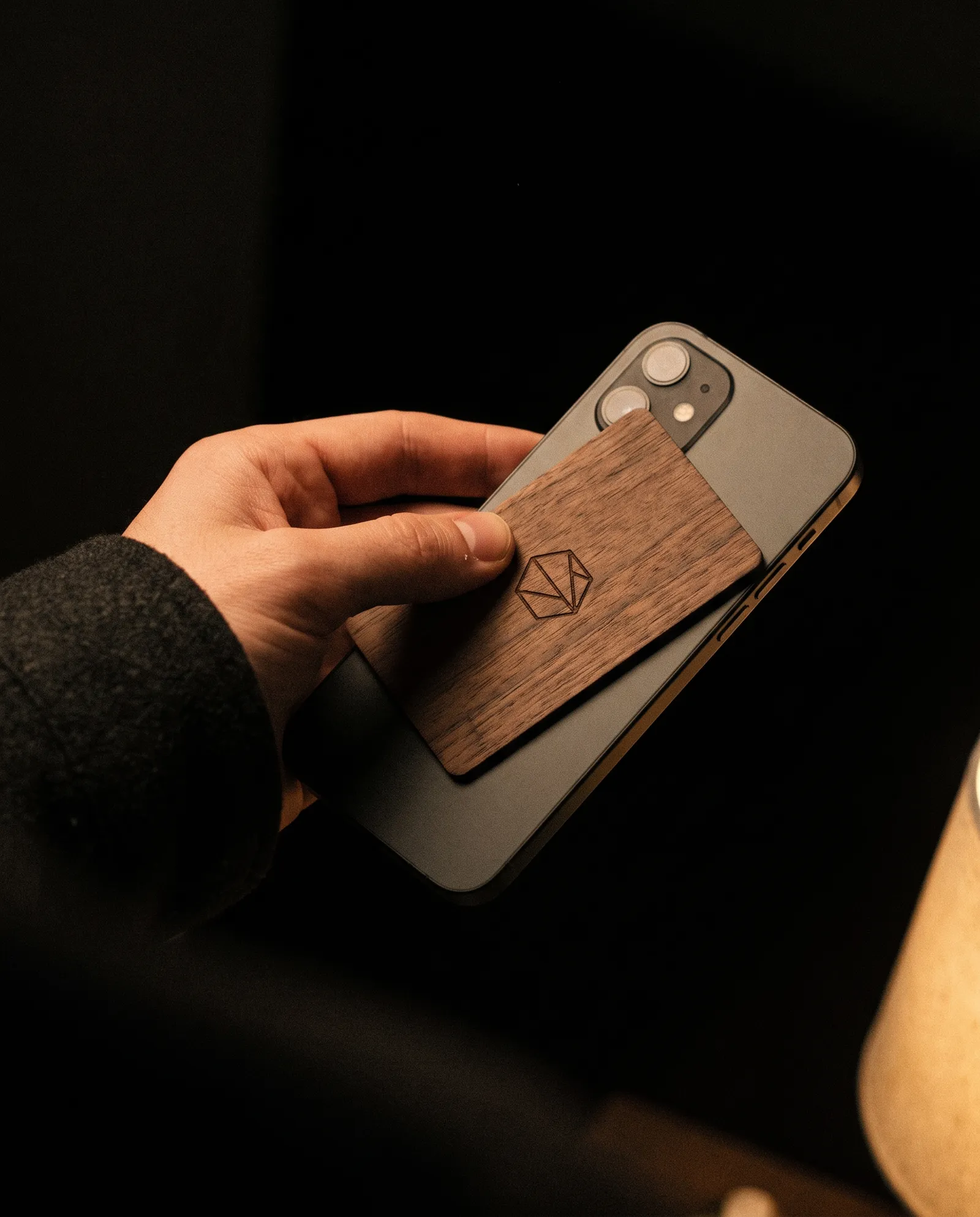
A wood card can carry an NFC chip sealed inside it. Tap the card to the top of a phone and it opens your website, portfolio or contact card. No app is needed on most modern phones. The NFC version is built at 1 mm thick so the chip reads reliably, and it starts at 299 US$ for 50 cards. We can program each card with your link before it ships, or ship the cards blank for you to program. If the chips are left unlocked, a free NFC writing app can change the link later; easier still, point the chip at a short link on your own domain and change where that goes.
If you'd rather keep the card thin and simple, an engraved QR code does the same job with a phone camera. You can also have both: the chip for the tap, the QR code as a backup for the odd phone that doesn't read NFC.
What wood business cards cost
100 wood business cards cost 335 US$, about 3,35 US$ each, with laser engraving, a designer proof and free continental US shipping included. The per-card price falls steeply with quantity: at 1,000 cards it's 0,76 US$ each.
| Quantity | Per card | Total | Saving per card vs 100 |
|---|---|---|---|
| 100 | 3,35 US$ | 335 US$ | — |
| 250 | 1,56 US$ | 389 US$ | 54% off |
| 500 | 1,02 US$ | 509 US$ | 70% off |
| 1,000 | 0,76 US$ | 759 US$ | 77% off |
| Add-on | Price |
|---|---|
| Laser cut-outs | Get a price |
| Color printing | Get a price |
| Engraved QR code | Get a price |
| Custom outline shape | Quoted |
Look at the 250 line before you settle on 100. If you'll hand out more than a hundred cards this year, the larger run usually costs only a little more in total.
Lead time: about 3 weeks after you approve your proof, plus transit. That's an estimate, not a delivery date. If you need the cards for an event, tell us the date before you order and we'll tell you honestly whether it's realistic.
How wood cards hold up
- In a wallet: at about 0.6 mm a wood card is slightly thinner than a credit card, so it slides into a wallet slot or a card holder like a thick paper card. The standard size is 2 × 3.5 in.
- Bending: thin wood flexes a little and springs back. Fold it hard across the grain and it will crack along a grain line, the way a thin plank does. Keep it flat in the box and it's fine.
- Water: the card is left raw, with no varnish or coating on top. A splash wipes off. A soak raises the grain and can make the card cup as it dries.
- Light and age: wood moves with time. Cherry deepens toward a richer red; the engraving stays put because it's burned into the wood rather than printed on top.
Wood vs metal vs plastic
Choose the material by how the card gets handed over. Wood is warm and a little slower: people turn it over and look at the grain. Metal is heavy and cool, and it is the card people remember the weight of. Plastic is tough and can be see-through.
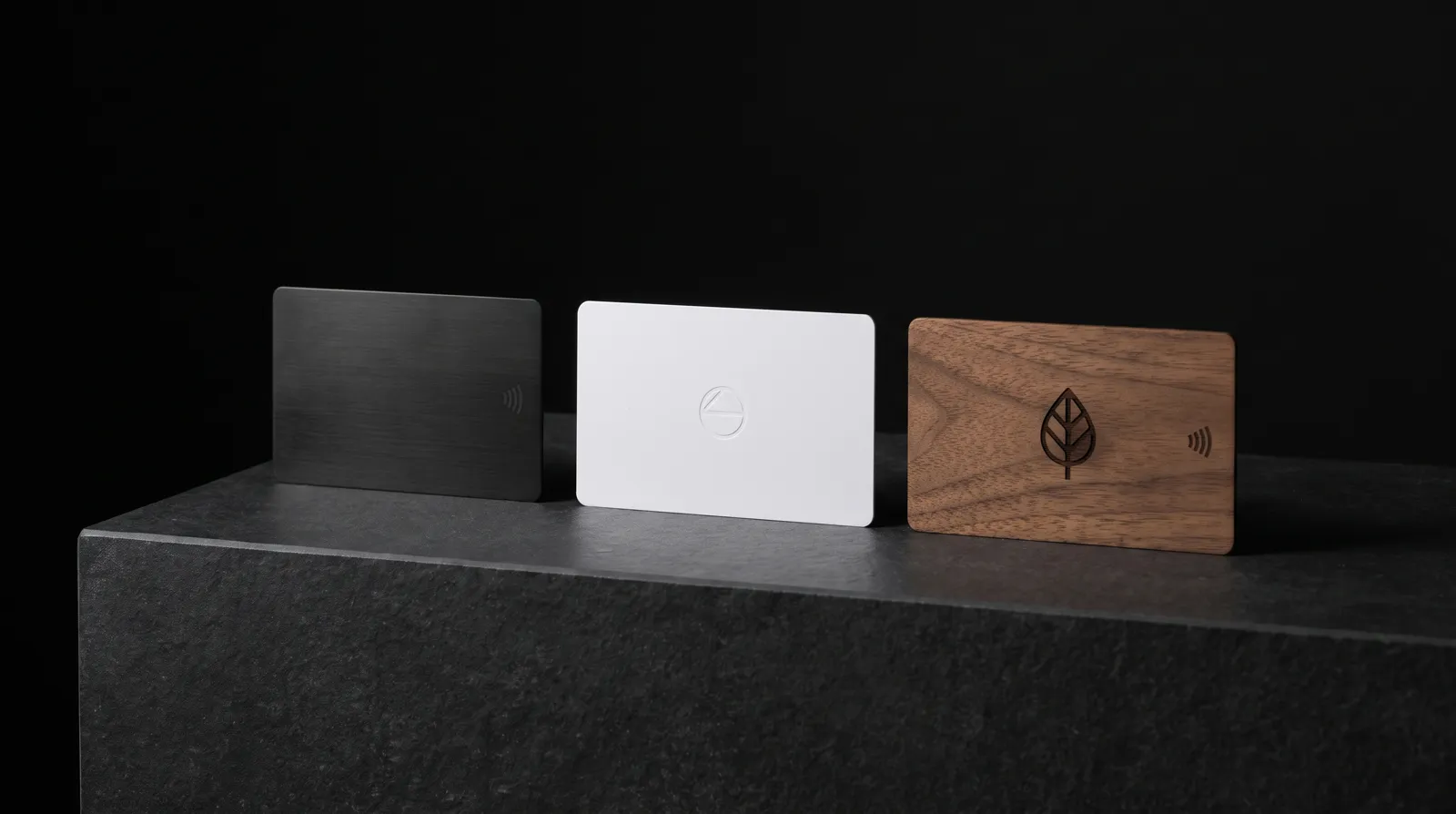
| Wood | Metal | Plastic | |
|---|---|---|---|
| Material | One thin sheet of real wood | Stainless steel, PVD color coats, or aluminum | PVC: clear, frosted, white or black |
| Thickness | About 0.6 mm; NFC version 1 mm | 0.5 mm or 0.8 mm | 20pt (about 0.5 mm) or 30pt (about 0.76 mm) |
| How it's decorated | Laser engraving, laser cut-outs, color print | Laser engraving, etching, cut-through, color print | Full-color print, white ink, foil, spot UV |
| Every card identical? | No, grain varies | Yes | Yes |
| Handles water | Wipes clean; don't soak | Yes | Yes, fully waterproof |
| From | 335 US$ for 100 | 475 US$ for 100 | 136 US$ for 100 (white, front only) |
| Typical lead | About 3 weeks after proof | About 3 weeks after proof | Standard ships in 3–4 business days after proof approval (estimate); Custom about 3 weeks |
| NFC available | Yes | Yes | Yes |
Case study · our own sample set
Eight woods, one laser
We wanted our sample pack to answer the question customers actually ask, which isn't "does wood work?" but "which wood?". So we cut the same card eight times: cherry, maple, beech, bamboo, sapele, walnut, birch and basswood, each 2 × 3.5 in with rounded corners on 0.6 mm solid wood sheet, each engraved in a single pass with the same beaver illustration.
Three rules made the set comparable. The artwork never changed; only the laser's power and speed changed per species, because each wood burns at its own rate. Every stroke was floored at 0.3 mm so the fine hatching held on bamboo and still looked right on cherry. And nothing went on top: no ink, no coating, so there's nothing to scuff off. Lay the eight out together and you stop asking whether wood works and start picking a favorite.

Setting up your file
Every cut and every engraved line comes from clean vector outlines, so send your logo as a vector file (AI, EPS, SVG or PDF) if you have one. If you only have a JPG or a screenshot, our designers can redraw it for the press.
- Keep strokes at 0.3 mm or heavier. Hairline serifs and very light typefaces soften as the laser burns into the grain.
- Expect one solid tone. A gradient, a drop shadow or a photo becomes a single engraved shape. If the gradient is the idea, it has to move to color printing.
- Give cut-outs room. Keep bridges at least 1 mm wide, slots at least 0.8 mm, 1 mm between neighboring cuts, and a 3 mm frame between any cut and the edge of the card. Tell us whether each cut is a window (the middle drops out) or a stencil (we bridge it).
- Size QR codes at 2 cm or more with a clear margin around them, and keep the link short so the pattern stays open.
- Keep text 3 mm inside the edge. Cutting can shift slightly, and a line close to the edge looks uneven.
- Corners: square by default; rounded corners use a 3 mm radius.
Your proof shows the design on the species you chose. Treat it as a guide to layout and contrast, not a picture of your exact grain, because the grain is different on every card.
Who wood suits
Wood suits anyone whose work is physical: furniture makers, architects, builders, carpenters, landscape designers, coffee roasters, outdoor and craft brands. It also suits a brand built on materials and sustainability, where the card should say so before anyone reads it.
Wood is the wrong choice in three cases, and we'd rather tell you now:
- You need a pure white or pale logo on a dark card. Choose black cards with white pigment foil instead.
- Every card must match exactly. Choose kraft or recycled paper for a natural feel with consistent color.
- You hand out thousands at trade shows. A wood card costs more than paper. Keep wood for the conversations you want remembered and use paper for the volume.
Frequently asked questions
Are wood business cards solid wood?
Yes. Each card is a solid sheet of walnut, maple or cherry, about 1.1–1.2 mm thick — not a thin face glued to a core. It is real wood all the way through: not wood-look paper, not a printed grain and not a laminate with a photo of wood on it. Our eight-species sample set is cut from 0.6 mm solid wood sheet.
How thick are wood business cards?
Our standard wood business card is about 0.6 mm thick, slightly thinner than a credit card (about 0.76 mm), so it fits a wallet or card holder easily. The NFC wood card is built at 1 mm so the chip inside reads reliably.
Which wood species do you offer, and which engraves darkest?
Cherry, walnut, birch and bamboo are on the order form. Birch shows the strongest contrast: the laser burn reads dark brown on near-white wood. Cherry's burn reads near-black against warm red-brown. Bamboo reads mid-brown across its striped grain. Walnut is the quietest, a darker mark on dark wood. We've also cut maple, beech, sapele and basswood for our sample set; ask for a quote if you want one of those.
Can you print color or white on wood business cards?
Yes, color printing is an add-on. The grain shows through the ink, so colors look most like your screen on pale birch or bamboo, shift warmer on cherry, and fade into walnut. Pale colors and white don't read reliably on dark wood. If a white or pale logo on a dark wood is essential, ask before you order and we'll confirm what's possible on that species.
Can you laser cut a custom shape or cut-outs?
Yes. Laser cut-outs inside the card are an add-on on the order form, and a custom outline shape is quoted separately. Cut details need bridges at least 1 mm wide, slots at least 0.8 mm, 1 mm between neighboring cuts and a 3 mm frame from the edge so the card stays strong. Free-floating pieces, like the middle of an "O", drop out unless we add a small bridge.
Can you foil stamp, letterpress or emboss wood cards?
No. Foil stamping, letterpress, embossing, spot UV and painted edges are paper processes, and we don't run them on wood. On wood, the decoration comes from the laser (engraving or cutting) and from color printing. If foil or a deep letterpress bite is the look you want, a thick cotton card is the better material.
Do wood business cards fit in a wallet or card holder?
Yes. At about 0.6 mm they're slightly thinner than a credit card and standard business-card size, so they slide into a wallet slot or holder. Avoid folding one hard across the grain; thin wood can crack along a grain line.
Are wood business cards eco-friendly?
Wood is a renewable material, and bamboo, technically a grass, regrows especially fast. An engraved-only wood card carries no ink and no coating, so it is simply wood. If you need certified sourcing documentation for a sustainability report, tell us before you order and we'll confirm what we can provide for your species.
Can a wood business card have an NFC chip?
Yes. Our NFC wood business cards have a chip sealed inside the card and are built at 1 mm thick. Tap the card to a phone and it opens your website, portfolio or contact card. We can program your link before shipping, or ship the cards blank for you to program. NFC wood cards start at 299 US$ for 50.
Will my cards match the proof or the sample I approve?
They'll match in layout, size, species and engraving contrast, but not in exact grain pattern. Wood grain is different on every card, and the burn tone shifts slightly with the density of the wood under it. Treat any sample or proof as representative of the batch, not a template for every card.
How much do wood business cards cost?
100 wood business cards cost 335 US$, about 3,35 US$ each, including laser engraving, a designer proof and free shipping within the continental US. Larger runs cost much less per card: 250 cards are 389 US$ and 1,000 are 759 US$. Cut-outs, color printing and an engraved QR code are optional add-ons.
How long do wood business cards take?
About 3 weeks after you approve your proof, plus transit. That's an estimate, not a guaranteed delivery date. If you need cards for an event, tell us the date before you order and we'll tell you honestly whether it's realistic.
Can I see real wood before I order?
Yes. Our sample kit costs 8 US$ with free shipping within the continental US and includes real wood alongside our papers, metal and plastic, with a credit toward your first order. Holding the wood is the fastest way to choose a species.
More from Wood & Eco
Explore other materials
We rebuild supplied artwork for the press.
Our design team redraws your artwork as clean, layered, press-ready files so every plate, die and colour can be produced properly.
Need something we haven't covered?
Request a custom quote335 US$
100 cards