The label is the product.
Product labels, address labels and packaging seals on premium adhesive stock — foil-stamped, textured or waterproof film, die-cut to your shape. On a jar or a bottle, the label is the only thing the customer touches.
 Reviewed by a human before anything prints.
Choose labels that match the rest of your luxury packaging.
Explore more: custom boxes in the same paper and foil.
Foil is the cheapest way to make a small label read as expensive. See our foil labels for stocks, rolls and prices.
Closures and seals go on foil stickers; product labels stay here.
Explore more: hang tags. Pair it with a neck tag from our hang tags range.
For the card inside the box, see packaging inserts.
What’s possible
Substrate before design.
Where the label lives decides what it's printed on. A candle jar gets warm. A bottle sweats in an ice bucket. A soap wrapper meets water on day one. We pick the face stock and the adhesive for the shelf life first, then design into it.
Product labels
Jars, bottles, tins — die-cut to shape.
Waterproof film
White or clear BOPP for wet environments.
Textured & uncoated
Felt, laid and cotton faces for a matte read.
Foil & spot gloss
Metallic detail on a matte face.
Why Peppermint
A human guides every custom order.
Checked by a person
We confirm files, materials and finishes before you pay.
Materials others won't
Papers, foils and techniques most printers can't offer.
A free proof, always
Nothing prints until you approve exactly what you get.
Custom labels FAQ
Which label stock survives a candle jar or a cold bottle?
For anything that gets warm, wet or condensation-prone, a BOPP film face with a permanent adhesive. Uncoated textured papers look beautiful and they wick moisture — gorgeous on a dry-goods box, a mistake on a chilled bottle. Tell us where the product lives and we'll spec around it.
Can you foil stamp a label?
Yes — foil sits beautifully on a matte or textured label face, and it's often the cheapest way to make a small label read as expensive. On film stocks we'd usually recommend metallic ink or a metallised substrate instead; foil adhesion on some films is unreliable and we'd rather say that now.
Can labels be die-cut to a custom shape?
Any shape you like, with one caveat: tight interior corners and very narrow necks tear when the label is peeled off the liner. We'll soften the radius slightly on the die — a change nobody notices on the shelf and everybody notices on the applicator.
Do you supply labels on rolls or sheets?
Both. Sheets for hand-application and low volumes, rolls wound to your applicator's spec for anything machine-applied. If you're using a machine, send us the core size and wind direction with the quote.
How should I set up the artwork file for a die-cut label?
Send the label artwork with bleed past every cut edge, and supply the die shape as a separate vector path on its own layer — not as a drawn outline in the artwork itself. Keep type and logos back from the trim so a small shift on the die never crops them. Send what you have and we'll check it before anything is made.
We rebuild supplied artwork for the press.
Our design team redraws your artwork as clean, layered, press-ready files so every plate, die and colour can be produced properly.
Explore more
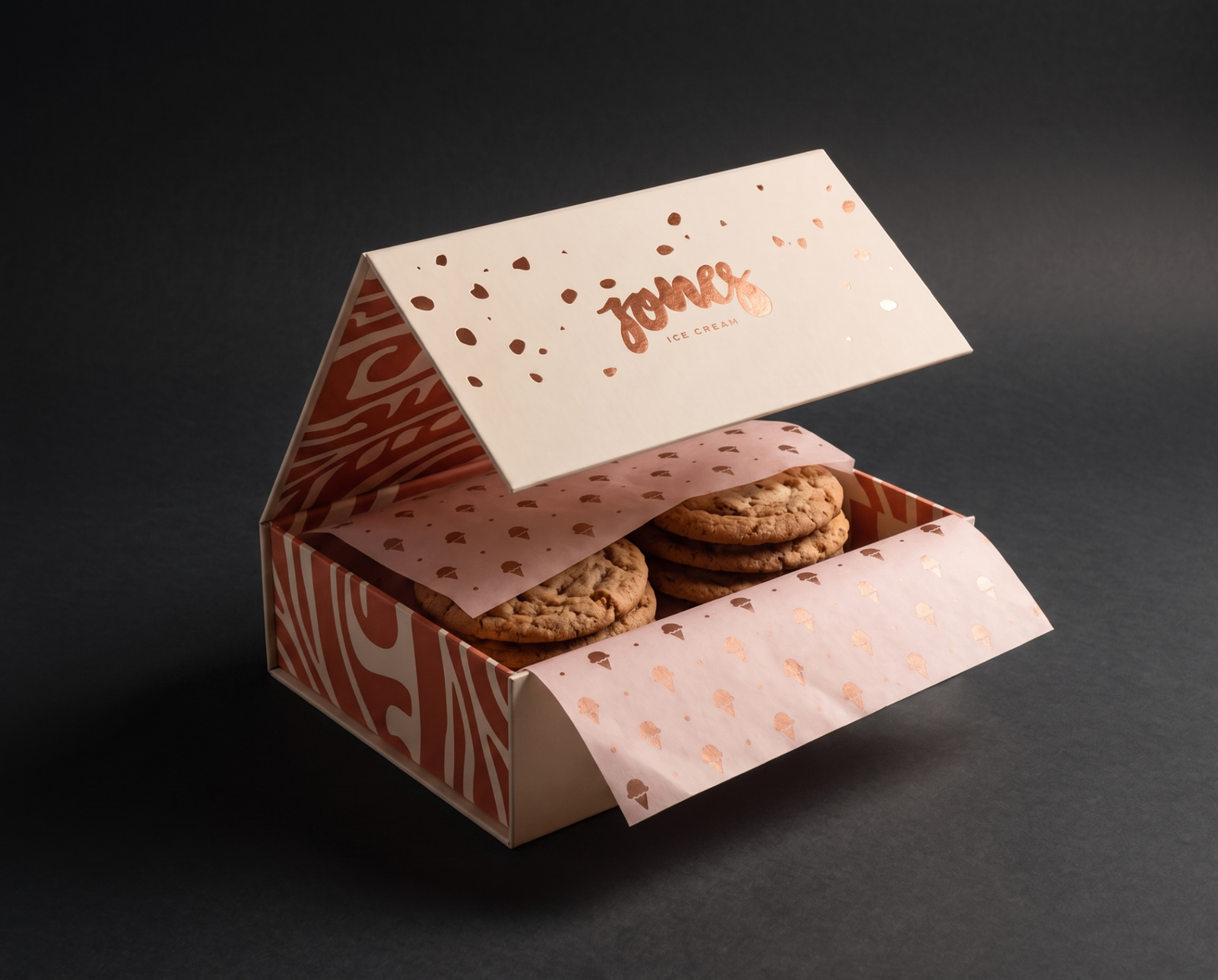
On a jar or a bottle, the label is the only thing the customer touches. Everything else — the glass, the tin, the box it shipped in — gets handled once and forgotten. So we start with where the product lives, not with the artwork. Product labels, address labels and packaging seals on premium adhesive stock: foil-stamped, textured, or waterproof film, die-cut to your shape.
Where the label lives decides what it's printed on
A candle jar gets warm. A bottle sweats in an ice bucket. A soap wrapper meets water on day one. Each of those is a different face stock and a different adhesive, and no amount of good design saves a label that curls at the corner two weeks in.
So we spec for the shelf life first and design into it. Wet, warm or condensation-prone means a BOPP film face — white or clear — with a permanent adhesive. Dry goods on a shelf open the door to felt, laid and cotton faces. Tell us where the product sits and for how long, and the stock decision usually makes itself.
Foil is the cheapest way to make a small label read as expensive
Foil is a heated die pressing metallic leaf into the sheet. On a matte or textured face, that mirror finish sits against a surface with no shine at all, and the contrast does the work — a two-inch label reads like a much bigger investment than it was. Spot gloss does a quieter version of the same trick.
Here's the landmine. Foil adhesion on some film stocks is unreliable, and we'd rather say that now than after a run. If your label has to be waterproof, we'll usually steer you to metallic ink or a metallised substrate instead.
The die shape that looks right on screen can tear on the liner
Any shape you like. But tight interior corners and very narrow necks tear when the label is peeled off the liner — the paper gives up before the operator's fingers do. We soften the radius slightly on the die. Nobody notices it on the shelf; everybody notices it on the applicator.
Sheets or rolls, both. Sheets suit hand-application and lower volumes. Rolls get wound to your applicator's spec, so send the core size and wind direction with your quote request — those two numbers are the difference between a roll that runs and a roll that sits in a box.