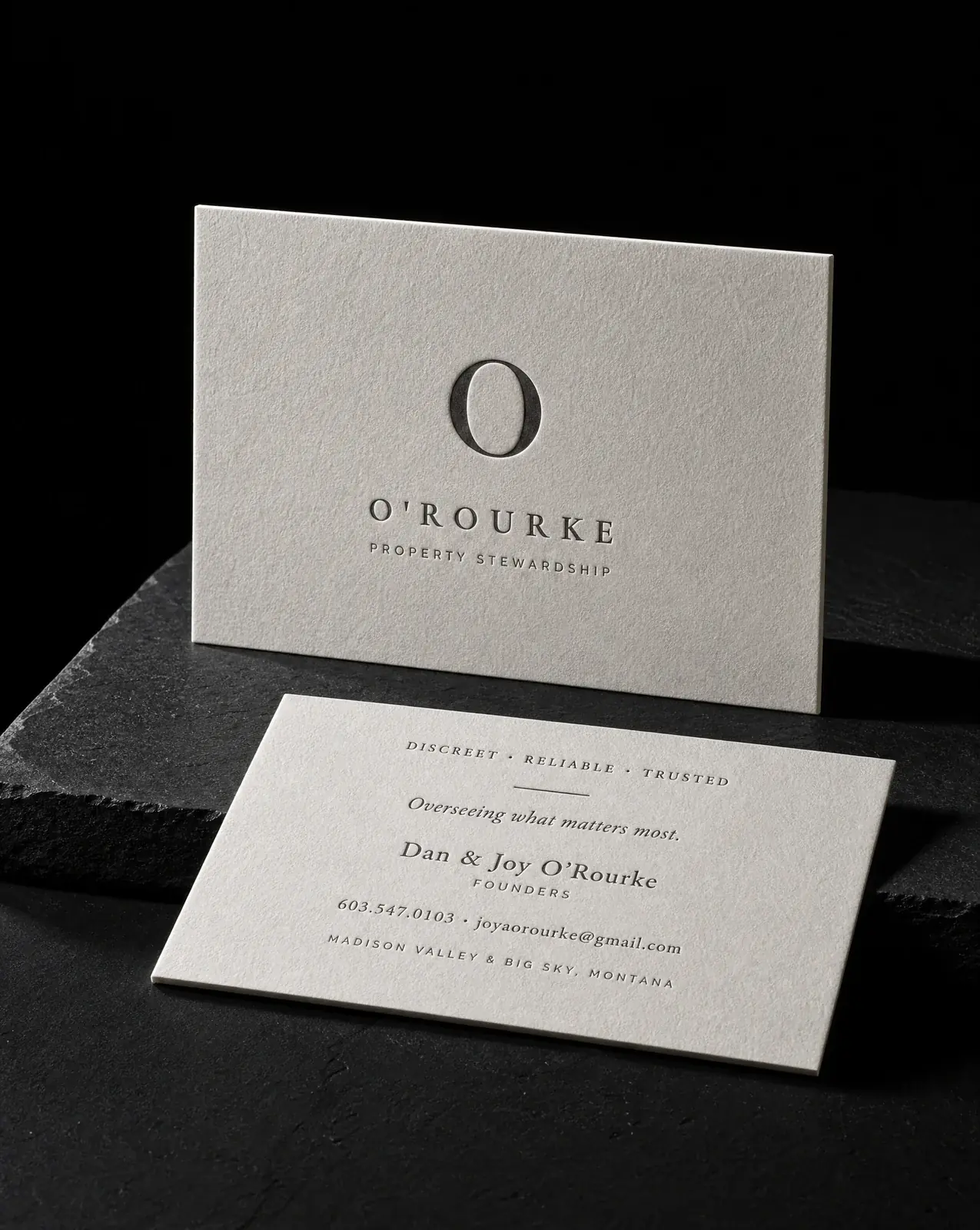
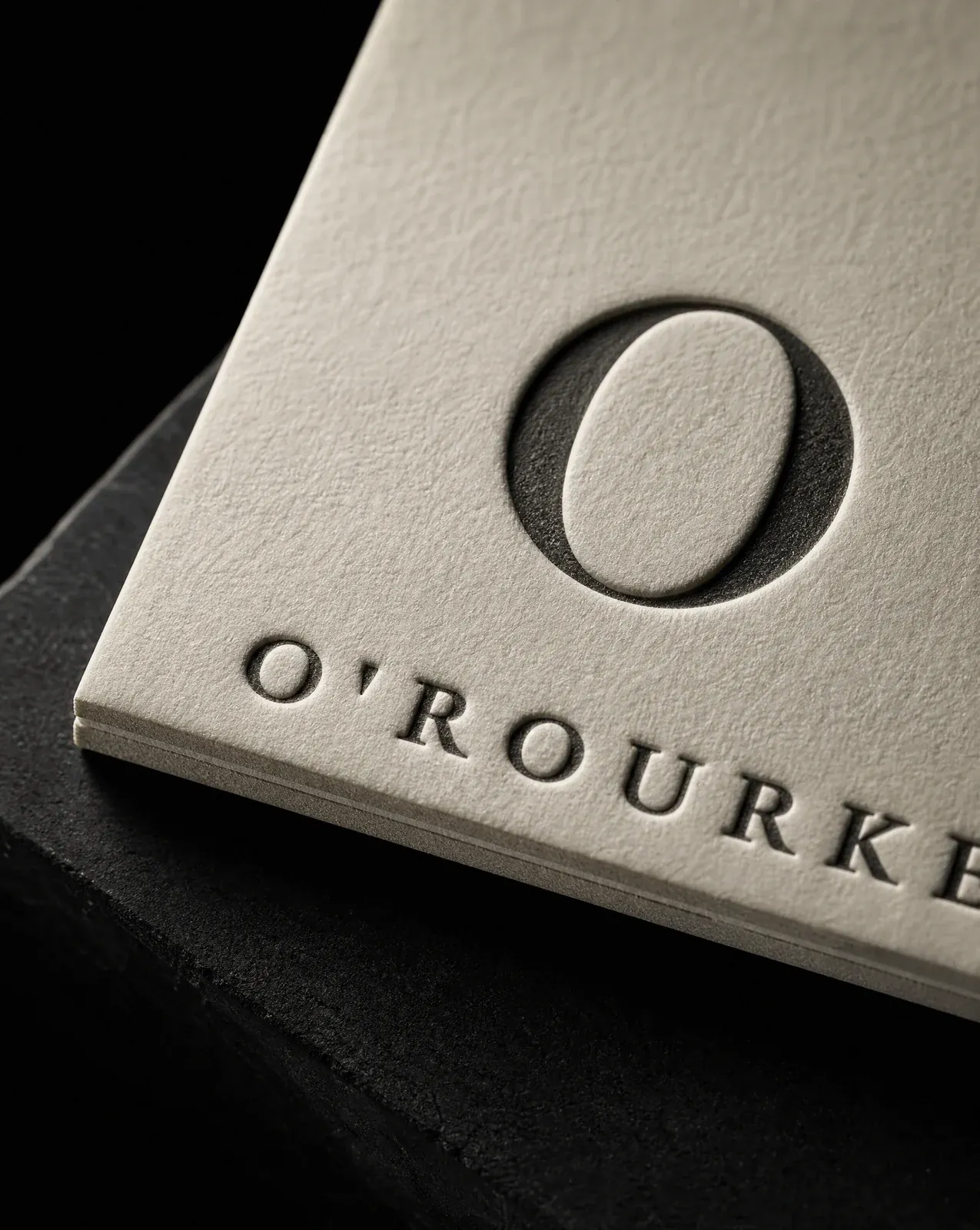
Real estate · one PMS black, letterpress, duplexed cotton
A painted edge in the brokerage colour, with the QR code on the back in flat ink at 2 cm or larger so it scans at arm's length. Foil or embossed QR codes glare and fail.
Order this specBusiness cards
Heavy cotton, die-stamped foil and a letterpress bite you can find with your thumb. Built to your spec and checked by a person before anything prints.
Custom from 310 USD for 250 · Standard from 126 USD for 500
Custom about 3 weeks, Standard 3–4 business days, after proof approval. Estimates.
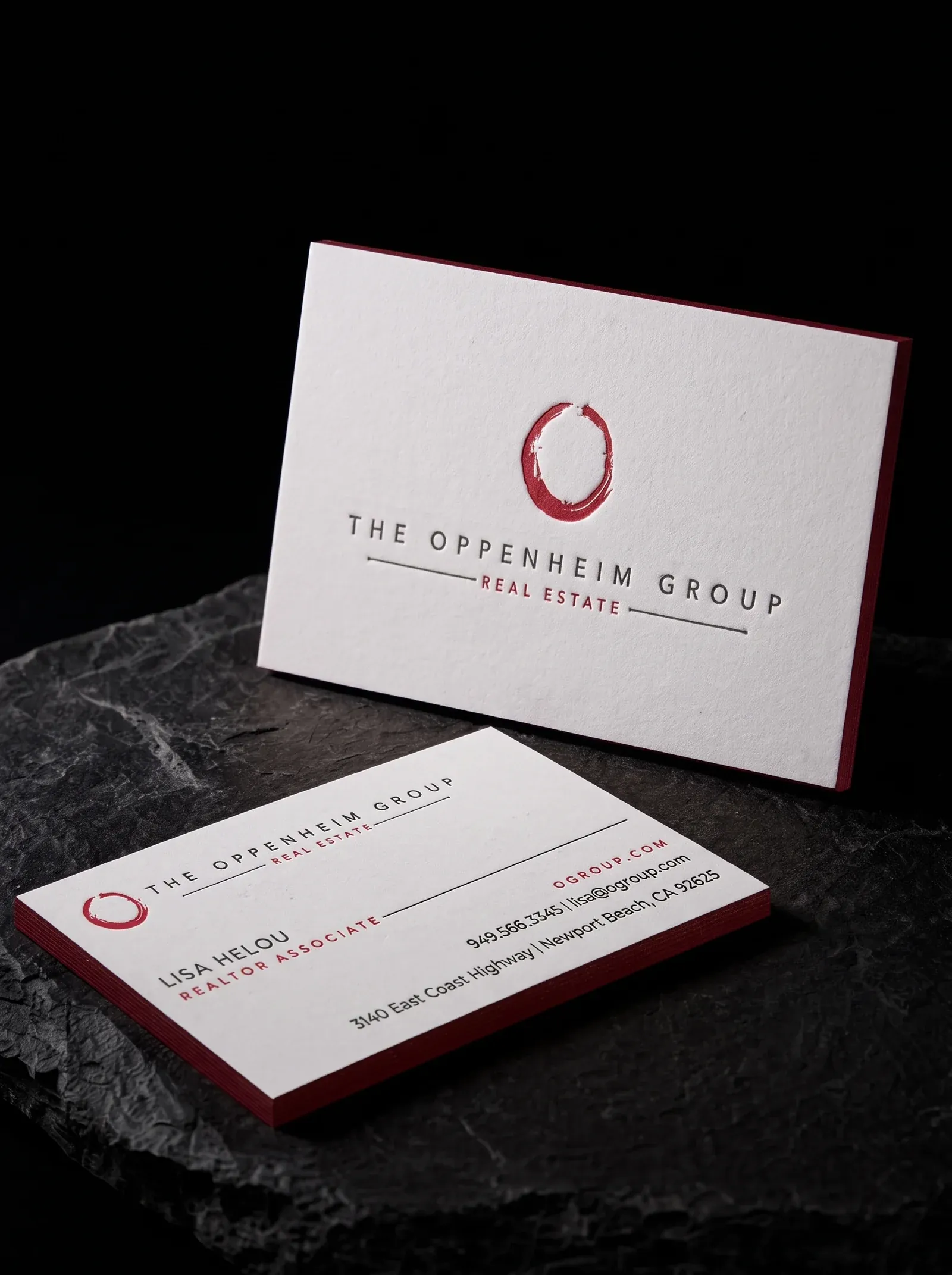 The Oppenheim Group · letterpress, red painted edge
What are luxury business cards?
Luxury business cards are cards you could pick out with your eyes shut. They're heavier than a standard card (32pt and up, against the 14–16pt most printers default to), they carry a pressed process like hot foil, letterpress or a deboss, and the edge is finished rather than left as a white cut line. Premium business cards usually mean a thicker, better-coated stock made fast. A luxury card adds a process you can feel. We make both, and we'll tell you when a finish won't work on your paper before you've paid for it.
A high quality business card gets two of these five things right. A luxury card gets three. Here's what each one does in the hand, and the rule that comes with it.
A standard card is 14–16pt, about 0.4 mm. Our thick cards start at 32pt, roughly 0.8 mm, which is close to a credit card. At 48pt (about 1.2 mm) the card stops flexing and starts feeling like an object. Weight is the first thing a hand notices and the cheapest way to change how a card lands. 48pt is impressive; some people find it a little much for a wallet, so 32pt is where most builds sit. More on thick business cards.
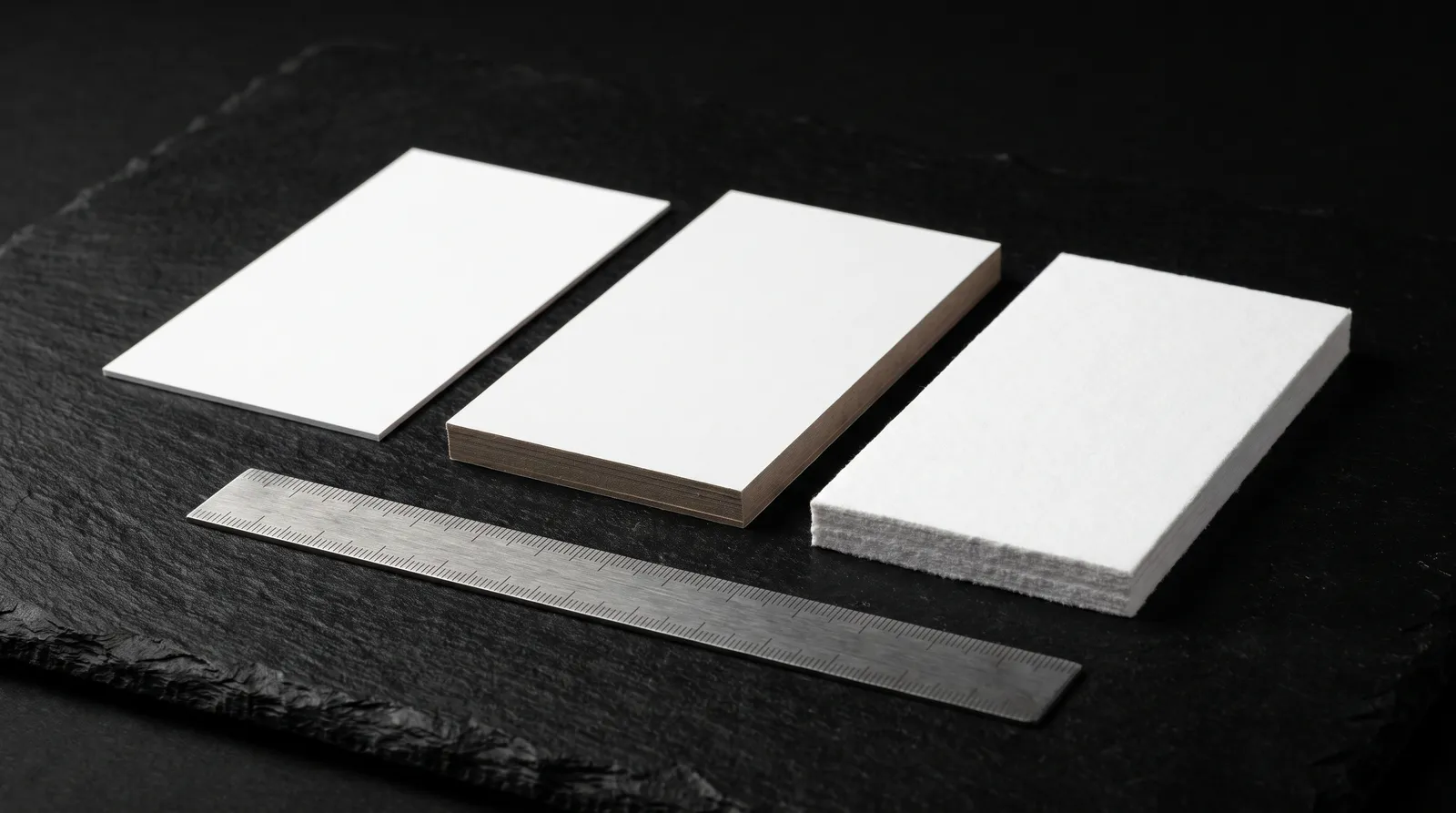
Cotton paper is soft and uncoated, with a slight tooth you feel under a fingertip. It takes an impression better than any coated stock because the fibres compress instead of cracking. It also has rules: spot UV won't cure on cotton, so where you want gloss we use a clear foil instead. Coated and soft-touch stocks suit raised UV and photo printing. See cotton business cards.
Letterpress pushes an inked plate into the sheet, so the ink sits at the bottom of a shallow bite. Blind deboss does the same with no ink at all: the mark reads by its shadow. On a single sheet, a deep impression shows through on the back, so when the back carries type or foil we bond two sheets, or lighten the impression. See letterpress and embossed and debossed cards.
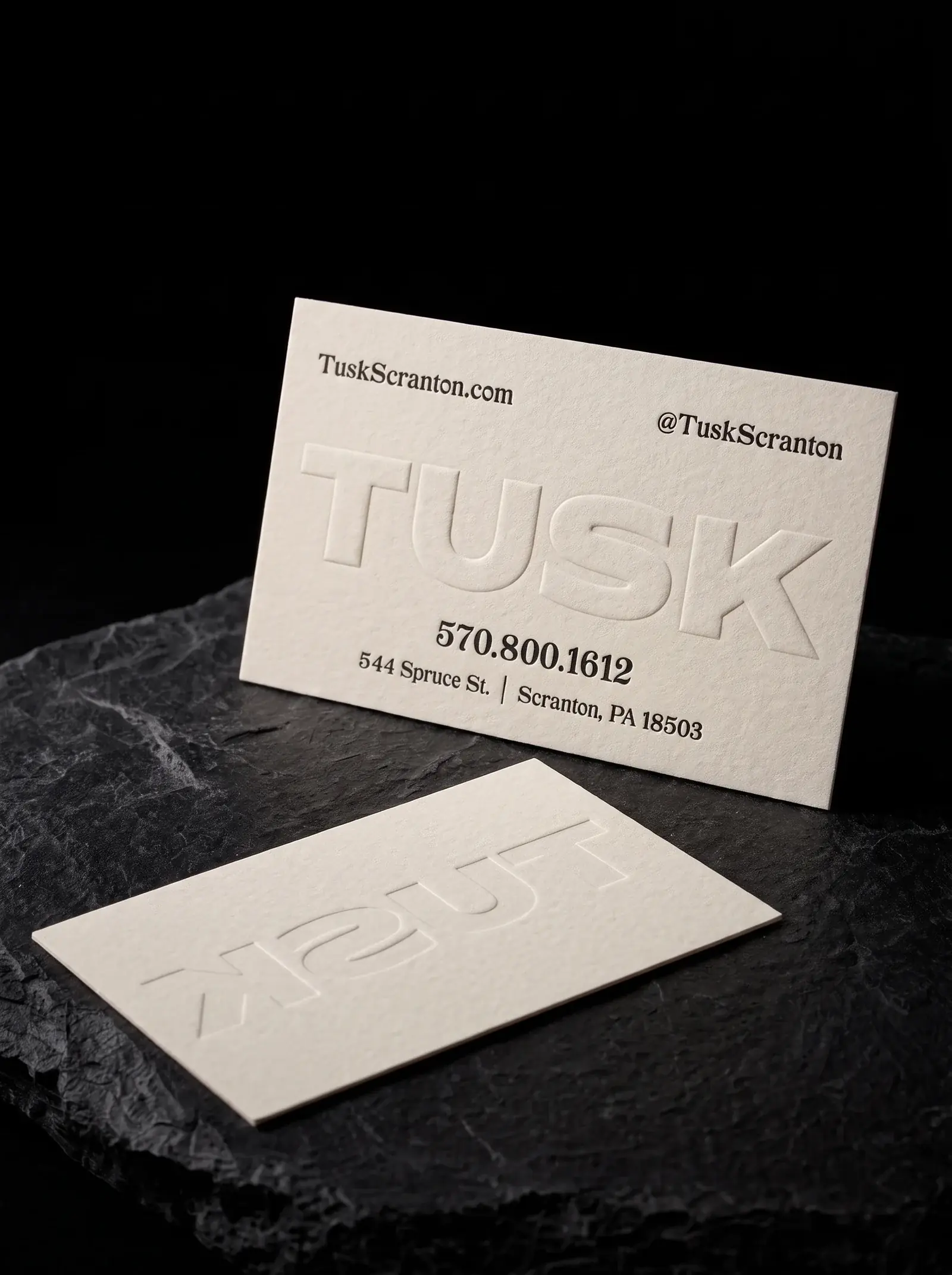
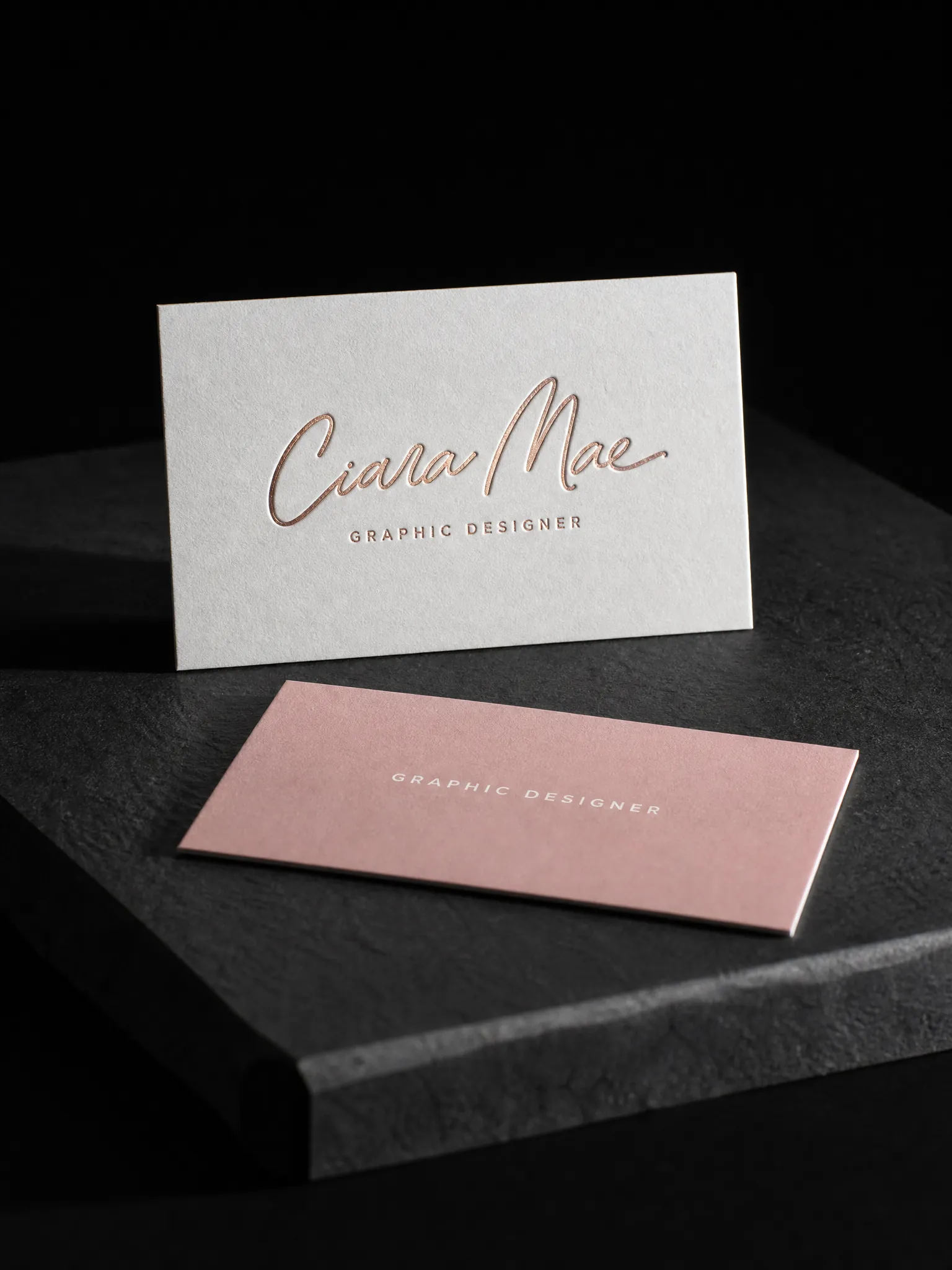
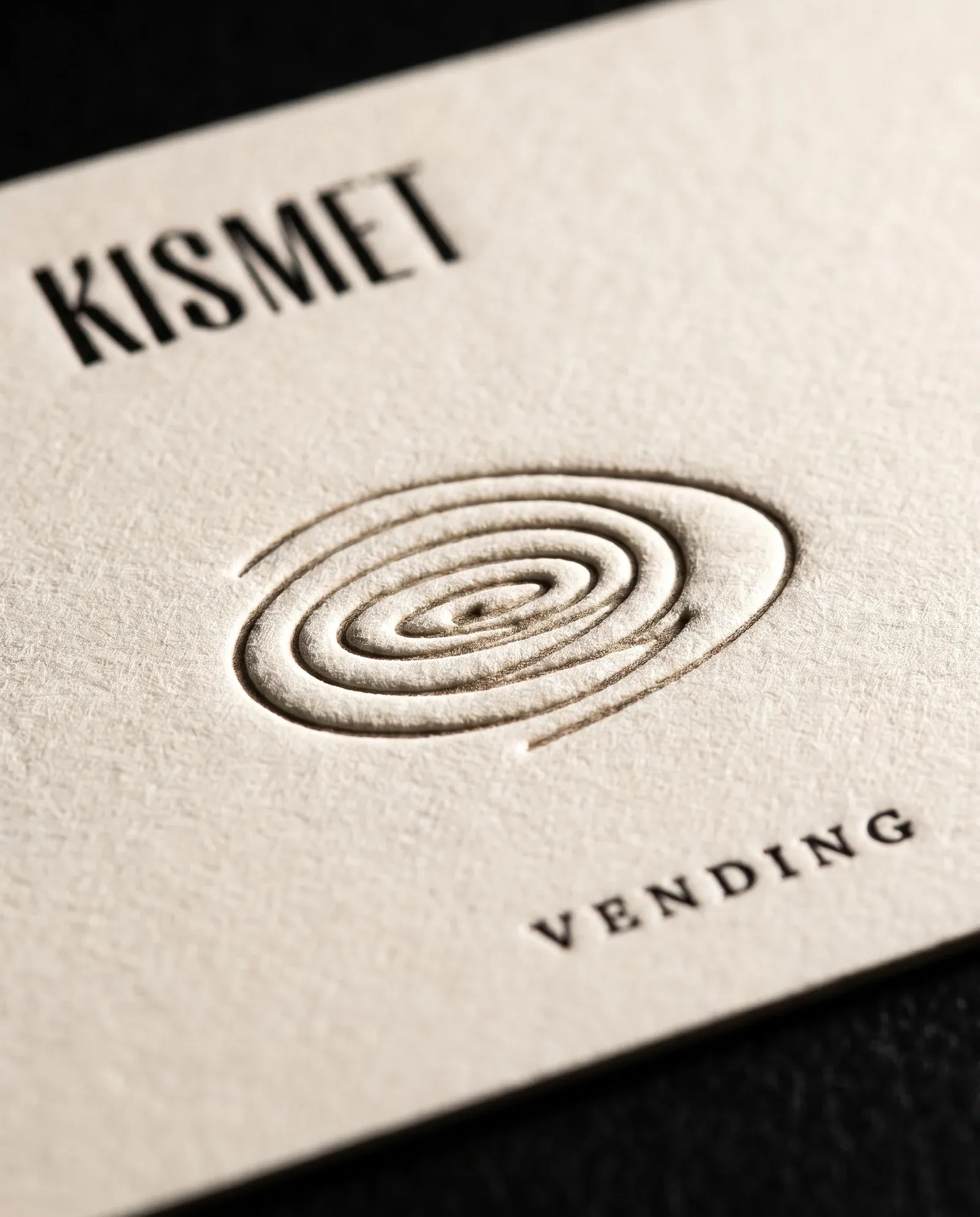
Die-stamped hot foil uses heat, pressure and a metal die to press a metallic film onto the card. On a soft stock like cotton it leaves a slight bite you can feel. Digital foil is fused onto a toner layer with no die: faster, flatter and fine for short runs. Fine detail survives foil: lines hold to 0.1 mm; we design to 0.15 mm, and a gradient becomes one flat tone. Hot foil vs digital foil explains the difference.
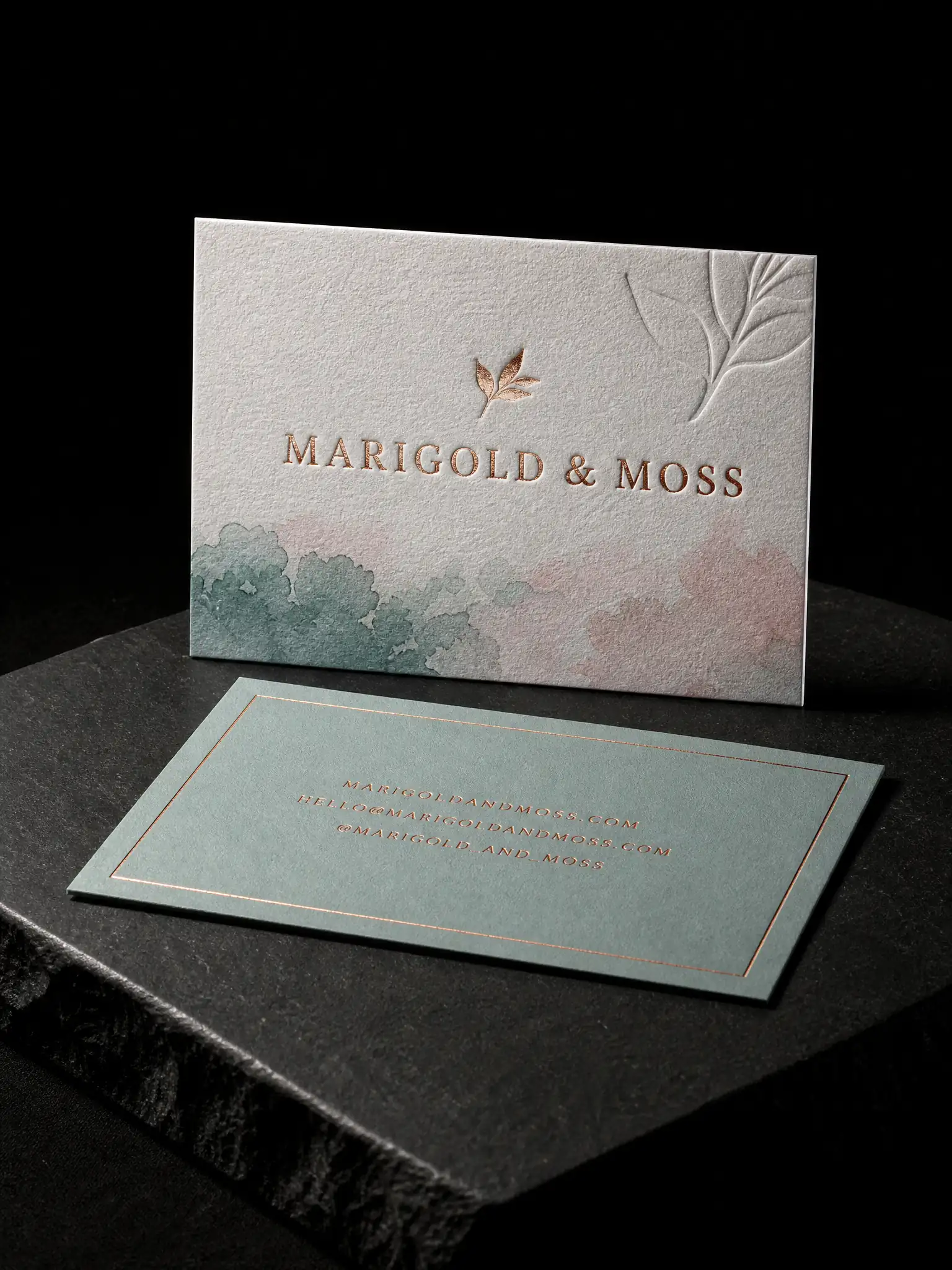
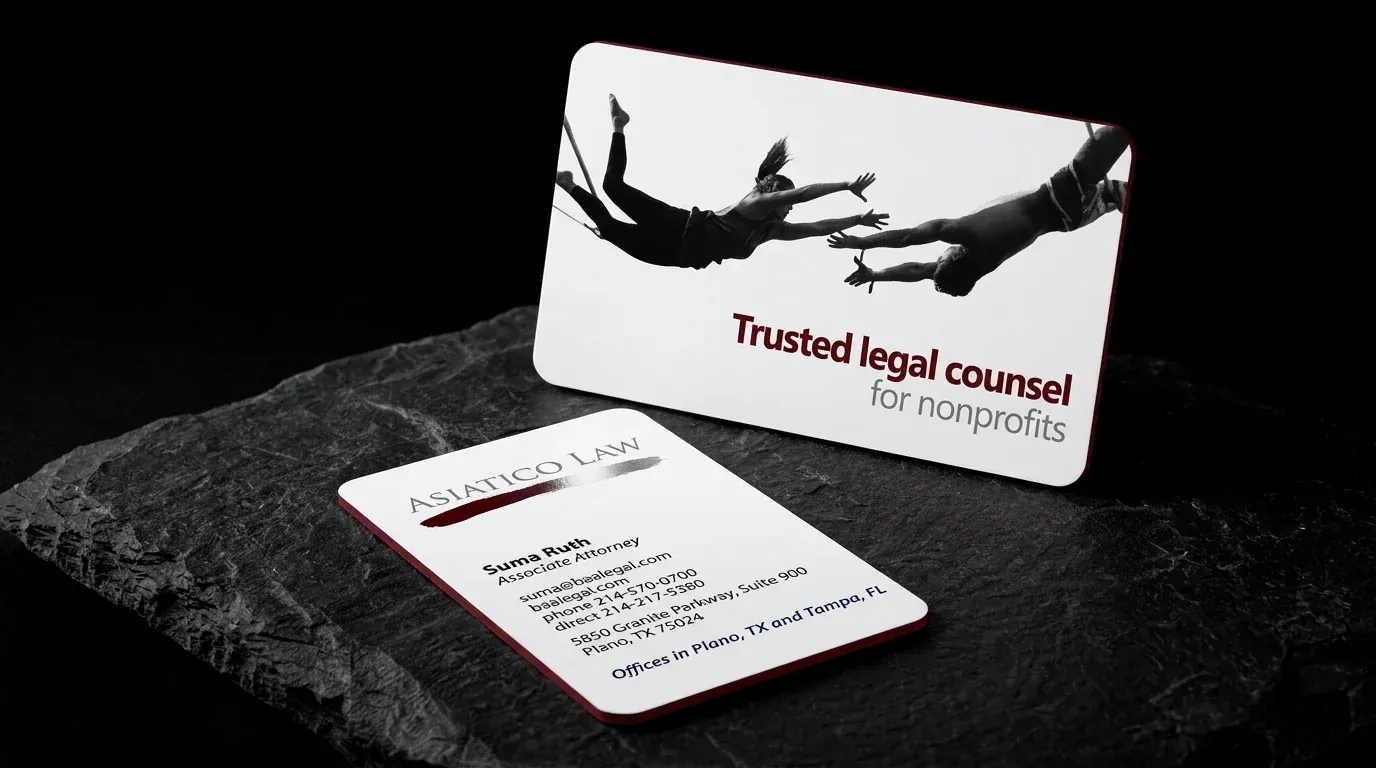
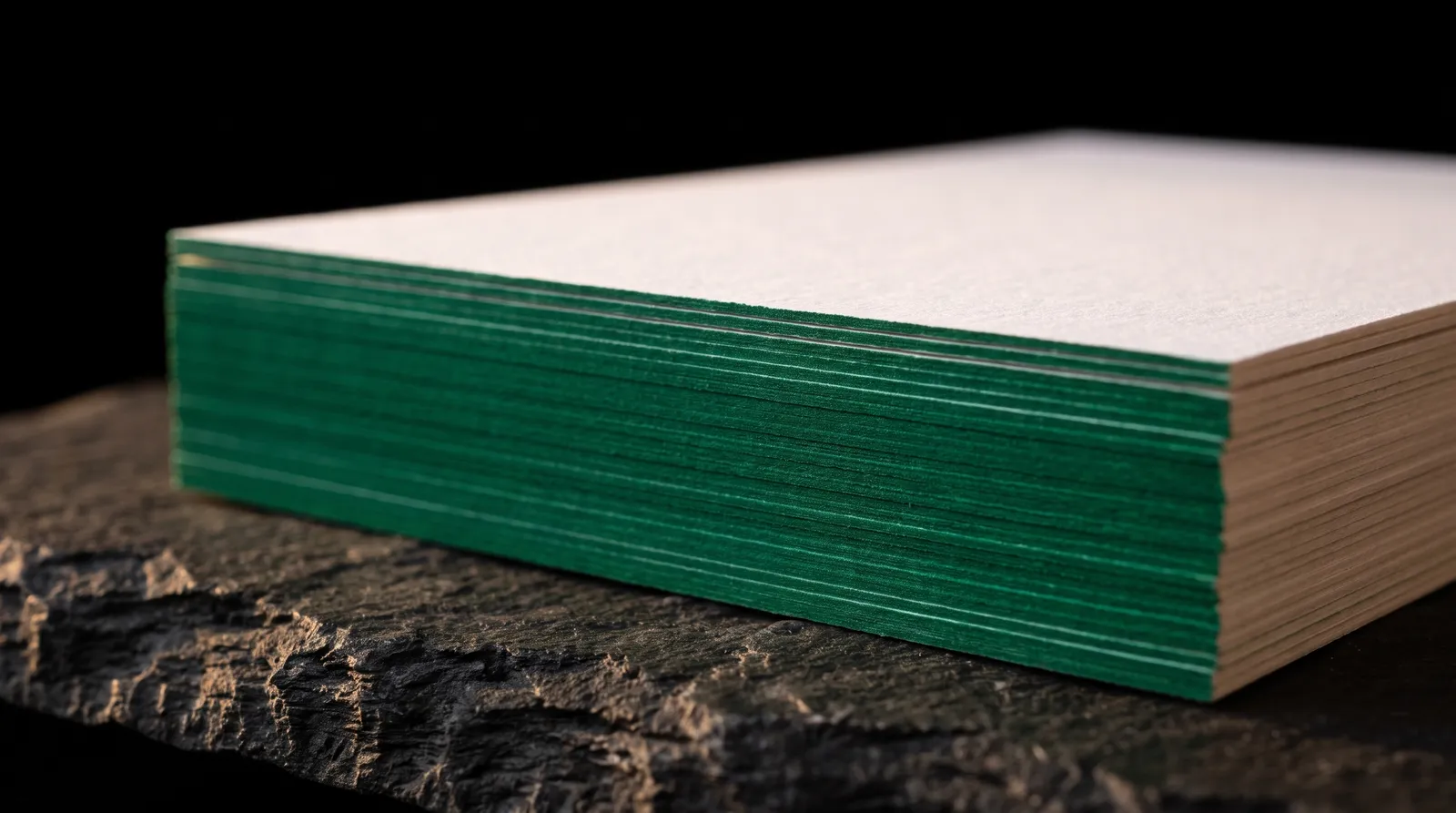
On a thick card the edge becomes a surface. Painted edges are applied to a clamped stack, so the colour runs clean around all four sides. Duplex and triplex builds show their seam or coloured core instead. Gilded (foiled) edges work with square or rounded corners, and on soft cotton we test before we promise them. On black or dark stock the edge is always foil, never paint. See painted edges.
Ten starting points. Each tile shows the spec and the live starting price; every one can be adjusted in a brief.
 Custom
 Custom
 Custom
 Custom
 Custom
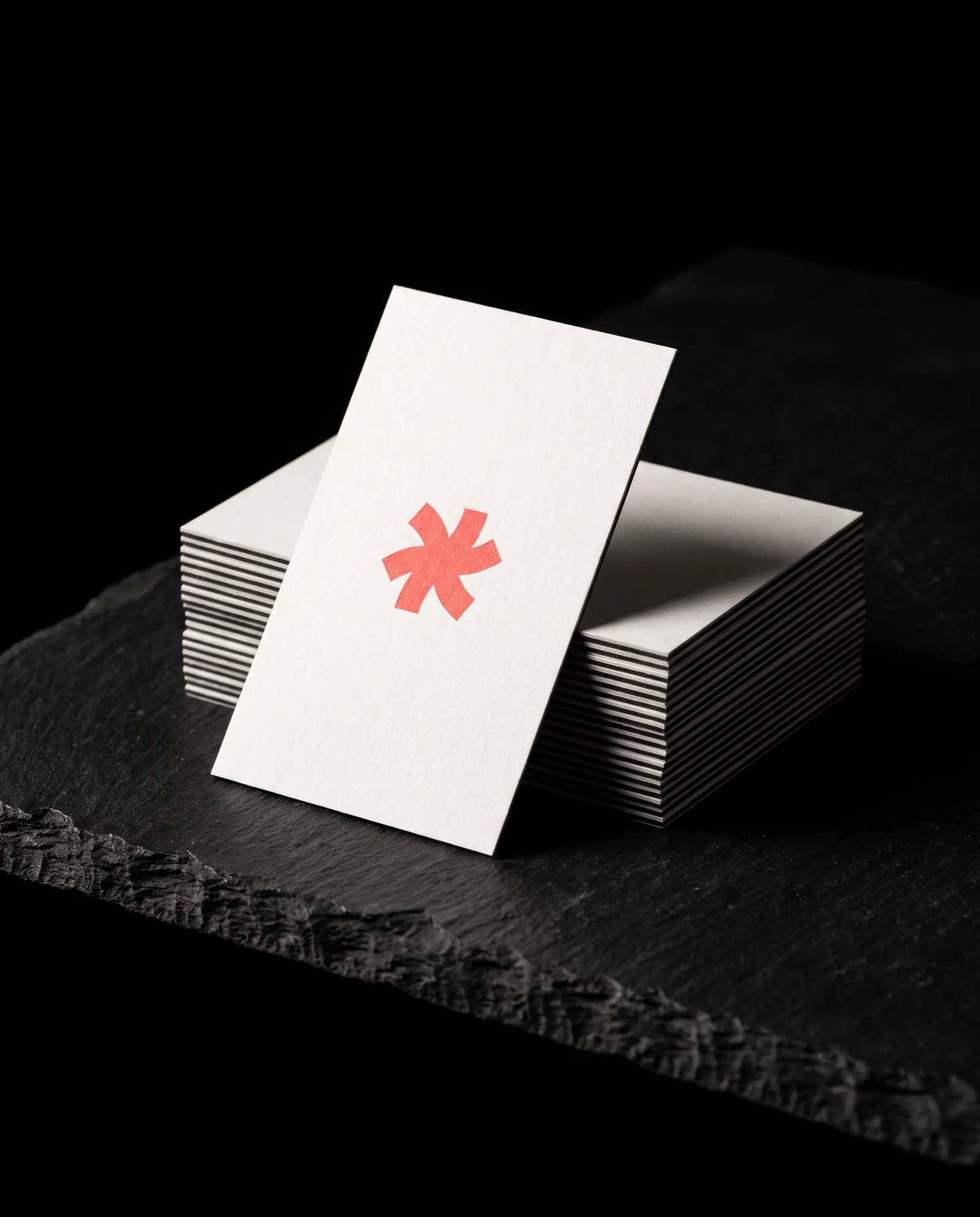 Standard
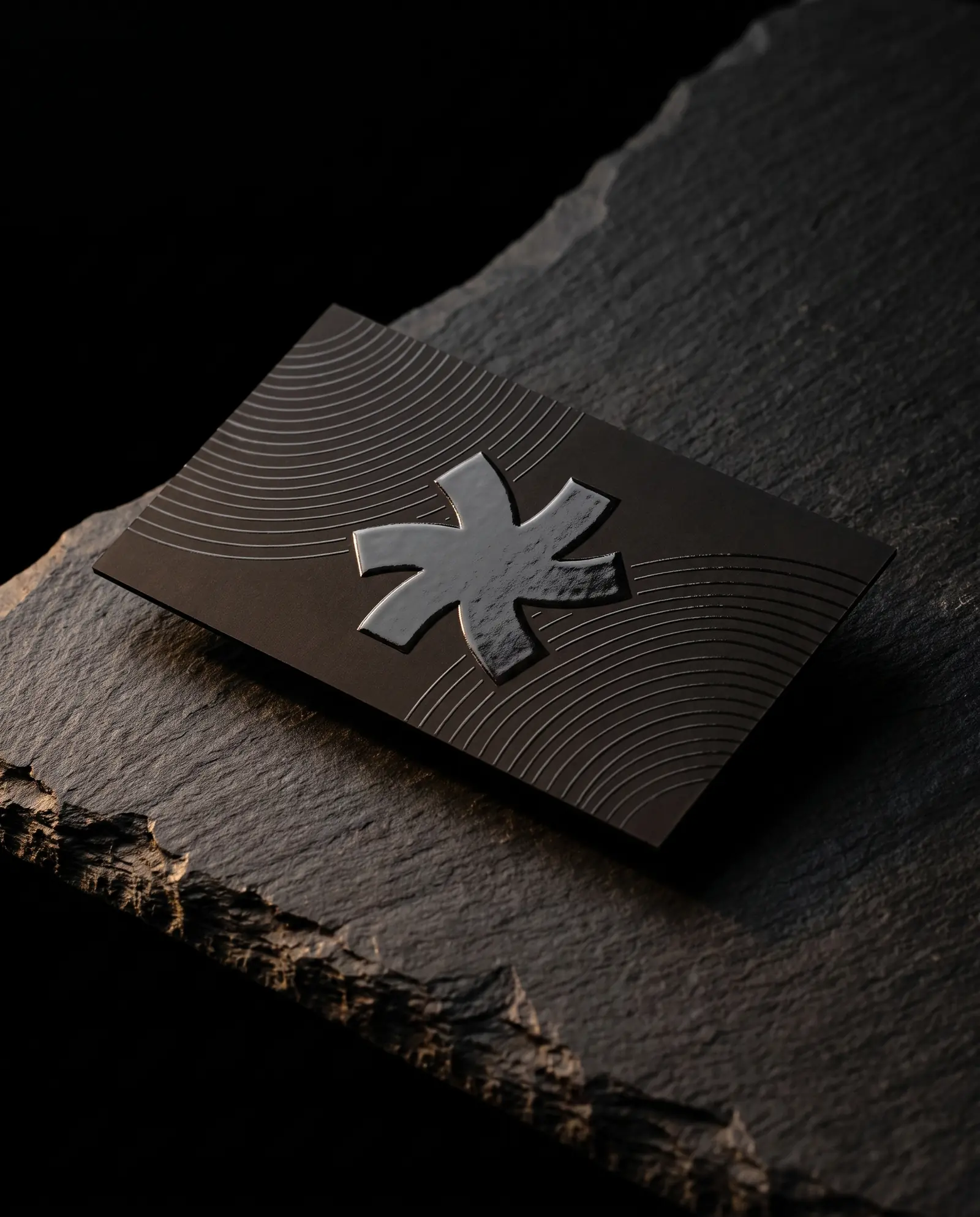 Standard
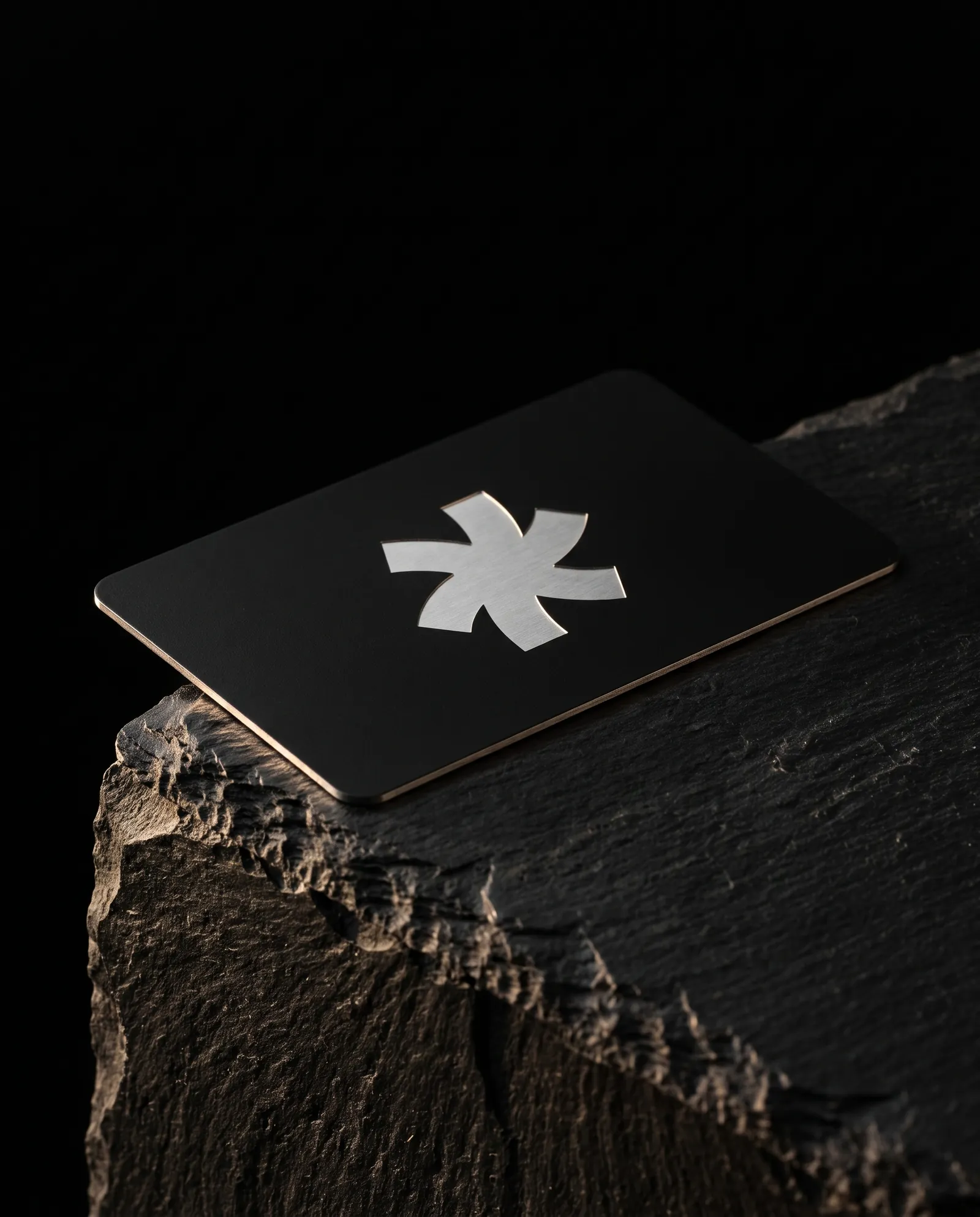 Custom
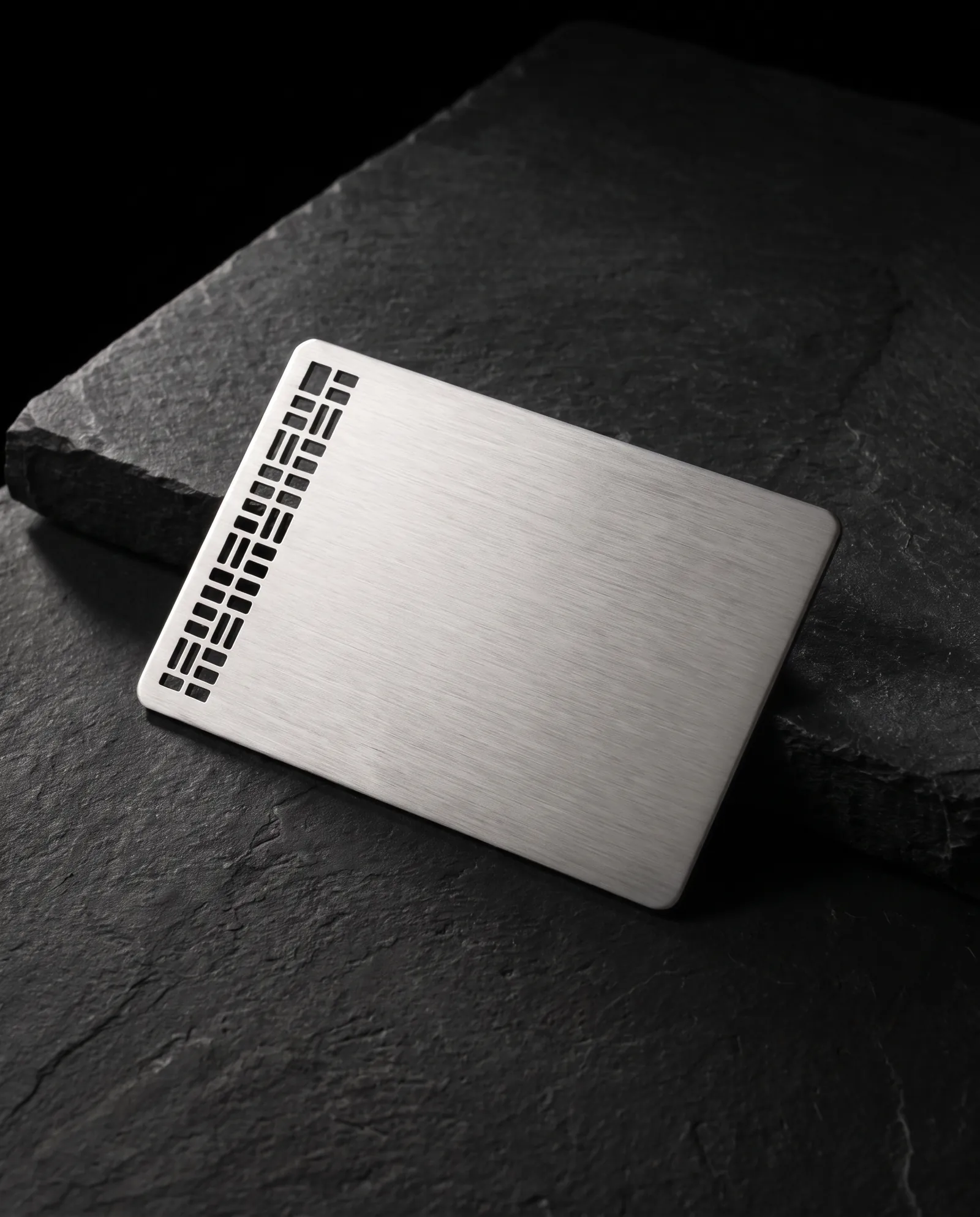 Custom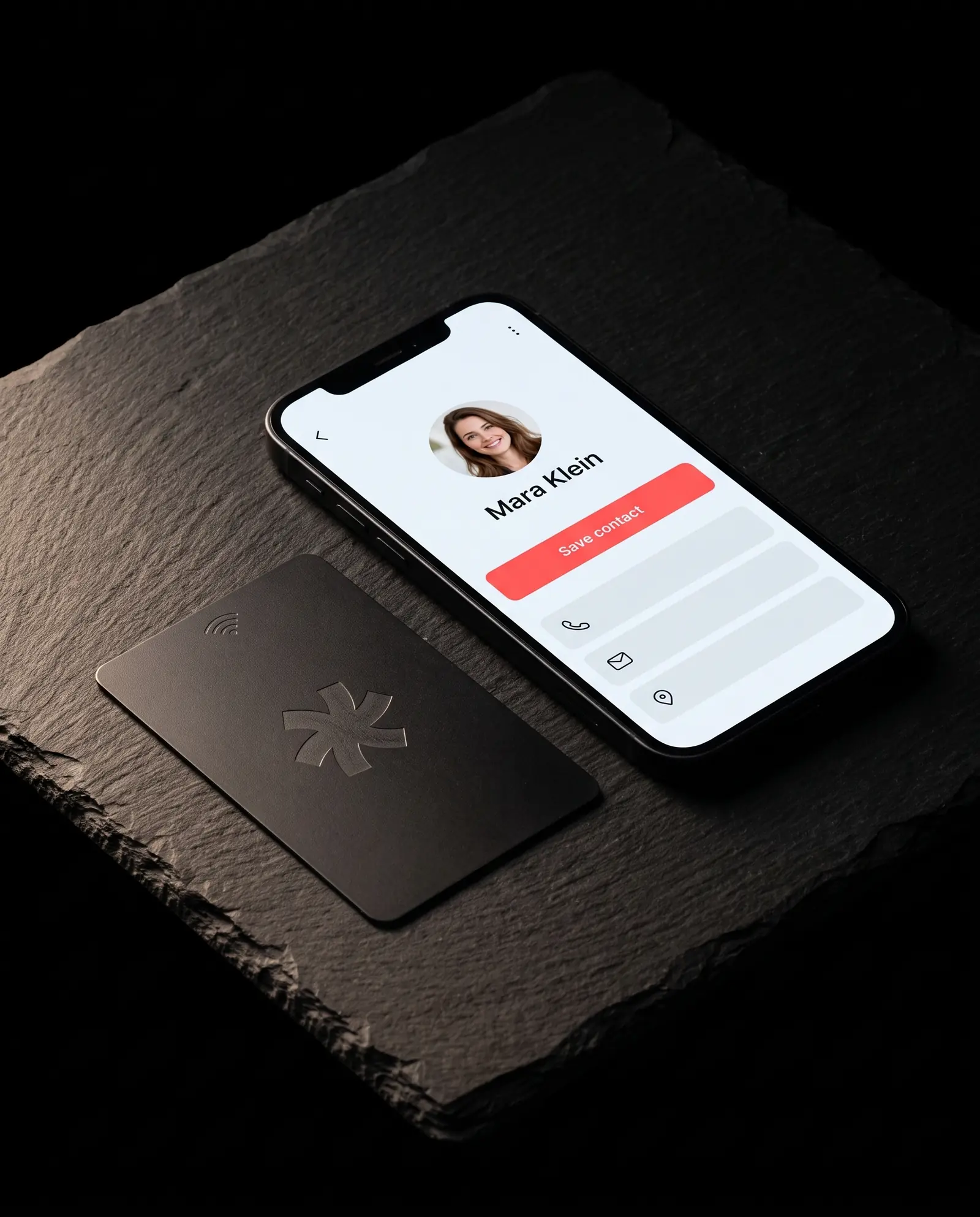
Plenty of online printers now sell a 32pt card. What usually stops at 32pt is the finishing. The thickest stock is often foil-free, or limited to one foil colour, and letterpress is sold as a separate, thinner product. A Custom card starts from the finish and picks the paper to suit it.
| Typical online 32pt card | Peppermint Custom | |
|---|---|---|
| Thickness | 32pt layered stock | 32pt or 48pt cotton, duplex, triplex |
| Foil on the thick card | Often not offered on the thickest stock, or one foil colour only | Die-stamped hot foil, more than one colour, front and back |
| Letterpress impression | Usually a separate product, or not offered on the thickest stock | Letterpress on 48pt cotton |
| Edges | Coloured seam or painted edge | Painted, gilded or a duplex seam |
| Who checks your file | Automated preflight | A person, before your proof |
| Production time | Days | About 3 weeks after proof approval (Standard: 3–4 business days) |
Faster is a fair reason to choose an online card. If the date allows three weeks, the Custom card is the one people keep.
See the best business card printers, compared by finish
For 500 luxury business cards, expect roughly 126 USD for a fast thick card, 410 USD for cotton with one hot foil, and 535 USD for 48pt letterpress. Metal starts much higher. Four things move the price: stock weight, the number of processes, the number of foil or ink colours, and whether the back gets finished too. Each foil colour on each side is its own die and its own press pass.
| 250 | 500 | 1,000 | |
|---|---|---|---|
| Triplex black core 32pt (Standard) | n/a | 126 USD | 171 USD |
| 32pt painted edge (Standard) | Get a price | Get a price | Get a price |
| Soft touch + raised spot UV, front (Standard) | 140 USD | 180 USD | 360 USD |
| 32pt cotton, printed (Custom) | 215 USD | 310 USD | 485 USD |
| 48pt cotton, printed (Custom) | 320 USD | 465 USD | 755 USD |
| 32pt cotton + hot foil, front (Custom) | 310 USD | 410 USD | 620 USD |
| 48pt cotton letterpress, one colour (Custom) | 340 USD | 535 USD | 920 USD |
| Metal, 0.5 mm matte stainless (for scale) | 820 USD | 1330 USD | 2350 USD |
Custom prices include shipping. Standard shipping is calculated at checkout. Prices update from our live price list.
The most elegant business cards we make usually use fewer techniques, not more. Classy reads as restraint. These are the four notes we give most often on luxury business card design.
Gold and silver on one card fight each other. Pick the foil that matches your brand's warmth and let it carry the card. If you need a second colour, make it a pigment foil or an ink.
Foil lines hold to 0.1 mm; we design to 0.15 mm with internal gaps around 0.25 mm. Foil type stays at 7pt or larger. We adjust only below-floor detail and show any change at proof.
A quiet front (one foil, or a blind mark) with a full-colour back gives you both: the first look is calm, the turn-over carries the brand.
If the front is busy, keep the edge neutral. If the front is nearly blank, a painted edge in your brand colour does the talking.
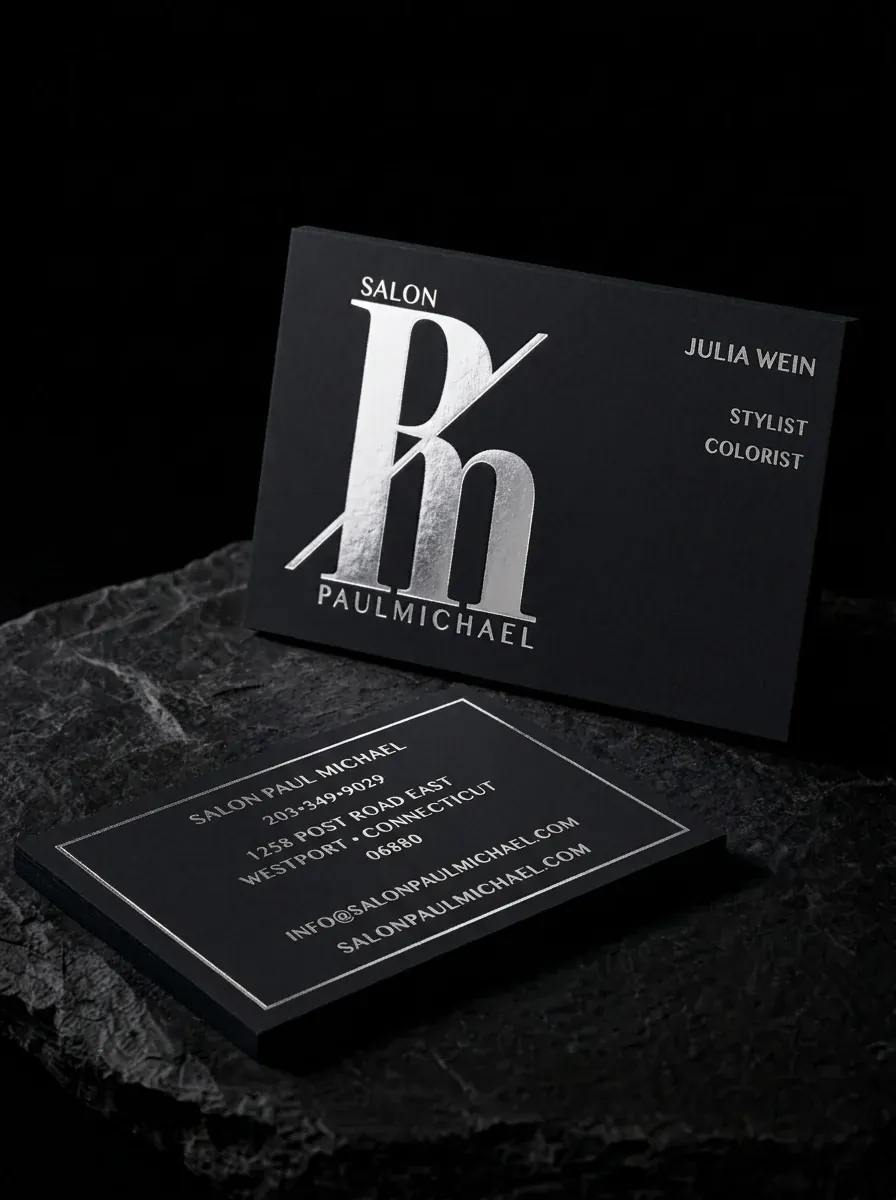
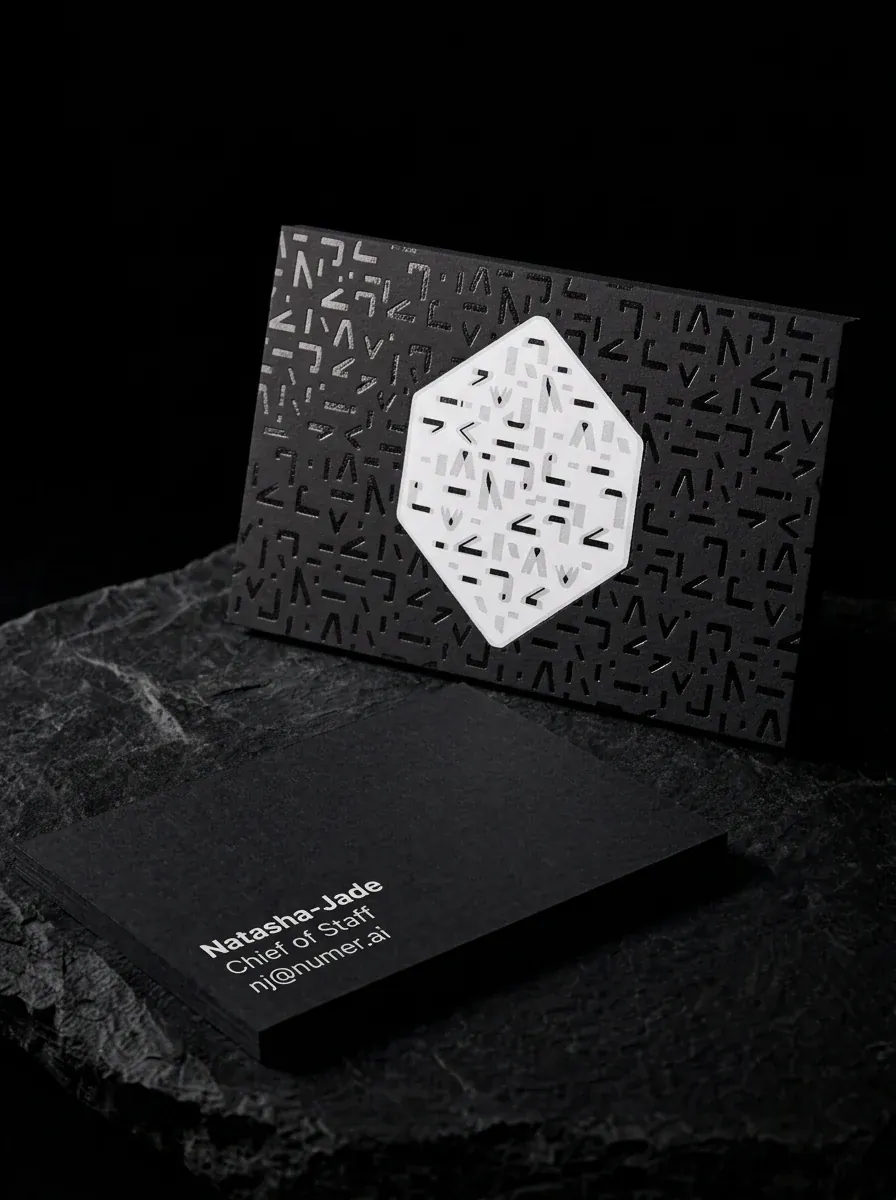
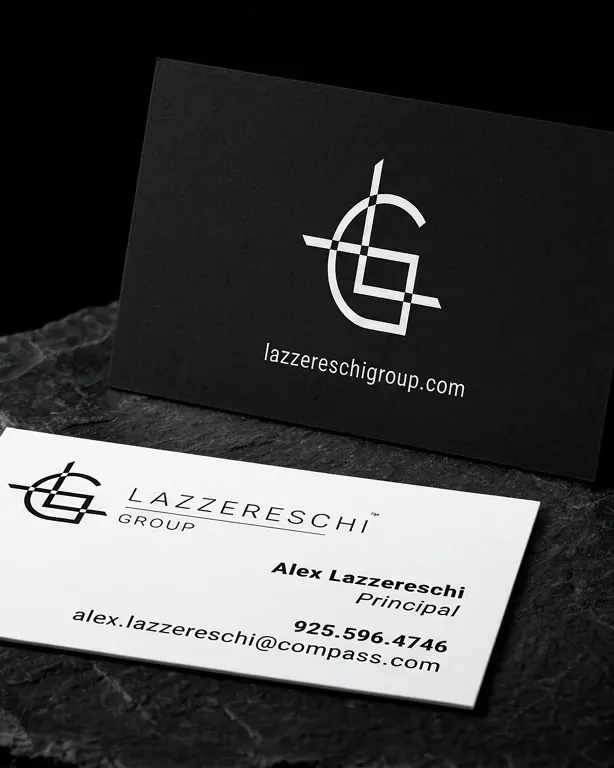
On black cotton, white and light colours come from pigment foil, because ink sinks into dark paper. Black foil on black stock reads as a sheen you see at an angle, which is lovely for a quiet mark and wrong for a phone number.
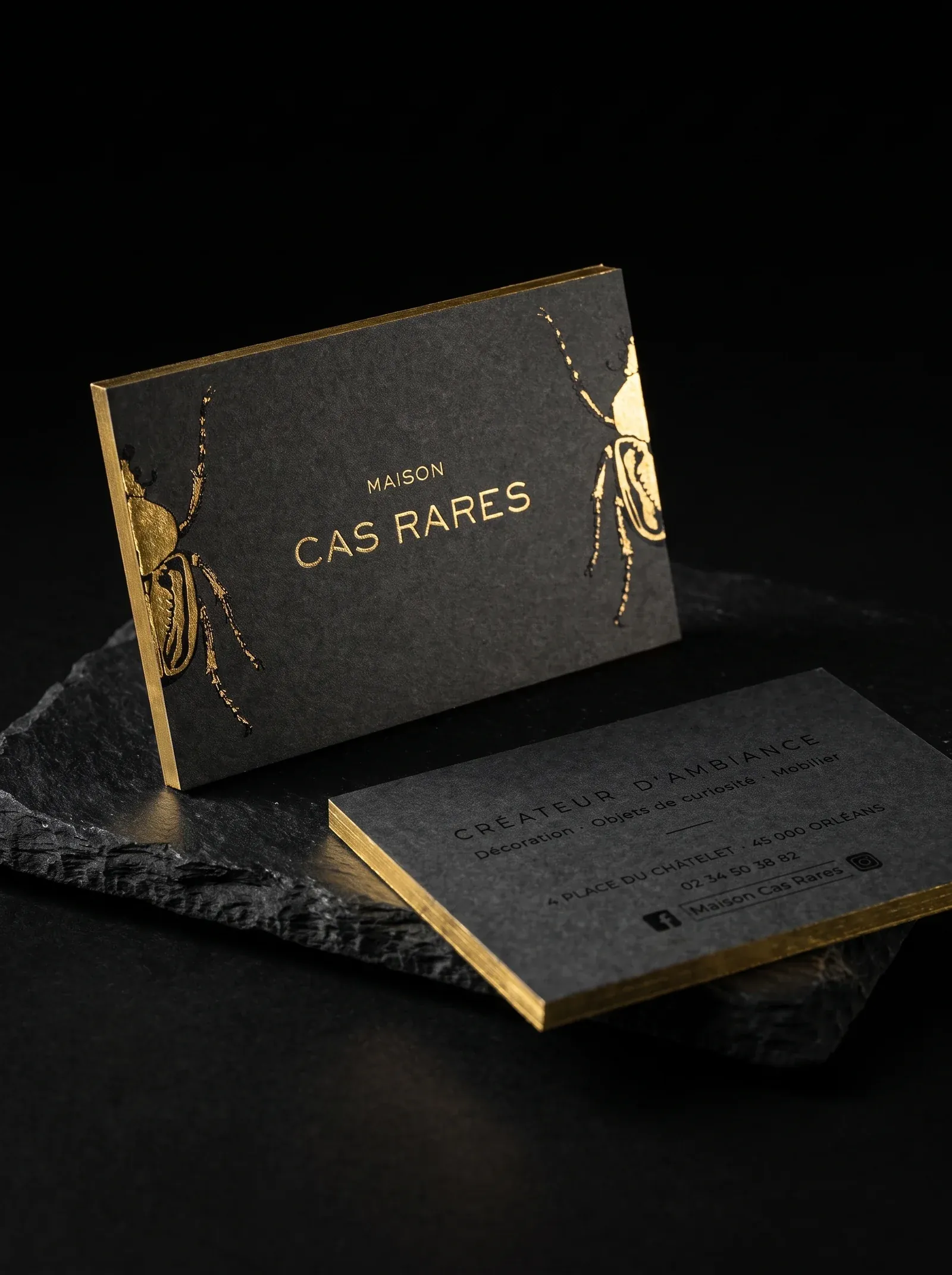
Gold foil on true black paper: black and gold business cards.
Executive business cards don't need to look the same across professions. A starting point for four of them.
Real estate · one PMS black, letterpress, duplexed cotton
A painted edge in the brokerage colour, with the QR code on the back in flat ink at 2 cm or larger so it scans at arm's length. Foil or embossed QR codes glare and fail.
Order this spec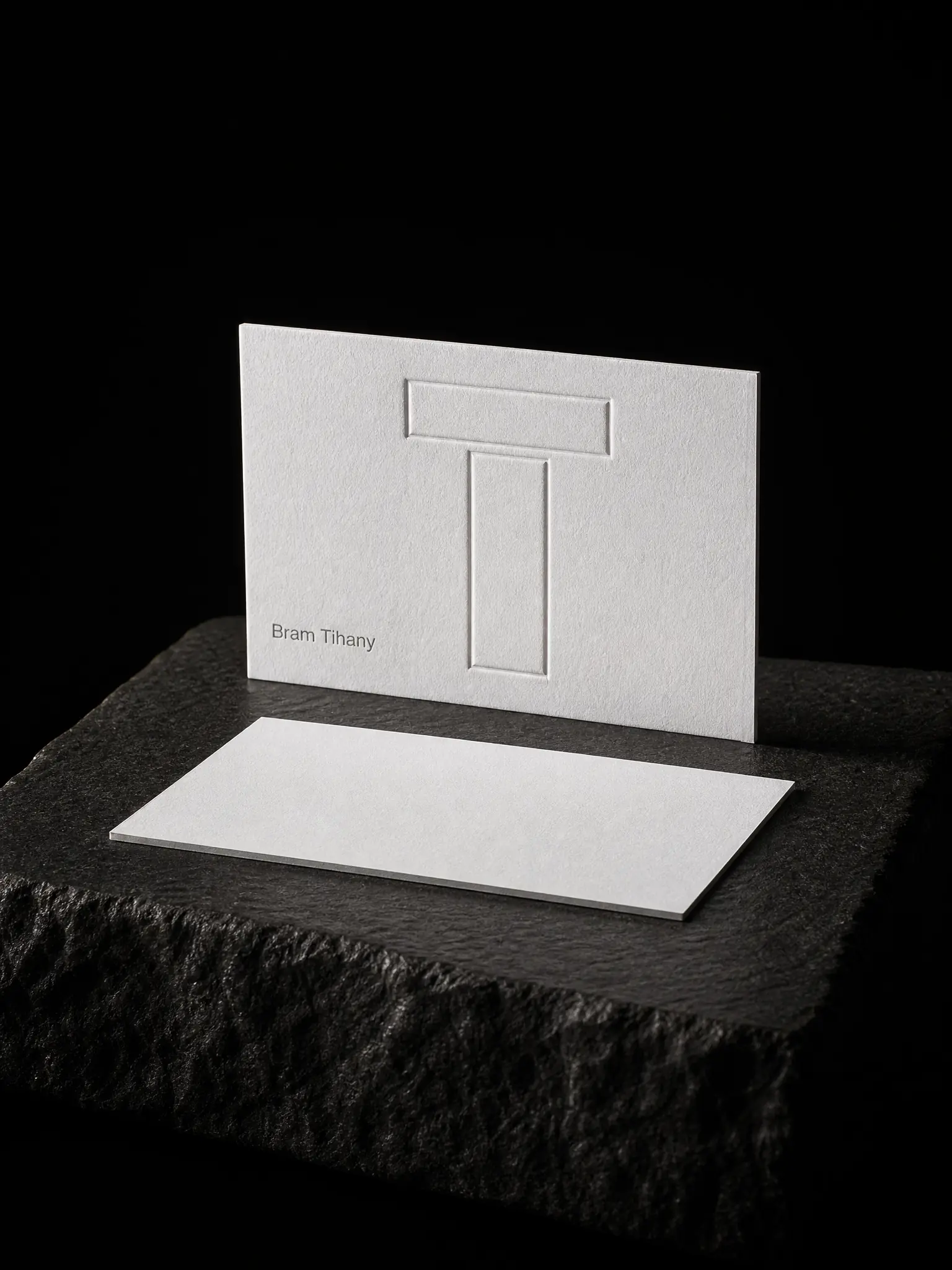
Law, advisory and architecture · two-level blind emboss on 48pt cotton
48pt white cotton, one letterpress ink on the front and a blind mark on the back, pressed on two separate sheets and bonded so neither impression shows through. Nothing shiny.
Order this spec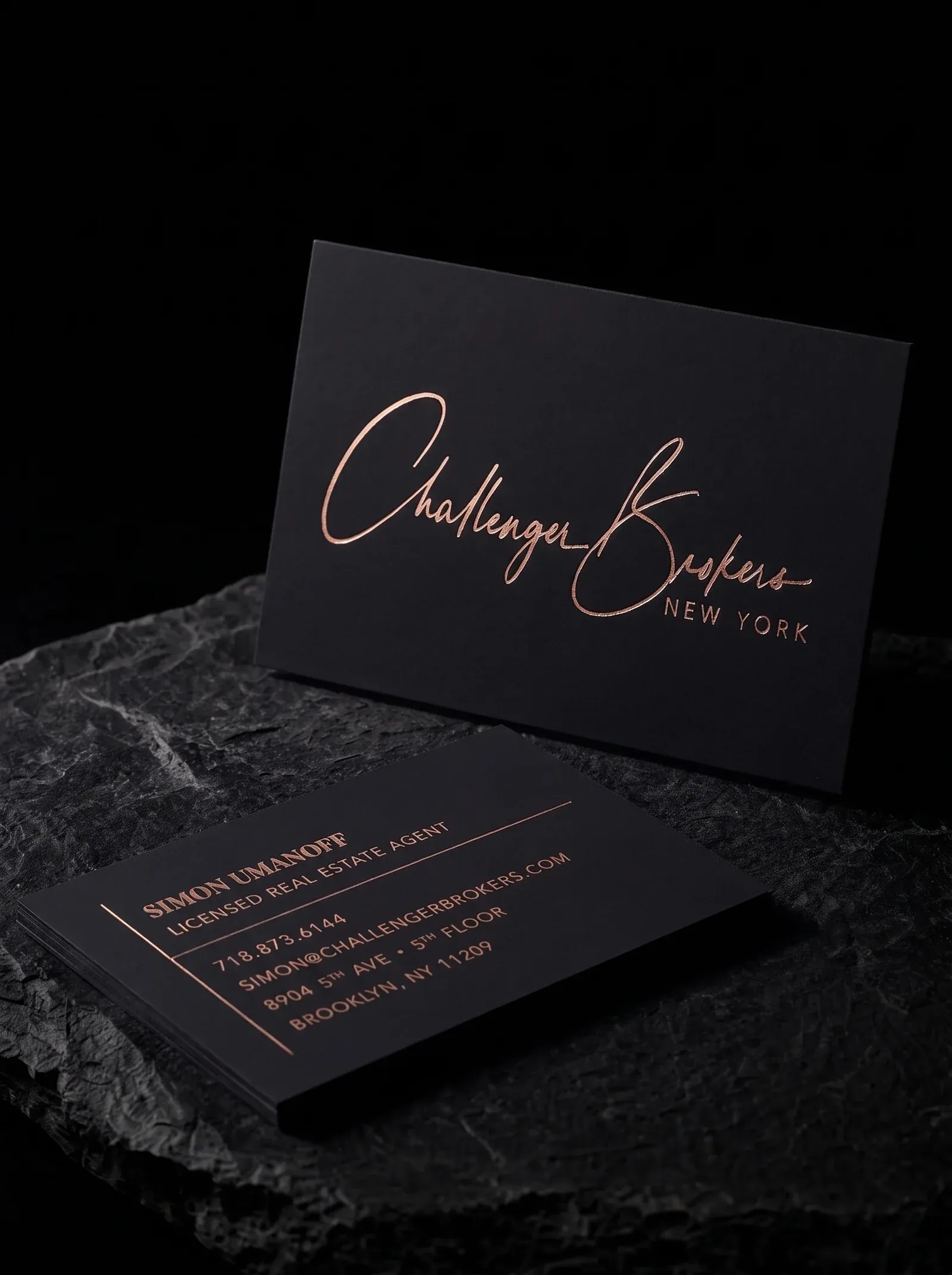
Finance · rose gold foil on 48pt black soft touch
Black-coated steel, etched, or 48pt black soft touch with one foil. Both read as serious before a word is read.
Order this spec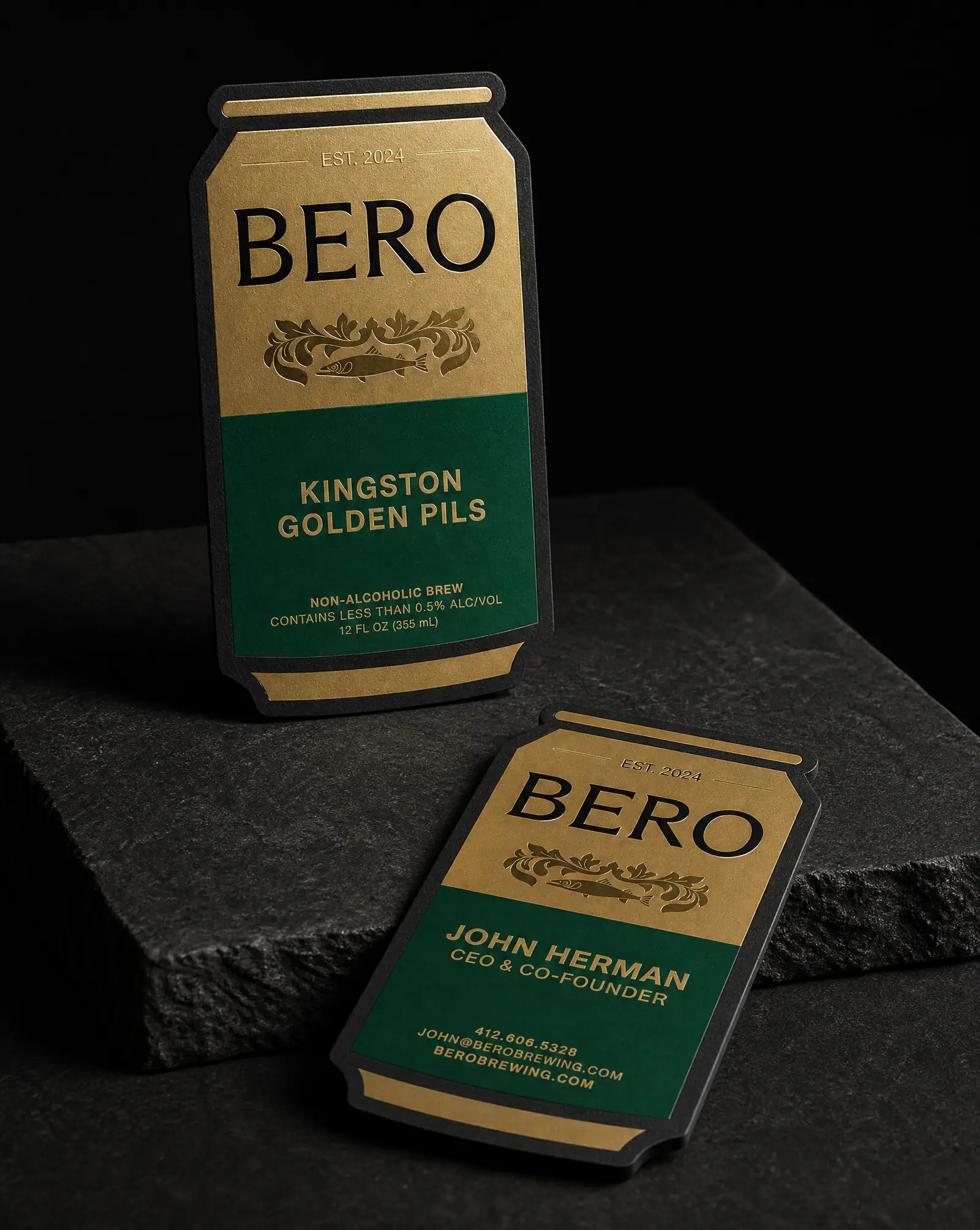
Hospitality · die cut to a can, three foils on black
A custom shape or a coloured edge people remember.
Order this specBrief. Tell us the card, the quantity and when you need it in hand. A rough idea or an AI mockup is fine.
Proof. A person rebuilds your file for the process (foil dies, plates, edge colour) and sends a proof with every change marked.
Approve. Production starts the next day.
Production. About three weeks for Custom work. This is an estimate, not a delivery guarantee.
Shipping. We ship worldwide. Shipping is included on Custom orders.
For a date-critical event, approve your proof at least four weeks before you need the cards in hand. That's an estimate, and it leaves room for one round of proof changes. If you're not happy, we reprint.
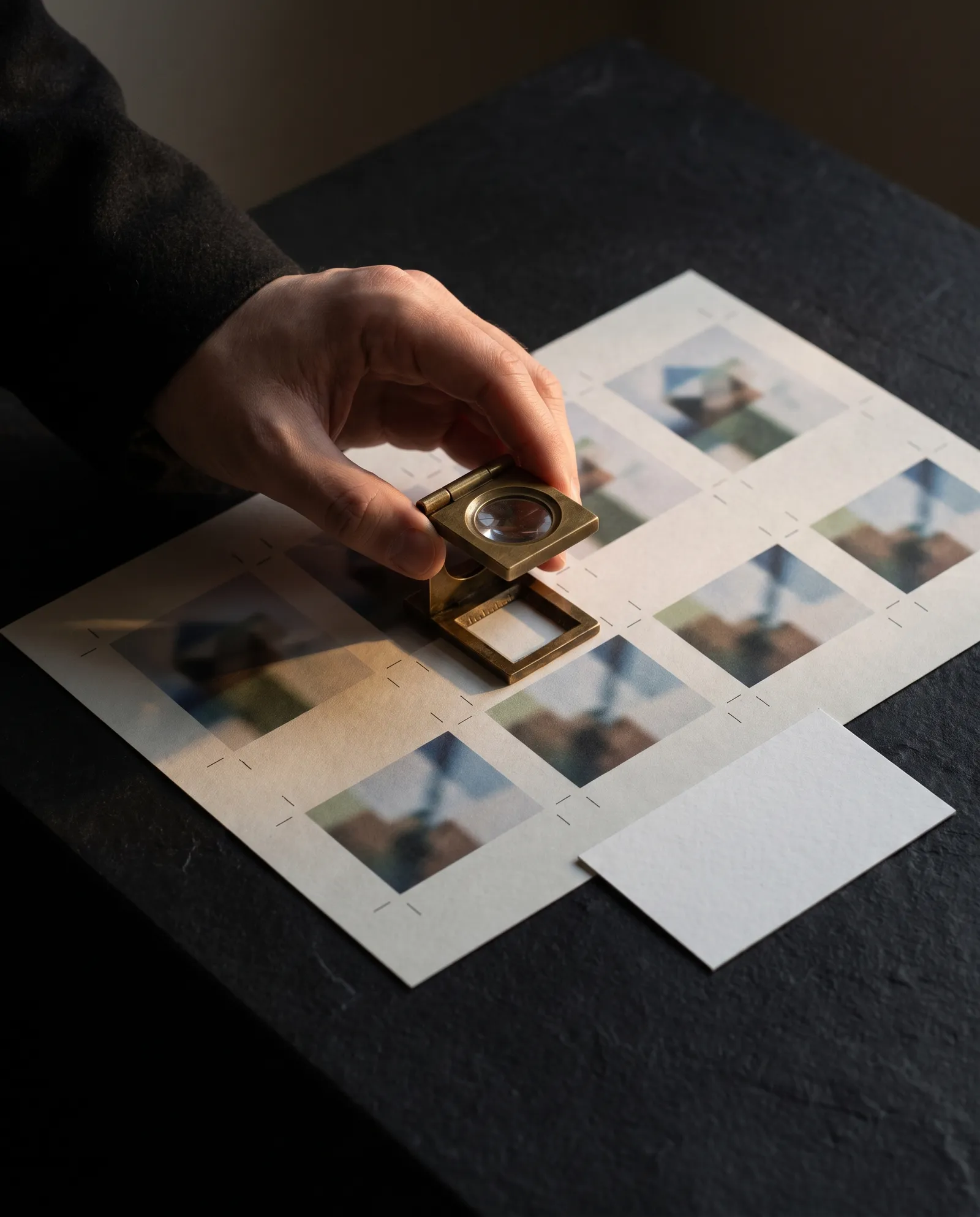
The sample pack is the fastest way to decide. It holds a range of real production cards across papers, foils and both lanes, including steel, wood and frosted plastic, plus our hot foil swatch card with 40 stamped foils, so you can hold a foil against your own paper and your own light. It's 8 USD with free shipping within the continental US.
A luxury business card changes how the card feels before anyone reads it. That usually means three things: a heavy stock (32pt or more, ideally cotton), a pressed process such as die-stamped hot foil, letterpress or a blind deboss, and a finished edge, either painted, gilded or a coloured core. A thick card with flat digital print is premium. Add a process you can feel with your thumb, and it becomes luxury.
The best luxury business cards pair one pressed process with a stock chosen for it. Three builds cover most briefs: 32pt cotton with one die-stamped hot foil, the all-rounder; 48pt cotton letterpress, the deepest bite and the quietest look; and black-coated steel, the heaviest and the most expensive. If you add only one thing to a card, make it a process you can feel. That's what separates luxury from merely thick.
Check four things rather than trusting a label. Is the foil die-stamped, or digital foil fused to toner? Is the letterpress a real impression, or print plus a deboss? Can the thickest stock take a finish, or is it print-only? And does a person check your file before the proof, or only software? The printers that answer yes to the real process and the human check are the ones making high quality cards. We do all four on Custom orders. For named comparisons, see Peppermint vs MOO vs Vistaprint.
They are when the card gets handed over in person and kept. A 48pt letterpress card costs about 1,36 USD each at 250, against roughly 0,23 USD for a standard 16pt card. If you hand out a few hundred a year to people you want to hear from again, that difference is small. If cards go into a fishbowl at a trade show, buy the standard card.
A standard card is 14–16pt coated stock, printed and cut. Premium usually means a heavier or better-coated stock made quickly: 18–32pt, soft touch or silk, sometimes raised foil or raised UV. Luxury means a process you can feel, such as die-stamped foil, letterpress, deboss or a painted edge, on a stock chosen for it, often 32pt or 48pt cotton. On our site, premium lives in the Standard lane and luxury in the Custom lane.
It depends on the build. A standard 16pt card runs about 70 USD for 500. A thick Standard card such as our triplex black core is 126 USD. Custom cotton with one hot foil colour is 410 USD, and 48pt letterpress is 535 USD. Metal costs several times more. The cost table on this page shows every build at 250, 500 and 1,000.
Metal is the most expensive card most people will buy. Stainless steel is laser engraved, etched or cut card by card, so the cost scales with quantity in a way paper doesn't. Our custom metal cards start at 230 USD for five. On paper, cost comes from stacking processes: every foil colour on every side is its own die and press pass, and a painted edge or a second bonded sheet adds another step.
Up to a point. Weight is the first thing a hand notices, and 32pt (about 0.8 mm, close to a credit card) is where a card starts to feel substantial. Our thickest paper build is 48pt cotton, about 1.2 mm: dramatic, and a little much for some wallets. Duplex and triplex builds bond two or three sheets with a visible seam or coloured core. Past 32pt, a process you can feel does more than extra thickness. See thick business cards for every option.
Custom cards take about three weeks after you approve the proof, plus transit. Standard cards ship in 3–4 business days after proof approval, plus transit. These are estimates, not guaranteed delivery dates. For a fixed event, approve your proof at least four weeks ahead, and tell us the date when you send the brief.
Yes. The sample pack holds real production cards across our papers and finishes, from both Standard and Custom, plus a hot foil swatch card with 40 stamped foils. It's 8 USD with free shipping within the continental US.
Yes. Our business card artwork service lays out both sides around the actual size, stock and finish, with press-ready separations for each foil, plate and edge colour. If you already have a design, or an AI mockup, a person rebuilds it for the process and marks every change on the proof. Fine lines are thickened to what foil can hold, and small text moves to ink where needed.
NFC cards are the main alternative: tap the card to a phone and it opens your contact page or website, with no app needed. Many people now carry both. Our NFC cards come in plastic, wood and metal, starting at 149 USD for 25. Metal blocks the signal, so NFC metal cards use a steel face with a plastic back. A printed card still gets kept on a desk; a tap only lives in a phone.
Yes, we ship worldwide. Transit times vary by destination, and shipping is included on Custom orders. Tell us your in-hand date in the brief and we'll say honestly whether it's realistic.