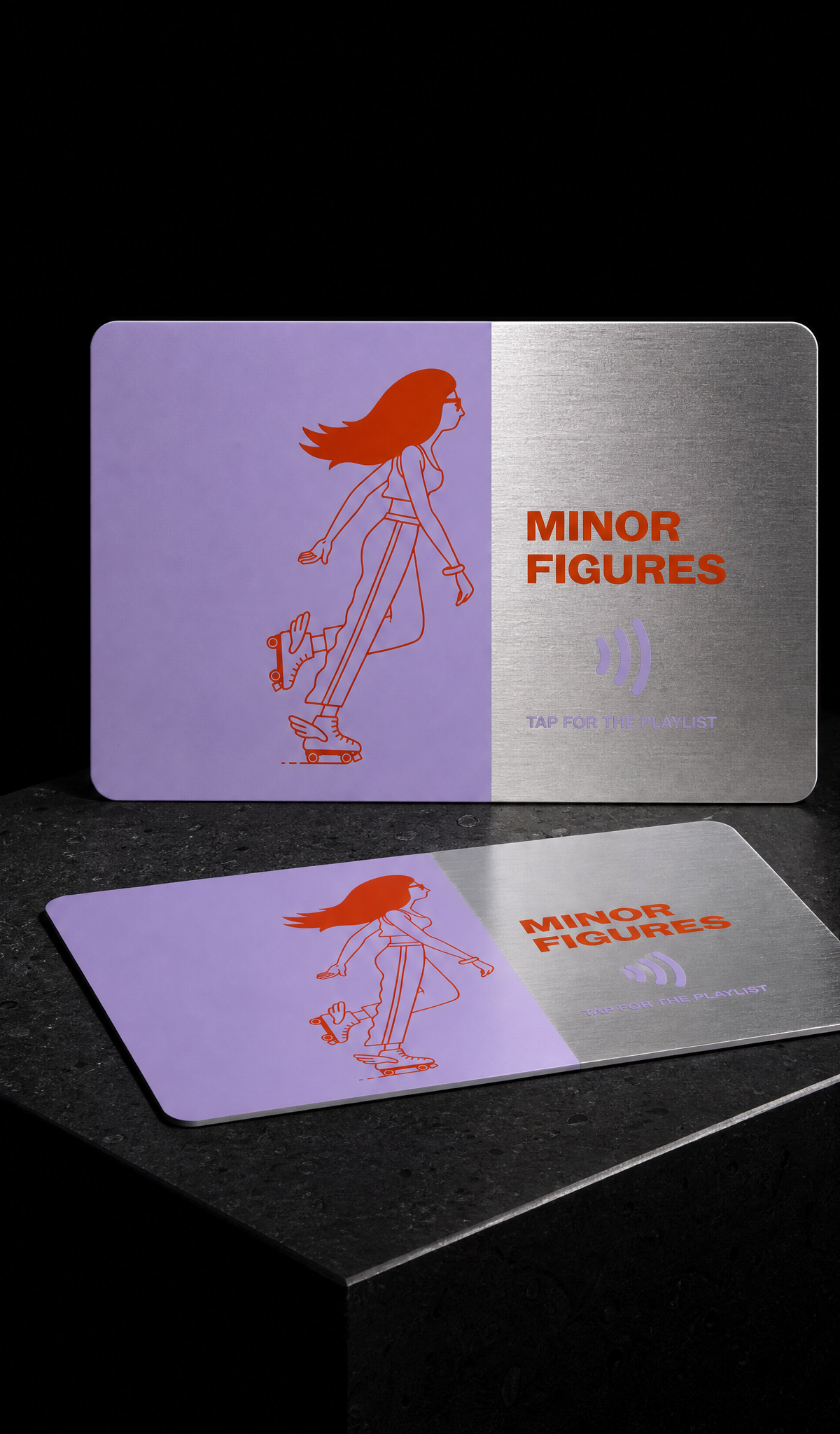
Client project
Two inks, a steel core, and a playlist
Minor Figures' launch card for Barista Chai: a stainless core laminated to PVC, two Pantone inks, and an NTAG213 in the PVC layer that taps to a playlist.
See the case studyMetal, plastic and wood
The NFC-enabled digital business card, printed properly.
NFC plastic from 149 USD for 25 · metal from 229 USD for 25
About 3 weeks after proof approval (estimate).
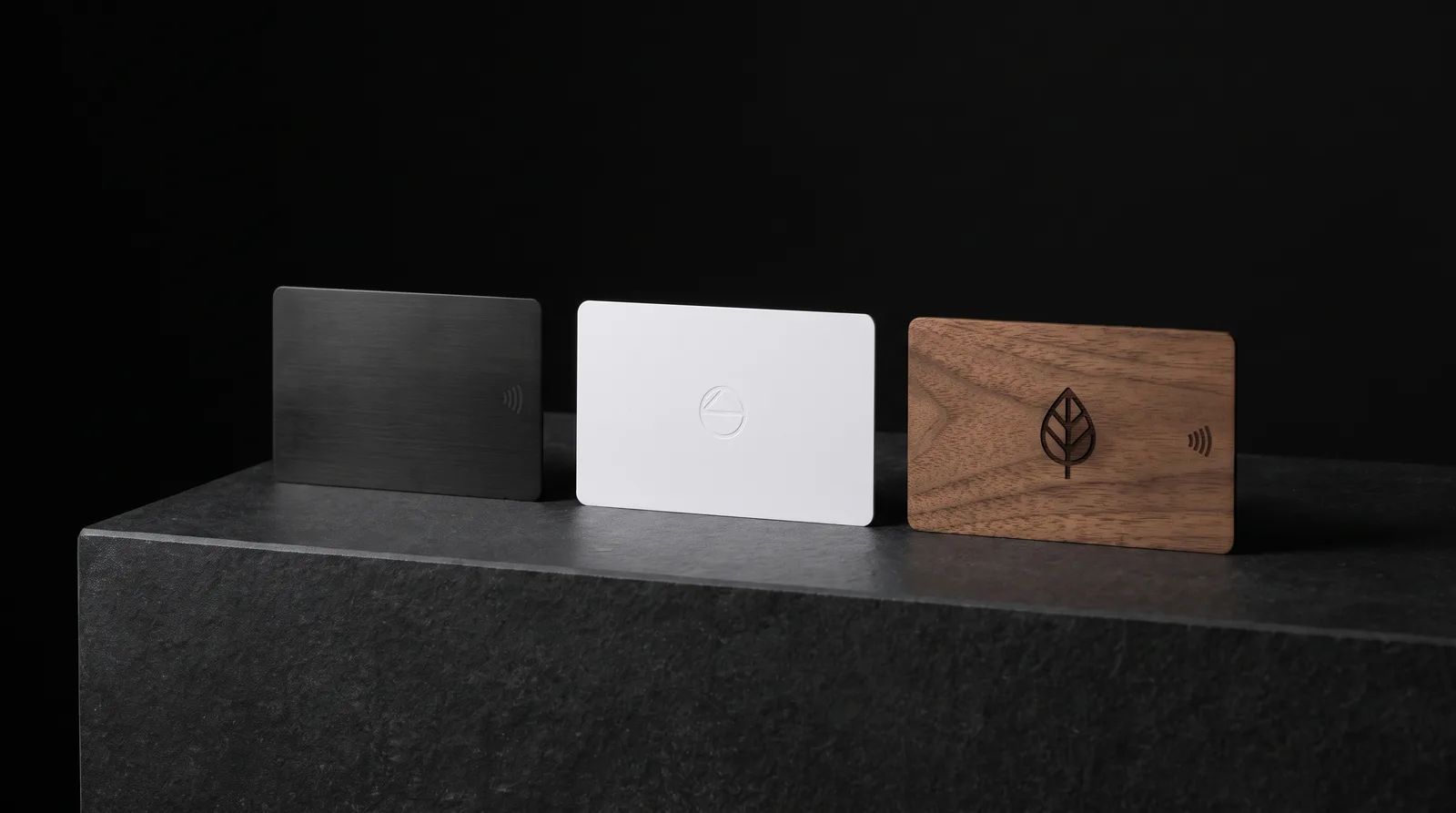
An NFC business card is a printed card with a small chip sealed inside. Tap it to a phone and your digital business card opens: your website, a contact card that saves straight to their phone, your portfolio, or a profile you already use. The person you meet needs no app. We make NFC business cards in stainless steel, white PVC and real wood, printed to your design and programmed to your link. No platform logo on your card and no monthly plan from us. Production takes about 3 weeks after you approve the proof.
30 pt white PVC, full color on both sides, and the chip reads from either face.
From 149 USD for 25
2,49 USD each at 100
About 3 weeks after proof approval
Cherry, walnut, birch or bamboo, laser engraved or color printed, with the chip sealed in the wood.
Get a price for 50
Get a price each at 100
About 3 weeks after proof approval
A stainless steel face bonded to a printed back, where the chip lives.
From 229 USD for 25
5,95 USD each at 100
About 3 weeks after proof approval
Free design proof · Free shipping within the continental US · Pre-programmed or shipped blank
Many of the NFC cards you'll find online are sold by app companies. The card is the accessory; the subscription is the product. You get their template, often their logo on your card, and a profile that only works while you keep paying.
We work the other way around. We print the card and let the chip point wherever you want.
Why we don't sell sticker tags. An NFC card gets handed to someone you want to remember you. If it bends, peels, or looks like it came from a vending machine, the chip inside is wasted. Every card we make has the chip sealed inside the card body, with nothing stuck on the outside.
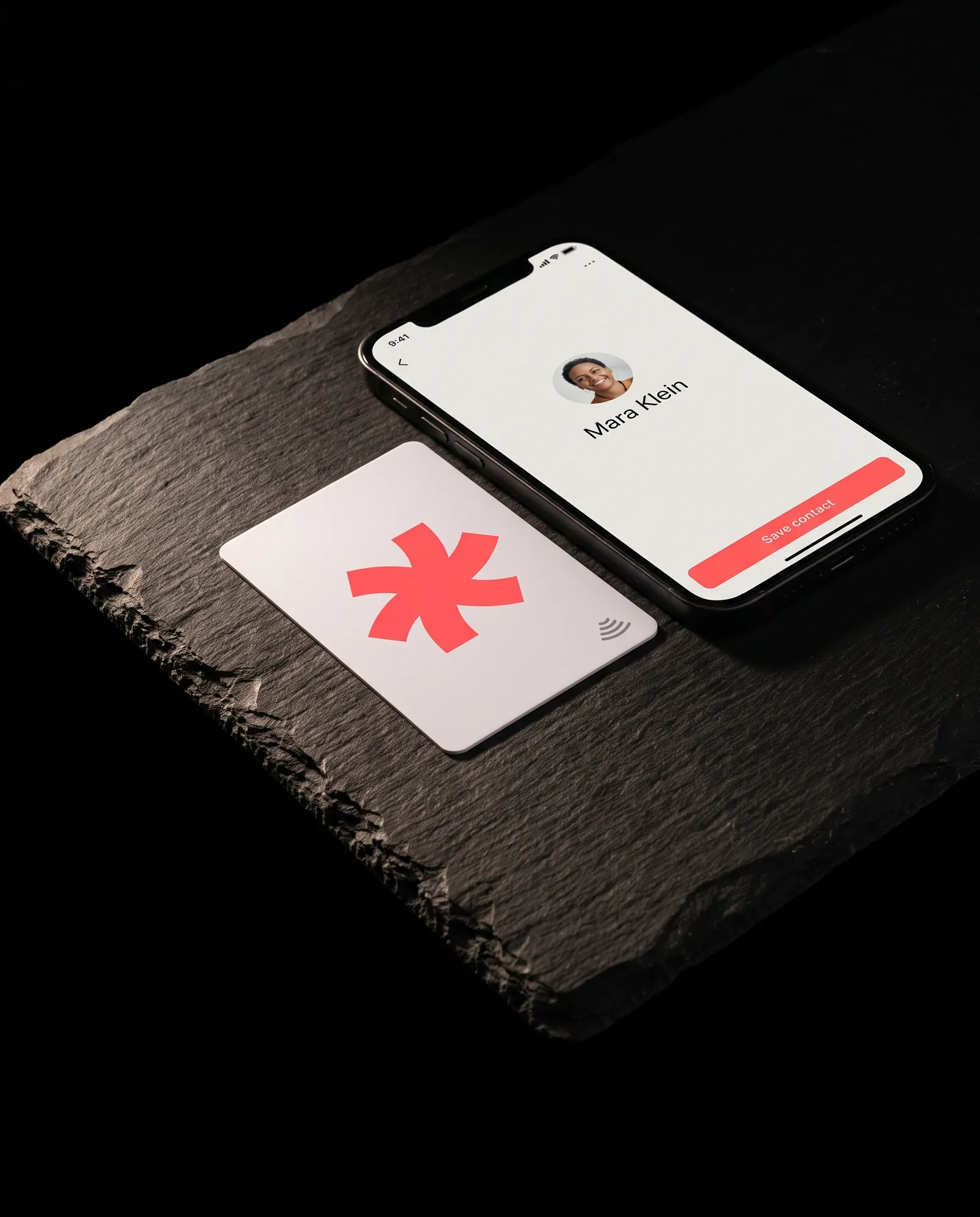
They aren't competitors. A digital business card is the page: your name, photo, links and a "save contact" button, living at a web address. An NFC business card is the physical object that opens that page with one tap.
So the real question is where your page lives:
| Where the tap goes | What the other person sees | Good for | Watch out for |
|---|---|---|---|
| Your own website or a page on it | Your site, at your own address | Anyone with a site; you control it forever | Make it a mobile page built for this, not your homepage |
| A contact card (vCard) | An "Add contact" screen with your details filled in | Sales, real estate, anyone who wants to be saved, not browsed | Host the contact file on your own site and point the chip at it: that opens on iPhone and Android. A vCard stored on the chip itself opens on Android but not on iPhone without an app, and needs a larger chip (see the chip section below) |
| A link page you already use (Linktree and similar) | Your list of links | Creators, musicians, multi-link people | Free tiers can add their branding to the page |
| A digital business card app profile | Your profile in their layout | Teams already on a platform | The profile stops working if the plan lapses; the card doesn't |
| A redirect link you control | Whatever you point it at this month | Anyone whose role, site or campaign will change | You need a domain or redirect service to manage it |
Our default recommendation: a short link on your own domain (for example yourname.com/card) that redirects to wherever you want today. The chip never has to be rewritten, and nobody else can switch it off.
Hand over the card.
They hold it near the back of their phone (the top edge on an iPhone). No pairing, no camera, no download.
A notification appears.
They tap it, and your link opens in their browser, or the "Add contact" screen appears if you chose a vCard.
Nothing to charge.
The chip has no battery. The phone's own NFC field powers it for the second it takes to read.
| Phone | How it reads the card |
|---|---|
| iPhone XS, XS Max, XR and every iPhone since | Reads in the background. With the phone unlocked, hold the card near the top edge of the back, tap the banner. |
| iPhone 7, 8 and X | Reads with the NFC Tag Reader in Control Center (iOS 14 or later). It has to be opened first, so this is where a printed QR backup earns its place. |
| iPhone 6 and older | No NFC tag reading. Use the QR backup. |
| Android phones with NFC | Reads when NFC is switched on (on by default on most phones). The reader is usually near the middle of the back. Some budget models have no NFC. |
Reading range is about 1–3 cm: a tap, not a wave across the room. Most phone cases are fine. Thick rugged cases, metal cases and magnetic card wallets on the back of the phone can block the read, so if the first tap misses, slide the card a little or take the wallet off.
Both open a link. NFC is one tap with the card still in your hand. A QR code asks the other person to open the camera, frame the code and wait for focus, but it works on any phone with a camera. That's why we print both on most cards: the chip inside, a small QR on the back as the fallback.
| NFC chip | QR code | |
|---|---|---|
| How it opens | Tap the card to the phone | Open the camera, frame the code |
| Phones | iPhone XS/XR and later in the background; iPhone 7–X via Control Center; Android with NFC on | Any phone with a camera |
| On the card | Nothing visible; the chip is sealed inside | A printed square, about 2 cm minimum |
| Changing the link | Rewrite the chip, or point it at a redirect you control | Reprint, unless it points at a redirect |
| On metal | Reads from the non-metal side only | Engraved; scans best on matte or black finishes |
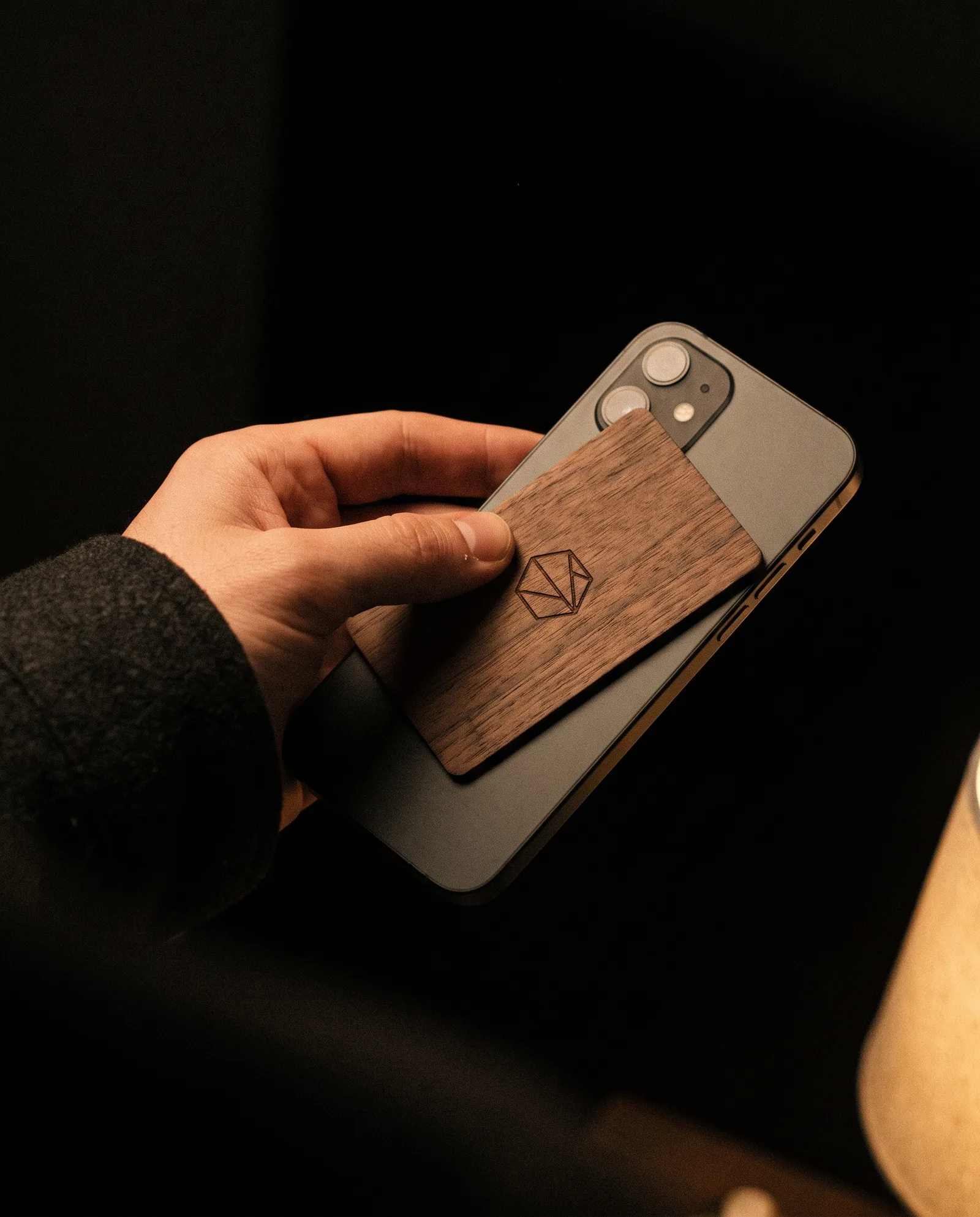
Same chip, three very different objects in the hand. Here's what each one is, what it costs, and where each one can disappoint you if nobody tells you first.
| NFC Plastic | NFC Wood | NFC Metal | |
|---|---|---|---|
| What it is | 30 pt white PVC, credit-card size (CR80) | Cherry, walnut, birch or bamboo, 1 mm thick | Stainless steel face bonded to a printed PVC back |
| Where it reads | Either side | Either side | The printed back only (steel blocks the signal) |
| Design | Full color both sides; add foil or spot UV | Laser engraving, cut-outs or color print | Laser engraving, cut-outs or color print on the steel; full color on the back |
| In the hand | Light, smooth, flexible | Light, warm, every card's grain is different | Heavy, rigid, cold |
| Best for | Full-color designs, teams, first orders | Natural and sustainable brands | Executive cards, the "weight" moment |
| 25 cards | 149 USD | not offered (minimum 50) | 229 USD |
| 50 cards | n/a on the ladder | Get a price | n/a on the ladder |
| 100 cards | 249 USD (2,49 USD each) | Get a price (Get a price each) | 595 USD (5,95 USD each) |
| 250 cards | 445 USD (1,78 USD each) | Get a price (Get a price each) | 1195 USD (4,78 USD each) |
| Product page | NFC plastic business cards | NFC wood business cards | NFC metal business cards |
If you're not sure, start with 100 NFC plastic cards. Full color on both sides, the chip reads from either face, and at 2,49 USD a card there's room to reorder when your title changes. Go metal when the weight in the hand is the point of the card. Go wood when the material is part of your brand story.
Every card carries a passive NTAG chip: a chip smaller than a grain of rice, joined to a hair-thin antenna that loops close to the card's edge. Both are sealed inside the card, so nothing sticks out and nothing needs charging.
| Spec | Value |
|---|---|
| Chip | NTAG213 as standard; NTAG215 or NTAG216 for larger payloads |
| Memory (user) | NTAG213: 144 bytes · NTAG215: 504 bytes · NTAG216: 888 bytes |
| What fits | NTAG213 holds a web address comfortably, including a link to a contact file on your own site. A full vCard written onto the chip itself, with several phone numbers, an address and links, usually needs NTAG215 or NTAG216. |
| Read range | About 1–3 cm |
| Power | None; powered by the phone during the tap |
| Reads | No practical limit |
| Rewrites | Rated for 100,000 write cycles, with 10-year data retention (NXP datasheet). Changing your link once a week would take nearly two thousand years to reach it. |
| Protection | Can be password-protected or permanently locked so nobody else can rewrite it |
| Standard | NFC Forum Type 2, 13.56 MHz; read by iPhone and Android |
Design note: don't print the address the chip opens as a long URL on the card. The moment that address changes, the card is out of date and you've thrown away the one advantage NFC gives you. Print your name, role and mark. Let the chip carry anything that might move.
Every NFC card can ship ready to tap, ship blank for you to program, or carry a different link on every card for a team.
| Option | What happens | Who it's for | Price |
|---|---|---|---|
| Pre-programmed (our pick) | You give us the link at checkout. We write it to every chip and test-tap the run before it ships. | Almost everyone | NFC chip encoding and setup: Get a price per order |
| Ship blank | Cards arrive unwritten. You program them yourself in a couple of seconds each with a free NFC writing app such as NFC Tools (iOS and Android). | People who want to set the link later, or change it often | Included |
| One link per person | Each card is printed with a different name and each chip carries that person's own link or vCard. | Sales teams, brokerages, firms ordering for everyone at once | Custom quote |
Need a vCard, several links, or something unusual? Mention it in the order notes at checkout or request a custom quote.
If your cards are unlocked, any free NFC writing app can rewrite them in seconds. If you'd rather never touch the cards again, point the chip at a redirect you control (a short link on your own domain) and change where the redirect goes. That's what we recommend for anyone whose role, company or campaign is likely to change.
A small QR code on the back covers every phone that won't read the chip on its own: iPhone 6 and older, an iPhone 7, 8 or X whose owner has never opened the Control Center reader, Android phones with NFC switched off, and the occasional person who just doesn't believe a card can do that.
How we set it up:
NFC cards aren't paper, so some of the finishes we're known for on cotton don't apply. Here's what each material takes, and what it doesn't.
| Material | Works | Doesn't work |
|---|---|---|
| Plastic (PVC) | Full-color print both sides; hot foil, one side (40 USD), which our press team confirms on the sheet before we promise it; spot UV (35 USD); rounded corners (15 USD); Pantone match (100 USD per color) | Embossing, debossing, letterpress. Plastic won't take an impression; for texture we use raised spot UV or foil instead. |
| Metal | Laser engraving (included), cut-outs (1,58 USD per card), color printing on the steel (1,18 USD per card), full color on the PVC back, engraved QR | Hot foil, letterpress, paper embossing. Those are paper processes; on steel the equivalents are a mirror-polished or color-filled engraving for a "foil" look and a deep etch for a "deboss" look. |
| Wood | Laser engraving (included), engraving with cut-outs (30 USD), color printing (25 USD), engraved QR | Spot UV and foil are not on the wood menu |
| Paper | NFC on cotton and other paper cards is a custom build. Tell us the finishes you want and we'll confirm what the build allows before we quote. | Not available as a fixed-price product |
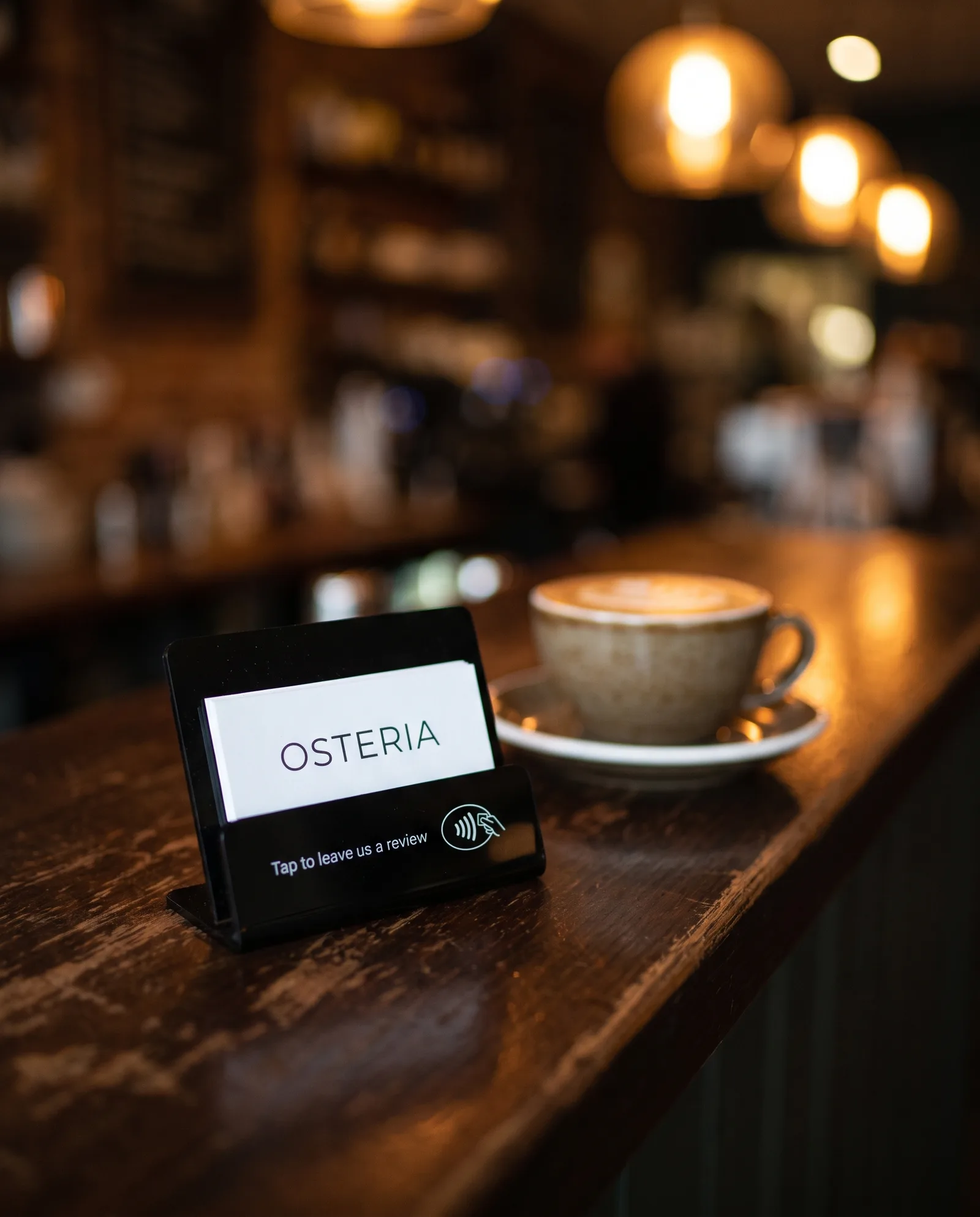
Client project
Minor Figures' launch card for Barista Chai: a stainless core laminated to PVC, two Pantone inks, and an NTAG213 in the PVC layer that taps to a playlist.
See the case study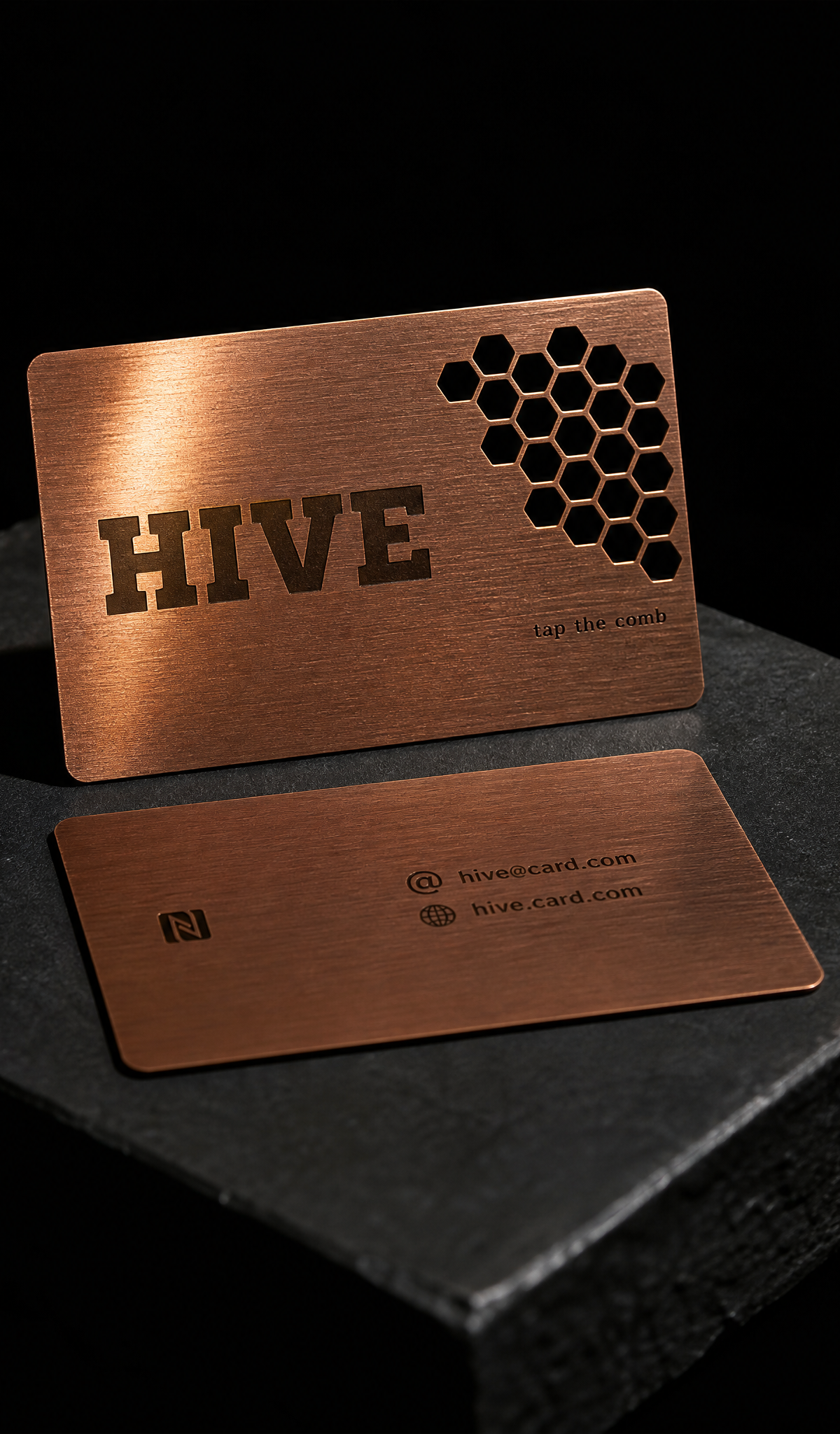
Design exercise
NFC construction across metal, plastic and wood: inlay windows in steel, a visible coil in clear PVC, and pockets kept inside the grain of wood.
See the exerciseNFC cards take about 3 weeks to produce after you approve the proof. That's an estimate, not a delivery date: production and shipping times vary, and we'll tell you if a date looks tight before you pay.
An NFC business card, sometimes called a tap business card or a smart business card, is a printed card with a small passive chip and antenna sealed inside. When someone holds the card near their phone, the chip sends the phone a link, so your website, contact card or digital business card profile opens with one tap. It needs no battery and no app on the other person's phone. We make them in stainless steel, white PVC and real wood, printed to your design and programmed to your link.
A digital business card is a web page or contact file with your details: name, photo, links and a "save contact" button. An NFC business card is the physical card that opens that page when tapped. You need somewhere for the tap to land, and that can be your own website, a contact file, a link page, or a profile on a digital business card app you already use. Our cards work with any of them, because the chip just holds a link.
No. iPhone XS and newer, and Android phones with NFC switched on, read the chip with the operating system itself and show a notification that opens your link. iPhone 7, 8 and X can read it through the NFC Tag Reader in Control Center. For older phones, a QR code printed on the back of the card does the same job with the camera.
Yes. iPhone XS, XS Max, XR and every newer iPhone read NFC cards in the background: with the phone unlocked, hold the card near the top edge of the back, and tap the banner. iPhone 7, 8 and X read them through the NFC Tag Reader in Control Center on iOS 14 or later. iPhone 6 and older can't read NFC tags, so we recommend a QR code on the back as a backup. One iPhone catch: a contact card stored on the chip itself won't open without an app, so for contact cards we point the chip at a contact file on your own site instead.
Not from us. You pay once for the printed cards. The chip holds a link you choose, so there's no profile service to keep paying for unless you decide to point your card at one. If you already use a digital business card app, the card can open your profile there, but our card keeps working even if you cancel that plan; you just point the chip, or your redirect, somewhere else.
Our NFC plastic business cards are 149 USD for 25 and 249 USD for 100, about 2,49 USD a card. NFC wood cards start at 50 cards (get a price), and NFC metal cards at 229 USD for 25 (595 USD for 100). Plastic prices include full-color printing on both sides; wood and metal prices include laser engraving, with color printing as an add-on. Every order includes the embedded chip and a free design proof, and shipping within the continental US is free. Encoding your link and test-tapping the run is priced per order (get a price).
Yes. If the chips are unlocked, a free NFC writing app such as NFC Tools rewrites the link in a few seconds per card. The easier route is to point the chip at a short redirect on your own domain, then change where that redirect goes whenever you like, without touching the cards. The only thing you can't change is anything printed on the card itself, so keep the changeable link off the face.
Any of them. The chip can hold a web address: your site, a portfolio, a booking page, a Linktree, a digital card profile, your Google review form, or a contact file (vCard) on your own site that opens an "Add contact" screen. A vCard can also be written onto the chip itself, but iPhones don't open an on-chip vCard without an app, so we recommend the hosted contact file for anyone who meets iPhone users. A simple link fits on our standard chip; an on-chip vCard with several numbers and an address usually needs a larger NTAG215 or NTAG216 chip, which we can fit by custom quote. Tell us at checkout which one you want.
Yes. We print each card with a different name and title and write each chip with that person's own link or contact card, all from one shared design so the whole team matches. Team orders with a different name on each card are quoted together: send us the list of names and links through a custom quote and we'll price the set.
The card has to be within about 1–3 cm of the phone's reader, which is near the top edge on an iPhone and usually near the middle of the back on Android. Most ordinary cases don't get in the way. Thick rugged cases, metal cases and magnetic card wallets stuck to the back of the phone can block the signal, so if the first tap misses, move the card around slightly or take the wallet off.
Not on our standard builds. On white PVC, on wood and on the printed back of our metal card, the chip and antenna are sealed inside where you can't see them. Clear and frosted plastic are the exception: the antenna coil and the chip show through. We build those by custom quote and tell you exactly what will be visible before you approve the proof. Some clients make the coil part of the design.
Yes, when they're built for it. Solid steel blocks the phone's NFC field, so a chip hidden behind a plain steel face won't read. Our NFC metal cards bond a stainless steel front to a printed PVC back, and the chip sits in the back layer. That back is the side you tap. Builds with steel on both faces need a pocket or window for the antenna and are quoted individually.
It depends on the material. On NFC plastic we can add hot foil (our press team confirms it on the sheet first) and spot UV, but plastic can't be embossed or letterpressed. On metal, the finishes are laser engraving, cut-outs and color printing; foil and letterpress are paper processes that don't work on steel. Wood is laser engraved or color printed. NFC on paper cards is a custom build, and we confirm which finishes the build allows before quoting.
Yes, and we recommend it on most cards. A small QR code on the back, at least 2 cm square with a clear margin around it, covers older iPhones and Android phones with NFC switched off. On plastic it prints in flat dark ink, never foil or spot UV, because shine stops the camera reading it. On metal and wood it's laser engraved. Point the QR code and the chip at the same redirect so they always land in the same place.
The chip has no battery, so there's nothing to run down. Reads are effectively unlimited, and rewrites are rated for about 100,000 cycles, with the data held for at least 10 years. Bending the card hard enough to crease it or snapping it can break the antenna. If cards arrive with a chip that doesn't read, tell us: a defect that wasn't in the proof you approved is reprinted under our terms.
The best one opens a link you control and is a card you're proud to hand over. Check four things before you buy: the chip is sealed inside the card, not stuck on; it reads on iPhone and Android without an app; the link is yours, not a profile that stops working when a plan lapses; and the material suits your brand. For most people we'd start with NFC plastic: full color on both sides, and it reads from either face. Choose metal when the weight in the hand is the point, and wood when the material is part of the story.
You can make your own: buy blank NFC tags or white cards and write your link with a free app. What you won't get is a card that looks like your brand. NFC cards are worth it when the card itself matters, when you meet people in person often, and when your details change, because one tap beats retyping an email and the link can be updated without a reprint. If you hand out a few cards a year and never change jobs, a well-printed paper card with a QR code does the job for less.
What NFC business cards actually cost
Send us your design, or just your logo and the link. We'll recommend the material, set up the file, and send a free proof showing both sides before anything is made.