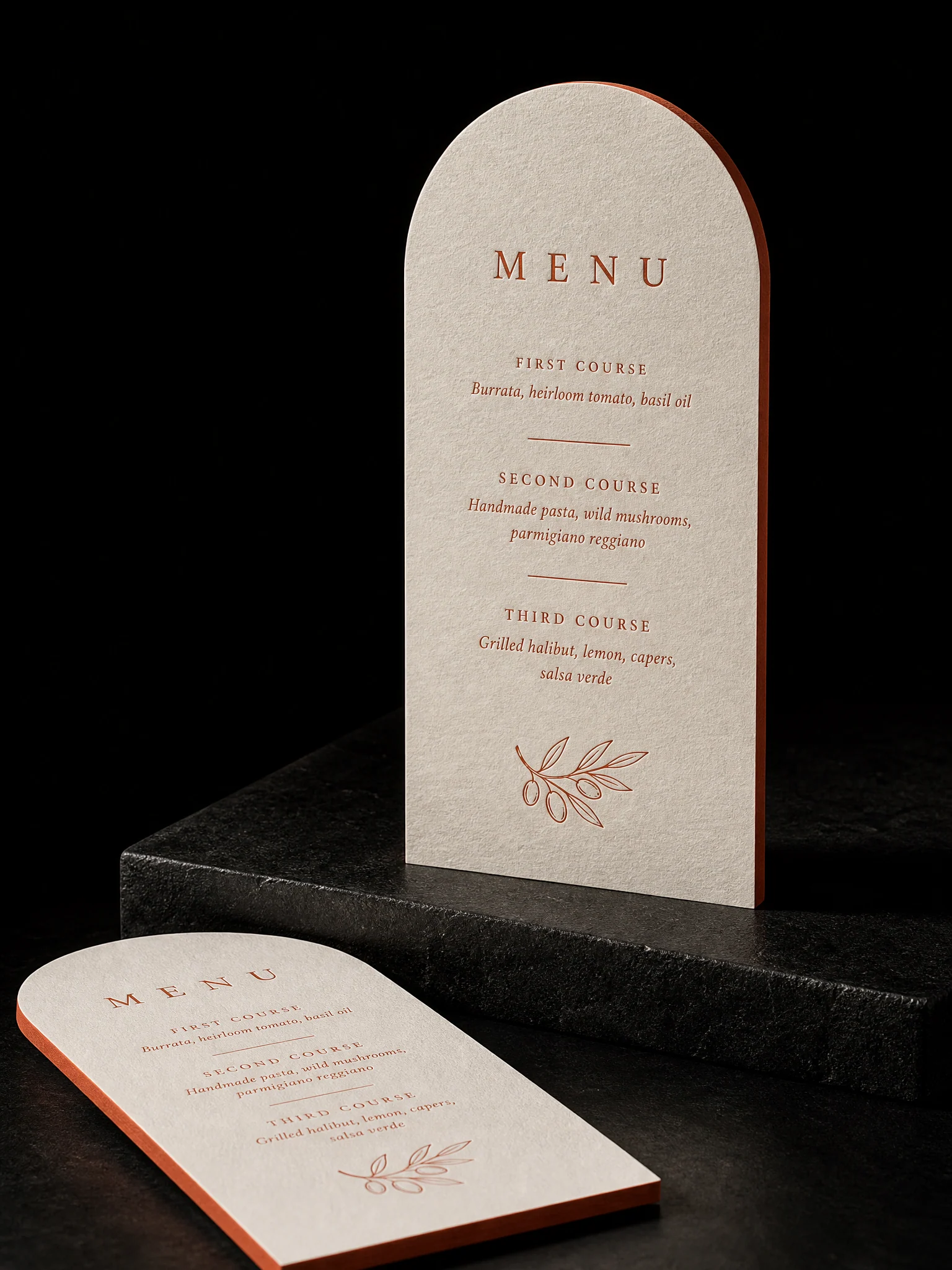
The piece they read at the table.
Reception menus, ceremony programs and orders of service on heavyweight stock — foil-stamped, letterpressed or painted-edged, matched to the invitation that got them there.
From 295 USD for 50 pieces
4x9 flat, 1 foil, cotton. Free shipping in the continental US.
355 USD
100 pieces · 3,55 USD each · ships in 7–12 business days
Self-serve price: you set it up, upload print-ready files and check out. Want a designer to check or rebuild your files, extra names, or a finish not listed? Get a custom quote (design prep, proofs until you're happy, a real person on it).
If you're not happy, we reprint. How our quality promise works
- Free proof. Nothing prints until you approve it.
- Want a human (or our AI art director) to check your artwork first? Ask our team or try the Studio.
Price-Lock Promise
You pay the price you see for the spec you ordered. If our artwork review finds a cheaper spec that suits your design better, we'll suggest it and refund the difference. Any upgrade is charged only if you approve it. If we can't print your artwork well on the ordered spec and you don't want to change it, you get a full refund before anything prints.
What’s possible
Long formats, held to the same standard.
Tall 4×9 menus, folded programs, single-panel orders of service — the long formats need heavier stock than a flat card so they stand up in a hand and don't curl on a table. We spec the weight around the format.
Menus
4×9 tall, A5 or square — flat or folded.
Programs
Folded or stitched, 4 to 12 pages.
Orders of service
Single panel or booklet, on cotton.
Foil & letterpress
Names and headings, stamped or pressed.
Why Peppermint
A human guides every custom order.
Checked by a person
We confirm files, materials and finishes before you pay.
Materials others won't
Papers, foils and techniques most printers can't offer.
A free proof, always
Nothing prints until you approve exactly what you get.
Custom menus & programs FAQ
What stock should a menu be printed on?
Heavier than you'd think. A menu gets picked up, held and set down all night, so we spec 32pt cotton or a duplex at minimum — thin stock curls in a warm room and goes soft under a water glass. Programs that fold can run lighter because the fold does the stiffening.
Can you print a different name on each menu?
Yes — variable printing lets us put a guest's name at the head of each menu, and we can foil the fixed elements and digitally print the names. Worth flagging your final headcount early; the name list is the long pole, not the press time.
Can menus and programs match our invitations?
That's the whole point of ordering them from the same shop. Same paper family, same foil, same typography — we design them alongside the invitation so the day reads as one piece rather than three near-misses.
How many programs should we order?
Plan on one per guest plus about 15% — programs get taken home and they get sat on. Reprinting a short run later costs more than the extra 15% does now, because you're paying setup twice.
Should the menu be flat or folded?
Flat if the meal is three courses and the type can breathe on one panel — a single 4×9 card reads fast and photographs well. Folded once you're adding wine pairings, a cocktail list or a second language. The fold also adds stiffness, which lets us run a slightly lighter sheet without the piece going limp.
How many pages can a program run?
Four to twelve. Four is a single folded sheet — order of events inside, names on the back. Beyond that we stitch through the spine so the interior pages stay put through a windy outdoor ceremony. Twelve gives you readings, a wedding party list and a memorial page without crowding any of them.
Do painted edges work on a folded program?
Painted edges live on the exposed edge of a stack of stock, so they read strongest on a thick flat piece — a 4×9 menu or a single-panel order of service on cotton. A folded program has a folded spine rather than a cut one, so the paint runs on three sides instead of four. Worth deciding before we build the file.
How late can we change the menu copy?
Later than most people fear, but the sequence matters. Foil and letterpress require a physical die, so the fixed elements — headings, monograms, borders — lock first. Course descriptions and guest names can move after that. Talk to us about your kitchen's timeline and we'll structure the file so a last-minute swap doesn't mean a new die.
Can orders of service run on the same cotton as the invitation?
Yes — that's how we prefer to build them. Cotton takes an impression deeply and has a soft hand that suits a ceremony piece. Single panel or booklet, both on the same sheet family your invitation ran on, so the paper feels familiar in the hand before anyone reads a word of it.
We rebuild supplied artwork for the press.
Our design team redraws your artwork as clean, layered, press-ready files so every plate, die and colour can be produced properly.
Explore more
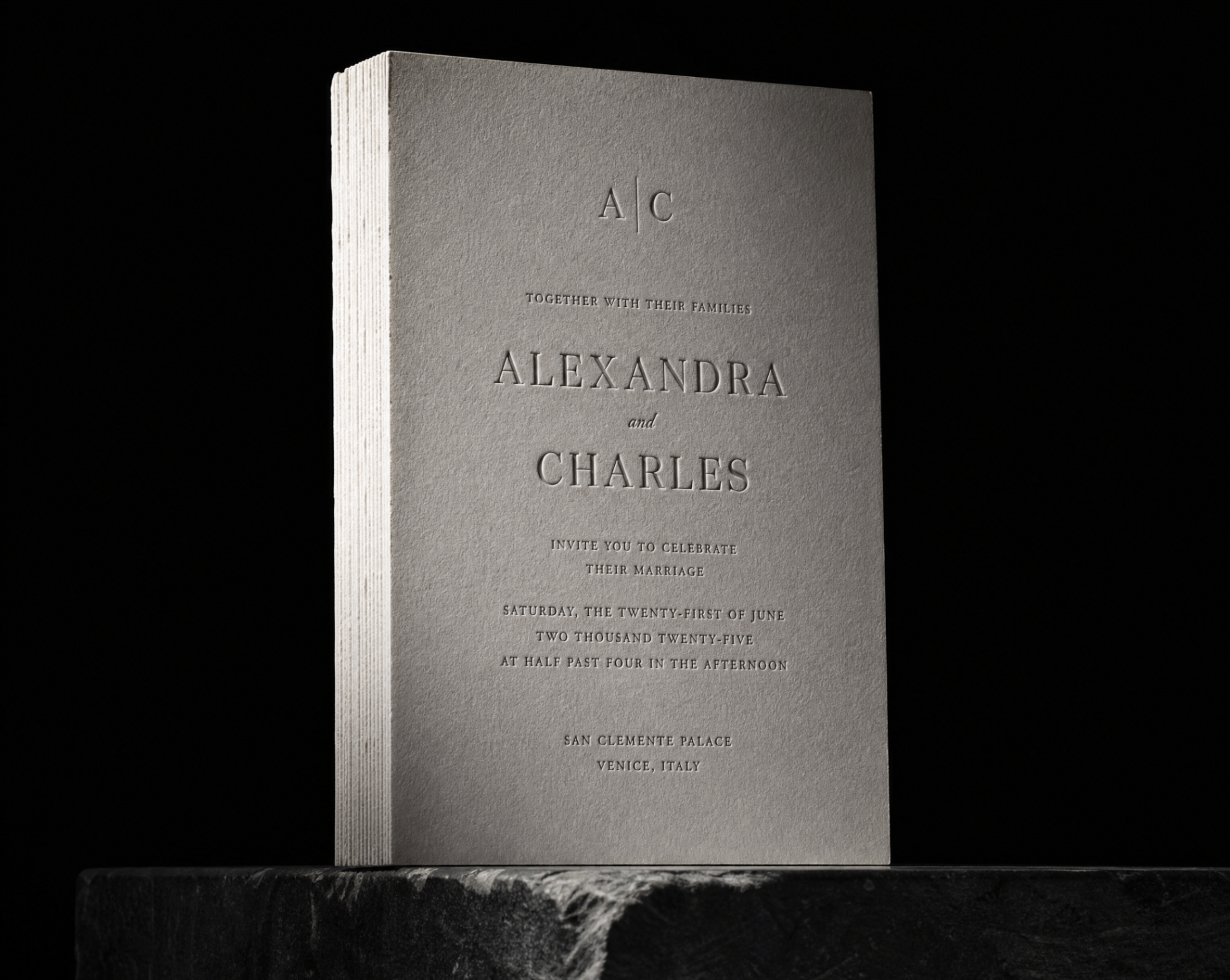
Wedding Invitations
AI-concepted, hand-crafted invitations on cotton, with foil, letterpress and painted edges.
View wedding invitations →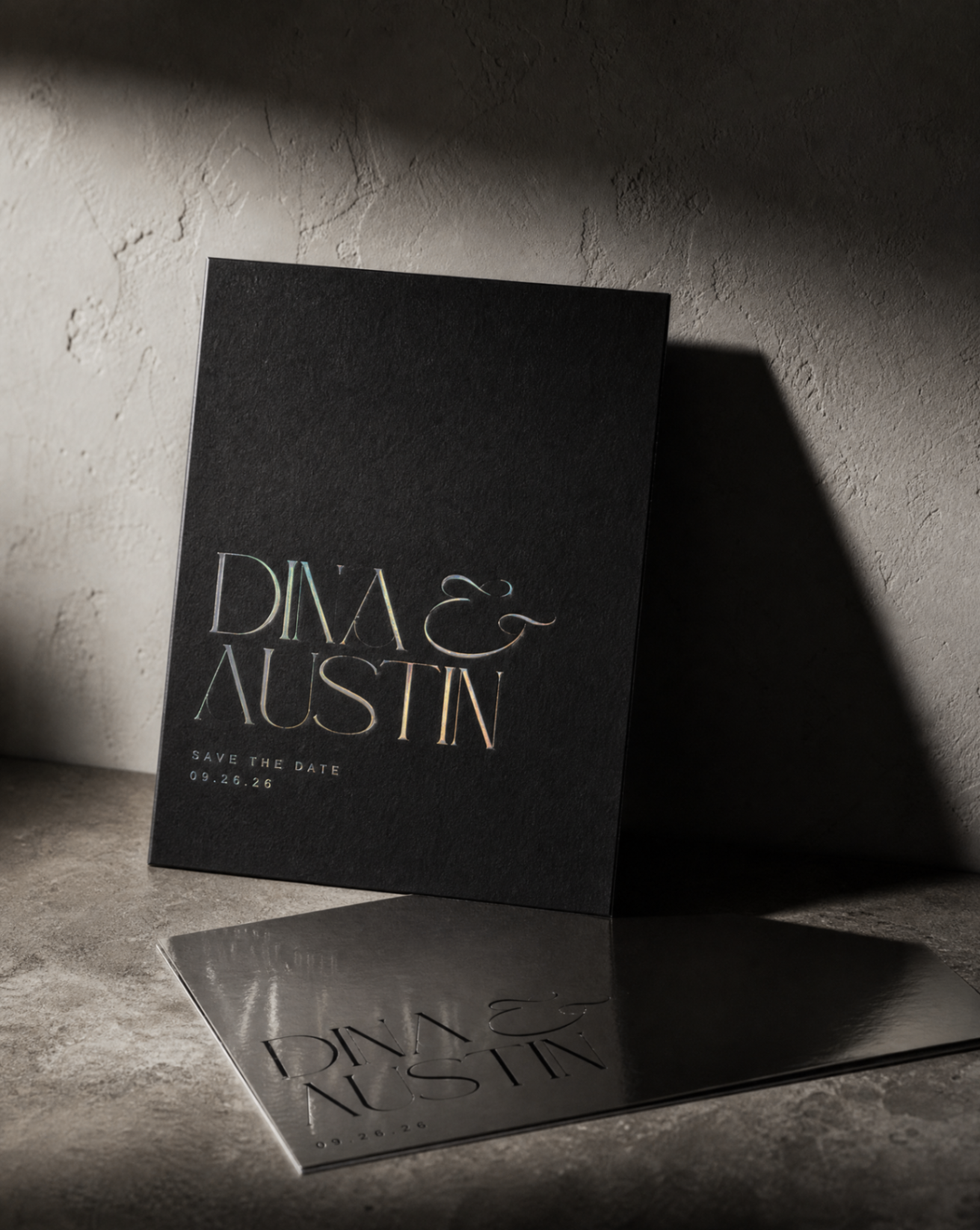
Save-the-Dates
The first hello of the day — foil, letterpress or magnet-mounted, matched to the invitation suite.
View save-the-dates →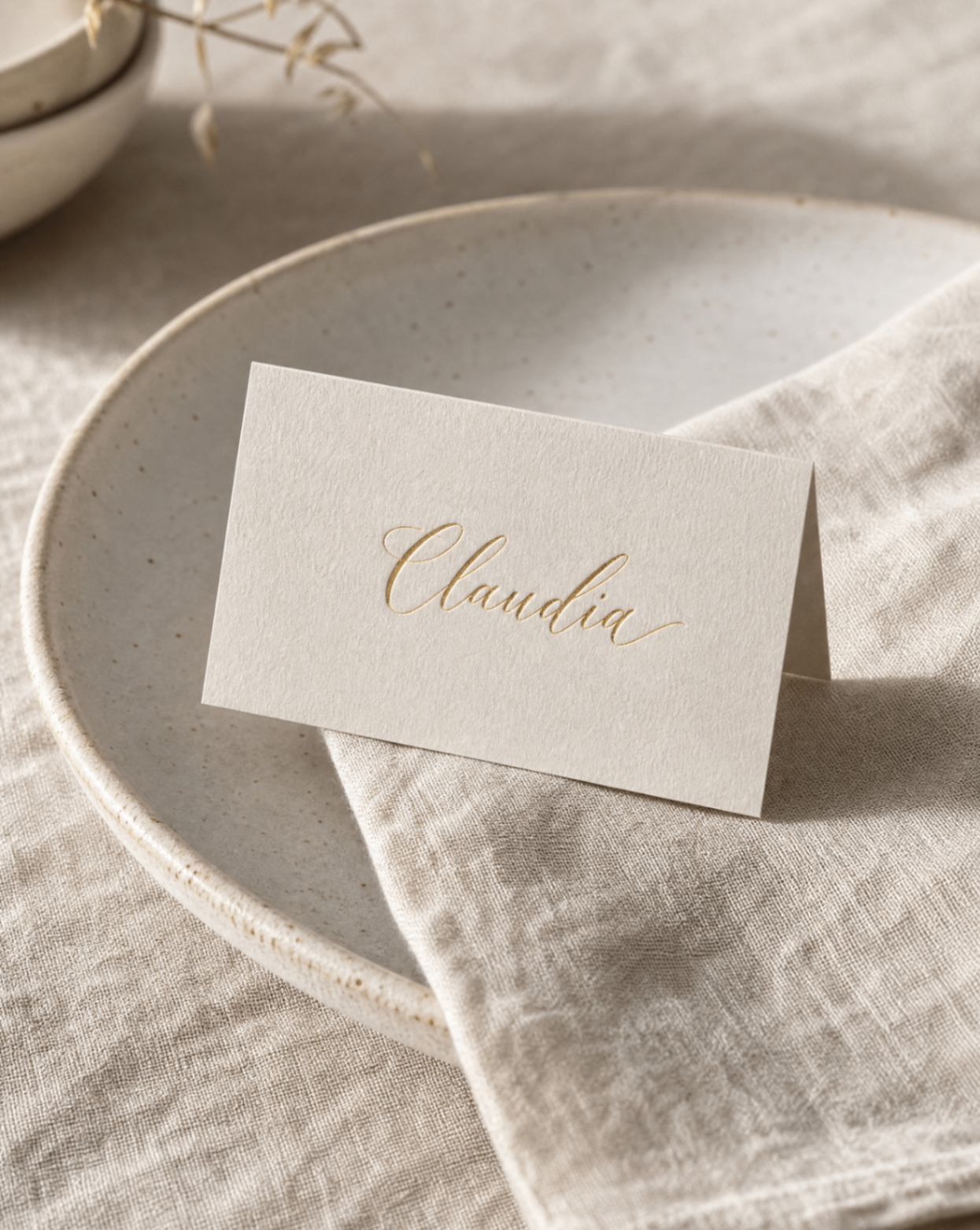
Place Cards
Folded tents, flat cards or escort cards — calligraphed or foil-stamped per guest.
View place cards →Reception menus, ceremony programs and orders of service on heavyweight stock — foil-stamped, letterpressed or painted-edged, matched to the invitation that got them there. These are the pieces guests actually hold during the event, which changes how we build them. A menu gets picked up between courses and set back down in a ring of condensation. A program gets folded, fanned and carried home in a jacket pocket. We spec the weight and the finish around that handling, not around how the piece looks flat on a desk.
A 4×9 menu needs more stock than a flat card its size
Tall formats fail in the hand before they fail anywhere else. A 4×9 menu held at the bottom edge wants to bend forward at the middle — the longer the panel, the more leverage the paper has against itself. So we spec heavier than the square footage suggests: 32pt cotton or a duplex at minimum, so the piece stays vertical when a guest reads it and flat when it goes back on the charger.
Folded programs get to cheat. The fold is structure, so the sheet can run lighter and still hold its shape through a ceremony.
Menus run 4×9 tall, A5 or square, flat or folded. Programs fold or stitch, four to twelve pages. Orders of service go single panel or booklet, on cotton.
Press the names and headings, not the whole page
Letterpress puts a real dent in cotton — you feel the impression with a thumb. That bite reads beautifully at display size and gets muddy when it's asked to carry six courses of small type. So we press the headings and the guest names, and let the fine copy sit crisp alongside them.
Foil behaves the same way. A stamped name at the head of a menu catches candlelight from across the table.
Variable printing lets each guest get their own name up top while the fixed elements stay foiled. Flag your final headcount early — the name list is the long pole here, not the press time.
The day should read as one piece, not three near-misses
Menus and programs ordered separately from the invitation almost always miss. Close paper, close ivory, close typeface — and the gap shows the moment they sit on the same table. When we design them together, it's the same paper family, the same foil, the same type hierarchy carried through from the envelope to the last course.
Quantity is the other place people get pinched. Plan on one program per guest plus about 15%. They get taken home and they get sat on. A short reprint costs more than the overage, because you pay setup a second time for a handful of pieces.