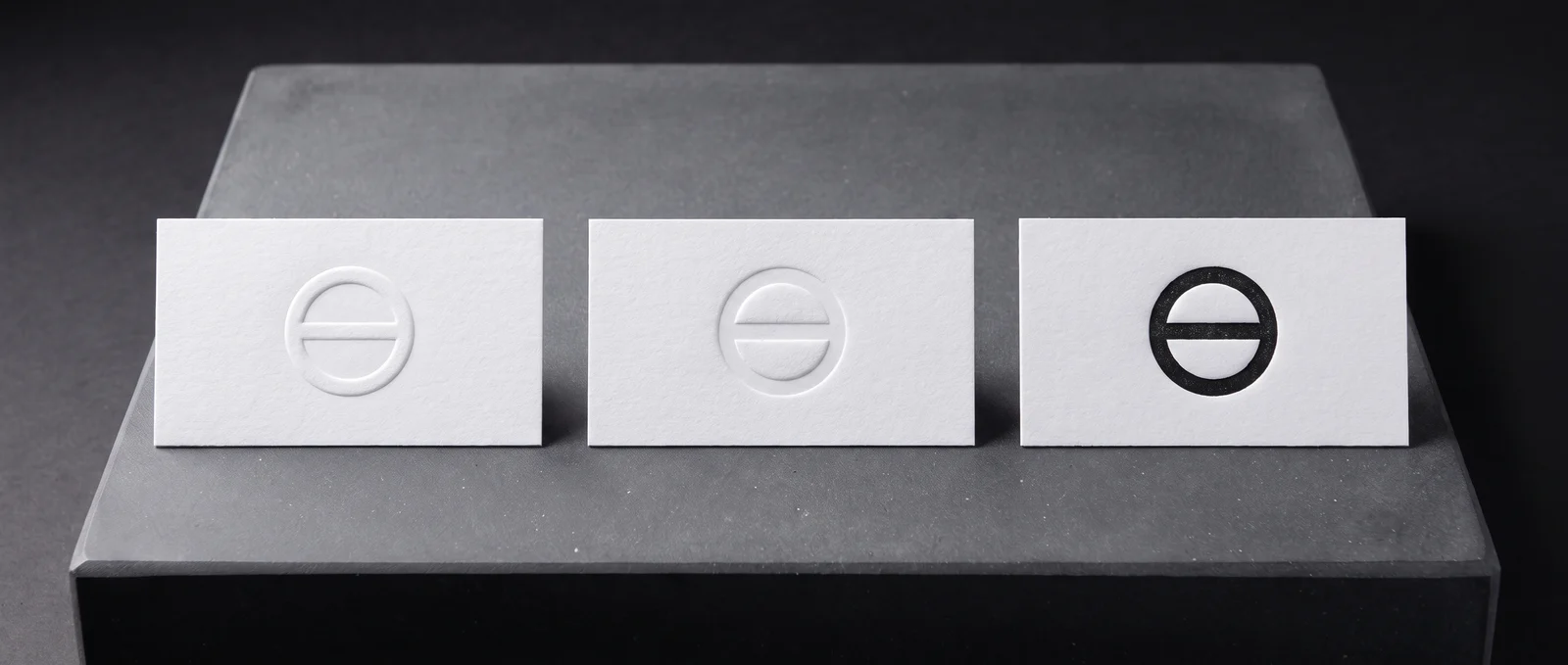
Three kinds of impression.
Emboss raises the sheet. Blind deboss presses it down with no colour. Letterpress prints colour inside a recess. They share pressure, not outcomes.
Start with the finish
See what emboss and letterpress does with your own brief.
Free · about two minutes
How it is made
Blind emboss uses a male-and-female pair to stretch the sheet upward. Blind deboss uses pressure to create a recessed mark without ink. Letterpress inks a plate before pressing it into the sheet, leaving colour in the recess. On cotton, ink sinks into the fibre and shifts with the stock; blind work has no colour to shift. Every raised impression creates a mirrored recess on the back unless the face is pressed before bonding to a backing ply.
Blind means no ink at all: the impression is the design. Letterpress is not blind when colour is present, however similar the shadow may look in one photograph.
What the screen cannot show
A screen flattens all three processes. The sample pack lets you compare raised paper, inkless recess and inked recess under the same light.
Hold the finish in your hand: order the sample kit →What it runs on
| Substrate | Verdict | Why |
|---|---|---|
| Uncoated & 100% cotton | Excellent | Raises cleanly, but the sheet must be thick enough to stretch without splitting at the shoulder. |
| Colour-through (dyed) stock | Excellent | Raises in the sheet's own colour, shadow doing all the work. |
| Recycled, kraft & inclusion stock | Excellent | Bulky fibre stretches willingly; fine detail softens. |
| Thick board, duplex & triplex | Good, tested | Emboss is done into a single ply before duplexing : raising bonded plies delaminates them. |
| Coated silk & matte stock | Good, tested | Coating can crack where the sheet stretches most; keep the relief shallow. |
Minimums and specs
- Emboss
- Raised · no ink
- Blind deboss
- Recessed · no ink
- Letterpress
- Recessed · inked
- Clean reverse
- Press before duplexing
Choose the process by the outcome
- Paper raised
- Emboss.
- Shadow only
- Blind deboss.
- Colour and bite
- Letterpress.
Pairs well with
Letterpress
A polymer or metal plate is inked and pressed into a soft sheet, leaving colour sitting in a visible impression rather than on top of a flat surface.
Blind deboss
A die presses the artwork into the sheet with no ink and no foil. The only thing you see is the depth: the surface reading differently where it's been compressed.
Emboss registered to foil
Foil supplies the reflection; emboss supplies the height. The two operations register to the same artwork but solve different physical jobs.
Seen in

Common questions
- Is blind deboss the same as letterpress without ink?
- They can use related equipment, but the specification differs: blind deboss is explicitly inkless topography; letterpress is an inked impression.
- Does emboss show on the back?
- Yes as a mirrored recess unless it is pressed into one ply before duplexing.
- Which process works best on cotton?
- All can, but cotton’s softness is especially useful for deep blind work and letterpress bite.