New: Peppermint Studio — Try it →

    Hot, raised and holographic foil

    Gold Foil Business Cards

    A metal film pressed onto the card with heat and a die. It flares gold when the card tilts, then goes dark, then flares again.

    Raised foil from US$ 105 for 100 · hot foil on cotton from US$ 310 for 250

    Raised foil ships 3–4 business days after proof approval; hot foil about 3 weeks (estimates).

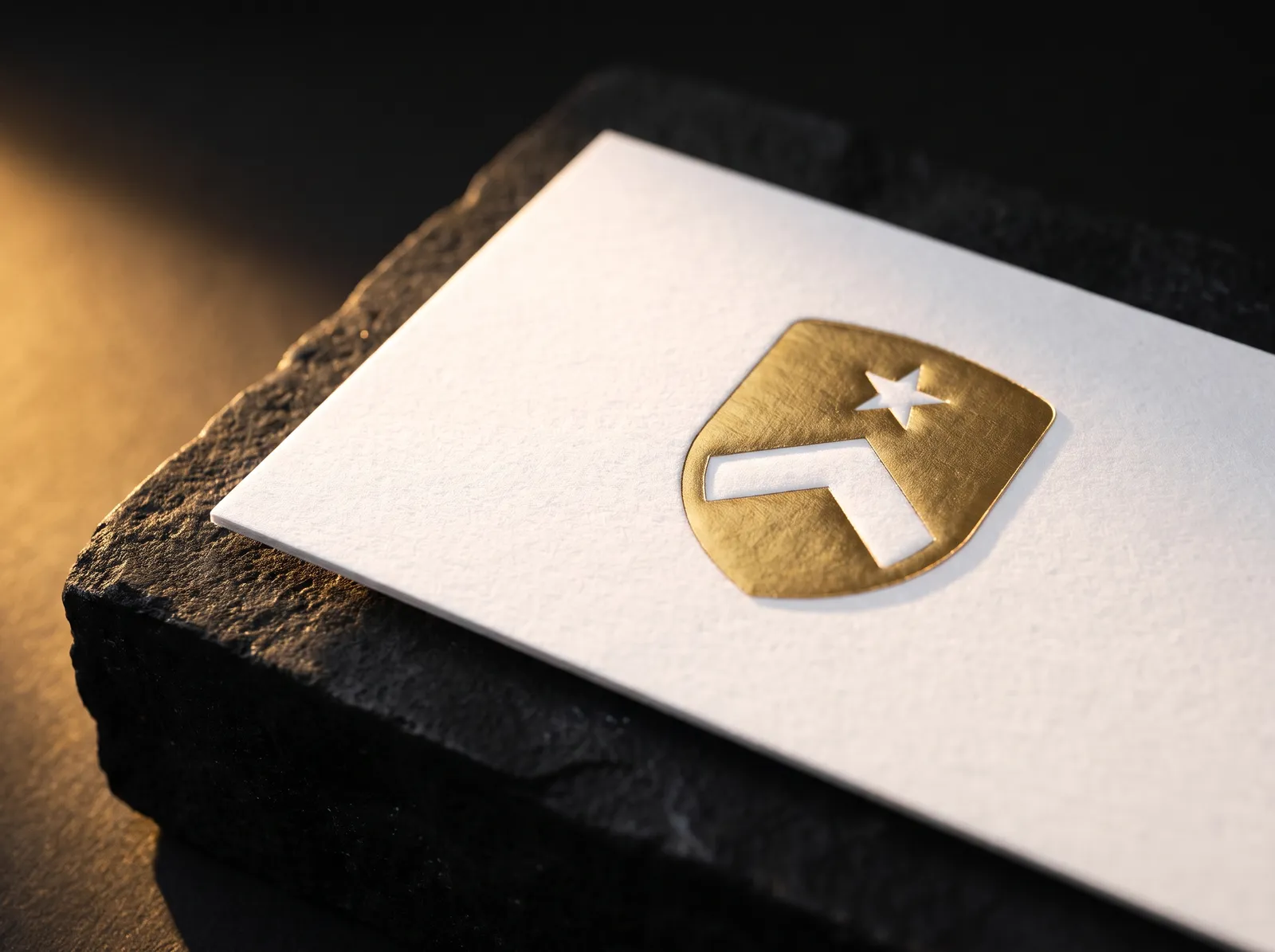
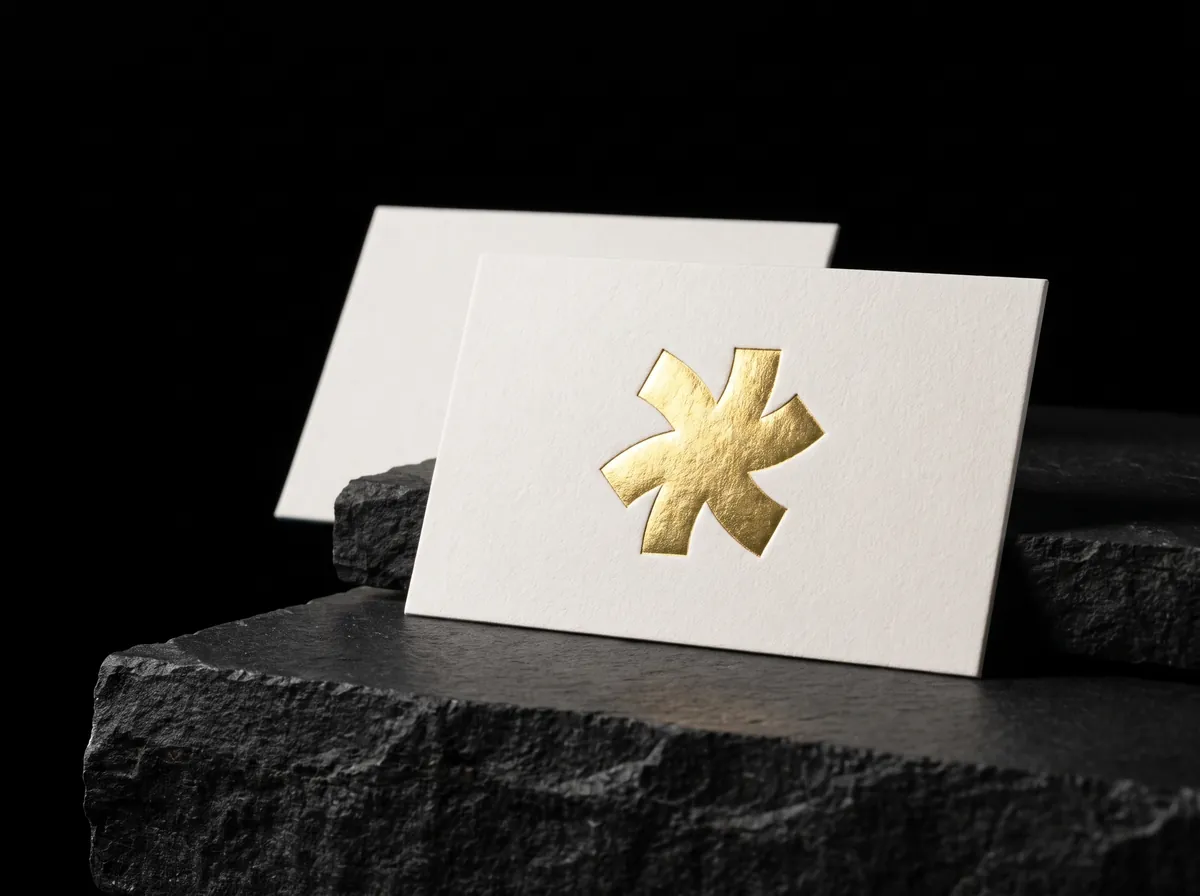
    Gold foil business card on 32pt white cotton: the Print Peppermint mark hot foil stamped, catching a raking light on black slate

    Gold foil business cards carry a metallic film bonded to the paper, pressed with heat and a metal die (foil stamping, also called foil press or foil blocking) or raised digitally with no die. Ours start at US$ 105 for 100 raised-foil cards, shipping in 3–4 business days after proof approval, or US$ 310 for 250 die-stamped on 32pt cotton in about 3 weeks.

    Methods
    Hot foil stamping (metal die) · Raised foil (digital, no die) · Holographic
    Papers
    32pt cotton, silk, black and coloured stock (hot foil) · 20pt soft touch (raised foil) · silk (flat foil)
    Foil colours
    Gold, silver, rose gold, copper, black, red, holographic on the configurator · 40 films on our swatch card · custom on request
    From
    US$ 105 for 100 · US$ 310 for 250 (hot foil)
    Lead time (estimate)
    Standard (raised and flat foil) ships in 3–4 business days; hot foil about 3 weeks; all after proof approval
    Minimum
    100 (raised, holographic) · 250 (hot foil) · 500 (flat foil)

    Prices checked 1 October 2026.

    Which foil option is right for you?

    We'd price your card with everything first, then scale back to the number that makes sense. Most people land in the middle.

    Full production

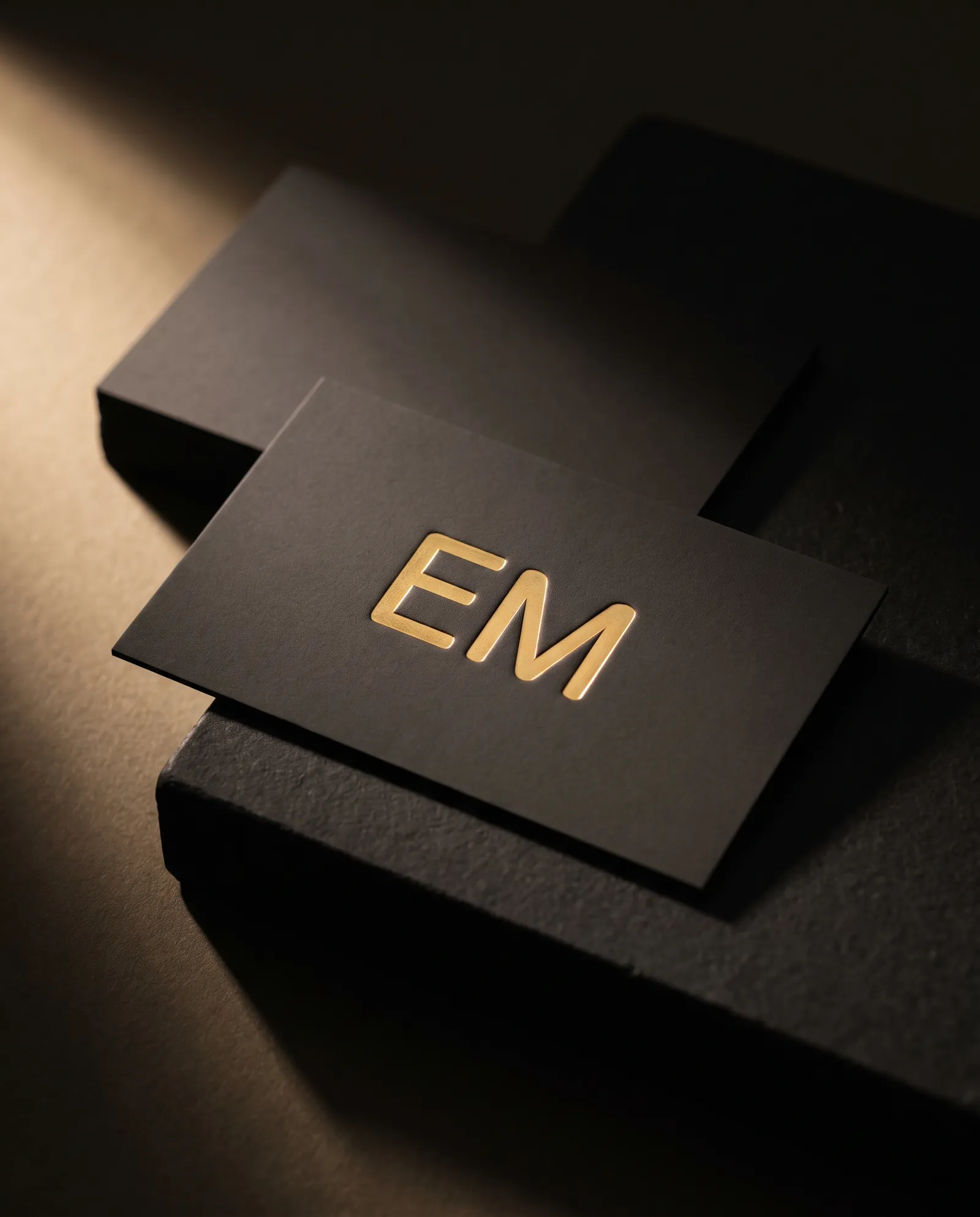
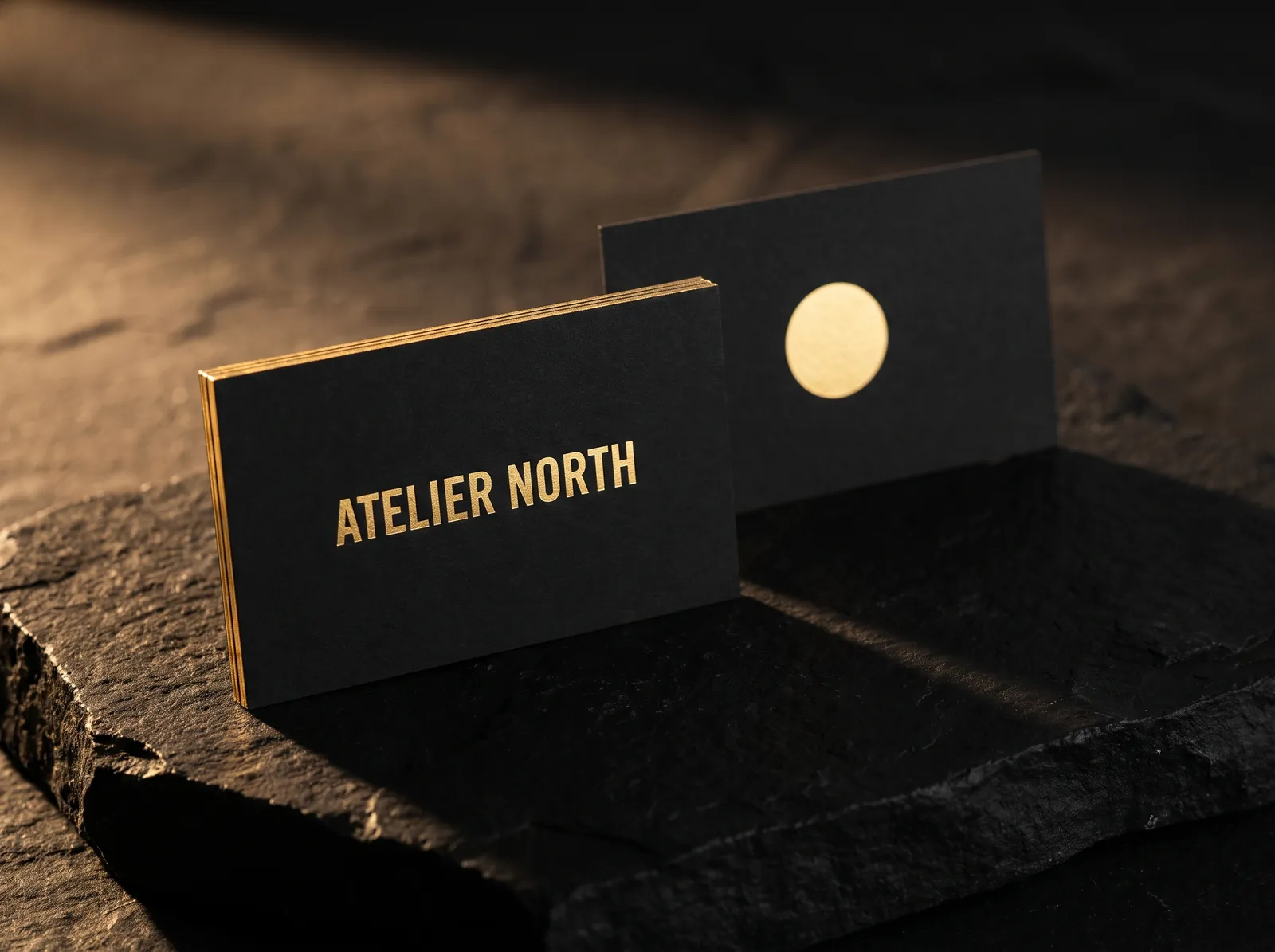
    Black business card with gold foil on both sides and gold foiled edges, square corners

    Gold on black, front, back and edges

    32pt black stock · gold hot foil front and back · gold edge foil · square corners

    The card glints from the side before anyone reads it. We cut it square for a crisp line; edge foil works with rounded corners too.

    Get a price · about 3 weeks

    Our pick

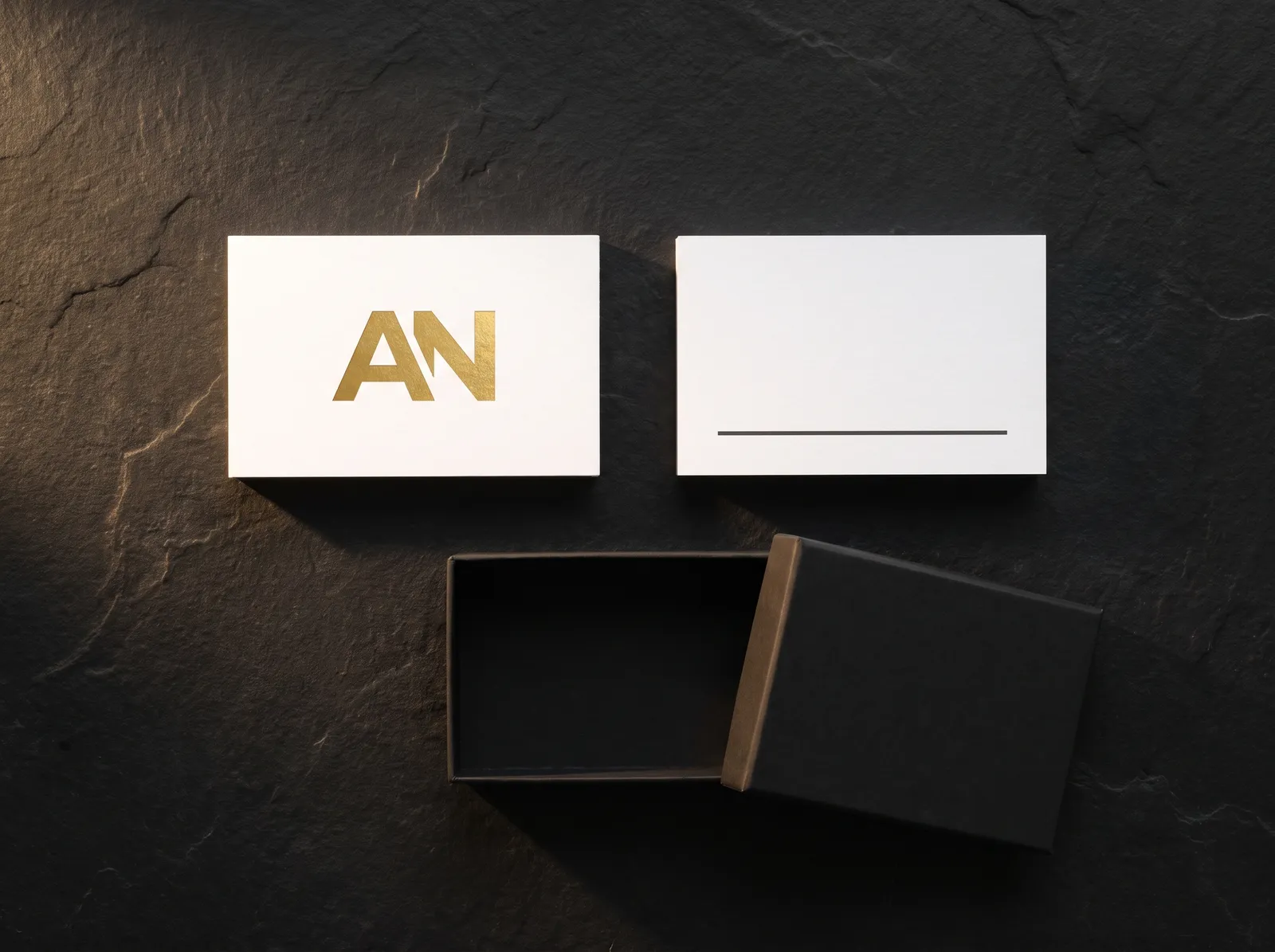
    White cotton card with a gold foil monogram, its printed back and a black card box in a flat lay

    Gold hot foil on 32pt cotton

    32pt cotton · one foil colour, front · back printed or left clean

    Soft cotton takes the die a hair deeper than coated stock, so the foil sits in a shallow bite you can find with a thumbnail. It's the one we recommend most.

    From US$ 310 for 250 · US$ 410 for 500 · about 3 weeks

    Essential

    Raised gold foil business card on soft touch stock, foil standing proud of the surface

    Raised foil on soft touch, Standard

    20pt soft touch · raised gold, silver or holographic · one foil colour · square corners only

    Raised foil is laid digitally, so there's no die to make. That's why it can run at 100 cards and ship in 3–4 business days after proof approval.

    From US$ 105 for 100 · US$ 145 for 250

    Need 500+ fast and flat? Flat foil on silk, from US$ 210 for 500, ships in 3–4 business days →

    Not sure which? Feel all three in the sample pack →

    The shine comes from a metal die and pressure, not from ink

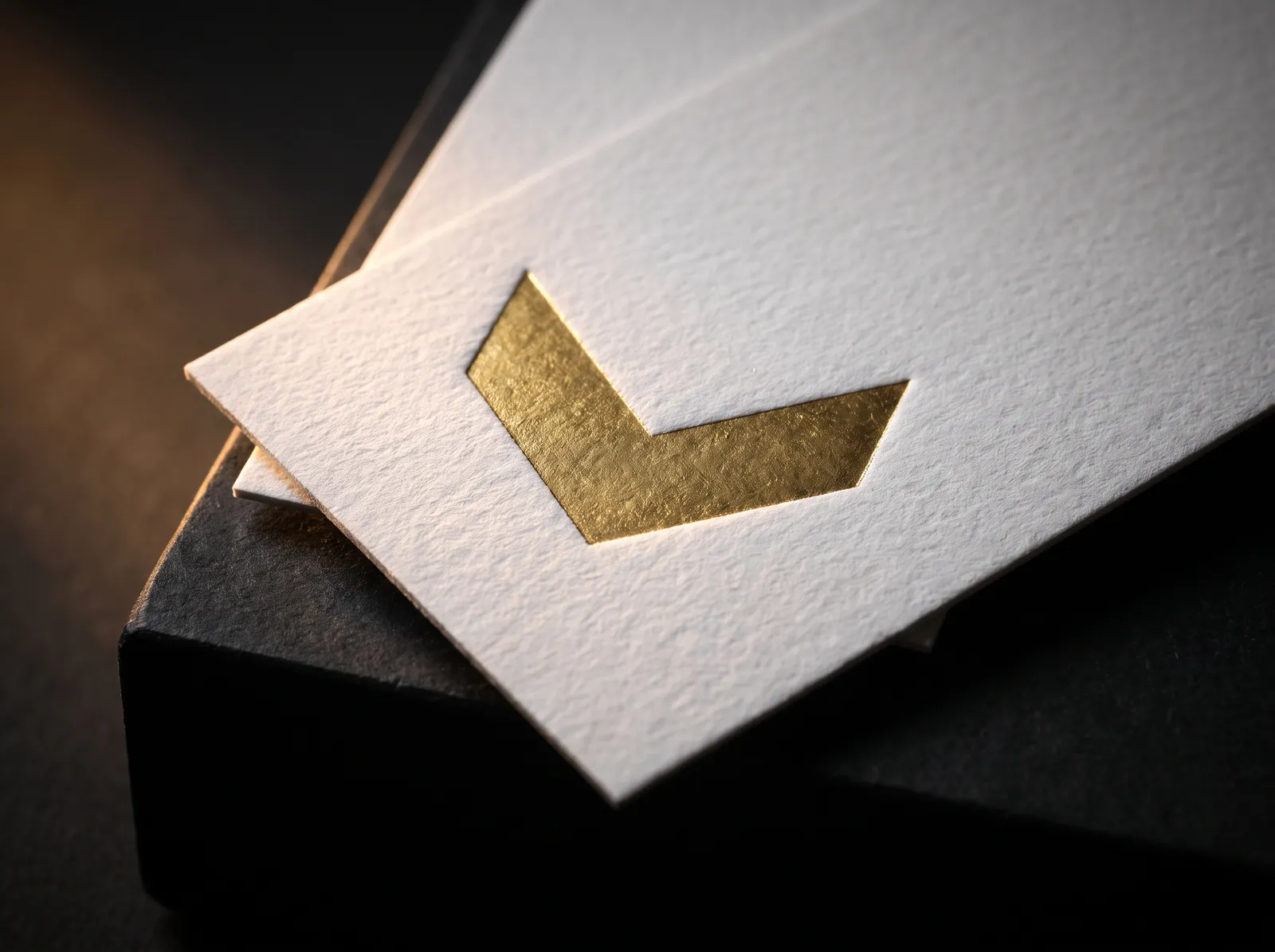
    Macro of gold foil stamped into white cotton paper, light catching the edge of the slight bite
    Hot foil on cotton at roughly 5× magnification.

    Pick up a foil card and you notice the weight before the gold. A 32pt cotton card is about as stiff as a credit card, soft at the edge, with a faint tooth under your fingertip. Run your thumb over the mark and you feel a step down where the die pressed the foil in.

    Now tilt it. Printed ink looks the same from every angle. Foil is a mirror cut into the shape of your logo, so it flares bright, drops to almost black, and flares again as the light moves. That's the moment people turn the card over to see what else it does.

    Watch foil move: our 2016 foil embossed business cards clip

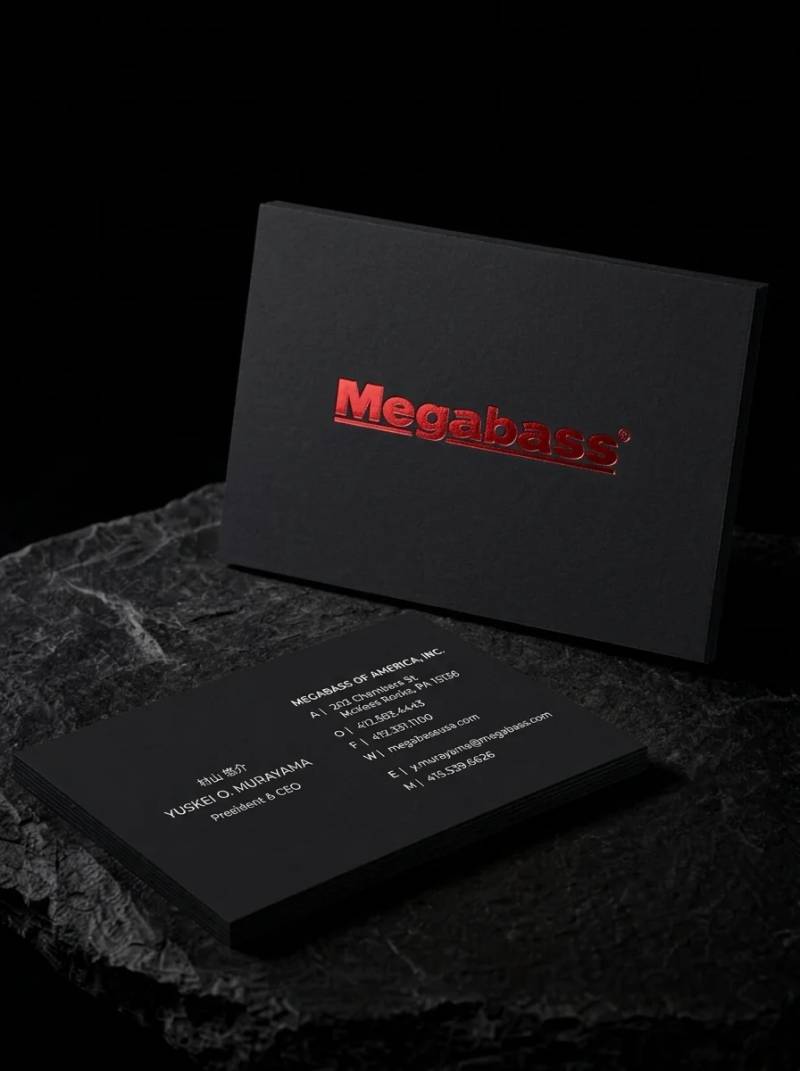
    Black-on-black foil and silver foil stamped on uncoated black stock, with an emboss. Black foil on black paper reads as a sheen, not as contrast: lovely for a quiet mark, wrong for a phone number.

    The 21-minute version: Austin on gold foil vs metallic ink vs cold foil →

    The one thing that ruins gold foil (and two that come close)

    None of these shows up in a render, and all three show up on press. We catch them at proof, before a die is made, and tell you in one line what changed.

    A gradient will come back as one solid tone of foil

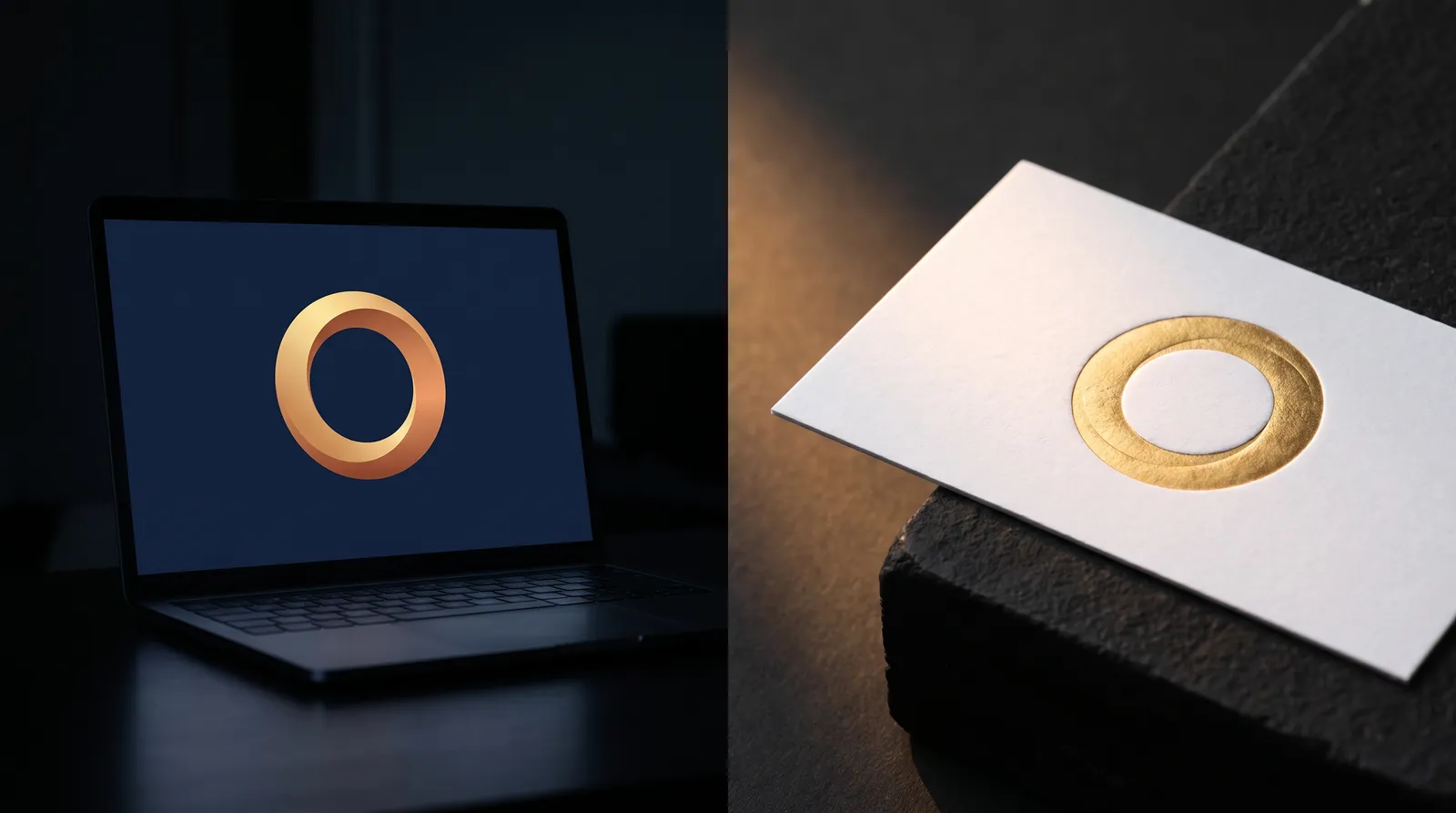
    A die either presses foil or it doesn't. There's no 30% gold. Send a logo that fades from light to dark, or a mockup with shading in the gold, and the whole shape stamps as one flat tone. So we rebuild the mark as solid shapes before anything is cut. If the gradient is the idea, we print it in ink and keep the foil for a solid element beside it.

    Left, a logo with a gold gradient on screen; right, the same logo stamped in a single flat tone of gold foil
    What a render promises vs what a die presses.

    Fine lines welcome

    Fine detail survives foil: lines hold to 0.1 mm; we design to 0.15 mm, with gaps inside letters around 0.25 mm. Foil type stays at 7 pt or larger (10 pt reversed). We adjust only below-floor details, preserving your mark.

    QR codes never go in foil

    Foil glares in a phone camera, and its edges spread just enough to blur the modules. Every QR code we print is flat dark ink on a light ground, at least 2 cm across, with foil kept 1 mm clear of it. We scan it at proof.

    • · Foil can't sit on top of ink; we knock the ink out underneath and leave a clean 1 mm gap.
    • · Two foils sit side by side, never stacked.
    • · Holographic foil needs a smooth sheet to throw its rainbow, so on textured cotton it looks softer than the sample.

    Check your file against these: Foil artwork: line and gap minimums →

    Setting up your file

    What is foil stamping?

    Foil stamping is heat, pressure and a metal die. The die is cut from your artwork, heated, and pressed through a roll of foil onto the card. The heat releases the metal film from its carrier and the pressure bonds it to the surface. On a soft stock like cotton it leaves a slight bite. On a smooth sheet it sits flat and bright.

    How foil stamping works, pass by pass → · The complete guide to foil stamping →

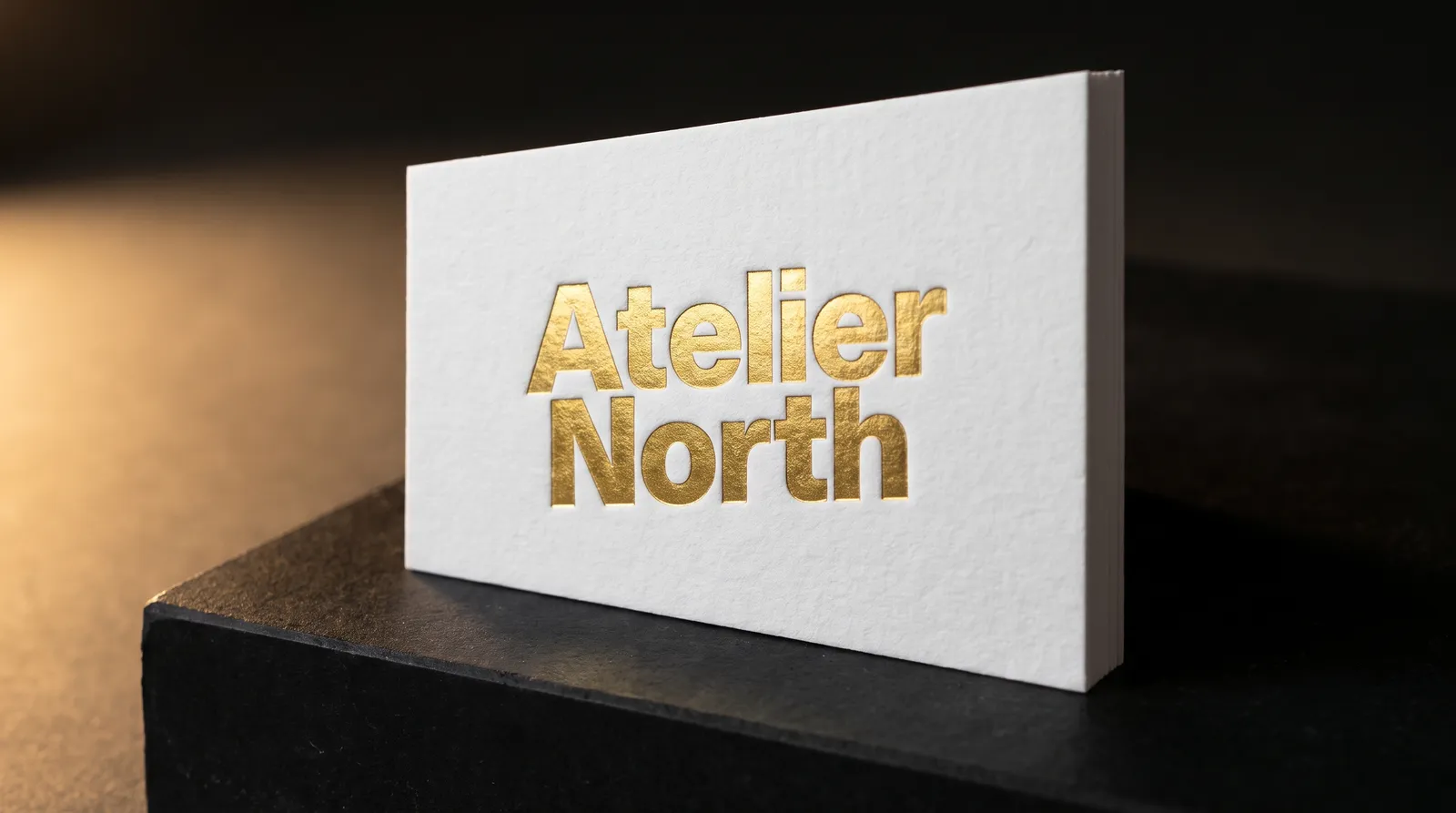
    Gold foil business card on 32pt white cotton, foil wordmark catching a raking light on a black stone plinth

    Hot foil stamping

    The classic. A custom die presses one flat tone of metallic foil onto the card: gold, silver, rose gold, copper, black, red or any of the 40 films on our swatch card. It works on 32pt cotton, silk, black and coloured stock, front and back. Each colour on each side is its own die and its own press pass, which is why one foil on the front is the best value.

    Can't: gradients, hairlines under 0.1 mm, QR codes.

    Custom hot foil stamped business cards →

    Raised gold foil standing proud of a matte soft touch business card, side light showing the dome

    Raised foil

    Instead of pressing down, raised foil builds up. A clear raised layer is printed first and foil is laid on top, so the shine rides on a slight dome you can catch with a fingernail. No die means it's fast and fine at 100 cards. It comes in gold, silver or holographic, one colour per design, on 20pt soft touch.

    Can't: rounded corners on this line, a second foil colour, cotton.

    Raised foil business cards →

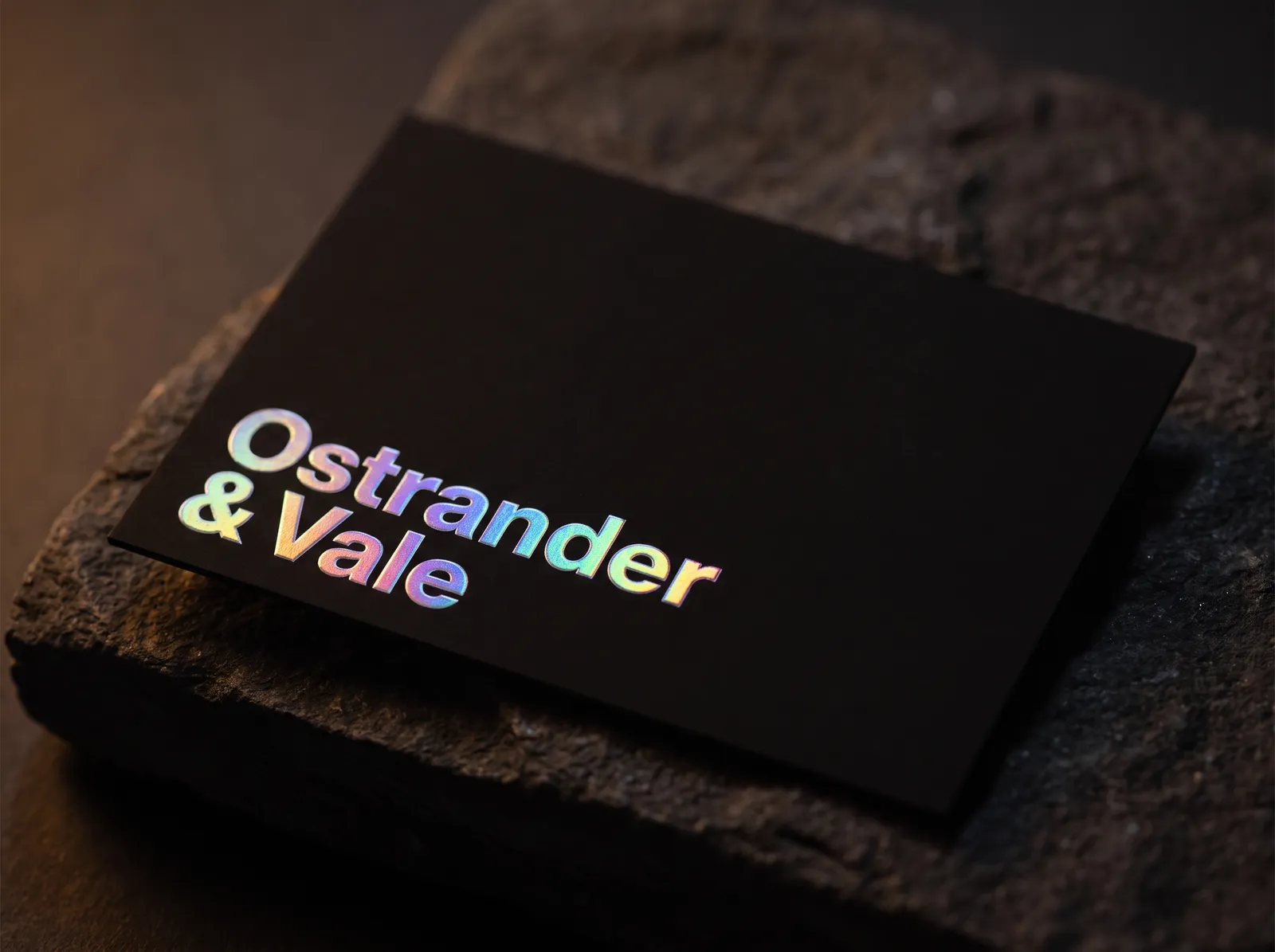
    Holographic foil business card on black soft touch, rainbow foil shifting colour as the camera moves

    Holographic business cards

    Holographic foil splits light into a rainbow that slides across the mark as the card turns. It's strongest on a bold shape and a smooth sheet. On thin script it can turn to glitter-noise, and on textured cotton it goes soft. We run it as raised holographic on soft touch for speed, or hot-stamped on smooth stock as a Custom build.

    Holographic business cards →Holographic foil, explained →

    Gold foil embossed business card, the foiled logo raised on white cotton, side light

    Foil embossed business cards

    For gold foil embossed business cards, where the foil has to sit exactly on a raised shape, we cut one combination die that embosses and foils in a single hit, so the gold lands precisely on the relief. You can also foil into a deboss, so the mark sinks and shines. On a single sheet an emboss leaves a mirror image on the back, so if the back carries type we bond two sheets.

    Embossed business cards →

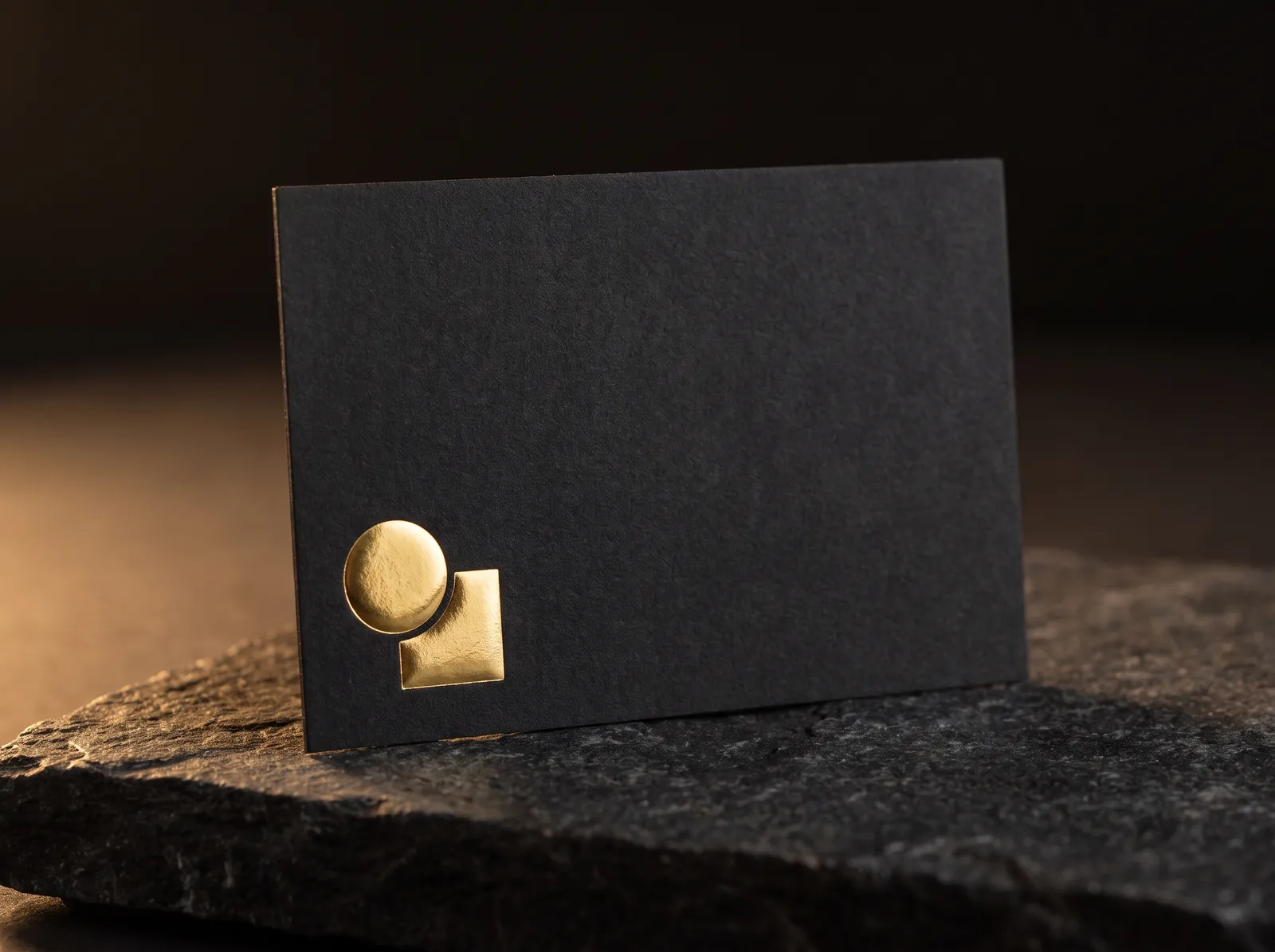
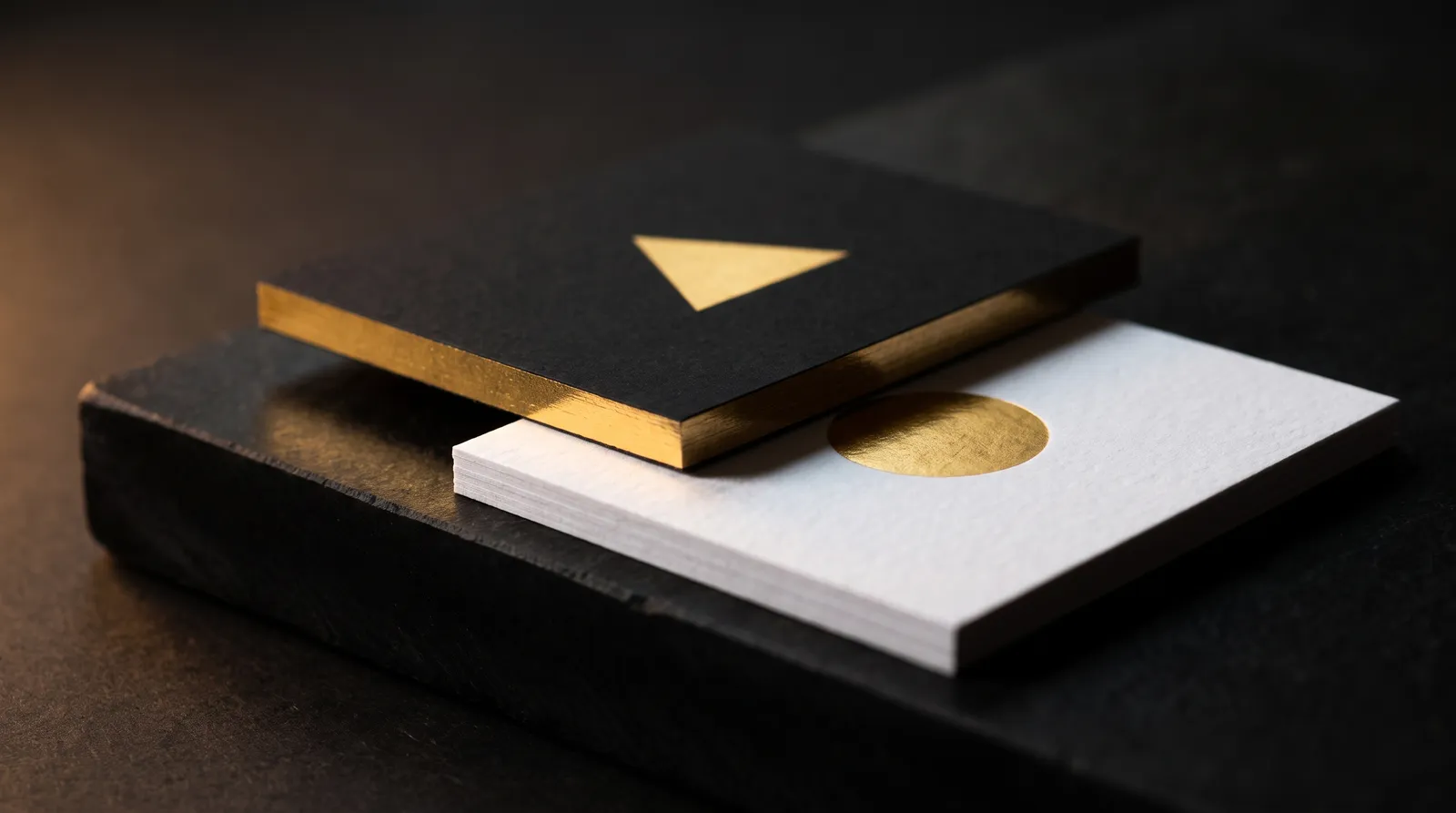
    Black business card with gold foil face and gold foiled square edges resting on a white cotton card with gold hot foil

    Foil on black and dark stock

    Ink sinks into black paper and nearly disappears. Foil doesn't: it's an opaque film, so gold and silver stay bright on the darkest sheet. For solid white on black we use white pigment foil, which reads like ink with no shine. One honest note: black foil on black paper is a sheen you see only at an angle.

    Black and gold business cards →

    Foil colours: gold, silver, rose gold, copper, red and more

    The configurator carries gold, silver, rose gold, copper, black, red and holographic. Behind those sit the 40 films on our swatch card, among them metallic blue, purple and green, blush pink, and white pigment, so red, blue and pink foil business cards are covered as well as the metals. Behind those sit 300+ in the full collection. Choose from a physical swatch, in daylight, against the paper you'll use: screens are terrible at metallics. Whatever you pick is named in full on your quote, so a reprint years from now can run in the same foil, not a close cousin.

    Looking for gold leaf business cards? What most printers sell as gold leaf is gold foil: a metallised film, pressed on with a die. It gives the gold-leaf look without flaking off in a wallet. Read the answer

    Gold vs silver foil: which suits your brand → · Browse every foil we run →

    Custom foil colours

    Most custom gold foil business cards use a gold from the swatch card. When nothing there matches your brand, we can look for a foil roll closer to it and show you the actual roll before we commit, because a metallic never looks the same in a file as it does in the hand.

    Ask about a custom foil

    Gilded edges

    Foil can run around the edge of the card, too, with square or rounded corners. It needs a thick card to show: 32pt at least, 48pt for a real band of gold. On cotton, our press team confirms it before we promise it.

    Gold edge gilding →

    Specs we run most often, priced

    See your logo in gold foil before you order

    Upload your logo and our Studio returns a few production-real directions in minutes: foil colour, paper and finish, laid out on a card. It's a rendering, not a proof. Gradients get flattened, fine lines get thickened, and a person rebuilds the file before anything is pressed. But it's the fastest way to see your mark shine.

    How much do gold foil business cards cost?

    Gold foil printing is priced by the die and the press pass, so the price per card falls quickly as quantity rises. Here's every live price, side by side.

    Per-card price under each total. All times run from proof approval, plus shipping. "—" means not offered at that quantity. Prices checked 1 October 2026.
    Build1002505001,000Lead time (estimate)
    Raised foil on 20pt soft touch, front (Standard)US$ 105US$ 1,05/cardUS$ 145US$ 0,58/cardUS$ 190US$ 0,38/cardGet a priceShips in 3–4 business days
    Holographic raised foil, front (Standard)US$ 105US$ 1,05/cardUS$ 145US$ 0,58/cardUS$ 190US$ 0,38/cardGet a priceShips in 3–4 business days
    Flat foil on silk, front (Standard)——US$ 210US$ 0,42/cardUS$ 235US$ 0,23/cardShips in 3–4 business days
    Hot foil on 32pt cotton, one foil, front (Custom, our pick)Get a priceUS$ 310US$ 1,24/cardUS$ 410US$ 0,82/cardUS$ 620US$ 0,62/cardAbout 3 weeks
    Gold on black, both sides + edge foil (Custom, full build)Get a priceGet a priceGet a priceGet a priceAbout 3 weeks

    Custom hot foil: second side (get a price), embossing +US$ 80, edge foil +US$ 60, rounded corners +US$ 10. Standard raised foil: second side (get a price).

    • The number of foil colours and sides. Each colour on each side is its own die and press pass, so consolidating saves real money.
    • Quantity. The die costs the same at 250 as at 2,000.
    • The stock. 32pt cotton and black cost more than 20pt soft touch.
    • Extra processes, such as an emboss, edge foil or rounded corners.

    A full breakdown: how much do foil business cards cost? →

    Hot foil, raised foil, metallic ink or metal: which one?

    Hot foil (Custom)Raised foil (Standard)Flat foil on silk (Standard)Metallic inkMetal card
    How it's madeHeated metal die presses foil onto the stockRaised layer printed, foil laid on top, no dieFlat foil on smooth silkInk with metallic pigmentLaser-engraved or etched steel
    How it feelsA slight bite on cotton; foil flush or sunkA dome you can catch with a fingernailFlat and smoothFlat; you can't feel itCold, heavy, rigid
    ShineMirror or matte, flares with the angleBright, glossyBrightA soft satin shimmer, never mirrorPolished or brushed metal
    PapersCotton, silk, black, coloured, 32pt20pt soft touchSilkCoated or uncoated (dulls on cotton)Stainless steel
    Colours7 on the configurator, 40 on the swatch, customGold, silver, holographic (one per design)6Pantone metallicsSteel finishes and colour fill
    Price, entryUS$ 310 for 250US$ 105 for 100US$ 210 for 500Not sold as a card lineSee metal business cards
    Lead time (est.)About 3 weeksShips in 3–4 business daysShips in 3–4 business daysn/aSee metal page
    Where it winsCotton, black stock, embossing, more than one colourSpeed, 100-card runs, a tactile look on a budgetLarge quantities at the lowest per-card priceA shimmer on a printed photo or patternDurability and weight
    Where it losesSlowest; needs a dieOne colour, no rounded corners, no cottonNo texture, thinnerNo real reflectionPrice, no paper processes

    Metallic ink and foil are not the same thing: if you want real reflection, it's foil. Hot foil vs digital foil, the full comparison

    Foil business cards we've printed

    Real client cards, already published as case studies. Each one shows the spec, and the link takes you to the full story.

    All case studies →

    How we print foil business cards

    1. 1. Configure or brief us. Pick paper, foil and quantity in the configurator, or describe the card in the Studio.
    2. 2. A person checks your file. A designer rebuilds the foil layer as clean vector, checks House Spec v2, adjusting only lines under 0.1 mm and sends a free digital proof. You see exactly what will be stamped.
    3. 3. You approve. Nothing is cut or pressed until you do. Changes to the proof are part of the service.
    4. 4. Production. For hot foil, the die is cut from your approved artwork and the foil is stamped. Raised foil is laid digitally, with no die. Then the cards are cut and packed. Standard raised and flat foil: ships in 3–4 business days. Custom hot foil: about 3 weeks. All estimates, from approval.
    5. 5. Shipping. Free shipping within the continental US; we ship to 30+ countries.
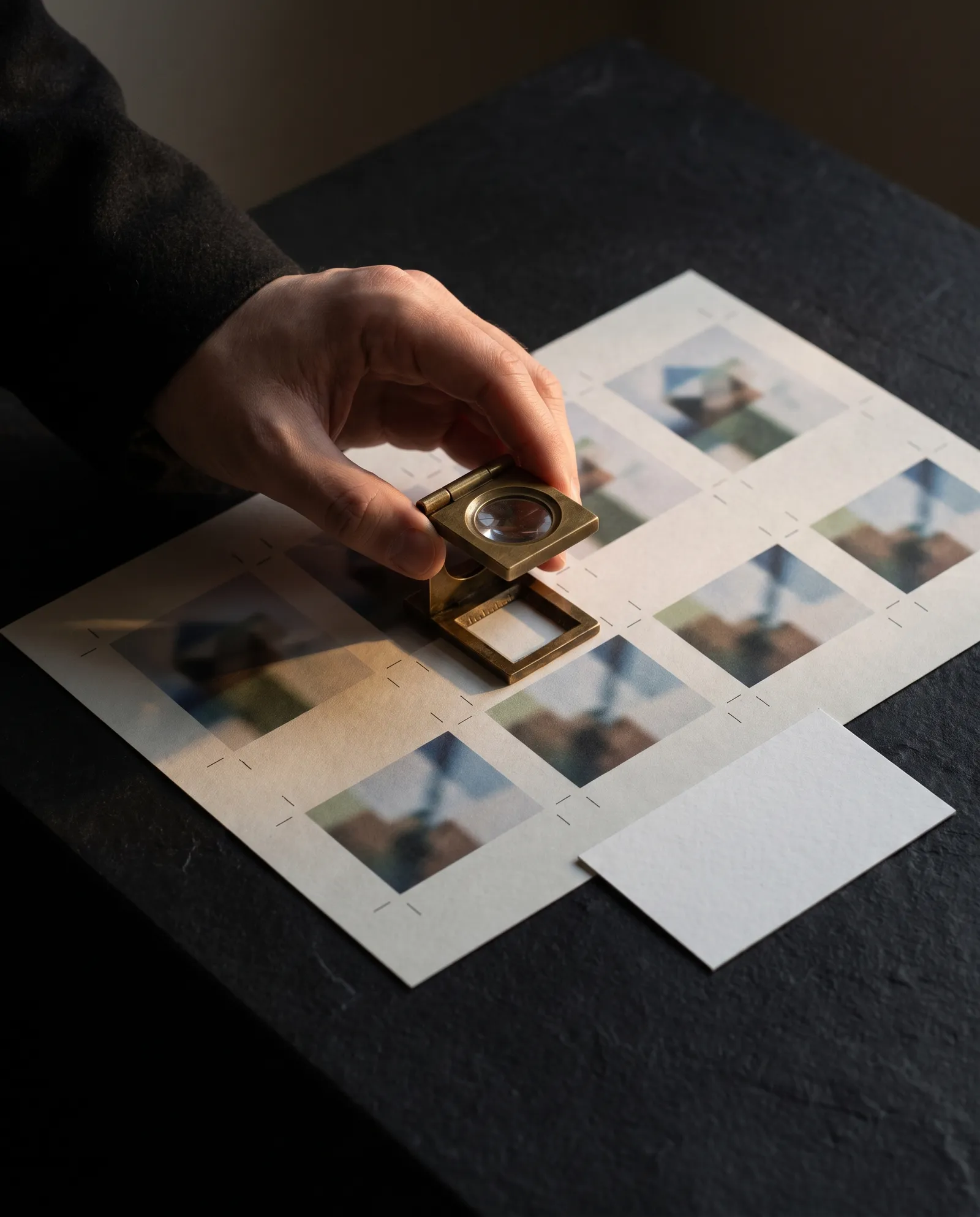
    Hands holding a loupe over a printed business card proof sheet

    If you're not happy, we reprint. How reprints work

    Proofing and approval → · Turnaround and shipping →

    Hold the foil before you decide

    Sample pack · US$ 8.

    Hot foil, raised foil and edge work in your hand, plus our foil swatch card: 40 stamped films to hold against your own paper and light. You get US$ 10 off your first order.

    15 minutes with Austin.

    Bring a logo or a photo of a card you liked, and he'll tell you whether it foils cleanly, what it costs, and what he'd change.

    Free proof.

    A person checks your file and shows you the foil layer before anything is pressed. You approve it or it doesn't print.

    Ready to price yours?

    Print Peppermint is a specialty print studio founded by Austin Terrill. It makes foil, letterpress, metal, plastic, NFC and cotton cards, wedding stationery and packaging, proofed by a person, shipped to 30+ countries.

    Foil business card questions

    How much do gold foil business cards cost?

    Raised gold foil on 20pt soft touch starts at US$ 105 for 100 and US$ 145 for 250. Die-stamped gold foil on 32pt cotton starts at US$ 310 for 250 and US$ 410 for 500. The die is a fixed cost, so the price per card drops quickly as quantity rises. Adding a second side, a second foil colour or edge foil adds a die and a press pass each.

    Are gold leaf business cards real gold leaf?

    Almost never, and ours aren't. “Gold leaf business cards” usually means gold foil: a thin metallised film pressed onto the card with a heated die, so the gold is bonded to the paper and won't flake in a wallet. Real gold leaf is beaten metal laid by hand with adhesive, and it isn't practical on a card people carry. Foil gives the same mirror or matte gold look.

    What is a foil accent business card?

    It's a card where foil is used on one element, usually the logo, the name or a single line, and the rest is printed or left blank. It's the most effective way to use foil: one bright element draws the eye, and you pay for one die. On our cards a foil accent can be gold, silver, rose gold, copper, red, black or holographic.

    Is foil blocking the same as foil stamping?

    Yes. Foil blocking is the British term, and foil press and hot foil stamping mean the same thing. A heated metal die presses foil from a roll onto the paper. Raised foil and digital foil are different: they're laid without a die, which makes them faster at small quantities but limits the papers and colours.

    Will foil work on black or dark card stock?

    Yes, it's the best way to put metal or light colour on dark paper. Ink sinks into black stock and almost disappears, while foil is an opaque film that stays bright. For solid white on black we use white pigment foil. Black foil on black paper is the exception: it shows only as a sheen at an angle, so we don't use it for anything that has to be read.

    Can I foil both sides of the same card?

    Yes. Each side needs its own die and press pass, which is why the second side adds to the price on both Custom hot foil and raised foil; the configurator shows the exact amount. On thick cards it's straightforward. If both sides carry heavy foil coverage or an impression, we bond two sheets so one side doesn't press through to the other.

    How small can foil detail go?

    Fine detail survives foil: lines hold down to 0.1 mm. We design to 0.15 mm for the crispest strike and keep internal gaps around 0.25 mm. Foil type stays at 7 pt or larger, 10 pt reversed; only detail below the floor needs a local adjustment.

    Can a gradient or shaded logo be foil stamped?

    No. Foil is one solid tone per die, so a gradient stamps as one flat colour. We rebuild the mark as solid shapes before the die is cut. If the shading matters, we print it in ink and keep the foil for a solid element, or split the design across two foil colours that sit side by side.

    Can I put a QR code in gold foil?

    No. Foil glares in a phone camera and its edges spread enough to blur the code. We print every QR code in flat dark ink on a light ground, at least 2 cm across, keep foil at least 1 mm away from it, and scan it at proof.

    How long do foil business cards take?

    Raised, holographic and flat foil (Standard) ship in 3–4 business days after you approve the proof, and die-stamped Custom hot foil takes about 3 weeks, plus transit. These are estimates, not delivery guarantees. If you have a date, tell us when you order and we'll say honestly which line can make it.

    Is metallic ink the same as foil?

    No. Business cards with metallic print use ink with metallic pigment, which gives a soft satin shimmer, and on cotton it dulls further. For a metallic finish with real reflection, you want foil: a metallised film that throws light like a mirror (or like brushed metal, with matte foil) and changes as the card moves. If you want shine you can see across a table, it's foil.

    How much should I pay for 500 foil business cards?

    With us, 500 cards cost US$ 190 in raised foil on soft touch, US$ 210 in flat foil on silk, or US$ 410 die-stamped on 32pt cotton. The difference is the stock and the process: cotton and a real die cost more, and you can feel why.
    More ideas: modern business cards

    Who orders these: tattoo artists, illustrators and photographers. See our artist business cards.

    Who orders these: notaries and signing agents who want their name in gold foil. See our notary business cards.