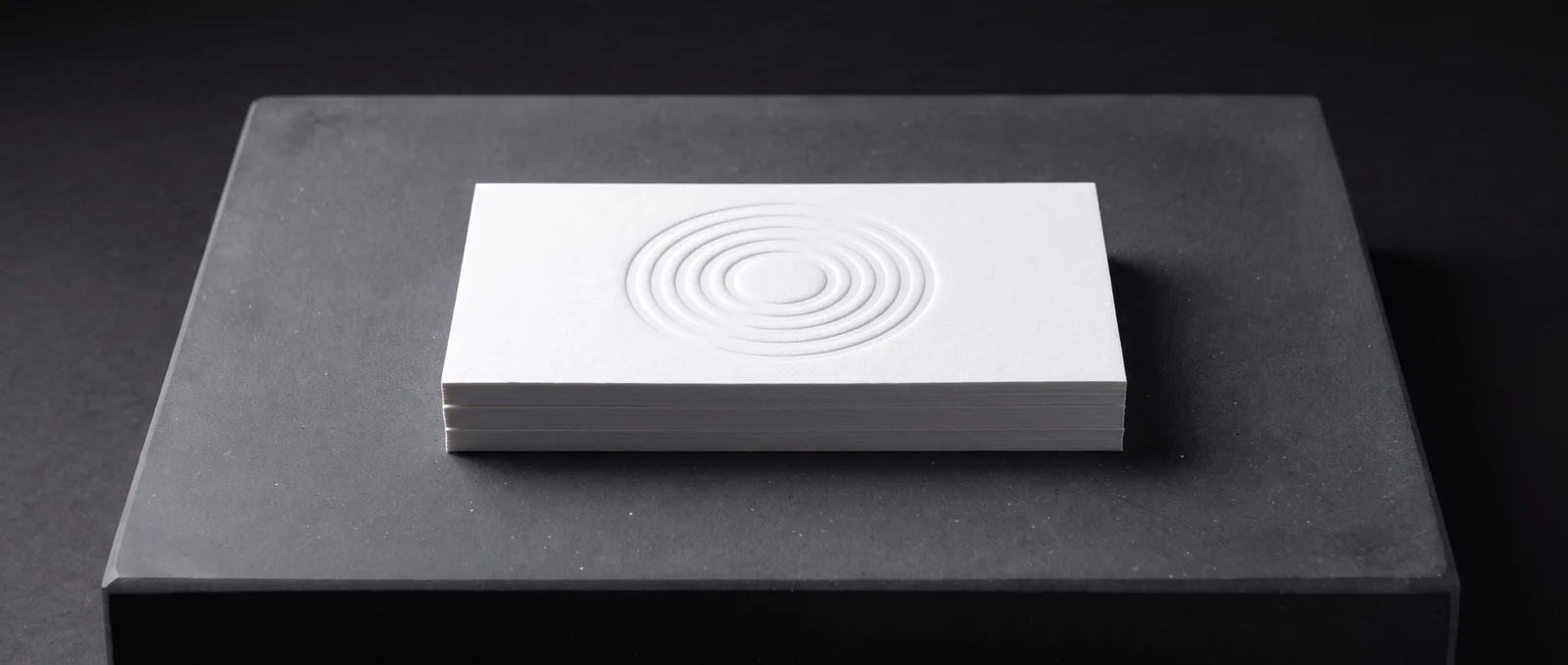
The design, with nothing on it.
A die presses the artwork into the sheet with no ink and no foil. The only thing you see is the depth: the surface reading differently where it's been compressed.
Start with the finish
See what blind deboss does with your own brief.
Free · about two minutes
48pt duplex cotton·Blind deboss
Soft-touch laminate·Shallow deboss
Black vs grey uncoated·Blind deboss
White cotton·48pt·Deboss macro
How it is made
The cheapest-looking brief and one of the hardest to do well, because the entire effect is topography. It needs a thick, soft, uncoated sheet: 32pt cotton and above: and it needs generous shapes; fine detail disappears into the compression. Deep bite on heavy duplex is where it sings, and it costs one plate with no ink and no make-ready colour matching, which makes it one of the best value-per-impression finishes we run.
An emboss always shows on the back of the sheet it's pressed into, as a mirrored impression. To keep a clean back, emboss one sheet and mount a second behind it, or switch to a deboss: on 32pt / 0.8 mm and thicker, a deboss generally does not reach the back: and on a duplex sheet the second ply backs it entirely, so you can deboss one face and leave the other clean. Like foil, this is invisible to a flat scan: it only appears under raking light, which is why every photograph here is lit from one low angle.
What the screen cannot show
A screen physically cannot show this finish. It is a reflection, not a colour, and every image on this page is light hitting a surface at one chosen angle.
Hold the finish in your hand: order the sample kit →What it runs on
| Substrate | Verdict | Why |
|---|---|---|
| Uncoated & 100% cotton | Excellent | The house answer for quiet work. No ink at all : the mark exists only as depth, and cotton holds it sharply. |
| Thick board, duplex & triplex | Excellent | Maximum depth. On 32pt and up you can run a bite you can read with your eyes shut. |
| Colour-through (dyed) stock | Excellent | A dyed sheet debosses into its own colour, so the mark reads as shadow rather than as a second tone. |
| Coated silk & matte stock | Good, tested | You get a shallow mark and the coating can crack along the edge of a tight counter. |
Minimums and specs
- Minimum stroke
- 0.5 mm (1.5 pt)
- 1 mm gaps
- Minimum type
- 10 pt
- Counters
- Generous
- Thin enclosed shapes fill in
- Tooling
- 1 die
Choose the process by the outcome
- Same effect with colour
- Letterpress.
- Raised instead of recessed
- Emboss: account for the reverse face.
- Subtle luxury on a thin sheet
- Don't; specify a thicker stock.
Pairs well with
Foil stamping
A heated die transfers a metallic film onto the stock under pressure. Not printed, not simulated: a layer of metal with an impression around it.
Letterpress
A polymer or metal plate is inked and pressed into a soft sheet, leaving colour sitting in a visible impression rather than on top of a flat surface.
Edges and thickness
Paint adds colour, foil adds reflection, and duplex or triplex adds real plies. Choose the edge and construction together, not as interchangeable effects.
Seen in
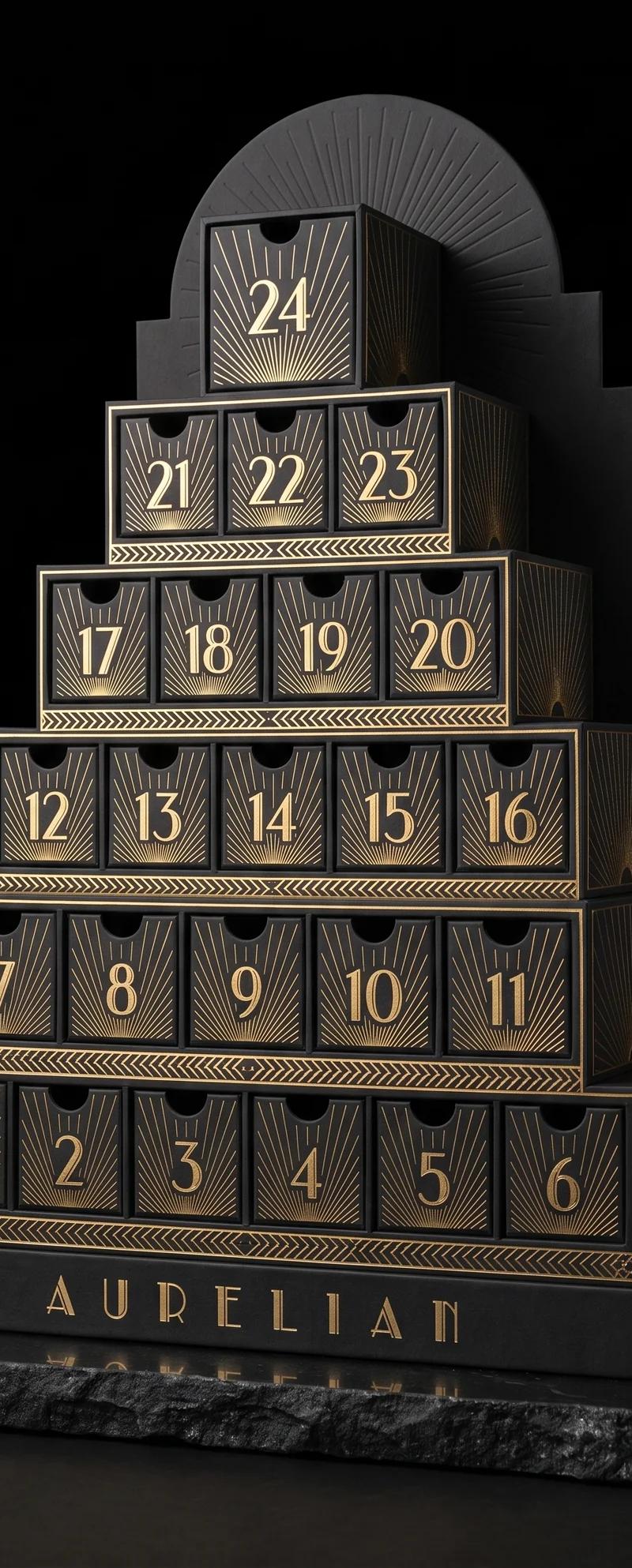
Peppermint design exploration
One brief, twelve design movements: the same 24 days, built the way each era would have built them, from papers and foils we actually stock.
Read the project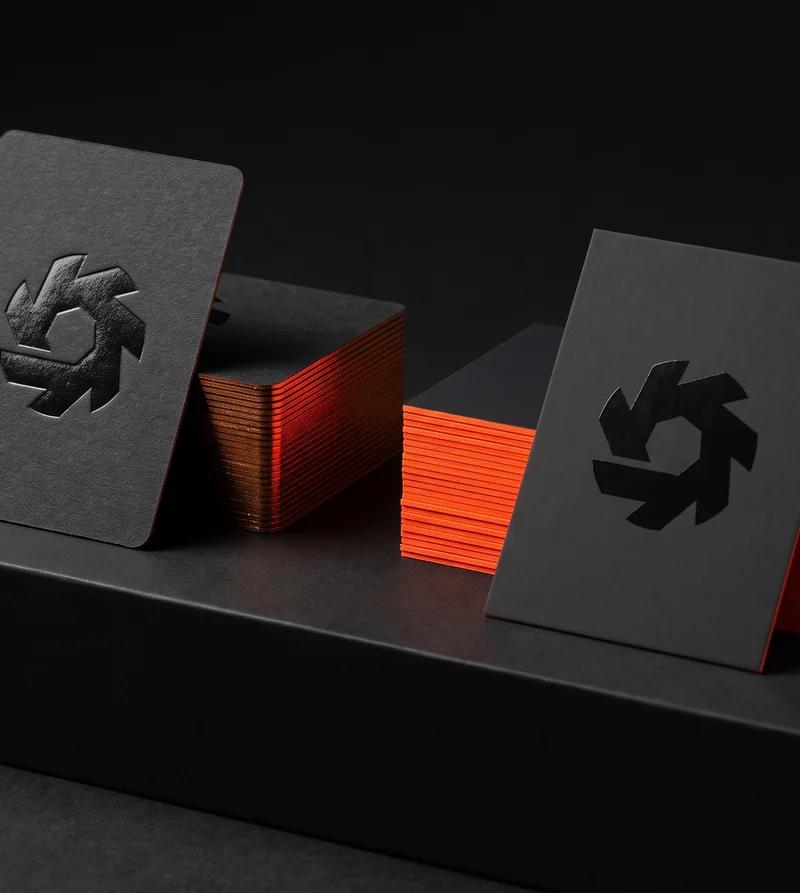
Soundtoys
The deboss wanted one paper. The neon edge wanted the other.
Read the project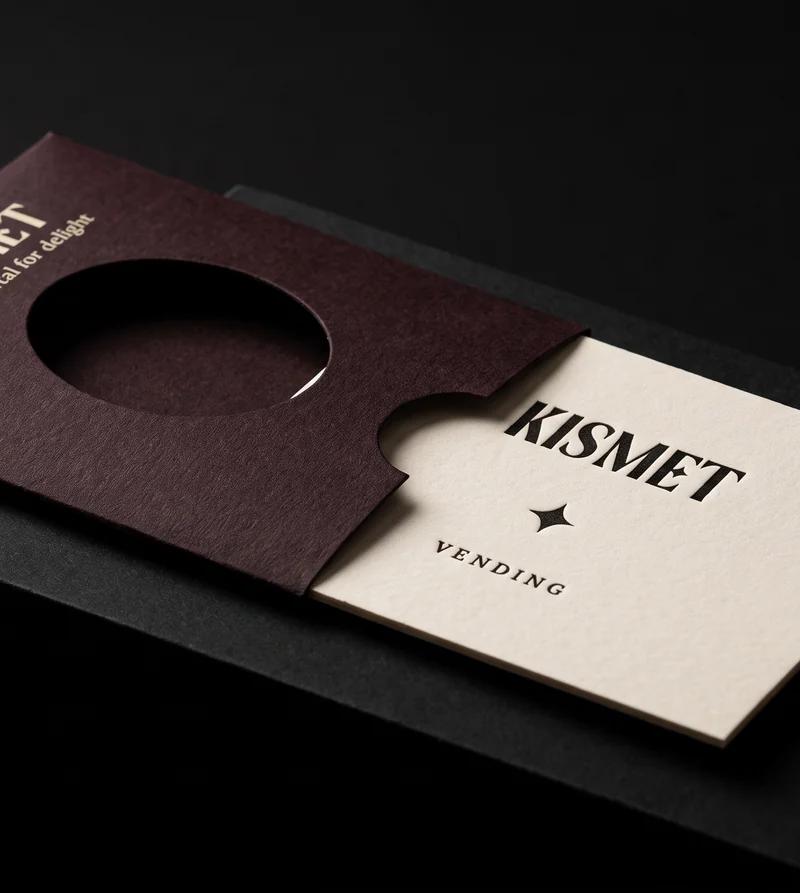
Kismet Vending
A card worth keeping, thin enough to fall out of a vending machine.
Read the project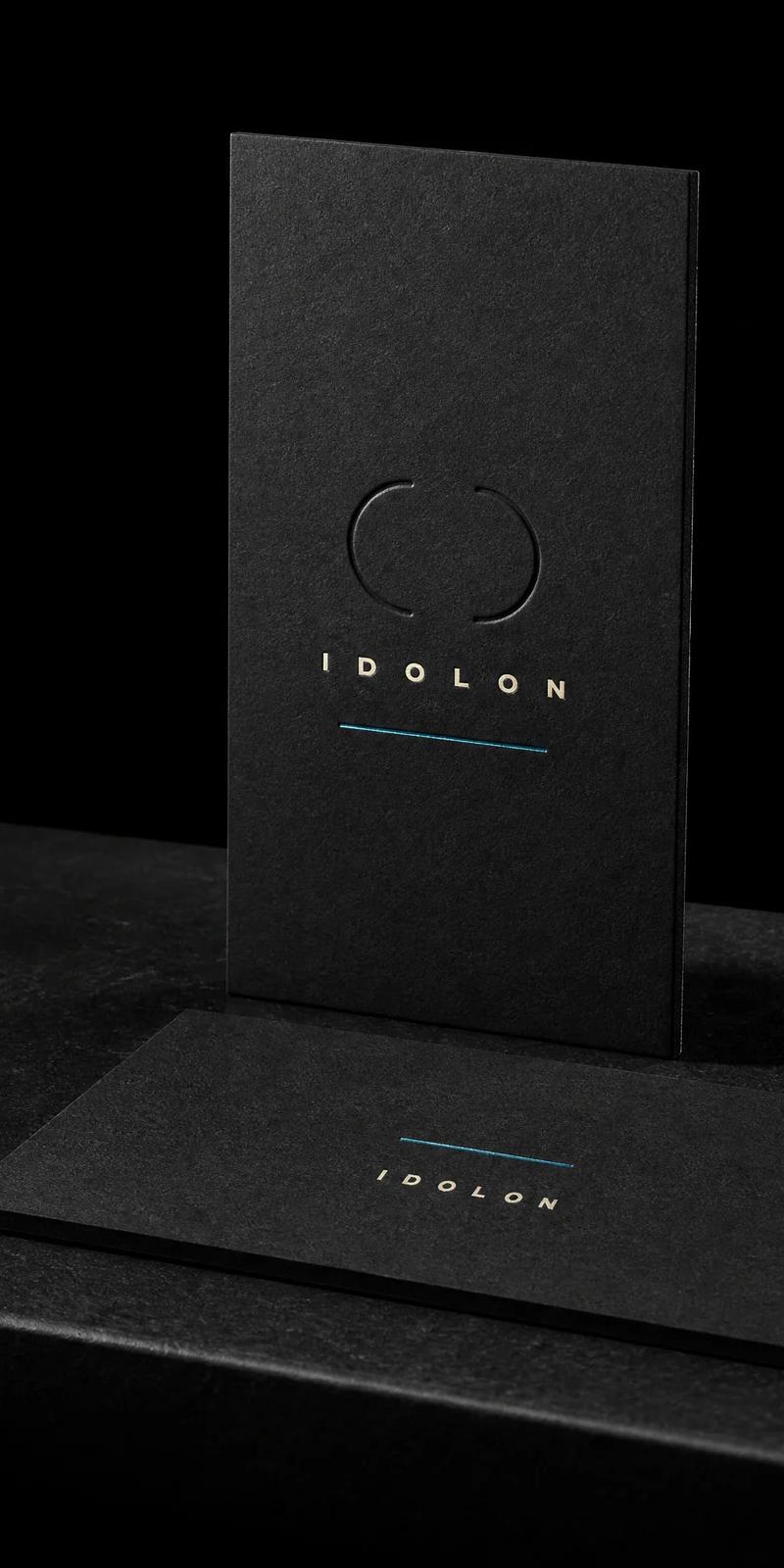
IDOLON
Five dies. No ink at all.
Read the projectCommon questions
- Will blind deboss show on the back?
- On thin stock, yes. At 32pt / 0.8mm and above it generally does not; a duplex backing ply keeps the reverse clean.
- Why does blind deboss disappear in a scan?
- The mark is shadow and topography, not colour. It needs light crossing the surface to become visible.
- How fine can the artwork be?
- Use strokes of at least 0.5mm (1.5pt), gaps of at least 1mm, type of at least 10pt and generous counters. Fine enclosed detail fills in under pressure.
- Is deboss cheaper than letterpress?
- It avoids ink, colour matching and wash-up, so it is often the best-value impression finish. The die and thick stock still matter.