Wedding invitation wording: examples for every kind of host
By Austin Terrill, founder and creative director of Print Peppermint · Updated
Wedding invitation wording follows one order: who's hosting, the request line, the couple's names, the date and time, the place, and what happens afterwards. Get those six lines right and the invitation is correct, whatever the style. Everything else, from the hotel block to the dress code, belongs on a details card or your wedding website, not on the invitation itself.
Most wording that reaches us has the same two problems: too many lines, and a host line nobody has agreed on yet. So here's what I'd want you to have before you write a word. The six lines in order. Copy-ready wording for every hosting situation we see, from couples hosting themselves to divorced parents to two languages on one card. Reply card and details card wording. And the part most wording guides skip: how the length of your wording changes the size of the type, the size of the card and sometimes the price. Every name and venue below is made up. Swap in your own.
Bring your wording. We set it in real type.
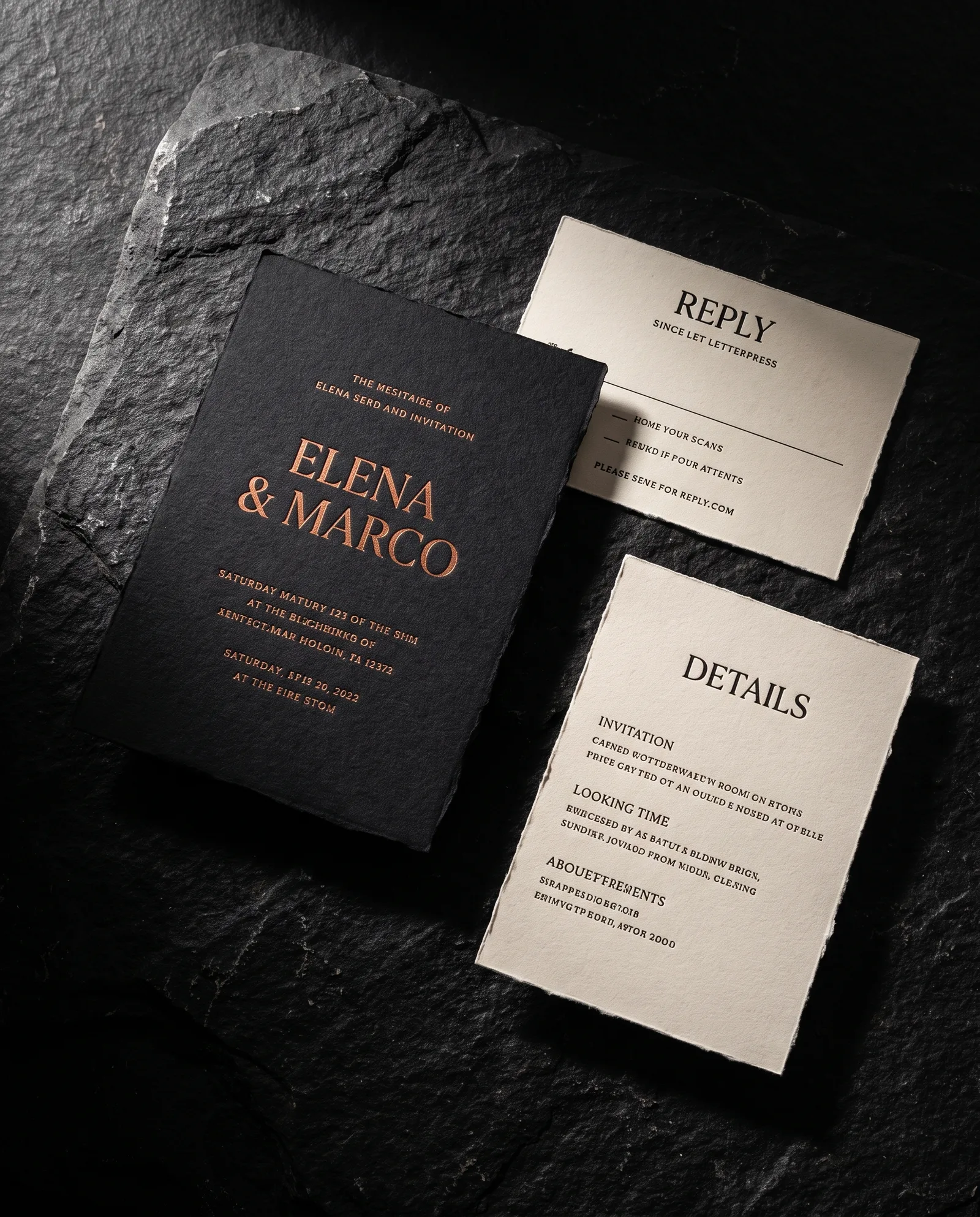
The six lines of a wedding invitation, in order
Wedding invitation etiquette comes down to order. Here are the six lines, what each one does, and a formal example of each.
| Line | What it does | Formal example |
|---|---|---|
| 1. Host line | Says who is inviting. Traditionally whoever paid; today, whoever the couple wants to name. | Mr. and Mrs. Robert Hale |
| 2. Request line | Asks the guest to come. Its wording sets the formality of the whole suite. | request the pleasure of your company |
| 3. The couple | Full names on a formal invitation, first names on a casual one. | Clara Elizabeth Hale / and / Benjamin James Osei |
| 4. Date and time | Spelled out on a formal invitation, numerals on a casual one. | Saturday, the eighteenth of September / two thousand twenty-seven / at four o'clock in the afternoon |
| 5. Place | Venue name, then city and state. No street address on a formal invitation. | Saint Aldric's Church / Portland, Maine |
| 6. Afterwards | Tells guests there's a reception, and whether it's in the same place. | Reception to follow |
One exception to the order: when the couple hosts, their names move up to the top and the request line follows them ("Clara Hale and Benjamin Osei invite you to celebrate their marriage"). Nothing else changes.
Mr. and Mrs. Robert Hale
request the honour of your presence at the marriage of their daughter
Clara Elizabeth to Mr. Benjamin James Osei
Saturday, the eighteenth of September two thousand twenty-seven at four o'clock in the afternoon
Saint Aldric's Church Portland, Maine
Reception to follow
What doesn't go on the invitation
A wedding invitation does one job: it invites. Everything practical goes somewhere else, and the invitation looks better for it.
- How to reply goes on the reply card, or on the details card if guests reply online.
- Hotels, shuttles, timings and the weekend schedule go on a details card.
- Dress code goes on the details card. If you have no details card, one short line ("Black tie") in the lower right corner of the invitation is fine.
- Adults only goes on the reply card, by reserving a number of seats, and on the details card or your website. Never "no children" on the invitation.
- The registry goes on your website. By long convention it's never printed on the invitation, and I'd keep it off the details card too; a link to the website covers it.
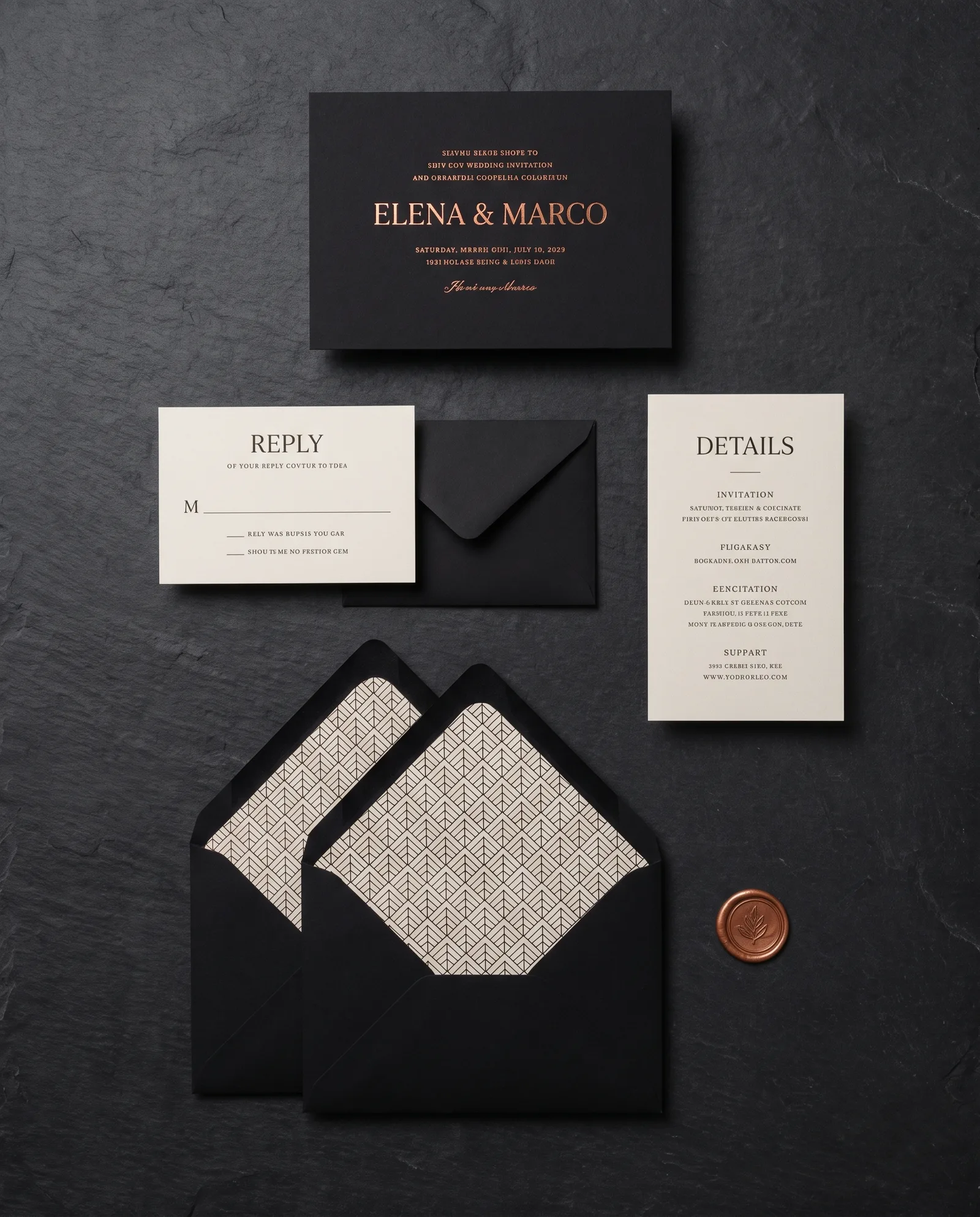
Wedding invitation wording examples for every kind of host
Find the card that matches who's hosting, then adjust the tone. These are the invitation only; the reply card and details card wording come further down. Line breaks are where I'd break them on a 5×7 card.
The couple hosting, formal
Use this when you're hosting yourselves and the ceremony isn't in a house of worship.
Elena Sofia Rojas and Marco Andrea Bellini request the pleasure of your company at their marriage Saturday, the twelfth of June two thousand twenty-seven at half past four o'clock The Glasshouse at Alder Hill Hudson, New York Dinner and dancing to follow
Together with their families
A widely used modern opening, and the one I'd pick if the question "who's hosting?" is complicated. It thanks everyone without listing anyone.
Together with their families Elena Rojas and Marco Bellini invite you to celebrate their marriage Saturday, the twelfth of June two thousand twenty-seven at half past four o'clock The Glasshouse at Alder Hill Hudson, New York Dinner and dancing to follow
The bride's parents hosting, traditional
The traditional form for a ceremony in a house of worship. The bride is named by her first and middle names only, because her surname is already in the host line; the groom gets his full name and title.
Mr. and Mrs. Robert Hale request the honour of your presence at the marriage of their daughter Clara Elizabeth to Mr. Benjamin James Osei Saturday, the eighteenth of September two thousand twenty-seven at four o'clock in the afternoon Saint Aldric's Church Portland, Maine Reception to follow
A modern version of the same card drops the titles and gives both people their full names: "Clara Elizabeth Hale and Benjamin James Osei".
Both sets of parents hosting
Each couple gets its own line, joined by "and". "Their children" covers both families at once.
Mr. and Mrs. Robert Hale and Dr. Grace Osei and Mr. Kwame Osei request the pleasure of your company at the marriage of their children Clara Elizabeth Hale and Benjamin James Osei Saturday, the eighteenth of September two thousand twenty-seven at five o'clock in the evening The Harbor Room Portland, Maine Dinner and dancing to follow
Divorced parents
Each parent goes on a separate line, with no "and" between them, because "and" on one line reads as a married couple. Traditionally the mother is listed first. Because the surnames differ, the daughter gets her full name.
Ms. Laura Bennett Mr. Daniel Okafor request the pleasure of your company at the marriage of their daughter Naomi Grace Okafor to James Whitfield Saturday, the twenty-second of May two thousand twenty-seven at six o'clock in the evening Fernhill Gardens Charlottesville, Virginia Reception to follow
If a parent has remarried and the new spouse is hosting too, the couple shares a line: "Mr. and Mrs. Peter Haines" above "Mr. Daniel Okafor". If the families can't agree on any of this, "Together with their families" solves it.
When a parent has died
An invitation comes from the living hosts. A parent who has died is honoured beside their child's name, not in the host line.
Mrs. Ana Ruiz requests the pleasure of your company at the marriage of her daughter Lucía Ruiz daughter of the late Carlos Ruiz to Owen Park Saturday, the ninth of October two thousand twenty-seven at three o'clock in the afternoon Mesa Verde Ranch Santa Fe, New Mexico Reception to follow
Two brides or two grooms
There's no rule about whose name comes first. Put them in the order that sounds right read aloud, alphabetically, or with the host family's child first.
Together with their families Maya Ellison and Rosa Delgado invite you to celebrate their marriage Saturday, the twenty-fourth of April two thousand twenty-seven at four o'clock in the afternoon The Conservatory at Lakeview Madison, Wisconsin Dinner and dancing to follow
When parents host, the wording is the same as any parents' card: "Mr. and Mrs. Thomas Reyes request the pleasure of your company at the marriage of their son Samuel Thomas Reyes to Jonah Whitaker."
A couple with children
Common for second weddings, and lovely on the page.
Together with their children Hannah Brooks and Leo Marsh invite you to celebrate their marriage Saturday, the eighteenth of September two thousand twenty-seven at five o'clock in the evening Willow Creek Barn Asheville, North Carolina Dinner, drinks and dancing to follow
Simple and casual
Numerals are fine here, and so is first person. This is the card for a backyard, a restaurant or a long table.
We're getting married Elena and Marco Saturday, June 12, 2027 · 4:30 p.m. The Glasshouse at Alder Hill Hudson, New York Come for the vows, stay for the dancing
A celebration after an elopement or a small ceremony
The marriage has already happened, so the invitation is to the party.
Elena Rojas and Marco Bellini were married in Lisbon this spring and invite you to celebrate with them Saturday, the twelfth of June two thousand twenty-seven at seven o'clock in the evening The Glasshouse at Alder Hill Hudson, New York Dinner, drinks and dancing
Bilingual wedding invitation wording: English and Spanish
The simplest layout is stacked: one language above the other, with the place and reception lines shared at the bottom so nothing is printed twice. Put first the language most of your guests read first, and set both in the same weight and colour. If one language is noticeably lighter or smaller, it reads as decoration rather than as an invitation.
Together with their families Elena Rojas and Marco Bellini invite you to celebrate their marriage Saturday, the twelfth of June, two thousand twenty-seven at half past four in the afternoon Junto con sus familias Elena Rojas y Marco Bellini les invitan a celebrar su matrimonio el sábado doce de junio de dos mil veintisiete a las cuatro y media de la tarde The Glasshouse at Alder Hill · Hudson, New York Dinner and dancing to follow · Cena y baile a continuación
Two languages roughly double the line count, so a stacked bilingual card usually needs smaller type or a larger card (see how your wording changes the card). The other option is one language on each side of the card. Here's the catch: a deep letterpress impression on the front shows through on the back of a single sheet. If both faces are pressed, we bond two sheets into one card (duplex) so each side stays clean. It's a real upgrade with a real cost, and it's quoted.
Arabic, Hebrew and other right-to-left languages
Arabic and Hebrew read right to left, so on a side-by-side card the right-to-left language usually takes the right-hand column or its own side of the card, and the English is never mirrored to match. We set Arabic and Hebrew in a real typeface, matched in weight to the English, and a native reader checks the proof. Image tools can't join Arabic letters correctly, so any concept image you see from us shows a placeholder where the Arabic will go; the real type is set by a person. For my own wedding suite we pressed the English and Arabic names in letterpress, in the same weight and the same warm grey, and that one decision is what made the two languages read as one piece (read the case study).
Paste it in. A person sets it.
Honour of your presence or pleasure of your company?
"Request the honour of your presence" is traditionally used for a ceremony in a house of worship. "Request the pleasure of your company" is used everywhere else. Both are formal; the difference is the setting, not the level of the event. Below that, the request line is where you set the tone for the whole suite.
| Request line | Use it for |
|---|---|
| request the honour of your presence | A formal ceremony in a house of worship |
| request the pleasure of your company | A formal ceremony anywhere else |
| invite you to celebrate their marriage | Warm and correct anywhere; the safest middle |
| invite you to join them as they say "I do" | Relaxed, still in the third person |
| would love for you to join us | Casual, with the couple speaking in the first person |
Honour or honor?
Both are correct. "Honour", with the u, is the traditional formal spelling and is still common on American invitations; "honor" is the everyday American spelling. The same goes for "favour" on a reply card. Pick one and use it on every piece of the suite.
Keep the voice consistent
If the invitation speaks in the third person ("invite you to celebrate their marriage"), keep the reply card and details card in the third person too, or in a neutral voice. Switching to "we can't wait to see you" on the details card is fine on a casual suite and jarring on a formal one.
How to write the date and time on a wedding invitation
On a formal invitation, spell everything out: the day, the date, the year and the time. Capitalise only the day and the month. Write "half past four", not "four-thirty", and leave out "p.m." Add "in the afternoon" or "in the evening" only where the hour could be misread. On a casual invitation, numerals are fine.
| Formality | Date line | Time line |
|---|---|---|
| Formal | Saturday, the twelfth of June / two thousand twenty-seven | at half past four o'clock |
| Semi-formal | Saturday, June twelfth, 2027 | at half past four in the afternoon |
| Casual | Saturday, June 12, 2027 | 4:30 p.m. |
A few rules that save reprints:
- The year is optional on a formal invitation, because guests know which June you mean. I'd keep it: the invitation is the piece people frame, and the year is what makes it a keepsake. If you include it, spell it out without "and": "two thousand twenty-seven".
- The time is when the ceremony starts. Don't print an earlier time to trick late arrivals. Put "Guests are invited to be seated by quarter past four" on the details card instead.
- Check the day against the date. "Saturday, the twelfth of June" has to be a Saturday in your year. It's an easy slip to miss on your own screen, and we check it again at proof.
The venue line and the reception line
Put the venue on its own line, then the city and state on the next, with the state spelled out on a formal invitation ("New York", not "NY"). A formal invitation doesn't carry a street address or zip code; those go on the details card. A casual invitation can include the street address if the venue is hard to find.
For the line after the venue:
- Reception in the same place: "Reception to follow", "Dinner and dancing to follow", or "Reception immediately following".
- Reception somewhere else: leave it off the invitation and put the reception venue, address and time on the details card, or on its own small reception card.
- A larger party after a small ceremony: invite the wider list to the celebration only, as in the elopement card above.
RSVP wording: five reply cards you can copy
Set your reply-by date three to four weeks before the wedding. That gives you time to chase the people who forget before your venue needs final numbers. Every reply card needs the date; most need a line for the guest's name. The "M" at the start of the name line is there for the guest to complete as Mr., Mrs., Ms. or Mx.
Formal
The favour of a reply is requested by the fifteenth of May M______________________________ ____ accepts with pleasure ____ declines with regret
With a meal choice
Kindly reply by May 15 Name(s) _______________________ ____ Joyfully accepts ____ Regretfully declines Please initial your dinner choice ____ Beef ____ Fish ____ Vegetarian
Seats reserved (the polite way to say adults only)
Write the number of seats in by hand for each household before you mail them. It tells guests exactly who's invited without a single word about children.
Please reply by May 15 M______________________________ We have reserved ____ seats in your honour ____ Will attend ____ Will not attend
Casual
Can you make it? Let us know by May 15 Name(s) _______________________ ____ Wouldn't miss it ____ Celebrating from afar The song that gets you dancing ______________
Online replies
If guests reply on your website, the reply card becomes a small card with the address, and you skip the reply envelope and its stamp.
Kindly reply by May 15 at [yourwebsite.com/rsvp] or scan the code below [QR code]
A QR code always prints in flat ink, never in foil or letterpress, because shine and a pressed edge confuse a phone camera. We print it at about 2 cm or larger with a clear margin around it, and scan it at proof. Print the web address as well; not every guest will scan.
Details card wording
The details card is where everything that would crowd the invitation goes. It's also the card that lets the invitation be just names, a date and a place, with room to breathe. Three versions:
Travel and timings
Accommodations A block of rooms is held at The Linden House, Hudson under the name Rojas–Bellini until May 1 Transport Shuttles leave the hotel at quarter to four and return from eleven o'clock Attire Cocktail
The weekend schedule
The Weekend Friday · Welcome drinks · 7 p.m. · The Linden House Saturday · Ceremony at 4:30 p.m., followed by dinner and dancing Sunday · Farewell breakfast · 10 a.m.
Website and adults only
For travel, gifts and everything else [yourwebsite.com] We love your little ones, but our celebration is for adults only
How your wording changes the card, the type and the price
Every line you add has to come from somewhere: smaller type, tighter spacing or a bigger card. On a 5×7 invitation I like to stay at about a dozen lines, counting the "and" between the names. Past that, the type gets small enough to fight the press, and that's where letterpress and foil have real limits.
Letterpress pushes the ink into soft cotton, and the ink spreads a little as it goes in. Foil is a metal film pressed on with heat through a die, and thin parts of a letter can break up or fill in. So the wording you write turns into production decisions. Here are the ones we make most often.
| If your wording... | What we do | Why |
|---|---|---|
| Runs past about a dozen lines | Move the practical lines to a details card, or go to a larger card | Small type fills in under pressure, and a crowded card stops reading as an invitation |
| Sets the names in a fine script, in foil | Measure at final size and preserve the script; adjust only below-floor strokes | Fine detail survives foil: lines hold to 0.1 mm; we design to 0.15 mm without boldening the lettering |
| Uses a high-contrast serif (thick and very thin strokes) in foil | Keep that type at 12 pt or larger | The hairline strokes close up |
| Has small lines in letterpress or foil | Keep text at 7 pt or larger, and 10 pt or larger if it's knocked out of a printed colour or a foil panel (12 pt for a thin typeface knocked out in letterpress) | Ink and foil spread slightly as they're pressed |
| Is gold or white on black paper | Foil, never ink | Letterpress ink is see-through, so light ink on dark paper looks chalky |
| Puts a second language on the back, both sides pressed | Bond two sheets into one card (duplex) | A deep impression shows through a single sheet |
| Includes Arabic, Hebrew or another right-to-left script | Set it in a real typeface and have a native reader check the proof | Image tools can't join the letters correctly |
| Includes a QR code | Flat ink, about 2 cm or larger, clear margin, scanned at proof | Foil glare and a pressed edge stop phones reading it |
Two colours, or one?
Letterpress and foil are priced per colour, per location. Names in gold foil with the rest in black letterpress is two plates or dies and two passes through the press. It can be beautiful. It's also the first thing I'd cut if the budget is tight, because one colour pressed well rarely looks like you held back.
Who sets the type
Our Studio shows you concept images in minutes, and they're useful for choosing a direction. They're pictures, though, not print files: image tools don't draw small text accurately. A designer sets your actual wording in real type, checks it against everything in the table above and sends you a proof. If you'd like us to set your wording and layout from scratch, design help is 95 $ at checkout. For a fully custom suite, see wedding suite artwork. Sizes for every piece are in our invitation and flat card size guide.
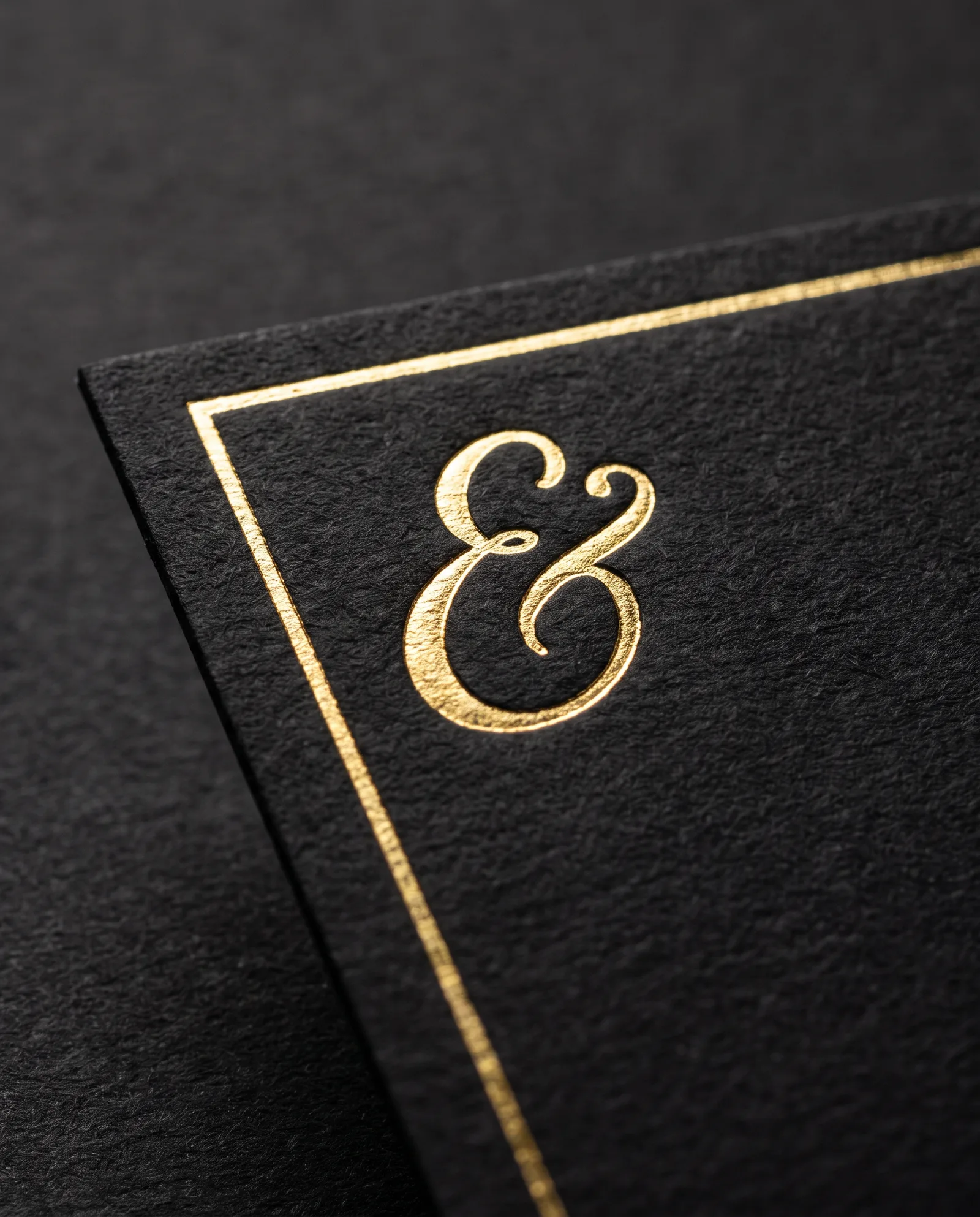
Which suite fits your wording
Your wording decides this more than anything else. If everything fits on the invitation and your website does the rest, you need two cards. If the invitation is starting to fill up, you need a third.
- Essential, 1.640 $ for 100: the invitation and a reply card. Choose it if your website carries the details and the invitation only has to carry the six lines.
- Classic, 2.690 $ for 100: adds a details card. This is the one I'd choose for most weddings. The details card takes the hotels, timings and dress code, and the invitation gets to be just the names, the date and the place.
- Signature, 4.190 $ for 100: Classic plus printed guest addressing, envelope liners and a wax seal. Choose it if you don't want to spend two evenings addressing envelopes.
The full suites we make for 100 guests usually land at about 2.500 $ to 5.000 $ once couples add colours, liners or a specialty piece. The cost guide has the totals at every guest count.
Our general sample kit, built around business cards rather than a wedding box: real production samples of the papers and finishes we print with, plus the hot foil swatch card. 10 $ credit on your first order.
Proofread your wording before it's pressed
A letterpress plate or foil die is made from the proof you approve. A typo found after that means a new plate and a new run, so this is the cheapest ten minutes of the whole project. Before you approve, check:
- Every name exactly as that person writes it, accents included (Lucía, not Lucia).
- Titles used the same way throughout. If one parent is "Dr.", the line reads "Dr. Grace Osei and Mr. Kwame Osei", not a mix of styles.
- The day of the week matches the date in your year.
- The time is the ceremony start, not the arrival time.
- The venue name is spelled the way the venue spells it.
- "Honour" or "honor", "favour" or "favor": the same choice on every piece.
- The reply-by date comes before your venue's final-numbers deadline.
- Every web address is typed correctly and opens, and every QR code scans.
- Read it aloud, then have someone who didn't write it read it too.
Once your proof is approved, production is about three weeks, then shipping. That's an estimate, not a guarantee, so work back from your mail date and leave yourself a cushion. The timeline guide does the counting for you.
Wedding invitation wording questions
What wording do you put on a wedding invitation?
A wedding invitation has six lines in a fixed order: the host line (who is inviting), the request line ("request the pleasure of your company"), the couple's names, the date and time, the venue with city and state, and a line about the reception ("Reception to follow"). When the couple hosts, their names come first and the request line follows. Reply instructions, hotels, dress code and the registry go on the reply card, details card or wedding website, not the invitation.
How do you write a simple wedding invitation?
Keep only the essentials: your names, what you're inviting people to, the date and time, the place, and what happens afterwards. For example: "We're getting married / Elena and Marco / Saturday, June 12, 2027 · 4:30 p.m. / The Glasshouse at Alder Hill, Hudson, New York / Come for the vows, stay for the dancing." Numerals and first person are fine on a casual invitation. Put everything practical on your wedding website.
What should I write in a wedding invitation message?
The invitation itself should stay short and factual: hosts, request line, names, date, time, place and reception. If you want to add something personal, add one line at the end in your own voice, such as "Come for the vows, stay for the dancing", or put a longer note on the details card or your wedding website. One warm line reads better than a paragraph squeezed into small type.
Is it "honour of your presence" or "pleasure of your company"?
By traditional wedding invitation etiquette, "request the honour of your presence" is used for a ceremony in a house of worship, and "request the pleasure of your company" for a ceremony anywhere else. Both are formal. If neither feels like you, "invite you to celebrate their marriage" is warm and correct for any venue.
Is it "honor" or "honour" on a wedding invitation?
Both are correct. "Honour", with the u, is the traditional formal spelling and is still widely used on American wedding invitations; "honor" is the standard American spelling. The same applies to "favour" and "favor" on reply cards. Choose one spelling and use it consistently on every piece of the suite.
Whose name goes first on a wedding invitation?
Traditionally the bride's name comes first. When parents host, their own child is usually named first. For two brides or two grooms, or any couple who'd rather not follow the old rule, there is no rule: choose the order that sounds best read aloud, go alphabetically, or put the host family's child first. Use the same order on every piece.
How do you word a wedding invitation when the couple is hosting?
Put your names at the top, followed by the request line: "Elena Sofia Rojas and Marco Andrea Bellini request the pleasure of your company at their marriage", then the date, time, venue and reception line. If you'd like to acknowledge your parents without naming them as hosts, open with "Together with their families" above your names and use "invite you to celebrate their marriage".
How do you word wedding invitations with divorced parents?
List each parent on a separate line without "and" between them, traditionally with the mother first: "Ms. Laura Bennett / Mr. Daniel Okafor / request the pleasure of your company at the marriage of their daughter Naomi Grace Okafor." A remarried parent hosting with a new spouse shares a line with them ("Mr. and Mrs. Peter Haines"). If the families can't agree on the host line, "Together with their families" avoids the question gracefully.
Should the year be on a wedding invitation?
It's optional on a formal invitation, because guests know which year you mean. I'd include it, because the invitation is the piece people keep and frame, and the year turns it into a keepsake. On a formal invitation spell it out without "and" ("two thousand twenty-seven"); on a casual one, numerals are fine.
Where do the registry, dress code and adults-only details go?
Not on the invitation. The registry goes on your wedding website. Dress code goes on the details card, or as one short line in the lower right corner of the invitation if there's no details card. For an adults-only wedding, write the number of reserved seats on each reply card ("We have reserved two seats in your honour") and mention it on the details card or website, never with "no children" on the invitation.
What should the RSVP card say, and when should the deadline be?
A reply card needs a reply-by date, a name line and a way to accept or decline, such as "The favour of a reply is requested by the fifteenth of May / M____ / accepts with pleasure / declines with regret". Add meal choices or a reserved-seat count if you need them. Set the deadline three to four weeks before the wedding, so you have time to follow up before your venue needs final numbers.
Can you print a bilingual wedding invitation?
Yes. The simplest layout stacks one language above the other with the venue and reception lines shared, set in the same weight and colour so neither looks like decoration. Printing one language on each side works too, but if both sides are letterpressed or debossed we bond two sheets so the impression doesn't show through. Arabic, Hebrew and other right-to-left scripts are set in a real typeface and checked by a native reader at proof.
Will you set our wording for us?
Yes. Every suite is set in real type by a designer, who checks every line against what letterpress and foil can hold and sends you a proof before anything prints. If you'd like us to write the layout and set your wording from scratch rather than following your file, design help is 95 $ at checkout. Concept images from our Studio are for choosing a direction; they're not print files.
How long does printing take once the wording is final?
Production is about three weeks after you approve your proof, then shipping. That's an estimate, not a guarantee, so work back from the date you want to mail and leave a cushion. If your date is tight, tell us before you order and we'll tell you honestly whether it fits; a simpler build with fewer finishes is the safer choice when time is short.
Bring your wording, and we'll set it
Paste your wording into the Studio with your date and roughly how many households you're inviting. Gus, our design assistant, sketches three directions in minutes. A designer then sets your real wording in real type, checks every line against what letterpress and foil can hold, and sends you a proof before anything is printed.