What is a wedding invitation suite? Every piece, explained
By Austin Terrill, founder and creative director of Print Peppermint · Updated
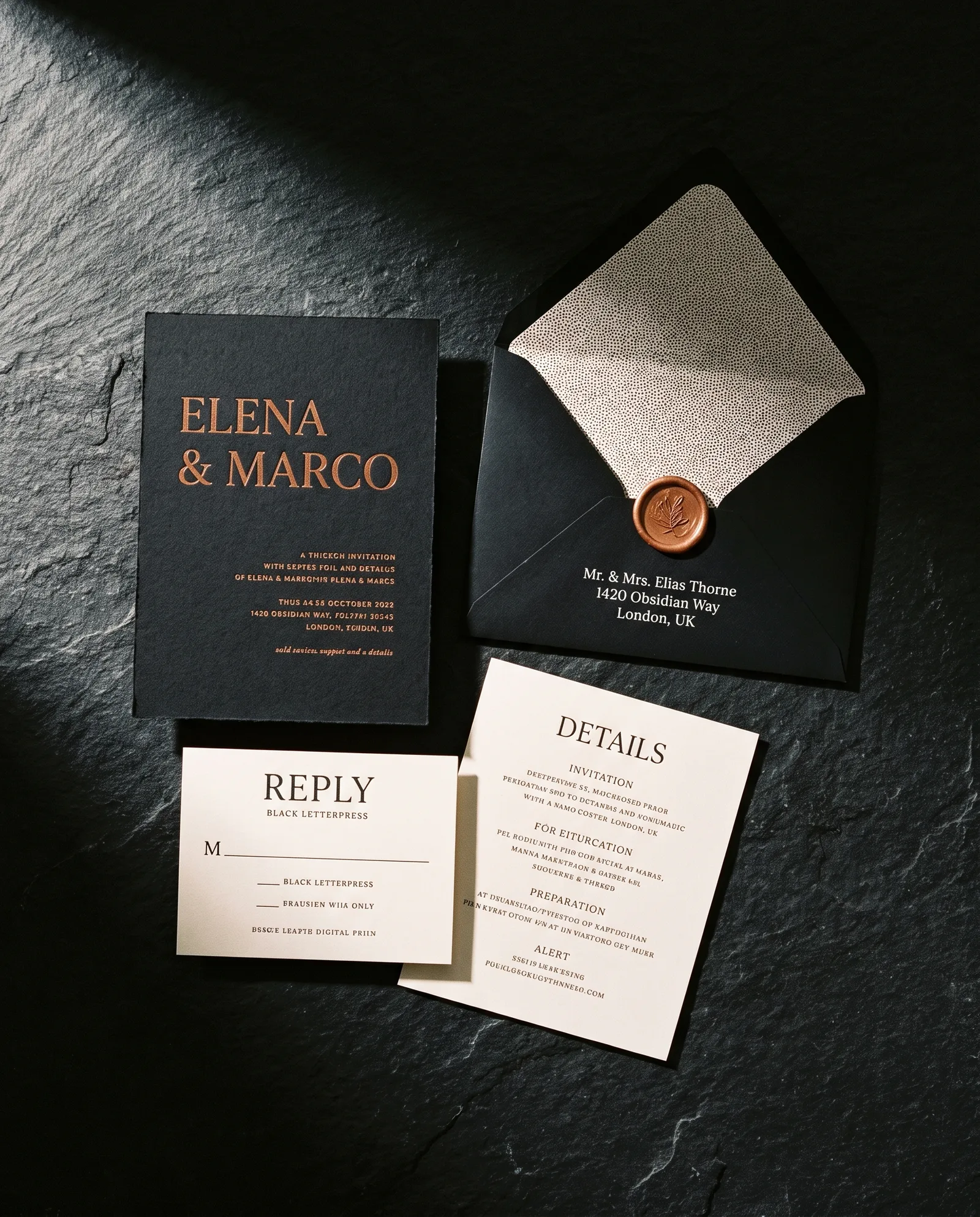
What is a wedding invitation suite? It's the set of matching cards your guests receive in one envelope: the invitation, a reply card with its own small envelope, a details card for travel and timings, and the outer envelope carrying your return address. Liners, belly bands, vellum wraps and wax seals are optional finishing. Save the dates, menus, place cards and thank-you cards can match the suite, but they go out at different times and are ordered as their own pieces.
Most couples I talk to know they want "the invitation" and then discover the rest one piece at a time, usually after the first piece has already printed. That's the expensive way to do it, and it's how suites end up not quite matching. So here's the whole family in one place: what each piece is for, which ones you can skip, the sizes they come in, how many of each to order, and why pieces printed months apart drift, and how to stop it. There's a printable checklist at the end.
Three directions in minutes. A person checks every finish.
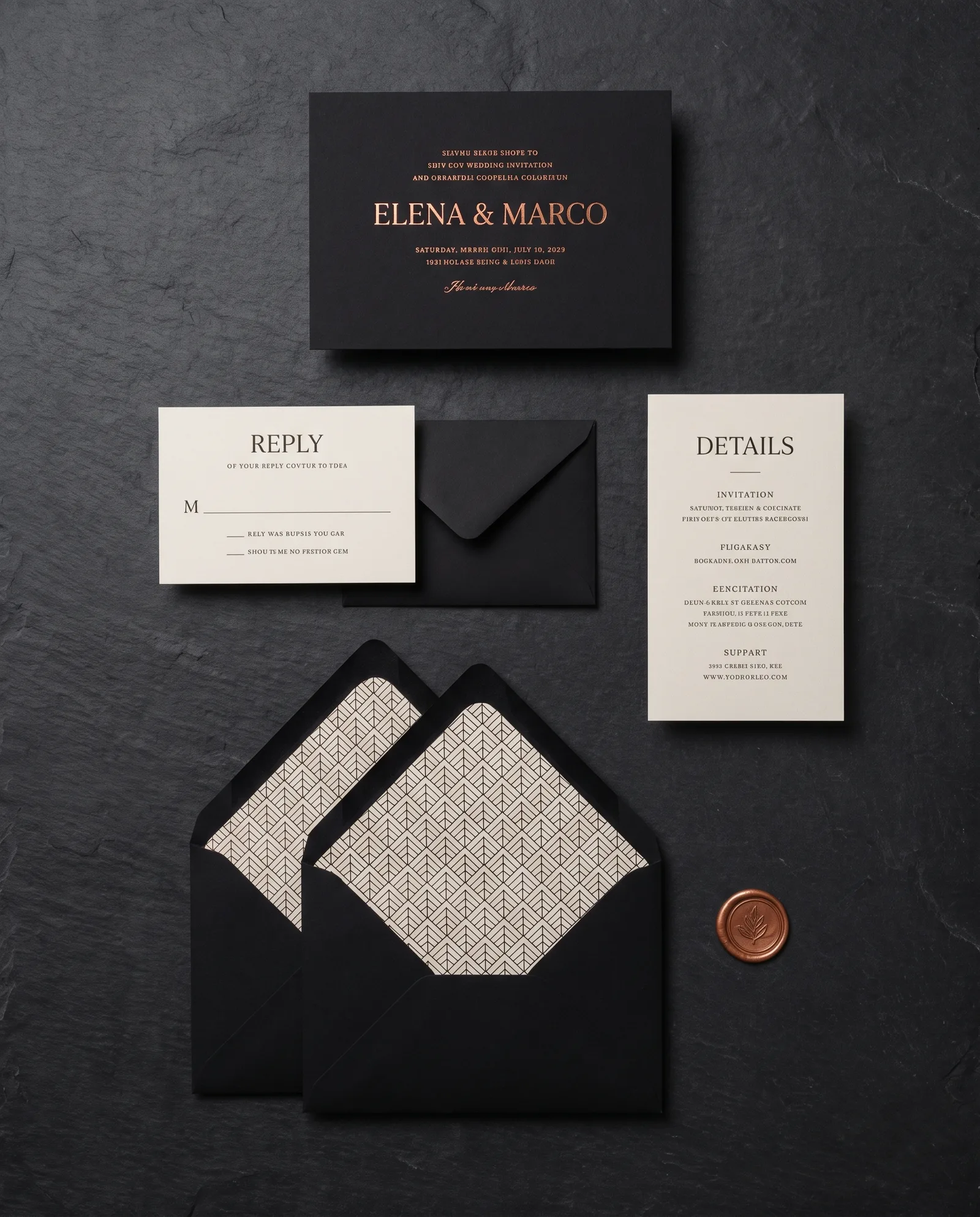
- 1Invitation
- 2Reply card and envelope
- 3Details card
- 4Outer envelope
- 5Liner
- 6Wax seal
What is included in a wedding invitation suite
A suite is a set of cards designed together and printed together, so the paper, the ink colour and the type carry across every piece. Four pieces do the work: the invitation, two enclosure cards (the reply card and the details card) and the outer envelope. Everything else is finishing, or a separate piece sent at another time.
| Piece | Must-have or optional | Typical size | When it's sent or used | How we'd usually print it |
|---|---|---|---|---|
| Invitation | Must-have | 5 × 7 in (A7), 127 × 178 mm | In the main envelope, mailed 6 to 8 weeks before the wedding | Letterpress or foil on 32pt cotton; the full treatment goes here |
| Reply (RSVP) card and reply envelope | Must-have, unless you collect replies online | 3.5 × 4.875 in (A1 or 4-bar); envelope 3⅝ × 5⅛ in | Inside the invitation envelope; guests post it back by your RSVP date | Same ink or foil as the invitation, usually one colour |
| Details card | Strongly recommended | 4.5 × 6.25 in (A6), or 4 × 6 or 3.5 × 5 in | Inside the invitation envelope | Same ink, one colour; any QR code printed flat in ink |
| Outer envelope | Must-have | 5¼ × 7¼ in (A7 envelope) | Carries the whole suite | Return address printed on the flap; guest address printed flat or handwritten |
| Envelope liner | Optional finishing | Cut to the envelope's flap | Inside the outer envelope | A printed pattern or colour |
| Wax seal | Optional finishing | About the size of a large coin | On the flap, a band or a vellum wrap | Coloured to match the suite |
| Belly band or vellum wrap | Optional finishing | Band 1.5 to 2 in tall; vellum wraps a 5 × 7 | Holds the stack together | Printed in the suite's colour |
| Inner envelope | Optional, traditional | Sized to slip inside the outer envelope | Inside the outer envelope, names only | Usually handwritten |
| Reception card | Only if the reception is at a different venue | Usually the reply-card size | Inside the invitation envelope | Same as the reply card |
Sizes are the common US standards. A suite can be any size, but square and non-standard envelopes cost more to mail. More in our invitation size guide and envelope size guide.
The core suite, piece by piece
The invitation
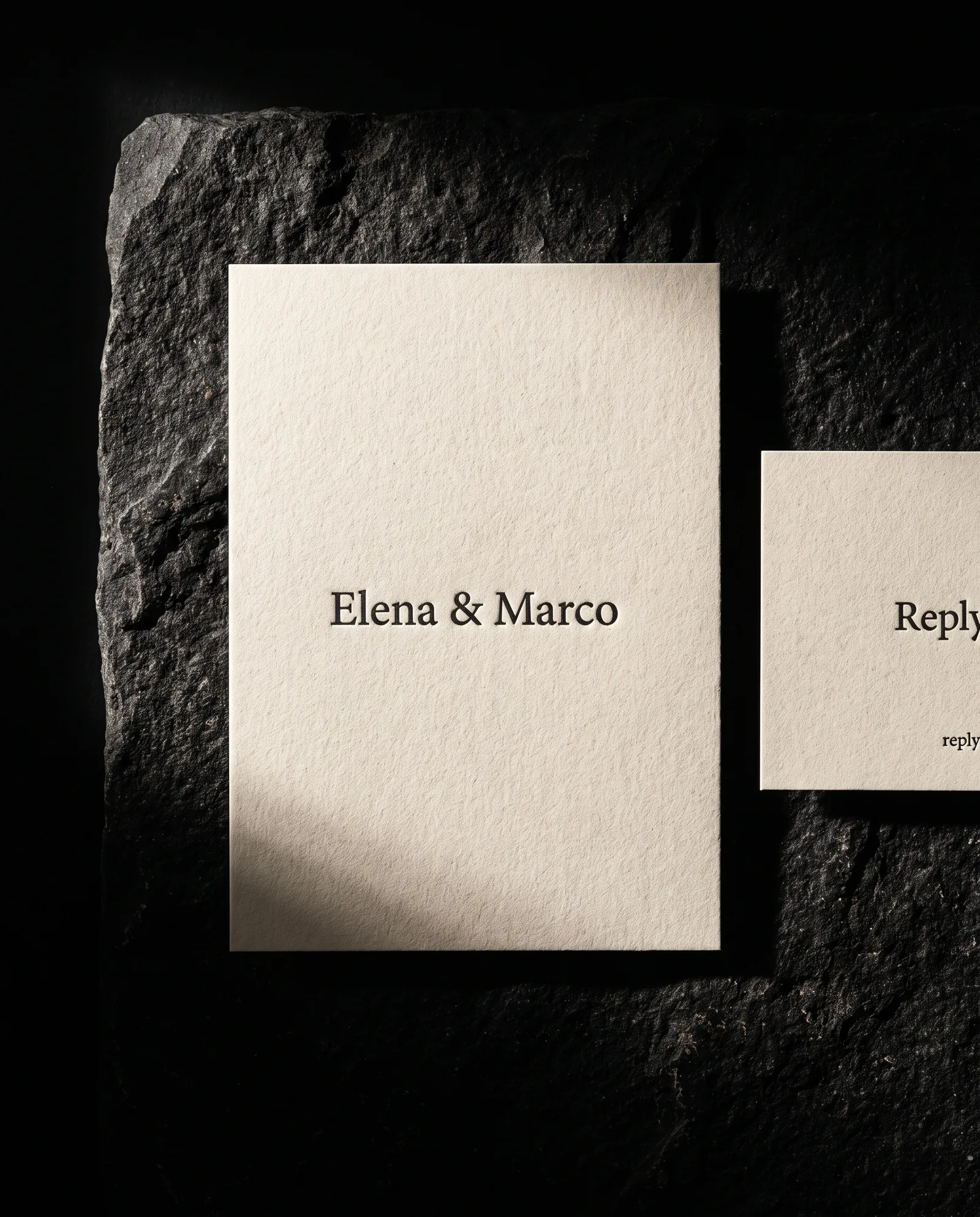
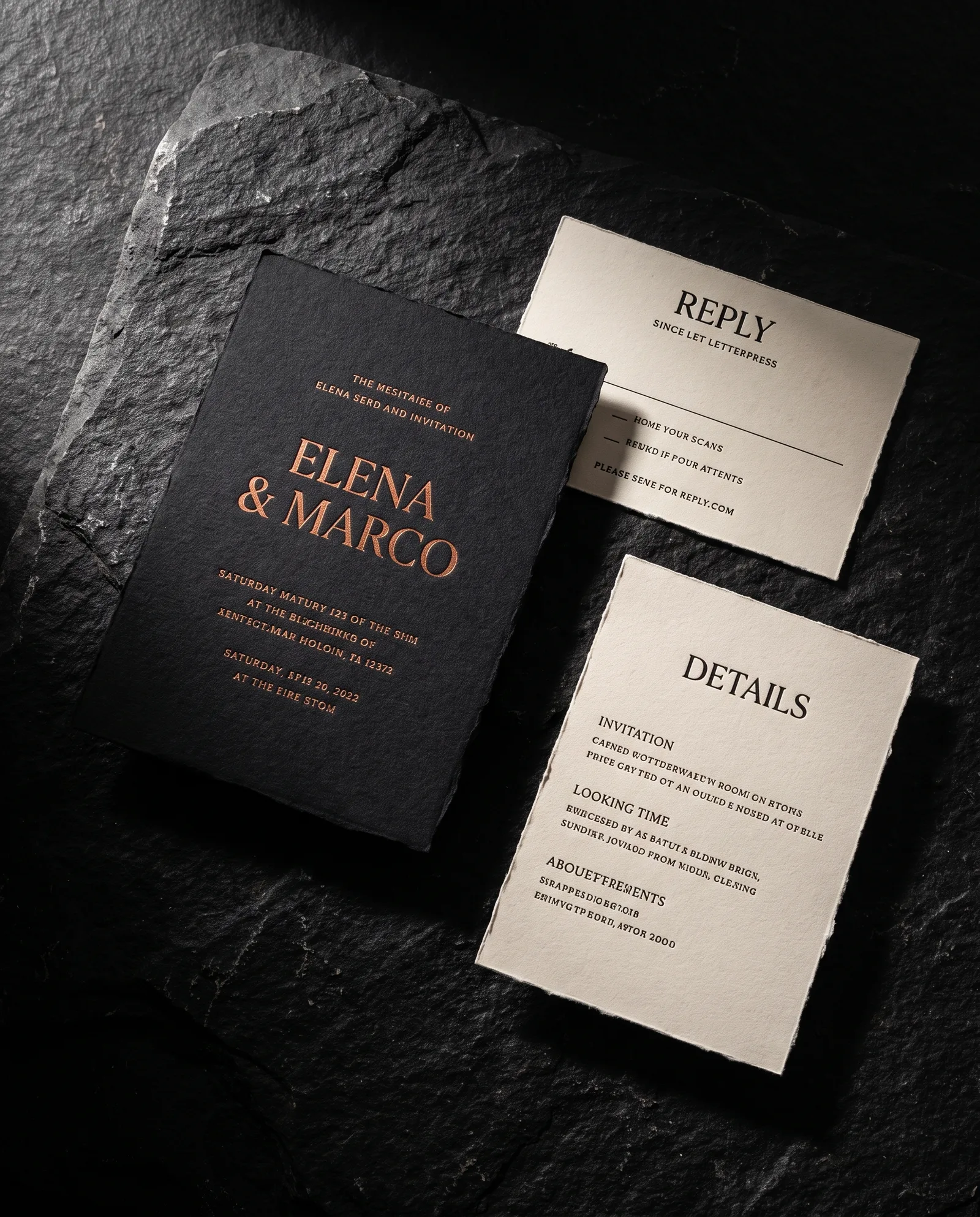
This is the card that gets the letterpress bite or the foil, and the one people keep. Names, the request line, date, time and place; nothing else if you can help it. On 32pt cotton, about 0.8 mm thick, a letterpress impression is deep enough to feel with your thumb. Two honest notes before you fall for a design. Letterpress ink is see-through, so light ink on dark paper looks chalky; on a black or navy invitation the light type goes in foil instead. And a deep bite on one face shows through on the other, so if you want type or foil on the back as well, we usually bond two sheets together (duplex) so each face can be pressed on its own; for a light touch on the back, a shallower impression can be enough.
The reply card, and when to skip it
A small card with its own pre-addressed envelope, so replying takes a guest ten seconds and a stamp you've already put on it. If you'd rather collect replies on your wedding website, drop the reply card and put the web address, and a QR code, on the details card instead. That saves a card, an envelope and a stamp for every household. The trade-off is that some guests reply more slowly online. If your list skews older, I'd keep the card.
The details card
Everything that would clutter the invitation lives here: hotel blocks, travel, the weekend's timings, dress code, your website. Keeping it separate is what lets the invitation stay clean. A QR code for your website always prints in flat, dark ink at a size a phone can read from arm's length. Foil, embossing or a shiny coating over a QR code glares or blurs it, and it stops scanning.
The envelopes
The outer envelope carries your return address on the flap. Envelopes can be printed only in set areas and never to the edge, so we place the return address on your envelope's own template before the proof. For guest addresses there are three honest options: printed flat in ink, handwritten by a calligrapher, or handwritten by you. Guest names in foil are possible but need a separate small die for every name, so they're priced per name. Inner envelopes are a traditional extra layer with only the guests' names on them. Lovely, entirely optional, and most couples now skip them.
What wedding stationery includes: before, on and after the day
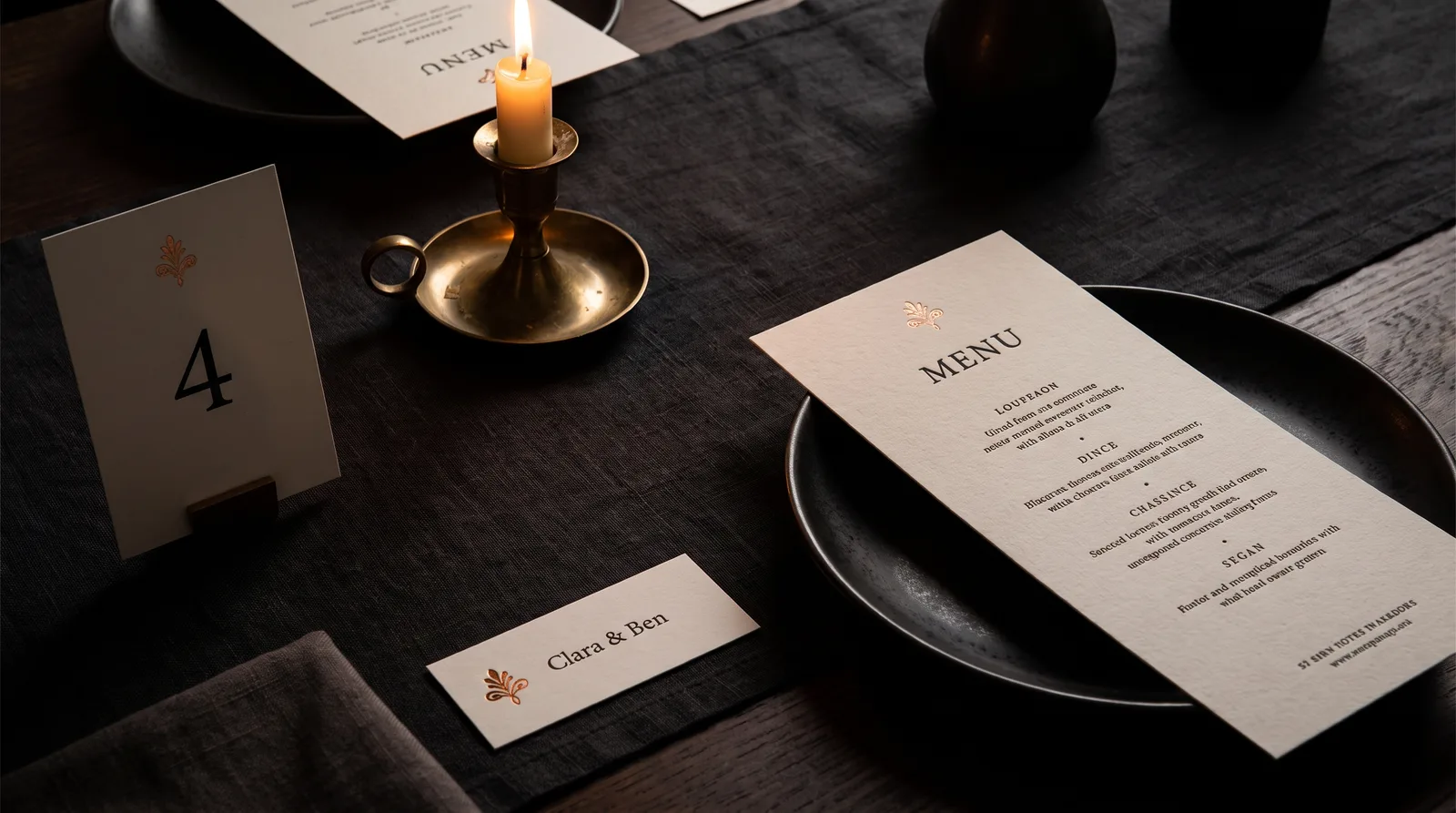
When people say "wedding stationery", or a wedding stationery suite, they usually mean the whole family: the invitation suite plus everything printed before, on and after the day. These pieces can share the suite's paper, ink and foil, but they're separate orders sent at different times.
| When | Piece | What it does |
|---|---|---|
| 6 to 8 months before (8 to 12 for a destination wedding) | Save the date | Holds the date before the invitation exists. It also sets the paper and colour the suite has to match. |
| On the day | Ceremony program | Order of service, readings, the wedding party |
| On the day | Menu | One per place setting, or one per table |
| On the day | Escort cards or a seating chart | Tells each guest which table is theirs |
| On the day | Place cards | One name per seat |
| On the day | Table numbers | One per table, heavy enough to stand |
| After | Thank-you cards | Sent within a few months of the wedding |
Common practice, not rules. The timings follow the windows most US planners use; our wedding invitation timeline works them back from your date.
Which pieces you actually need
I always start by pricing everything, then we take things away until the total is right. Here are the three ways a suite usually ends up, and the one I'd pick for most weddings. These are our three wedding invitation suites, each with envelopes and a free digital proof.
- The minimum: invitation and reply card. Our Essential suite, 1.640 $ for 100 households. Right when the weekend is simple and the invitation can carry the details. If you collect replies online, ask in the Studio about a details card in place of the reply card.
- What I'd recommend: invitation, reply card and details card. Our Classic suite, 2.690 $ for 100 households. The details card is what keeps the invitation clean, and it's where most of the practical questions get answered before guests text you.
- The full suite: Classic plus printed guest addressing, envelope liners and a wax seal. Our Signature suite, 4.190 $ for 100 households. The guest addresses arrive printed, so there's no calligrapher to book.
Once couples add colours, liners or a specialty piece, most of the full suites we make for 100 guests land at about 2.500 $ to 5.000 $. The pieces in a suite share one paper order, one ink mix, one foil setup and one proof, which is why a suite costs less than the same cards ordered one at a time. The full breakdown, at every guest count, is in our wedding invitation cost guide.
How to keep a suite matching when the pieces are months apart
Here's the landmine. Save the dates print six months or more before the invitation, and the day-of pieces print weeks after it. Between those runs, three things can drift: the ink colour, the paper shade and the foil. Each run is mixed and set up fresh, so "the same gold" from memory is not the same gold. The fix is to treat your first order as the spec sheet for everything that follows.
- Lock the paper by name and shade. Cotton comes in a natural white that leans a few percent warm, a clean bright white and a creamier ivory. Same texture, very different feeling. Pick one and keep it.
- Lock the ink by its Pantone number. On cotton we match to the Uncoated Pantone book. Letterpress ink is see-through, so the paper underneath tints it: the same blue reads greener on ivory than on bright white. Change the paper between pieces and the ink changes with it.
- Lock the foil by its exact name. "Gold" isn't a spec. Every foil we stock is on our hot foil swatch card; note the exact one and use it on every piece.
- Keep the typefaces and the files. The same fonts at the same weights, set from the same artwork.
We record the full spec from your first order, so a later piece starts from the same paper, ink and foil. The best fix of all is not to need it: order the menus, place cards and thank-you cards with the suite, unnamed if the seating isn't settled. Same batch of ink, same run. Names can be handwritten or printed flat later.
If you do add a piece later, it's its own production run: about 3 weeks after you approve its proof, then shipping. That's an estimate, not a guarantee, so leave a cushion.
Mixing letterpress, foil and flat print across the pieces
Not every piece needs the full treatment, and the best suites I see usually don't give it to every card. Spend the impression on the invitation, then let the other pieces echo it in one colour.
| Piece | What I'd usually do | Why |
|---|---|---|
| Invitation | Letterpress or foil, the full treatment | It's the card people hold, keep and photograph |
| Reply and details cards | The same ink or foil as the invitation, one colour | They match, and one colour keeps the setup down |
| Outer envelope | Return address in the suite's colour; guest addresses printed flat or handwritten | Per-name foil needs a die for every name |
| Place cards and escort cards | A shared pressed motif; names printed flat or handwritten | One plate serves every card; names change until the last week |
| Menus and programs | The suite's ink or foil, one colour | Text-heavy pieces read best kept simple |
Rules we design around, so you don't have to:
- Light on dark is foil. White or pale type on black or navy cotton goes in pigment foil, which stays opaque where ink would sink in.
- Foil never goes on top of ink. Where foil and letterpress share a card, we leave a clean gap between them.
- Foil and letterpress press one solid shape. A gradient or a watercolour wash becomes one flat tone. If the wash is the idea, it gets printed and the foil goes on a solid element.
- Small type has minimums. Foil holds lines to 0.1 mm; we design to 0.15 mm, and foil type stays at 7 pt or larger. Fine detail keeps its character.
- Arabic and other right-to-left scripts are typeset by a person and checked by a native reader, never drawn by an image tool.
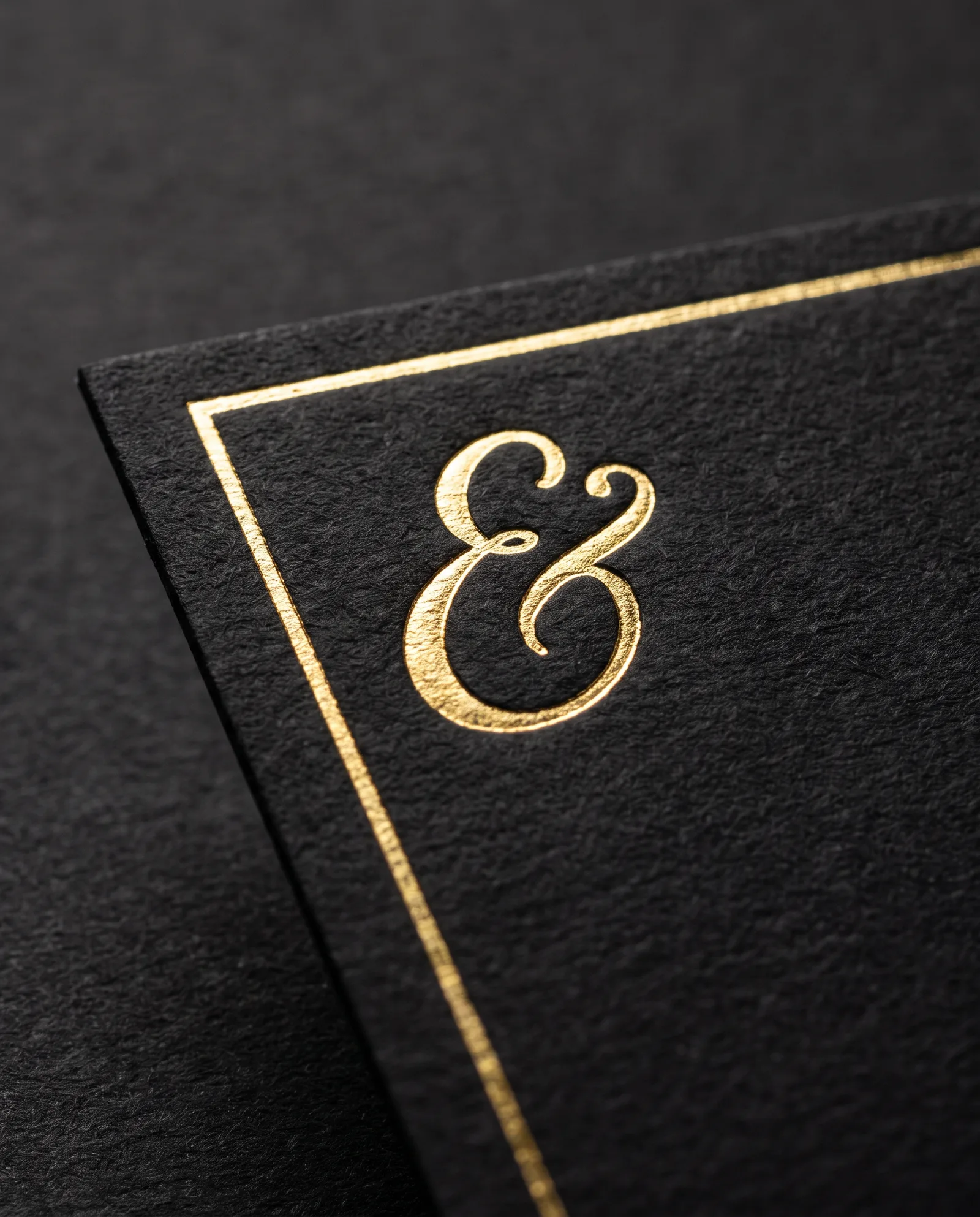
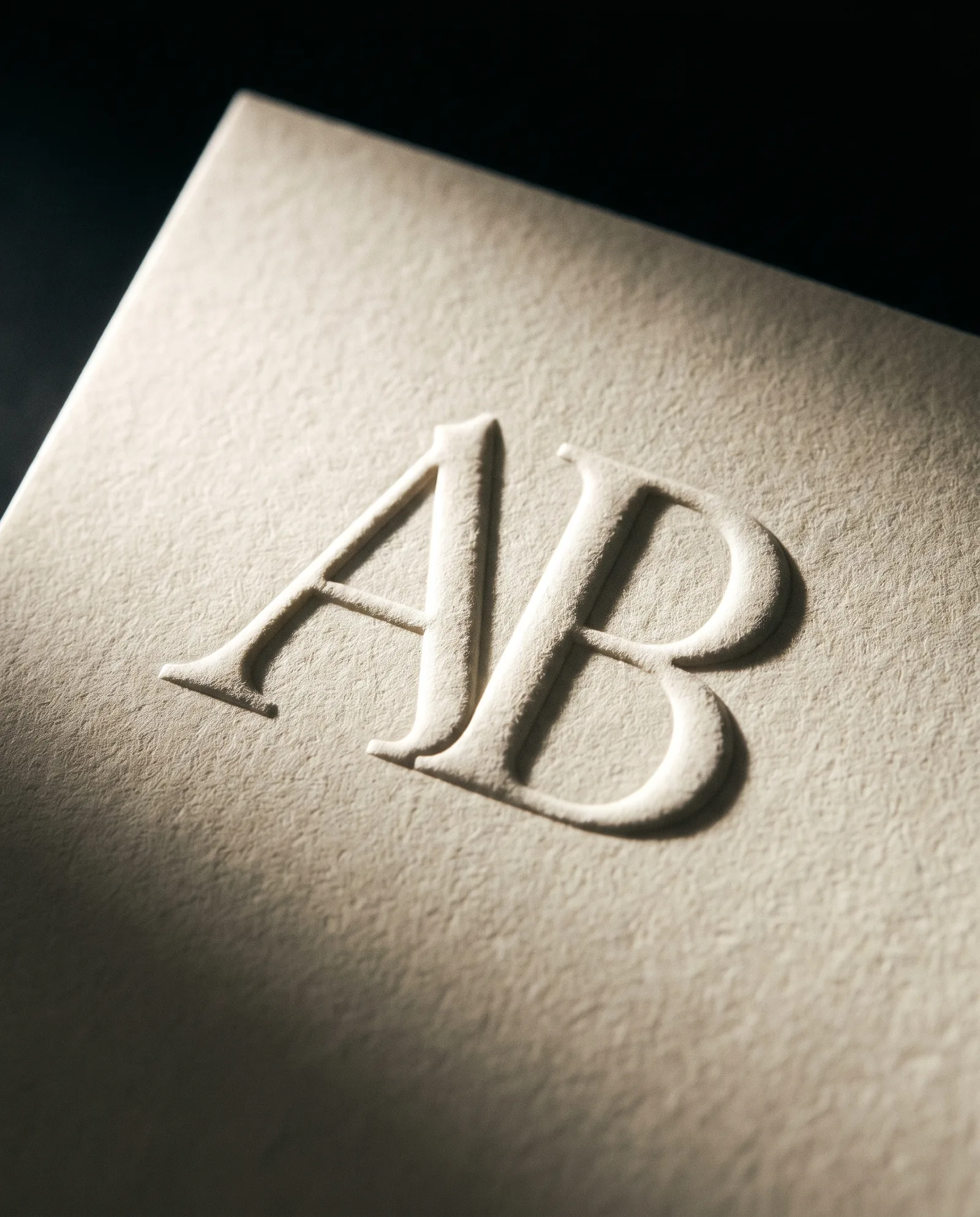
Learn more: Letterpress wedding invitations · Foil wedding invitations · Blind deboss wedding invitations · Duplex wedding invitations
Standard wedding invitation suite sizes
American invitation sizes are named after the envelopes they go into, which is why a 5 × 7 and an A7 are the same card. Each envelope runs about a quarter inch larger than the card it holds, and every enclosure has to slide into the invitation's envelope.
| Piece | Card size | Its envelope |
|---|---|---|
| Invitation | 5 × 7 in (A7), 127 × 178 mm | A7, 5¼ × 7¼ in |
| Large invitation | 5.5 × 8.5 in (A9), 140 × 216 mm | A9, 5¾ × 8¾ in |
| Reply card | 3.5 × 4.875 in (A1 or 4-bar), 89 × 124 mm | 4-bar, 3⅝ × 5⅛ in |
| Details card | 4.5 × 6.25 in (A6), or 4 × 6 or 3.5 × 5 in | Travels inside the invitation envelope |
| Save the date | 4 × 6 in, 5 × 7 in or A2 (4.25 × 5.5 in) | Its own envelope, or none as a postcard |
| Thank-you card | 4.25 × 5.5 in (A2), folded | A2, 4⅜ × 5¾ in |
Before you buy stamps, know what makes a suite cost more to mail in the US: square envelopes, wax seals, ribbon, rigid or lumpy packets, and anything thicker than a quarter inch all count as non-machinable and carry a per-piece surcharge. None of those is a mistake. Just weigh one fully assembled suite at the post office first. The details are in our guide to addressing and mailing wedding invitations.
How many of each piece to order
Count households, not guests. A couple or a family at one address gets one invitation, so a list of 100 guests usually needs well under 100 suites. Then add spares: a second run later carries its own setup, while spares on the first run cost very little.
| Piece | How many | Notes |
|---|---|---|
| Invitations | Households, plus 10 to 15% | Spares cover late additions, keepsakes and your photographer |
| Reply cards and reply envelopes | Same as invitations | One per invitation |
| Details cards | Same as invitations | One per invitation |
| Outer envelopes | Invitations, plus 15 to 20% if a calligrapher is addressing | Calligraphers need room for practice and mistakes |
| Save the dates | Households, plus about 10% | Send to everyone who'll get an invitation |
| Place cards and escort cards | One per guest, plus a few | Names change until the last week |
| Menus | One per guest, or one per table | One per guest feels generous; one per table is the economical version |
| Programs | About one per couple or household attending | Plus a few for the wedding party |
| Table numbers | One per table, plus one spare | |
| Thank-you cards | One per household that gave a gift, plus a few | Order them with the suite so they match |
Worked example. Say your list is 140 guests, and counting addresses gives you 80 households. Add 10 to 15% and you need about 88 to 92 invitations, reply cards and details cards. Round up to the next quantity in the builder. If a calligrapher is addressing, order about 96 to 100 outer envelopes. You'd need about 145 place cards and roughly 14 table numbers for tables of ten. That's an example, not a formula: your household count is the number that matters.
How the pieces stack in the envelope
The usual order, from the bottom up: the invitation face up, then the details card, then the reply card tucked under the flap of its own envelope rather than sealed inside it. Largest card at the bottom, smallest on top, all the type facing up. A belly band or vellum wrap goes around the stack, and the stack goes into the outer envelope so your guest sees the face of the invitation as they draw it out. The step-by-step version, with addressing etiquette, is in our addressing and mailing guide.
Wedding stationery checklist
Print this and tick it off.
Before the invitation
The invitation suite (start the design about four months before the wedding)
On the day
After
The full timing, counted back from your date, is in our wedding invitation timeline.
Feel the paper before you choose
Our sample kit is 8 $ with free US shipping, and you get a 10 $ credit on your first order. I'll be straight with you: it isn't a wedding swatch box. It's a bundle of real production samples built around business cards. But it holds what you're actually deciding between: cotton stock, how deep a letterpress bite reads, what a blind emboss does without ink, how a painted edge sits, and a hot foil swatch card with every foil we keep on the shelf. Hold the foils against your envelope colour, in your own light, before you lock the suite.
Real suites, start to finish
Three wedding projects from our case studies, with the briefs, the concepts and the decisions about which pieces made the cut.
The suite for my own wedding.
Two rounds and 43 concepts: a blind-embossed river map, bilingual letterpress and a PVC pass.
Read the case study: our founder's own wedding suite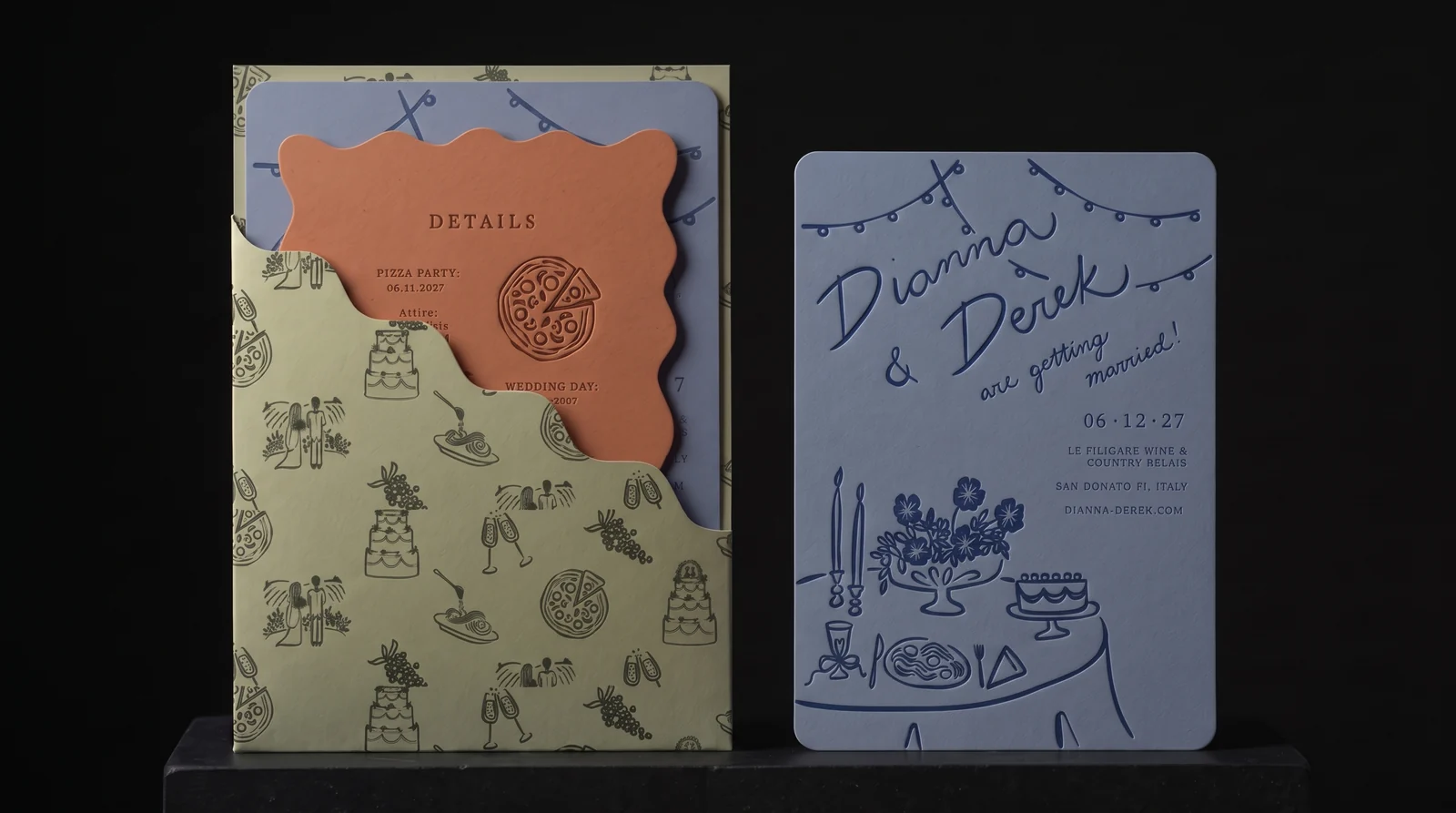
Keep it simple, and let the paper show.
A dusty-blue letterpress suite with a wave-cut pocket.
Read the case studySeventeen wedding directions, none of them ivory.
Letterpress arches, deco reply cards, acrylic, cork and holographic foil.
Read the case studyWedding invitation suite questions
What is a wedding invitation suite?
A wedding invitation suite is the set of matching cards your guests receive in one envelope, designed and printed together so the paper, ink colour and type match. The core pieces are the invitation, a reply card with its own envelope, a details card and the outer envelope. Liners, belly bands, vellum wraps and wax seals are optional finishing.
What does a wedding invitation suite include?
A typical suite has four core pieces: the invitation, a reply (RSVP) card with a pre-addressed reply envelope, a details card for hotels, travel and timings, and the outer envelope with your return address. Optional extras are envelope liners, a belly band or vellum wrap, a wax seal, inner envelopes and a reception card if the reception is at a different venue.
What is the difference between a wedding invitation suite and wedding stationery?
The invitation suite is only what goes in the invitation envelope. Wedding stationery is everything printed for the wedding: save the dates months before, the invitation suite, then ceremony programs, menus, escort and place cards and table numbers on the day, and thank-you cards afterwards. They can share one paper, ink and foil, but they are separate orders sent at different times.
Do you need an RSVP card if you have a wedding website?
No. Many couples drop the reply card and print the website address and a QR code on the details card, which saves a card, an envelope and a stamp per household. The trade-off is that some guests, often older ones, reply more slowly online. If your list includes people who rarely go online, keep a printed reply card for everyone.
Is a details card necessary?
Not strictly, but it's the piece I'd least like you to cut. It holds hotels, travel, timings, dress code and your website, which keeps the invitation itself clean and saves you answering the same questions by text. If the wedding is one venue, one afternoon and no travel, a short line on the invitation can do the job instead.
Do you still need inner envelopes?
No. Inner envelopes are a traditional extra layer with only the guests' names on them, from the days when outer envelopes got scuffed in the post. They're a nice formal touch and make it clear exactly who is invited, but most couples now skip them. If you leave them out, write the invited names clearly on the outer envelope.
What size is a standard wedding invitation suite?
The standard US invitation is 5 × 7 inches (A7) in a 5¼ × 7¼ inch envelope. Reply cards are usually 3.5 × 4.875 inches (A1 or 4-bar) with a 3⅝ × 5⅛ inch envelope, and details cards 4.5 × 6.25 inches (A6), 4 × 6 or 3.5 × 5 inches. Square suites are possible, but square envelopes carry a postage surcharge in the US.
How many wedding invitations do I need for 100 guests?
Count households, not guests: couples and families at one address share one invitation, so 100 guests usually need well under 100 invitations. Count your addresses and add 10 to 15% for late additions, keepsakes and your photographer. If a calligrapher is addressing the envelopes, order 15 to 20% extra envelopes for practice and mistakes.
How much does a wedding invitation suite cost?
Our three letterpress and foil suites on 32pt cotton run 1.640 $, 2.690 $ and 4.190 $ for 100 households, with envelopes and a free digital proof. Once couples add colours, liners or a specialty piece, most of the full suites we make for 100 guests land at about 2.500 $ to 5.000 $. Our wedding invitation cost guide breaks it down by guest count.
Do save the dates have to match the invitation suite?
They don't have to, but the pieces read as one family when they do, and the save the date is printed first, so it quietly sets the paper, ink colour and foil the suite has to follow. Lock those by name when you order the save the dates: paper and shade, Pantone number, the exact foil. We record the spec from your first order so the suite starts from it.
Can you mix letterpress, foil and digital printing in one suite?
Yes, and it's often the smartest way to spend. Give the invitation the full letterpress or foil treatment, print the reply and details cards in the same colour, and print anything with names or addresses flat. Two rules apply: foil never sits on top of ink, so we leave a gap between them, and light type on dark paper goes in foil, not ink.
Can we order the day-of pieces later?
Yes. Menus, place cards, programs and table numbers can be ordered once your seating is settled, usually names locked about six weeks before. Each later order is its own production run of about 3 weeks after you approve its proof, then shipping, and that's an estimate, not a guarantee. Ordering them unnamed with the suite keeps the ink and foil identical, and names can be handwritten or printed flat later.
What mistakes should you avoid with a wedding invitation suite?
The common ones: ordering one invitation per guest instead of per household; forgetting spares; printing light ink on dark paper, which looks chalky; putting a QR code in foil, which stops it scanning; choosing a square envelope or wax seal without budgeting the postage surcharge; and ordering pieces months apart without locking the paper, Pantone number and foil.
What is an enclosure card in a wedding invitation suite?
An enclosure card is any smaller card that travels inside the invitation envelope with the invitation: the reply card, the details card, and a reception card if the reception is at a different venue. Most suites need one or two. Enclosures are printed on the same paper in the same ink or foil as the invitation, and they have to fit inside its envelope, so with a 5 × 7 invitation they're usually 3.5 × 4.875 inches (A1) or 4.5 × 6.25 inches (A6).
See your whole suite before you order a piece
Tell the Studio your names, your date and roughly how many households you're inviting. Gus, our design assistant, sketches three directions for the whole suite in minutes. A person then checks every finish and sets your wording in real type, and nothing prints until you approve the proof.