SIZING
Business card size: standard dimensions in inches, mm and cm
The three standards (US 3.5 × 2 in, European 85 × 55 mm, credit-card ID-1) to scale, plus pixels, bleed, corners and every off-standard format.
By Austin Terrill, founder of Print Peppermint · Updated · 7 min read
On this page
The standard, typical business card is 3.5 × 2 inches (88.9 × 50.8 mm, 8.89 × 5.08 cm) in the US and Canada. In the UK and most of Europe it's 85 × 55 mm (3.35 × 2.17 in). A credit card, ISO 7810 ID-1, is 85.6 × 53.98 mm. Design files add 1/8 in (3 mm) of bleed on each side.
The three standards, overlaid · to scale
US 3.5 × 2 in · EU 3.346 × 2.165 in · ID-1 3.37 × 2.125 in
| US & Canada | UK & Europe | Credit card (ID-1) | |
|---|---|---|---|
| Inches | 3.5 × 2 | 3.35 × 2.17 | 3.37 × 2.125 |
| Millimetres | 88.9 × 50.8 | 85 × 55 | 85.6 × 53.98 |
| Centimetres | 8.89 × 5.08 | 8.5 × 5.5 | 8.56 × 5.40 |
| Pixels at 300 ppi | 1050 × 600 | 1004 × 650 | 1011 × 638 |
| With bleed | 3.75 × 2.25 in | 91 × 61 mm | 1 mm on metal; set by each product's template |
| Shape ratio | 1.75 : 1 | 1.55 : 1 | 1.59 : 1 |
If your cards will mostly be handed out in Europe, print them at 85 × 55. It reads as care, and they fit the cardholders there.
Standard business card size in inches
The standard US business card size is 3.5 inches wide and 2 inches tall. Canada uses the same size. It's the size every American cardholder, wallet slot and Rolodex was built around, and it's the default size on every paper card we make: you don't have to choose it.
Turn it on its side and it's still the standard size. A vertical (portrait) card is 2 × 3.5 inches: same trim, same price, just a different layout. So if you've seen "2 × 3" mentioned, that's not a business card size; the short side is 2 inches, and the long side is 3.5.
Business card size in mm and cm
In millimetres, a US standard card is 88.9 × 50.8 mm. Most printers round that to 89 × 51 mm, and either figure works in a design file. In centimetres it is 8.89 × 5.08 cm, often written 8.9 × 5.1 cm. The European standard is a rounder 85 × 55 mm (8.5 × 5.5 cm), and that's the number to use if you're designing for the UK, Germany, France or most of the EU.
| Format | Millimetres | Centimetres | Inches | Where it's standard |
|---|---|---|---|---|
| US standard | 88.9 × 50.8 (≈ 89 × 51) | 8.89 × 5.08 | 3.5 × 2 | US, Canada |
| European standard | 85 × 55 | 8.5 × 5.5 | 3.35 × 2.17 | UK, most of the EU |
| ISO 7810 ID-1 (credit card) | 85.6 × 53.98 | 8.56 × 5.40 | 3.37 × 2.125 | Bank cards, ID cards; metal cards |
| Japan (meishi) | 91 × 55 | 9.1 × 5.5 | 3.58 × 2.17 | Japan |
| Square | 63.5 × 63.5 | 6.35 × 6.35 | 2.5 × 2.5 | Our standard square |
| Our mini | 88.9 × 38.1 | 8.89 × 3.81 | 3.5 × 1.5 | Our standard mini (also called slim or skinny); 1 × 3 in on request |
Conversions use 1 in = 25.4 mm exactly. Rounded figures (89 × 51 mm) are fine for design files; we trim to the exact size.
European business card size (and the rest of the world)
The European business card size is 85 × 55 mm, about 3.35 × 2.17 inches. It's narrower and taller than the American card, by about 4 mm each way. That sounds like nothing until you try to slide a US card into a European cardholder: it's a few millimetres too wide, so it sits proud or won't go in.
There's no single world standard, only conventions. Here are the ones people ask us about most:
| Region | Millimetres | Inches | Notes |
|---|---|---|---|
| US, Canada | 88.9 × 50.8 | 3.5 × 2 | The North American standard |
| UK, most of Europe | 85 × 55 | 3.35 × 2.17 | Also called the “European format” |
| Japan | 91 × 55 | 3.58 × 2.17 | Meishi; slightly wider than European |
| Australia, New Zealand | 90 × 55 | 3.54 × 2.17 | |
| Scandinavia | 90 × 55 | 3.54 × 2.17 | |
| India | 89 × 51 | 3.5 × 2 | The US size |
What we print: every paper card we make defaults to the US standard, and that's the size in our configurators. The European 85 × 55 mm size is made to order: send us a custom quote request with your size and we'll confirm it before you pay.
Visiting card size
"Visiting card" is the name used in India and much of South Asia; "name card" is common across East and Southeast Asia. In India the usual visiting card size is 3.5 × 2 inches (89 × 51 mm), the same as the US standard, so a 3.5 × 2 file works for both.
Is a business card the same size as a credit card?
No, but it's close enough to confuse people. A credit card follows ISO 7810 ID-1: 85.6 × 53.98 mm (3.37 × 2.125 in), 0.76 mm thick, with corners rounded to 3.18 mm. A US business card is 3.3 mm wider and 3.2 mm shorter. Debit cards share the ID-1 size, and so do many ID badges and press cards.
Metal business cards are made at the credit-card size. Paper cards follow the business card standard, and plastic business cards come in several sizes.
| Measurement | Value |
|---|---|
| Size in mm | 85.6 × 53.98 mm |
| Size in cm | 8.56 × 5.40 cm |
| Size in inches | 3.37 × 2.125 in |
| Length (debit or credit card) | 85.6 mm (3.37 in) |
| Thickness | 0.76 mm (0.030 in, about 30 pt) |
| Corner radius | 3.18 mm (1/8 in) |
| Credit card size in pixels, 300 ppi (print) | 1011 × 638 px |
| Credit card size in CSS pixels (96 per inch, on screen) | 324 × 204 px |
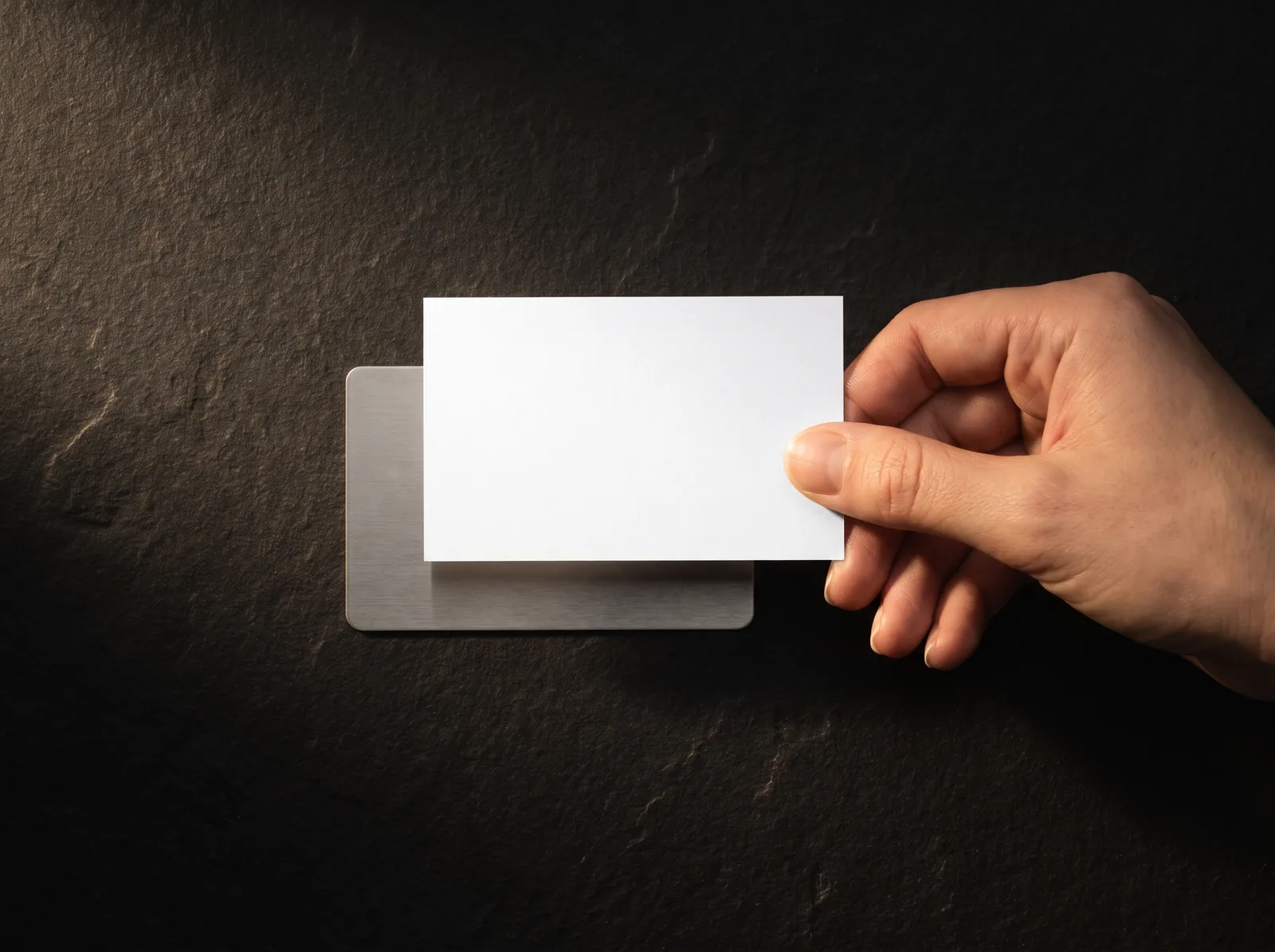
Business card size for your design file (pixels, points and bleed)
Your file is always bigger than your card. The extra is bleed: background colour or imagery that runs 1/8 inch (3 mm) past the edge on every side, so a tiny shift in cutting never leaves a white sliver. Keep text and logos at least 1/8 inch (3 mm) inside the edge. That's the safe area.
| US 3.5 × 2 in | European 85 × 55 mm | |
|---|---|---|
| Trim (finished card) | 3.5 × 2 in · 88.9 × 50.8 mm | 85 × 55 mm · 3.35 × 2.17 in |
| File size with bleed | 3.75 × 2.25 in · 95.3 × 57.2 mm | 91 × 61 mm |
| Safe area for text | 3.25 × 1.75 in | 79 × 49 mm |
| Pixels at 300 ppi, trim | 1050 × 600 px | 1004 × 650 px |
| Pixels at 300 ppi, with bleed | 1125 × 675 px | 1075 × 720 px |
| In points (design software) | 252 × 144 pt (270 × 162 pt with bleed) | 241 × 156 pt |
| On screen (CSS px, 96/in) | 336 × 192 px | 321 × 208 px |
One trap: "pt" in InDesign or Illustrator is a type point, 1/72 of an inch, so a 3.5 × 2 inch card is 252 × 144 pt. When a printer says a card is "16 pt" or "32 pt", that's a different point: a thousandth of an inch of thickness. Same word, two measurements.
And a mistake I see constantly: AI image tools and some templates default to 16:9 or 3:2 frames. A business card is 1.75:1. If your mockup was made in the wrong frame, the layout will squash or crop when it's set at the real size. Our designers rebuild every file at true size before the proof, so you'll see it before anything prints.
Off-standard sizes: square, mini, slim, vertical, folded and more
A card that doesn't fit the holder is a choice, and sometimes a good one. A square card gets noticed in a stack precisely because it doesn't line up. Just know which sizes we make as standard options and which are custom.
| Format | Inches | Millimetres | How we make it | From |
|---|---|---|---|---|
| Vertical / portrait | 2 × 3.5 | 50.8 × 88.9 | Standard size, turned; no price difference | Same as standard |
| Square | 2.5 × 2.5 | 63.5 × 63.5 | Standard size option on Standard and Custom | From 84 USD for 25 |
| Mini (slim, skinny) | 3.5 × 1.5 | 88.9 × 38.1 | Standard size option | From 52 USD for 100 |
| Slim (other printers) | 3.5 × 1.75 | 88.9 × 44.5 | Custom size | Get a price |
| Tiny / micro | 1 × 3 (3 × 1 landscape) or 2.75 × 1.1 | 25.4 × 76.2 or 70 × 28 | 1 × 3 in made on request; 2.75 × 1.1 custom | Get a price |
| Circle | 2 diameter | 50.8 diameter | Die cut | See circle and oval |
| Oval | 2 × 3.5 | 50.8 × 88.9 | Die cut | See circle and oval |
| Folded (top fold) | 3.5 × 4 flat → 3.5 × 2 closed | 88.9 × 101.6 → 88.9 × 50.8 | Scored and folded; 4 printable panels | 229 USD for 250 |
| Folded (side fold) | 7 × 2 flat → 3.5 × 2 closed | 177.8 × 50.8 → 88.9 × 50.8 | Custom | Get a price |
| Oversized | 3.5 × 2.5 or 4 × 2.5 | 88.9 × 63.5 or 101.6 × 63.5 | Custom | Get a price |
| Custom shape | up to 5 × 7 | up to 127 × 178 | Die cut; larger shapes need their own die quote | See die-cut cards |
Prices checked 1 Oct 2026.
For the size of each shape, and when a shape earns its place, see our guide to business card shapes.
Are business cards 4 × 6? No. 4 × 6 inches is a postcard. See invitation, flat card and postcard sizes.
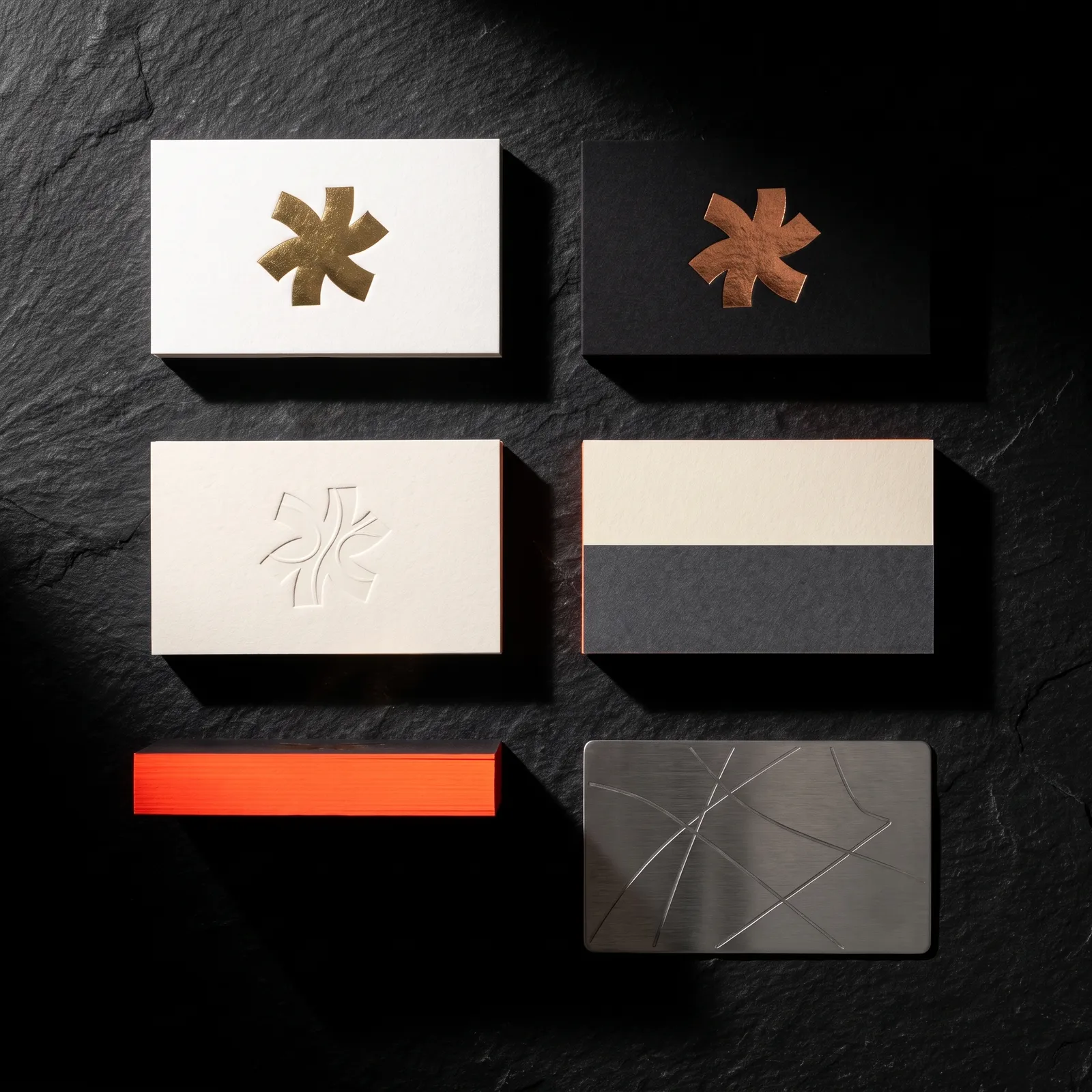
Corners
Square corners are the default and cost nothing. Rounded corners are a separate cutting operation. Two radii cover almost everything on paper. Metal, wood and NFC cards get a credit-card-style 3 mm radius as standard; plastic offers 1/8 or 1/4 inch.
| Radius | Inches | Millimetres | Where we use it |
|---|---|---|---|
| Soft | 1/8 | 3.2 | Paper cards (the rounded-corner option on Custom Thick); reads as a soft detail |
| Rounder | 1/4 | 6.35 | Our Standard rounded-corner cards; clearly a design decision |
| Credit-card style | ≈ 1/8 | 3 | Metal, wood and NFC, as standard (an ID-1 bank card is 3.18 mm) |
One thing worth knowing before you choose: gilded (foil) edges work with square or rounded corners. Painted edges can follow a rounded corner too, but our production team confirms each one first.
Painted edge business cards →rounded corner business card size
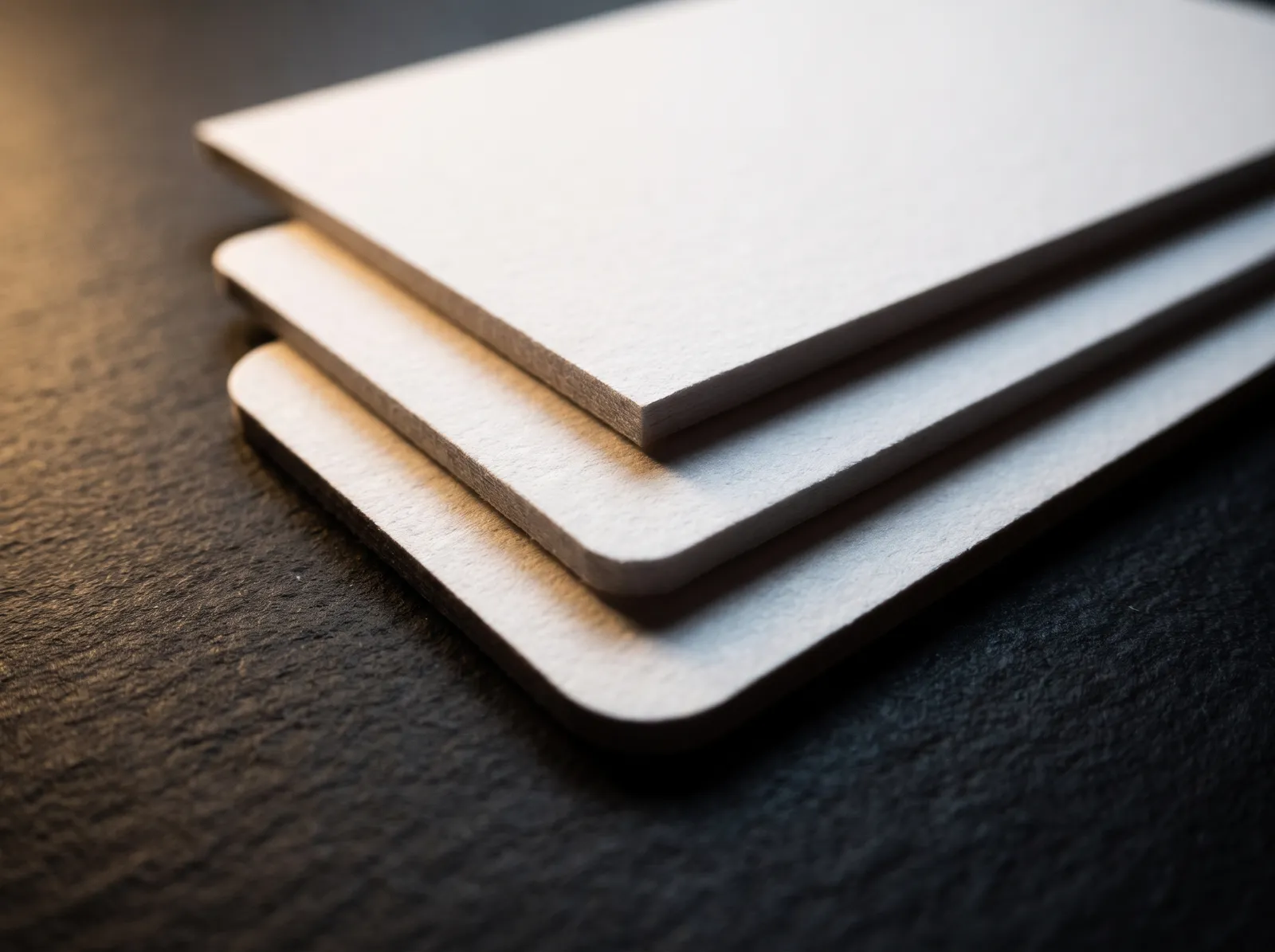
LANDMINE
The size mistake that costs people a reprint
It's almost never the card size itself. It's a file built at exactly 3.5 × 2 inches with the background stopping at the edge. Cutting stacks of cards moves by a fraction of a millimetre, and that fraction shows as a white hairline on one side. The fix is free: build the file at 3.75 × 2.25 inches and run the background past the edge.
The second one is regional: printing US-size cards for a European trade show. They work, but they're a few millimetres wider than the cardholders there were made for. If most of your cards will be handed out in Europe, print at 85 × 55.
Either way, a person checks your file before anything prints. If the bleed is missing or the size is off, we fix it and show you on the proof.
Thickness, in three vocabularies
Size is two dimensions; how a card feels is the third. Printers measure thickness in points (thousandths of an inch), paper mills in gsm, and everyone else in "compared with a credit card".
| Thickness | Inches | Millimetres | Roughly |
|---|---|---|---|
| 16 pt (standard) | 0.016 | 0.41 | ≈ 350 gsm |
| Credit card | 0.030 | 0.76 | the ID-1 standard |
| 32 pt (thick) | 0.032 | 0.81 | two 16 pt sheets bonded |
| 48 pt (extra thick) | 0.048 | 1.22 | three sheets |
For the full chart from 14 pt to 64 pt, and which finishes need which thickness, read business card thickness explained.
See it on your design.
Upload your logo and our art director shows you a concept in minutes. Concepts are direction, not proofs; a person rebuilds the final file at the real size.
Start in the StudioFeel it first.
Our sample pack puts 12–14 real papers, finishes and materials in your hand, so you can feel the difference before you choose.
Order the sample pack (8 USD)10 USD credit on your first order.
Talk to Austin.
Not sure which size works where you're handing them out? Book 15 minutes.
Talk to our teamKnow your size? Configure the card → specialty business cards
Business card size: questions
What is the size of a standard business card?
A standard business card is 3.5 × 2 inches (88.9 × 50.8 mm) in the US and Canada. In the UK and most of Europe the standard is 85 × 55 mm (3.35 × 2.17 inches). Both are the typical size for their region, and both fit the cardholders and wallets sold there.
What are business card dimensions in mm?
A US business card is 88.9 × 50.8 mm, usually rounded to 89 × 51 mm. A European card is 85 × 55 mm, a Japanese card 91 × 55 mm, and a credit card 85.6 × 53.98 mm. With 3 mm of bleed on each side, a US card's file is 95 × 57 mm and a European card's file is 91 × 61 mm.
What is a business card size in cm?
A standard US business card is 8.89 × 5.08 cm (often written 8.9 × 5.1 cm). The European standard is 8.5 × 5.5 cm. A credit card is 8.56 × 5.40 cm.
What is the European business card size?
85 × 55 mm, about 3.35 × 2.17 inches. It's used in the UK, Germany, France and most of the EU. It's narrower and taller than the US card, which is why a US card can be a tight fit in a European cardholder. It is not the same as the credit-card size (85.6 × 53.98 mm).
Is a business card the same size as a credit card?
No. A credit card follows ISO 7810 ID-1: 85.6 × 53.98 mm (3.37 × 2.125 inches, 8.56 × 5.40 cm), 0.76 mm thick, with 3.18 mm rounded corners. A US business card is 3.3 mm wider and 3.2 mm shorter. Metal business cards are made at the credit-card size; paper cards follow the business card standard.
What is a business card size in pixels?
At 300 pixels per inch, the print standard, a US business card is 1050 × 600 px, or 1125 × 675 px with bleed. A European card is 1004 × 650 px. On screen at 96 CSS pixels per inch, a business card is 336 × 192 px and a credit card is about 324 × 204 px. At 300 ppi, a credit card is 1011 × 638 px.
Is a business card 2 × 3 inches?
No. A standard business card is 2 × 3.5 inches. The short side is 2 inches and the long side is 3.5. Printed vertically, it's 2 inches wide and 3.5 inches tall: the same card turned on its side.
Are business cards 4 × 6?
No. 4 × 6 inches is a postcard or photo-print size. A business card is 3.5 × 2 inches, a little over a quarter of the area of a 4 × 6.
What size should I make my business card file?
For a US card, set the document to 3.75 × 2.25 inches: the 3.5 × 2 card plus 1/8 inch of bleed on every side. Keep text and logos inside 3.25 × 1.75 inches. For a European card, use 91 × 61 mm with text inside 79 × 49 mm. At 300 ppi that's 1125 × 675 px for the US file. A person checks every file at proof, so if the bleed is missing we fix it and show you.
What size is a vertical (portrait) business card?
2 × 3.5 inches (50.8 × 88.9 mm). It's the standard card turned on its side, so it costs the same and fits the same holders.
What is the standard visiting card size?
In India, the usual visiting card size is 3.5 × 2 inches (89 × 51 mm), the same as the US standard. In Europe the equivalent is 85 × 55 mm, and in Japan 91 × 55 mm.
How many business cards fit on an 8.5 × 11 sheet?
Ten: two across and five down, at 3.5 × 2 inches each with no space between them. That's how home-printable card sheets are laid out. Professionally printed cards are printed on larger press sheets with bleed around each card and then cut, which is why the edges come out clean.