Keep it simple, and let the paper show.
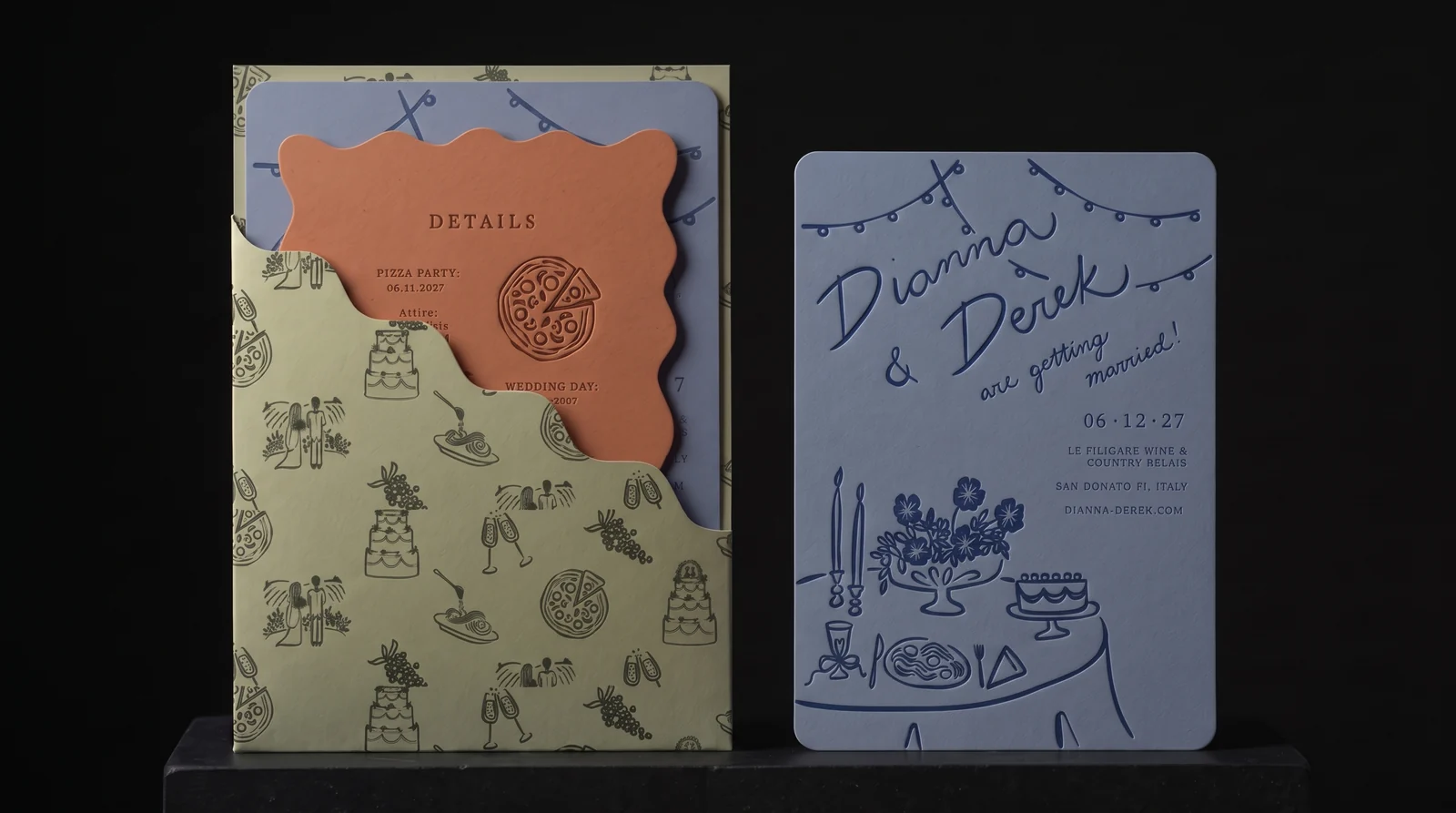
A dusty-blue letterpress suite for a Tuscan weekend, with a wave-cut pocket and the couple's final pick.
Read the case studyA wedding invitation suite is every piece your guests open in one envelope: the invitation, a reply card with its own envelope, a details card, and the outer envelope with your return address. Ours are printed in letterpress or foil on 32pt cotton. Most full suites for 100 guests land between about 2500 USD and 5000 USD.
Three directions in minutes. A person checks every finish.
Free digital proof. Nothing prints until you approve it, and a person checks every file and every finish first.
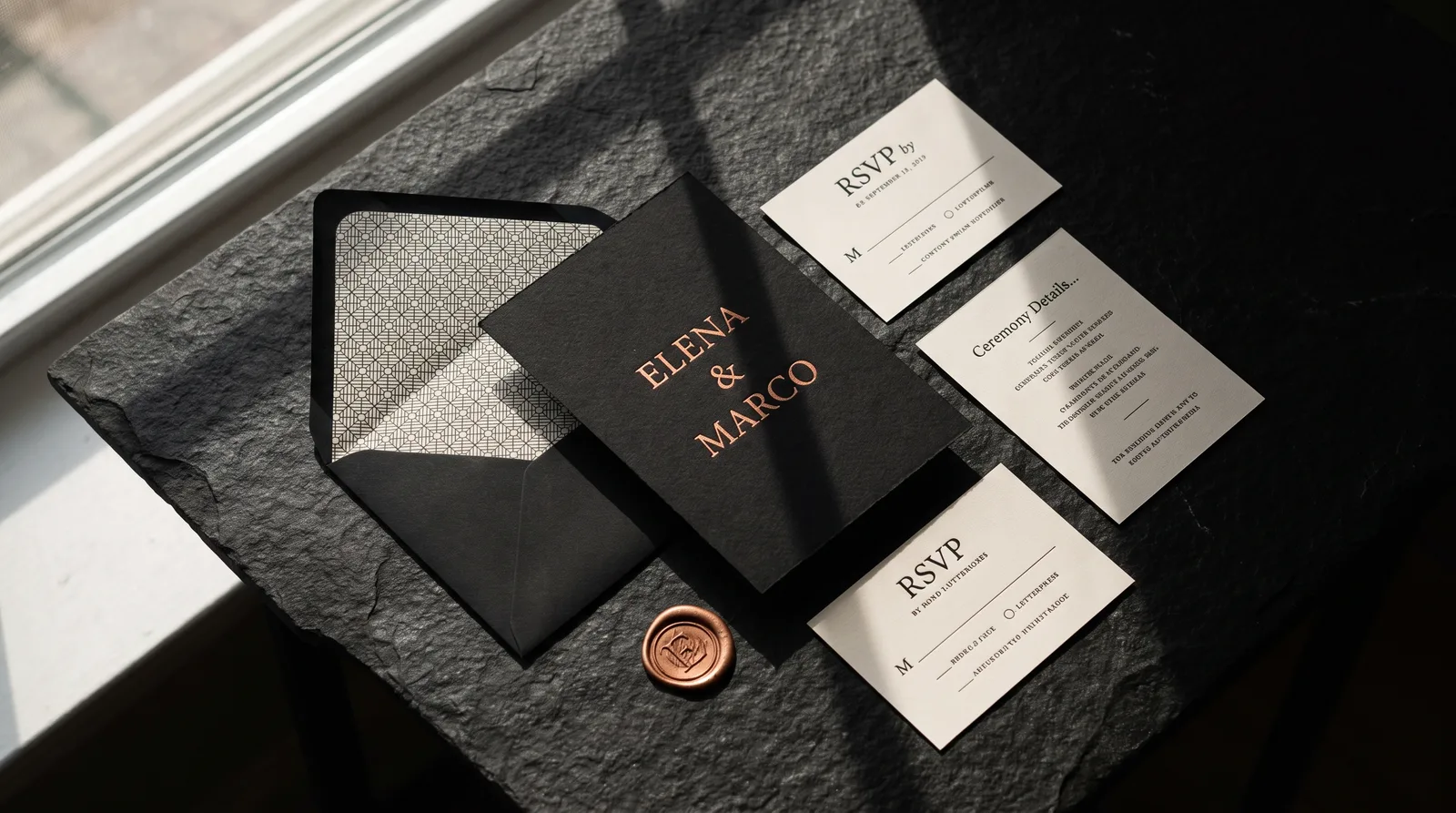
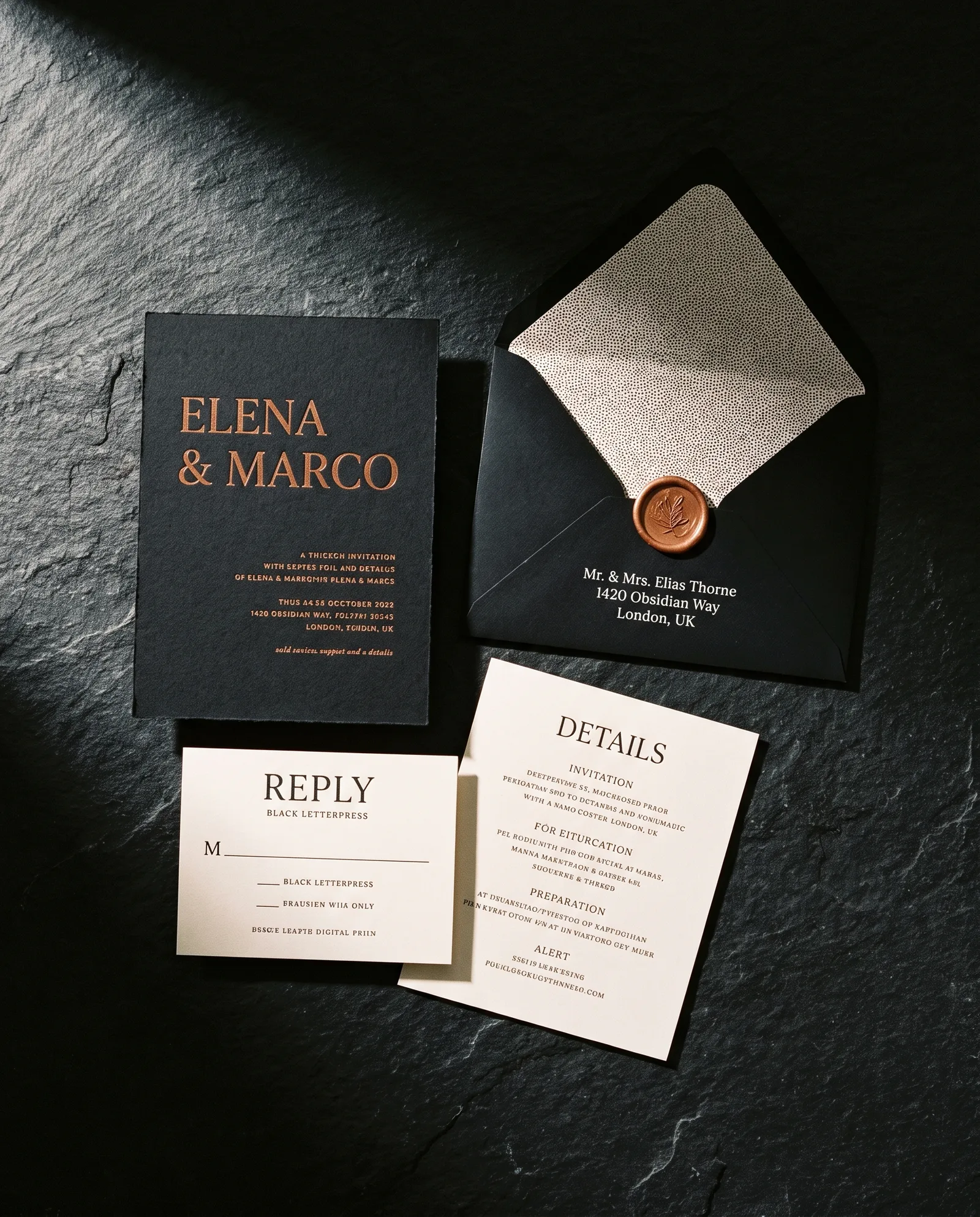
A suite, sometimes sold as a wedding stationery suite or a wedding invitation package, is a set of cards designed together and printed together, so the paper, the ink colour and the type match across every piece. Here is what goes in the envelope, and what each piece is for.
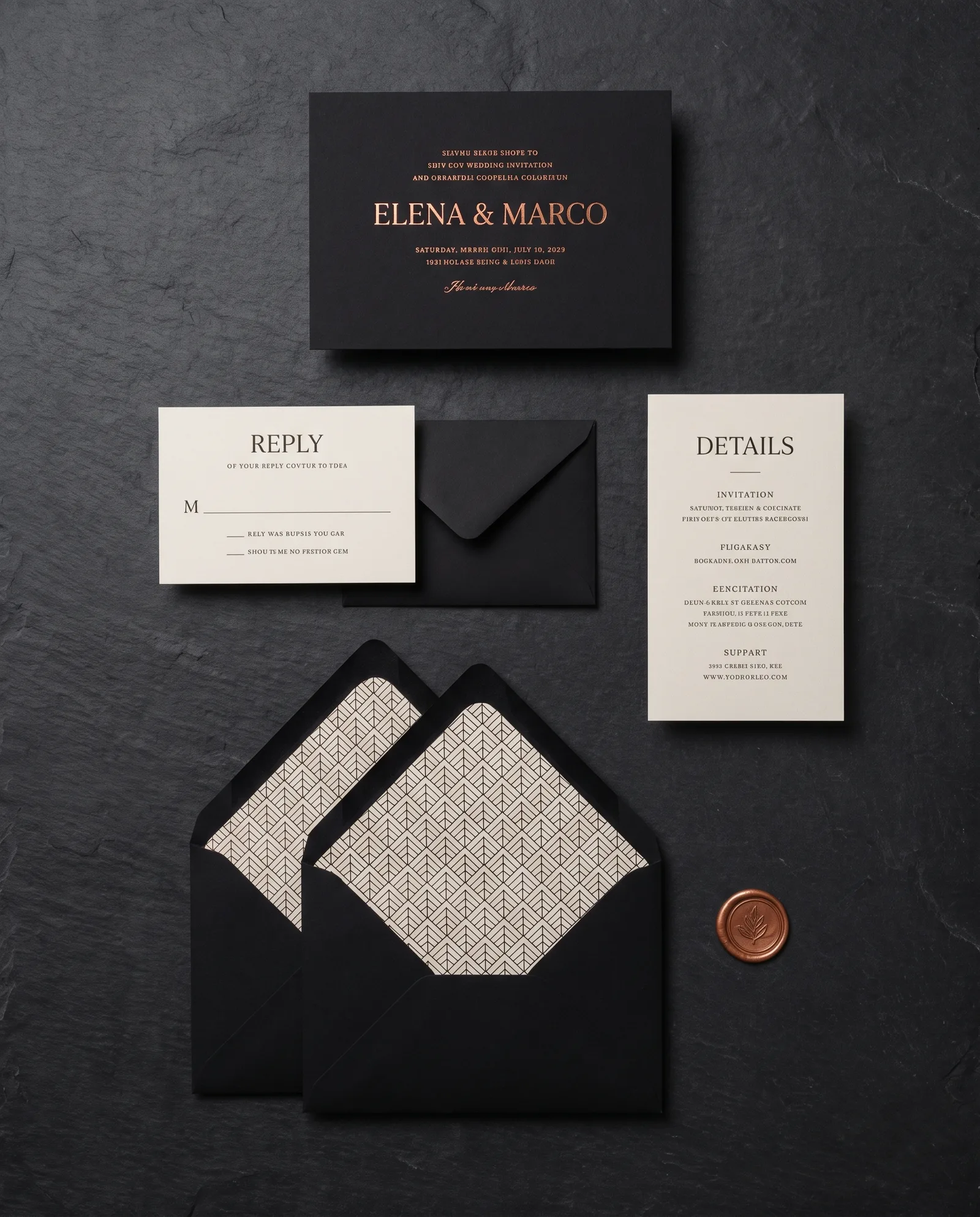
Outer envelope. Carries your return address, printed on the flap. Envelopes take ink and foil only in set areas and never to the edge, so we place the address on your envelope template before proof.
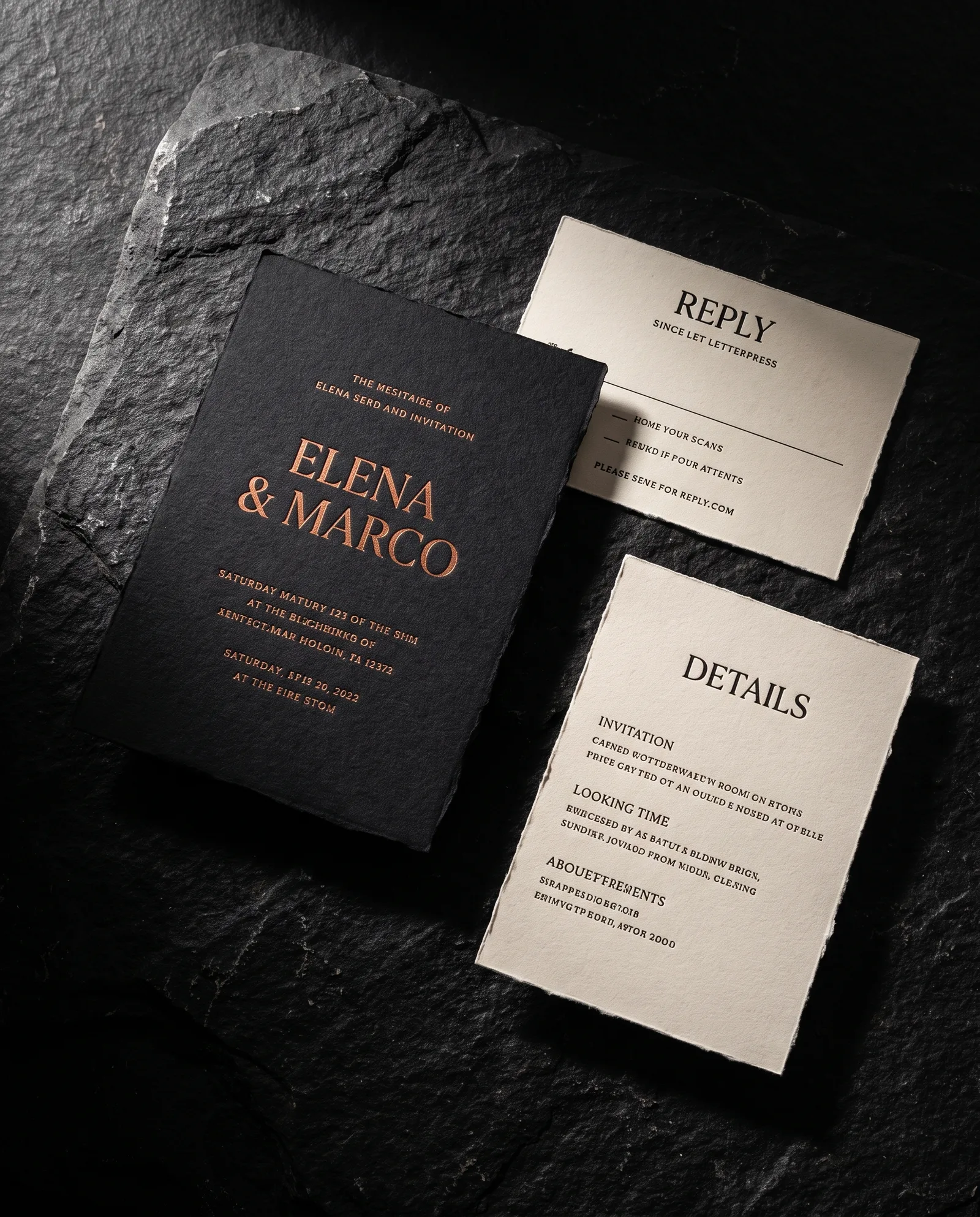
The invitation. Usually 5×7 inches. The names, the date, the place. This is the card that gets the letterpress bite or the foil, and the one people keep.
Reply card (RSVP) and its envelope. A smaller card your guests send back, with its own pre-addressed envelope so replying takes a pen and a postbox. If you'd rather collect replies online, a details card with your wedding website can take its place.
Details card. Travel, hotels, the weekend's timings, dress code, your wedding website. Keeping this off the invitation is what lets the invitation stay clean.
Finishing (optional). Envelope liners, belly bands, vellum wraps and wax seals. These are the pieces that turn a set of cards into something people photograph before they open it.
Matching pieces (separate orders). Save the dates go out months earlier; menus, place cards and table numbers come later. They can share the same paper and colour so the whole wedding reads as one family.
| Essential | ClassicThis page | Signature | |
|---|---|---|---|
| Invitation, 32pt cotton, letterpress or foil | Yes | Yes | Yes |
| Reply card | Yes | Yes | Yes |
| Details card | — | Yes | Yes |
| Envelopes with printed return address | Yes | Yes | Yes |
| Guest addressing (printed) | — | — | Yes |
| Envelope liners | — | — | Yes |
| Wax seal | — | — | Yes |
| Free digital proof | Yes | Yes | Yes |
| 100 guests | 1640 USD | 2690 USD | 4190 USD |
Prices are for one suite per household, at 100 households, with one ink or foil colour. Change the guest count in the builder below.
Pick a suite, pick your guest count, and the price you see is the price you pay for that spec. All three are wedding invitations with RSVP cards and envelopes included; Classic adds the details card, and Signature adds addressing and finishing. The total is the number that matters; the per-guest figure is underneath for comparison. Classic is the one we recommend for most weddings, so it opens first.
Wedding suites
Invitation, reply card and details card, one colour on 32pt cotton, envelopes included. Our recommendation for most weddings.
2215 USD
50 guests · 44,30 USD per guest
About 3 weeks of production after you approve your proof, then shipping. This is an estimate, not a guarantee.
Free continental-US ground shipping.
Self-serve price: you set it up, upload print-ready files and check out. Want a designer to check or rebuild your files, extra names, or a finish not listed? Get a custom quote (design prep, proofs until you're happy, a real person on it).
If you're not happy, we reprint. How our quality promise works
Price-Lock Promise
You pay the price you see for the spec you ordered. If our artwork review finds a cheaper spec that suits your design better, we'll suggest it and refund the difference. Any upgrade is charged only if you approve it. If we can't print your artwork well on the ordered spec and you don't want to change it, you get a full refund before anything prints.
For 100 guests, our three suites run 1640 USD, 2690 USD and 4190 USD. Most full suites for 100 guests land between about 2500 USD and 5000 USD once a couple adds a second colour, liners or a specialty piece. That's the honest range, and it's worth knowing before you fall for a design.
Every letterpress plate, foil die and press setup costs the same whether we run 50 cards or 200. Below about 75 guests, setup is most of what you pay for, so halving the guest list doesn't halve the price. A Classic suite is 2690 USD for 100 guests and 2215 USD for 50. Half the cards, most of the cost. We'd rather you hear that from us now than discover it at checkout.
The pieces in a suite share one ink mix, one paper order, one proof and one production run. Ordered one at a time, each piece carries its own setup. That's why a suite costs less than buying the same cards separately, and why everything matches: same batch of ink, same paper, every piece.
The Knot's 2026 Real Weddings Study puts the average couple's total stationery spend at about 510 USD. Stationers quoted in the same report put fully custom suites for around 100 guests at 4000 USD to 7000 USD. We sit between the two: real letterpress and foil on heavy cotton, art-directed and proofed for your wedding.
Price your own suite in the builder| Letterpress | Foil | Emboss and blind deboss | |
|---|---|---|---|
| How it's made | An inked plate is pressed hard into soft cotton, pushing the ink down into the sheet. | Heat and pressure transfer a metal or pigment film onto the paper through a die. | The paper is pressed between a matched pair of metal dies, usually with no ink at all. |
| What you notice | You feel every line under your thumb. Matte, quiet, very tactile. | Real shine: gold, copper, silver, or an opaque white on dark paper. | The shape stands up (emboss) or sinks in (deboss) and reads by its shadow. |
| Where it lets you down | Letterpress ink is see-through, so light ink on dark paper looks chalky. Big solid areas print with a soft, suede-like mottle. | Fine detail survives foil; we design to 0.15 mm and only adjust lines under 0.1 mm. Tiny type is checked at proof. A gradient becomes one flat tone. | On black paper a blind impression is very quiet. On a single sheet it leaves a mirror image on the back. |
| Best for | Names and text on white, ecru or pale cotton. | Light-on-dark designs, metallic accents, monograms. | Monograms, crests, a quiet border. |
| Learn more | Letterpress wedding invitations | Foil wedding invitations | Blind deboss wedding invitations |
Choose on look and feel first, then on the paper you love. A letterpress wedding invitation suite and a foil one sit on the same price ladder with us, so budget shouldn't decide it. Each process has one thing it does better than the others, and one place it lets you down.
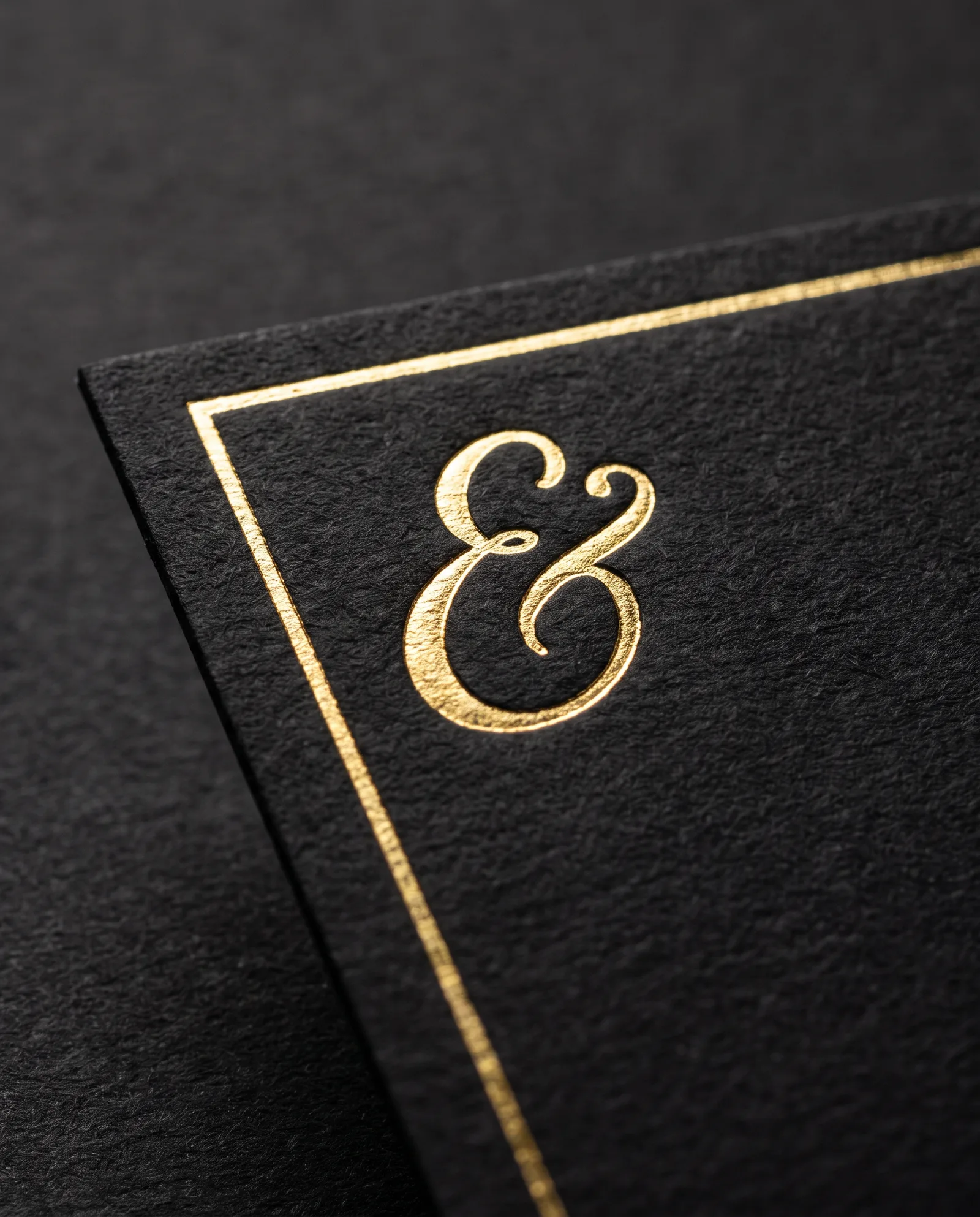
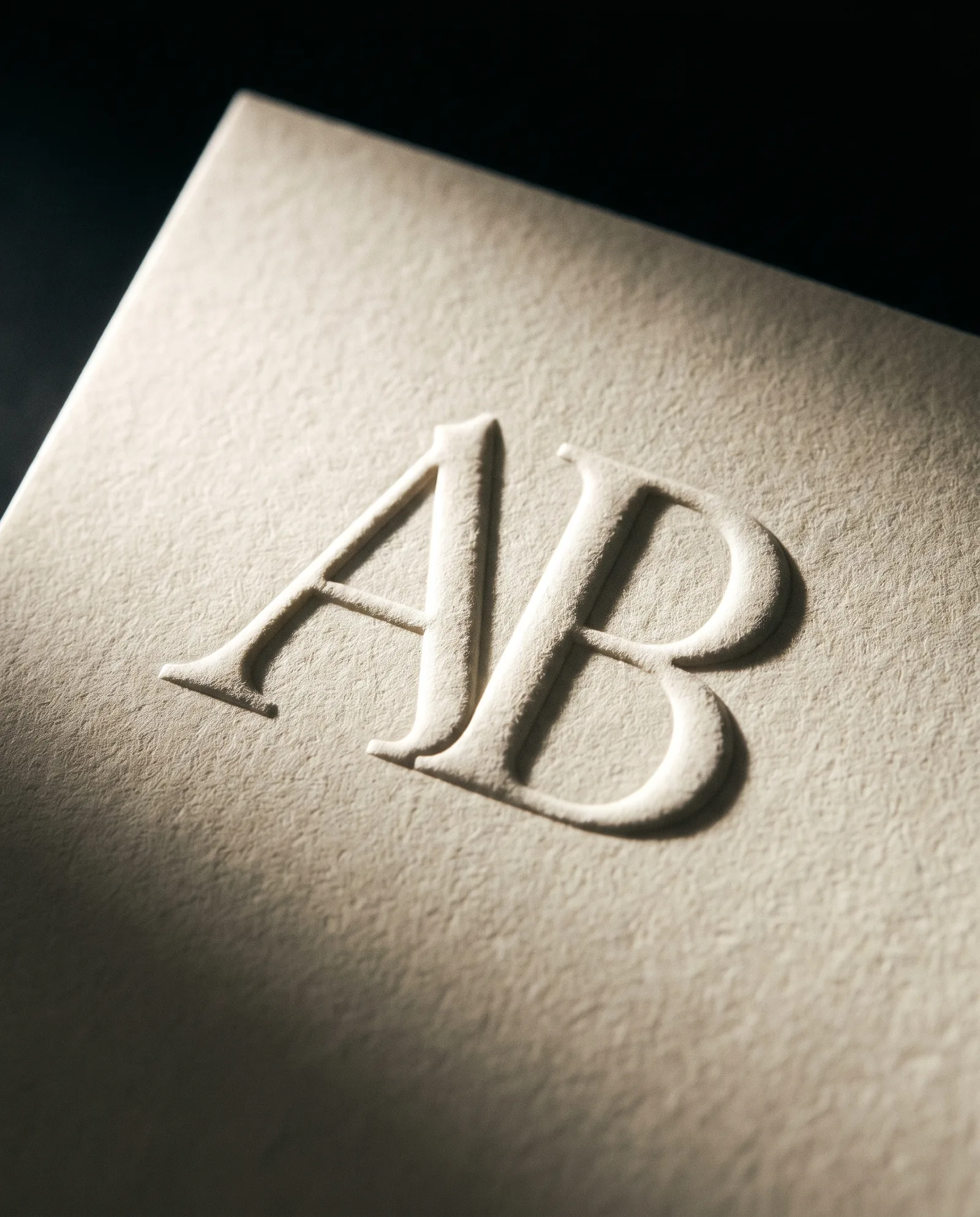
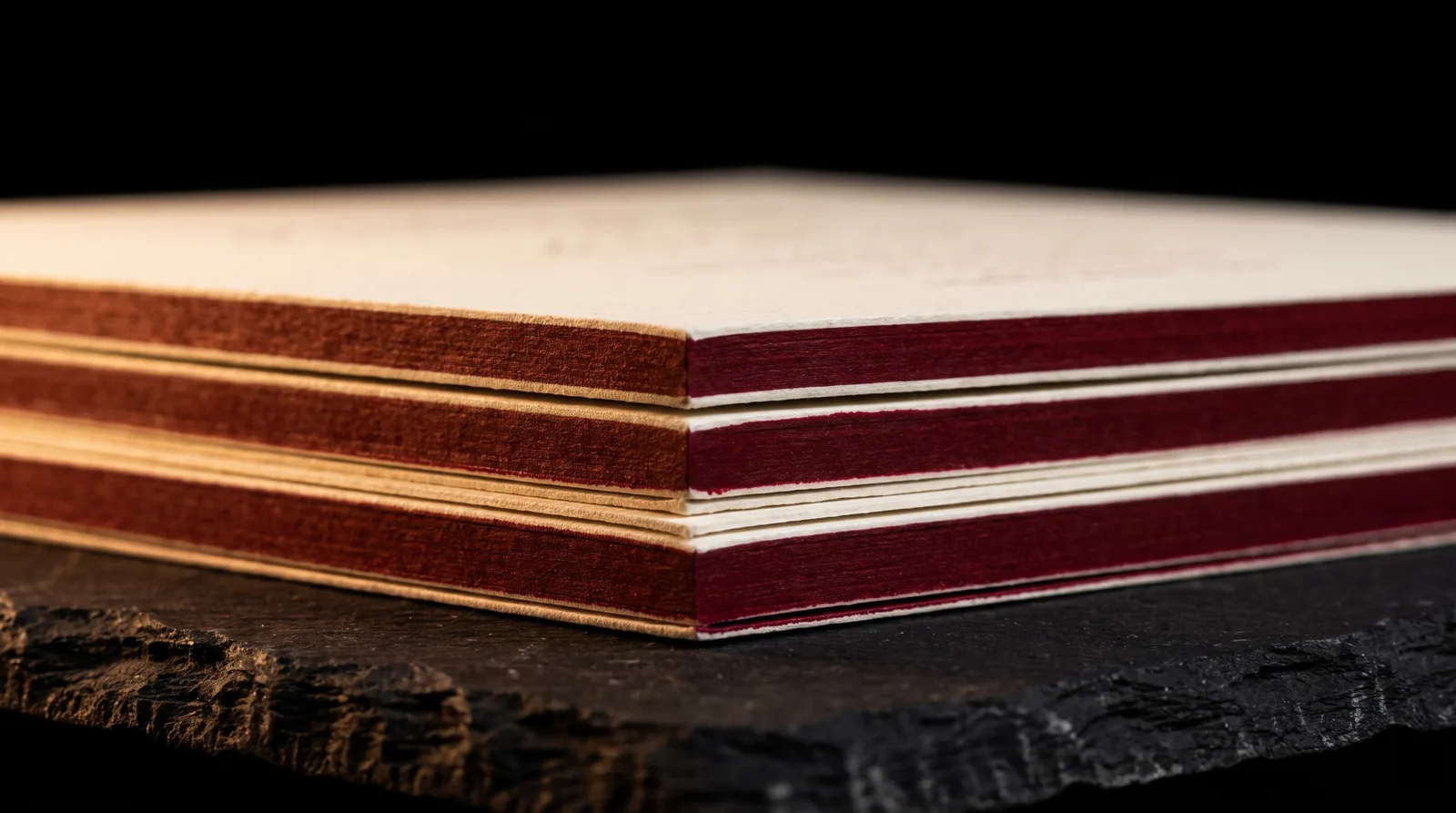
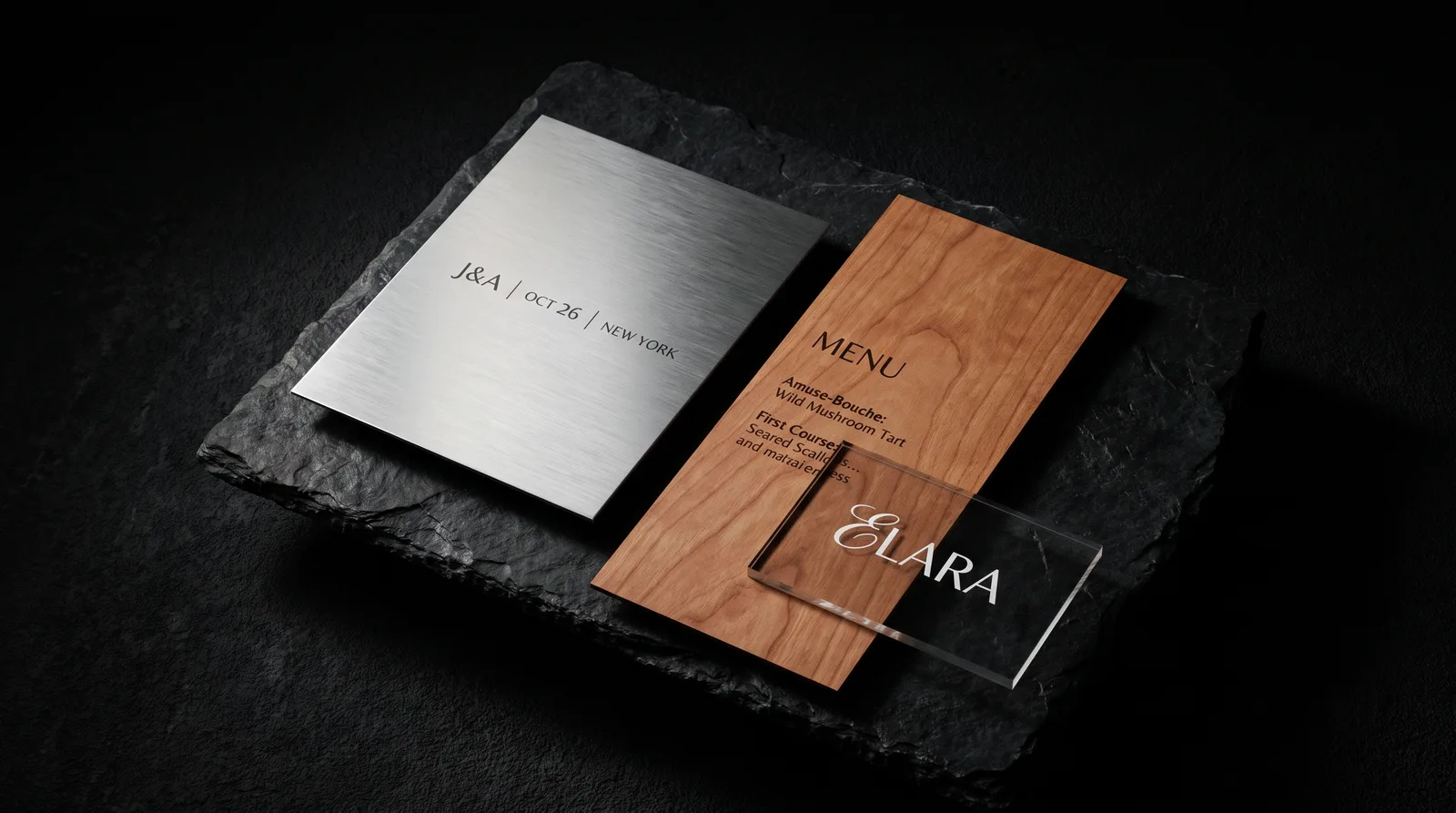
Some suites want one piece that isn't a card at all. We combine specialty materials in a single suite: duplex cotton with a coloured core, painted edges, die-cut and laser-cut shapes, and accent pieces in acrylic, metal or wood. Each one has its own rules. Metal takes laser engraving, etching, colour fill and UV print, never hot foil or letterpress. Acrylic takes UV print and laser engraving, never letterpress. Painted edges are brushed onto a clamped stack, so they follow a straight outline, not a notch or a window.
Fully custom wedding invitation suites like these are quoted, not configured. Start in the Studio and Gus, our design assistant, will sketch the direction first; a person then checks every material and finish before we price it.
Design your suiteSee three directions. Tell the Studio your names, date and guest count. Gus sketches three directions in minutes. They're pictures for choosing a direction, not print files.
A person checks every finish. We rebuild your chosen direction as a real print file, set your wording in real type, and flag anything that won't print the way it looks on screen.
Approve a free digital proof. Nothing prints until you approve it. Proofing usually takes a few days, depending on how quickly changes go back and forth.
Production, then shipping. About 3 weeks of production after you approve your proof, then shipping. Free continental-US ground shipping. US orders ship from the US; EU orders ship from Berlin.
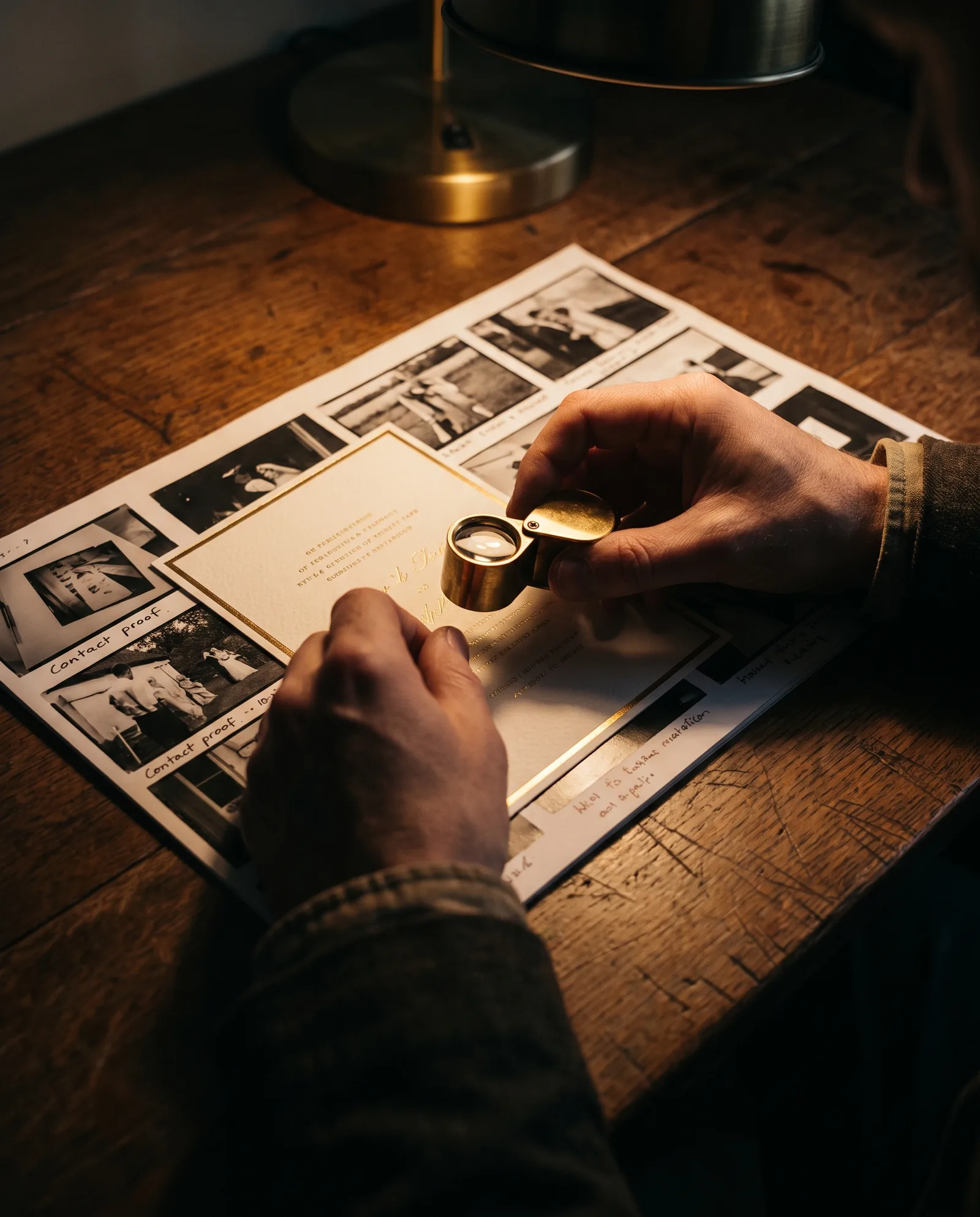
Three wedding projects from our case studies, with the briefs, the concepts and the decisions behind them.
A dusty-blue letterpress suite for a Tuscan weekend, with a wave-cut pocket and the couple's final pick.
Read the case studyIf your designer or stationer has already drawn the suite, upload it in the builder and we'll check it against how letterpress and foil really behave before anything prints. If you'd like us to set the wording and layout, add design help (95 USD) at checkout, or see our full design service if you'd like the whole suite designed from scratch.
Our sample kit is 8 USD and is credited toward your first order. It isn't a wedding swatch box. It's our general sample pack: real production pieces, mostly business cards, across our papers and finishes, plus a hot foil swatch card showing the foils we stock. A business card is small, but it's the same paper and the same press as your invitation, so you can feel the weight, see how an impression catches the light, and hold the foils against your own envelope colour before you choose.
Order the sample kitMatching pieces, ordered separately: Save the dates · Place cards · Menus and programs
A wedding invitation suite is the set of cards your guests receive in one envelope: the invitation, a reply card with its own envelope, a details card for travel and timings, and the outer envelope with your return address. Liners, belly bands, vellum wraps and wax seals are optional finishing. Save the dates and day-of pieces such as menus and place cards can match the suite but are ordered separately.
Our three suites for 100 guests are 1640 USD (Essential), 2690 USD (Classic) and 4190 USD (Signature), with envelopes, a free digital proof and free continental-US ground shipping. For 200 guests they are 2190 USD, 3615 USD and 6600 USD. Most full suites for 100 guests land between about 2500 USD and 5000 USD once you add extra colours, liners or a specialty piece.
Plates, dies and press setup cost the same for 50 cards as for 200. Below about 75 guests, setup is most of the bill, so a Classic suite for 50 guests is 2215 USD, not half of the 2690 USD it costs for 100. For the same reason, a few spare suites added to the original order cost far less each than the per-guest price suggests.
Choose letterpress if you want guests to feel the type: an inked plate presses the words into soft cotton. Choose foil if your design is light on dark paper or needs real shine, because letterpress ink is see-through and looks chalky on dark stock. On our suites one colour of either is priced the same, so choose on look, not budget.
On our suites, letterpress costs the same as one colour of foil: 1640 USD for an Essential suite for 100 guests and 2690 USD for Classic, envelopes included. Letterpress gets expensive through setup, not ink: every colour is its own plate and its own press pass, so extra colours and short runs cost the most. That's why we price a second colour as a flat add-on rather than per card.
If your guests will hold the card, yes. The impression is the one thing a screen or a flat print can't imitate, and on 32pt cotton you feel every line. It's the wrong choice for photographs, gradients or large solid areas of colour, which print with a soft mottle. Those work better with foil or a coloured paper.
Letterpress presses inked type into the paper, so the words sit below the surface in colour. Embossing presses the paper up from behind between two matched dies, usually without ink; a blind deboss presses it down without ink. All three need soft uncoated or cotton paper, and a deep impression of any of them shows on the back of a single sheet, which is why we bond a second sheet when the back matters.
An emboss reads only by its shadow, so it needs bold shapes: fine lines and small type disappear. On a single sheet it leaves a reversed impression on the back, which we fix by bonding a second sheet behind it. On black or very dark paper a blind emboss or deboss is very quiet, so if it has to be read we add foil inside the impression.
Work back from your mail date. Invitations usually go out 6 to 8 weeks before the wedding (8 to 12 for a destination wedding). Allow a week or so for concepts and proofing, about 3 weeks of production after you approve the proof, about a week of shipping, and a week or two to address and assemble. These are estimates, not guarantees, so leave a cushion.
We don't offer rush production, so we don't promise rush dates. A suite takes about 3 weeks of production after you approve your proof, then shipping. If your mail date is tight, tell us your date before you order and we'll say honestly whether it fits. If it doesn't, you'll hear that from us before you pay, not after.
Order one suite per household, not per guest, then add 10 to 15 percent for late additions, keepsakes and your photographer. If a calligrapher is addressing envelopes, order 15 to 20 percent extra envelopes for practice and mistakes. Because setup is most of the cost, extras added to the original order cost far less than a reprint later.
Yes. Our sample kit is 8 USD, credited toward your first order. It's our general sample pack rather than a wedding-specific box: real production pieces, mostly business cards, across our papers and finishes, plus a hot foil swatch card showing the foils we stock. It's the same paper and the same presses as your invitation, so you can judge weight, impression and foil colour in your hand.
Yes. Printed guest addressing is included in the Signature suite, along with envelope liners and a wax seal. Names are printed flat in ink, which keeps every envelope consistent. Guest names in foil need a separate small die for every name, so personalised foil is quoted on its own. If you'd like addressing on Essential or Classic, ask in the Studio and we'll price it.
Yes. US orders ship from the US, and EU orders ship from Berlin. Suites include free continental-US ground shipping. For addresses in Europe or elsewhere, tell us where the suites are going when you start and we'll confirm shipping before you pay.
Printing at home is cheaper for flat digital cards, and for some weddings that's the right call. It can't give you letterpress, foil, embossing or 32pt cotton, because those need plates, dies and a press. If the feel of the card matters to you, a printed suite is worth it; if it doesn't, save the money for the day.
The common ones: ordering one invitation per guest instead of one per household; asking for light ink on dark paper, which looks chalky (light on dark is foil); foil type or lines too fine to hold; leaving no cushion between production and your mail date; and buying stamps before weighing a finished suite. Thick cotton, a wax seal or a square envelope usually needs extra postage, so take one fully assembled suite to the post office and have it weighed first.
Three directions in minutes, a person checking every finish, and nothing printed until you approve the proof.