GUIDE · METAL
What Are Metal Business Cards Made Of?
The complete guide to steel, aluminum and PVD color: how a metal card is made, what it weighs, what it can't do, and who it's for.
By Austin Terrill, founder of Print Peppermint · Updated · 11 min read
On this page
- What are business cards made of?
- What metal cards are made from
- How colors work: PVD
- Copper business cards
- Three ways to put your design on metal
- What metal can't do
- Metallic business card design
- Matte, brushed and mirror
- Who orders metal cards
- Real metal cards
- Production process
- Adding NFC
- Pricing overview
- Metal vs premium paper
- Common questions
Metal business cards are made of stainless steel, or aluminum, cut to credit-card size (85.6 × 54 mm). Silver cards are bare steel. Black, gold, rose gold, copper-tone and white cards are steel with a PVD coating. The design is laser engraved or cut through, or UV printed in color. A 0.5 mm steel card weighs about 18 g.
I've spent a long time telling people when metal is right and when they're better off with paper. This is the honest version: what the card actually is, how it's made, what it can't do, and who it's for.
| Material | Stainless steel; aluminum as the lightweight option |
|---|---|
| Size | 85.6 × 54 mm (ID-1, bank-card size) |
| Thickness and weight | 0.5 mm, about 18 g · 0.8 mm, about 29 g (stainless) |
| Color | Bare steel (silver) or a PVD coating: black, gold, rose gold, copper-tone, white, iridescent |
| Techniques | Laser engraving (always included) · laser cut-outs · UV color printing |
| Can't take | Foil stamping, letterpress, paper embossing, painted edges |
| From | US$ 230 for 5 · US$ 475 for 100 (silver, engraved) |
| Lead time | About 3 weeks after proof approval, plus transit (an estimate, not a delivery date) |
What are business cards made of?
Most business cards are paper: a 16pt card (about 350 gsm) is the everyday standard, and premium cards run 32pt to 48pt. The rest are cotton paper, plastic (PVC), solid wood or metal. Here's how they compare in the hand:
| Material | Typical thickness | Weight per card | Feels like | Our page |
|---|---|---|---|---|
| Paper (16pt) | 0.4 mm | about 1.6 g | Light, flexible | — |
| Thick paper or cotton (32–48pt) | 0.8–1.2 mm | about 3–4 g | Soft, substantial | thick business cards |
| Plastic (PVC) | about 0.76 mm | about 5 g | Smooth, springy | plastic business cards |
| Solid wood | about 1.1–1.2 mm | light | Warm grain | wood business cards |
| Stainless steel | 0.5 or 0.8 mm | about 18 g or 29 g | Cold, rigid, heavy | metal business cards |
What metal business cards are made from
Stainless steel
Every stainless card we sell, silver or colored, starts as a flat sheet of steel, laser cut to credit-card size: 85.6 × 54 mm, the ID-1 size of a bank card. That's slightly narrower and taller in proportion than a US paper card (3.5 × 2 in). Stainless is the right metal for a card because it's dense enough to feel serious, rigid enough not to bend in a wallet, doesn't rust, and takes a laser beautifully. It's the same family of alloys used for watch cases and kitchen hardware.
Thickness and weight: 0.5 mm or 0.8 mm
- 0.5 mm is our standard and the one I'd choose for most people. It's thinner than a plastic credit card (about 0.76 mm) but weighs about 18 g, roughly three or four plastic credit cards, or about ten times a standard paper card. You feel it the moment it lands in your palm.
- 0.8 mm is about credit-card thickness, stiffer, and weighs about 29 g. It lands on a table with an audible tap. Choose it when the card is the gift. It costs a little more, and a stack of them is heavy to carry.
about 18 g · about 3–4 credit cards
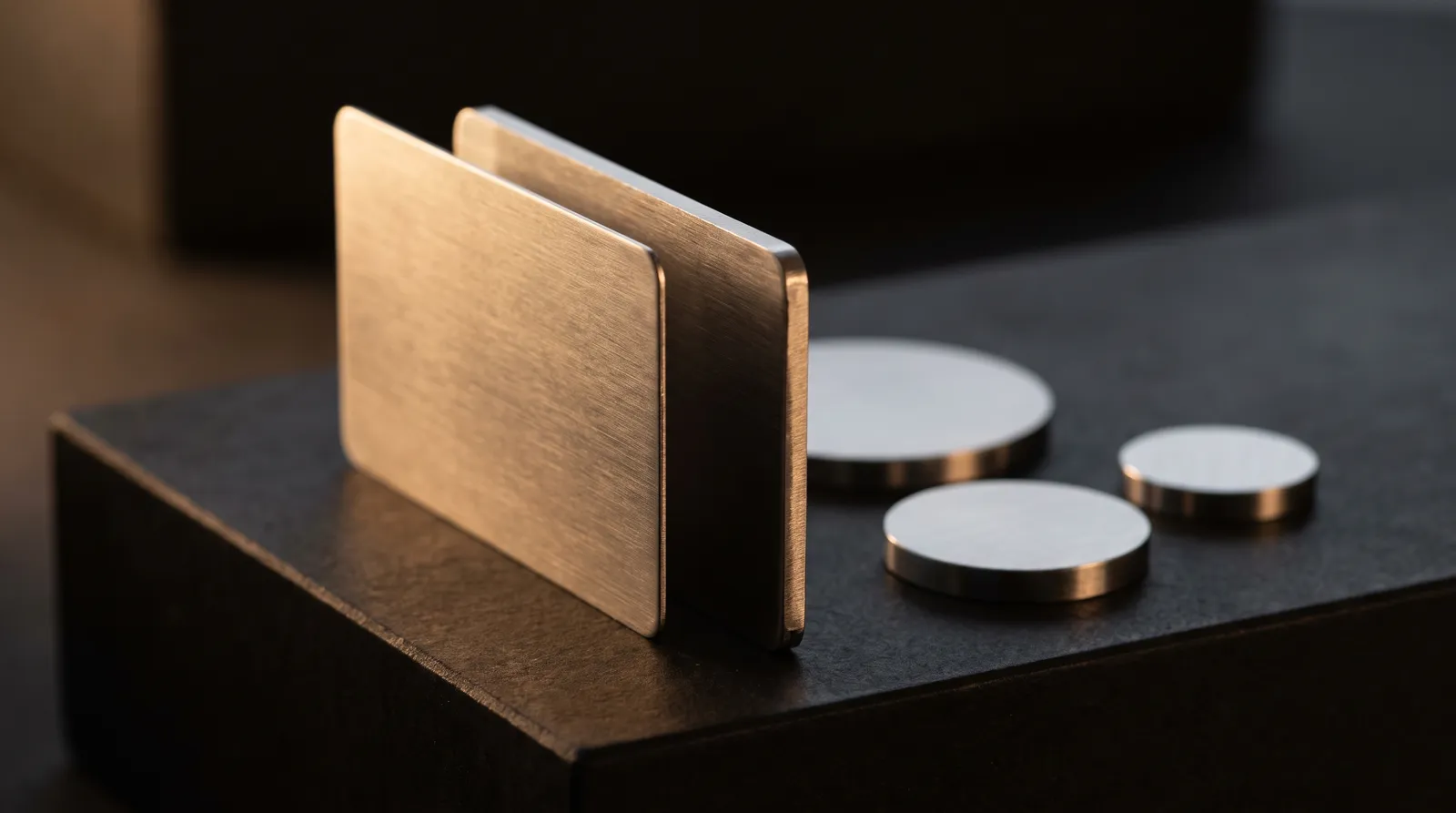
"Metal doesn't need thickness to feel substantial. Density does that."
Aluminum
Aluminum is our lightweight option. It takes engraving and color printing well and reads as metal the moment you touch it, but it's far lighter than steel: easier to carry a stack, less of a thud on the table. If you want a mirror face or the heavy 0.8 mm card, the configurator shows which metals offer them. I'd pick aluminum if you hand out dozens a night, and stainless if one card crosses a table and gets kept.
How colors work: PVD coating
A silver card is bare stainless steel; that's the color of the metal. Every other color is PVD (physical vapor deposition): in a vacuum chamber, a thin metallic layer is deposited onto the steel and bonds to it. It isn't paint and it isn't a sticker. It's very hard and won't flake like paint does, and it's the same family of finish used on watch cases and designer taps. Two honest limits: a mirror surface still shows scratches over time, and the cut edge of every card is bare steel (we never paint metal edges, because paint chips in a wallet; a color rim goes on the face instead).
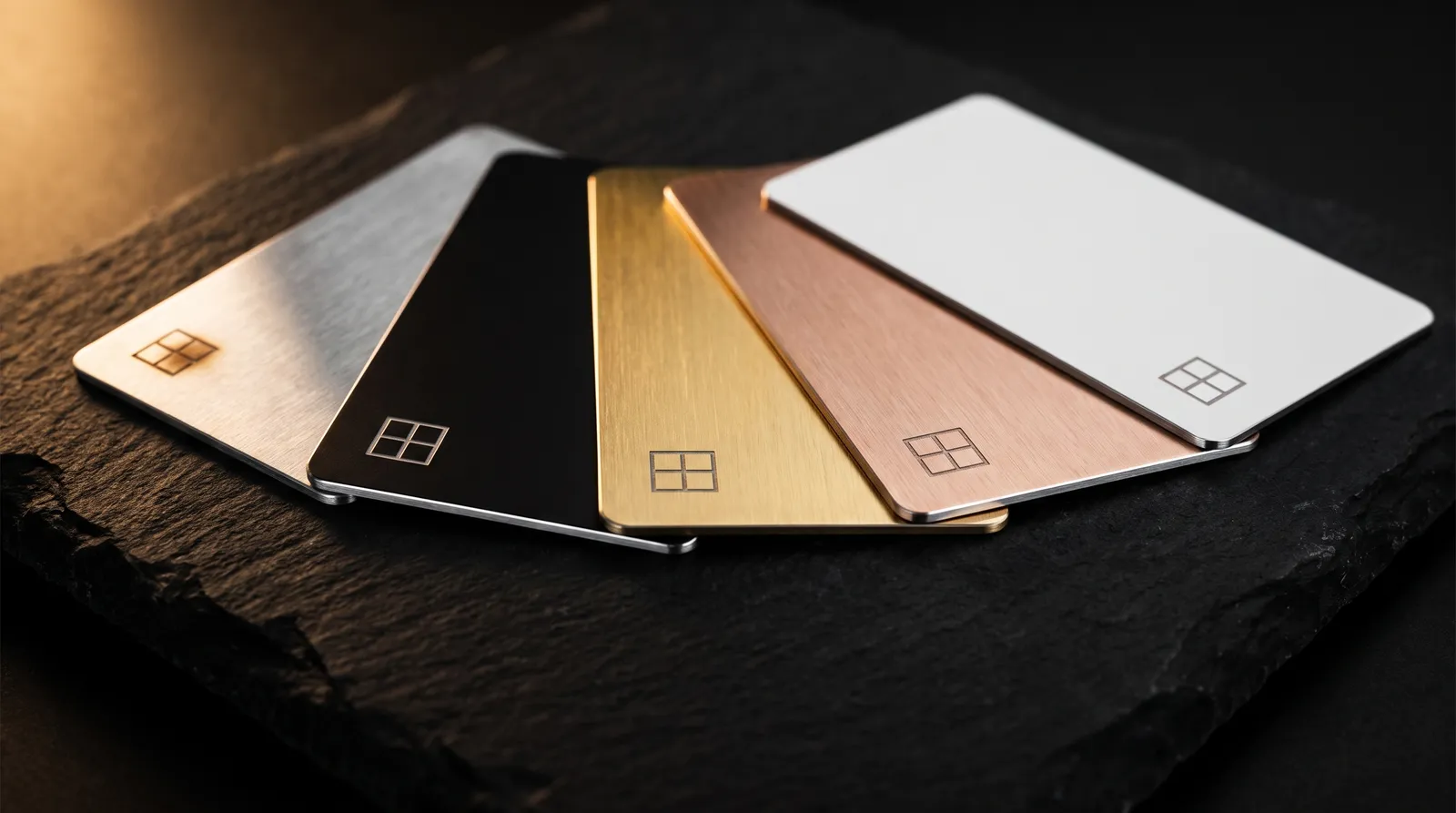
When the laser engraves a coated card, it burns through the color to the bright steel underneath. That's where metal contrast comes from: two tones, coating and steel, with no ink involved.
Silver
Bare stainless. Cool and industrial. Engraving reads slightly darker than the surface. The base price.
Black
A deep black PVD with a metallic depth; engraving shows bright silver, the highest contrast of any metal card.
Gold
A warm gold-tone PVD. Under a brushed finish the grain catches a moving band of light.
Rose gold
A soft pink-copper tone, warmer than gold and quieter than copper.
Copper-tone
White
An almost ceramic-looking PVD; engraving reveals steel through it. Also the cleanest base for color printing.
Iridescent
A multi-layer coating that shifts through purple, blue, green and gold as you tilt it. Polarizing, and that's the point.
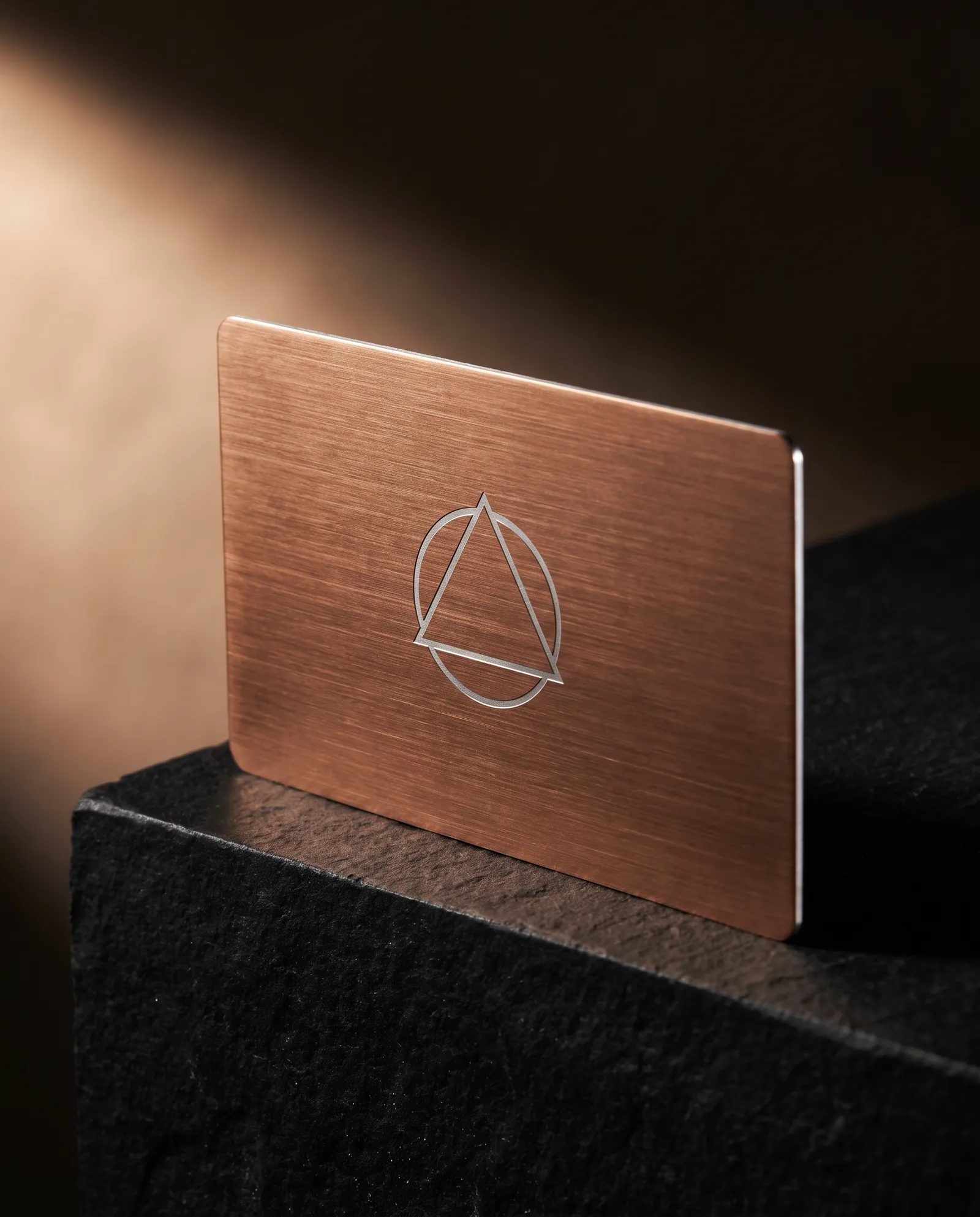
Copper business cards: copper-tone PVD, not solid copper
Copper business cards from us are stainless steel with a copper-tone PVD coating, not solid copper. That matters for two reasons:
- Solid copper is soft and darkens as it oxidises, so it browns in a pocket and marks with fingerprints.
- A copper-tone coating stays the same warm reddish-brown for years, on a steel card that doesn't bend.
Engraving reveals bright steel through the copper, a warmer contrast than black. Brushed copper looks earthier; mirror copper looks almost liquid. The same is true of brass tones: a coating, not the metal.
copper metal business cardsthe copper case study
Three ways to put your design on metal
Every metal card includes laser engraving. On top of that you can add cut-outs, color printing, or both.
Laser engraving
A focused laser burns your design into the surface. On a coated card it removes the color to show bright steel; on bare silver the marks read slightly darker than the metal around them. Run a fingertip across it and you can feel the line. It's precise, but it has a floor: text needs a cap height of about 1.5 mm (roughly 6 pt) and lines need to be at least 0.3 mm, or fine serifs start to break up. Engraving is on or off, so it can't do gradients, shading or photographs. Tone needs color printing.
A QR code can be engraved for a flat US$ 30 at any quantity. It scans best on matte or brushed black or matte silver, at about 2 cm square with a clear margin. Mirror reflects the phone camera, so avoid it for QR. We test-scan every QR at proof.
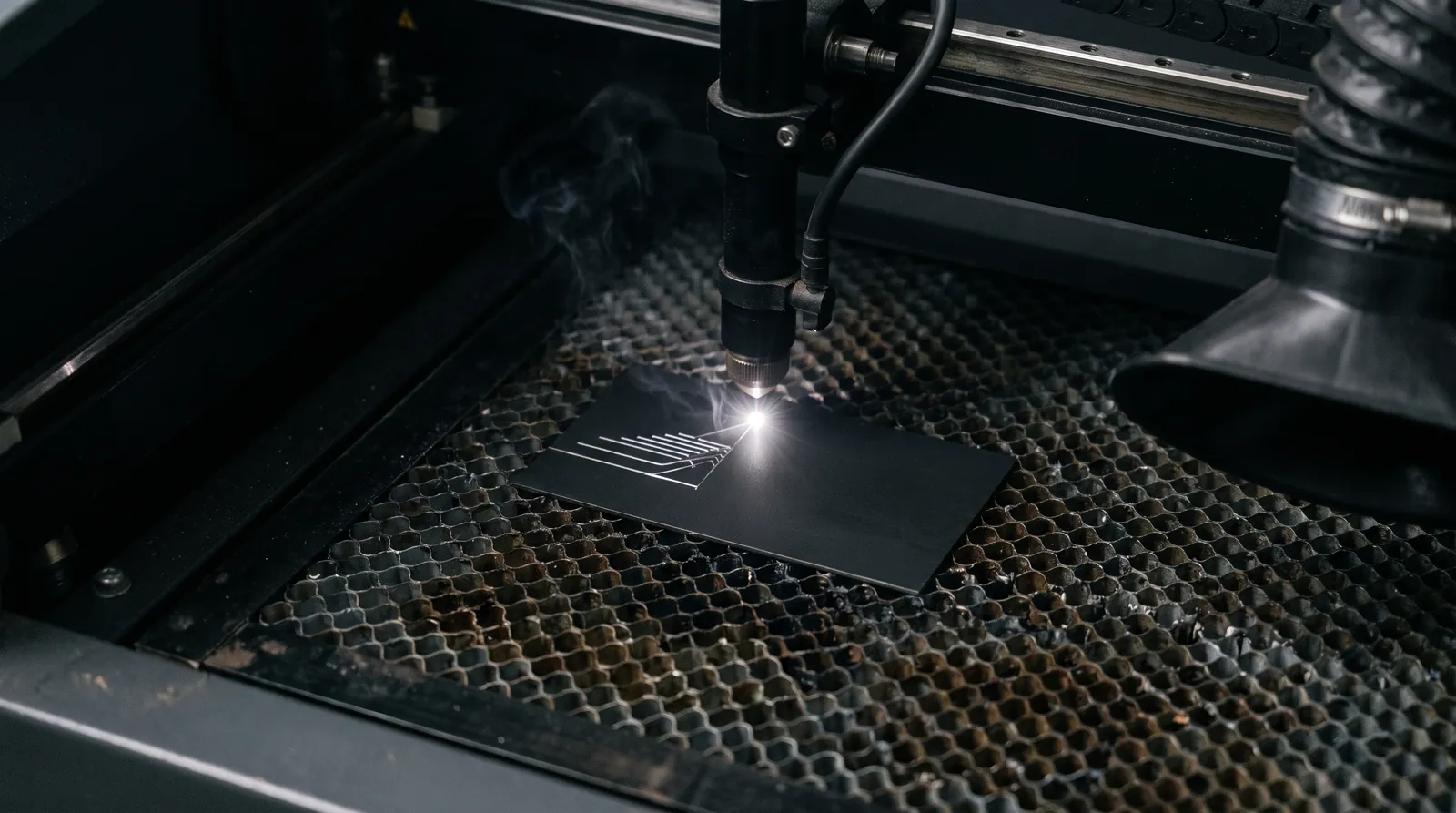
Engraving, etching and color fill
Engraving burns a line; etching removes a shallow layer of metal across an area, so a shape sits slightly below the surface. It's the metal equivalent of a deboss, and the way to get a "pressed" look on steel.
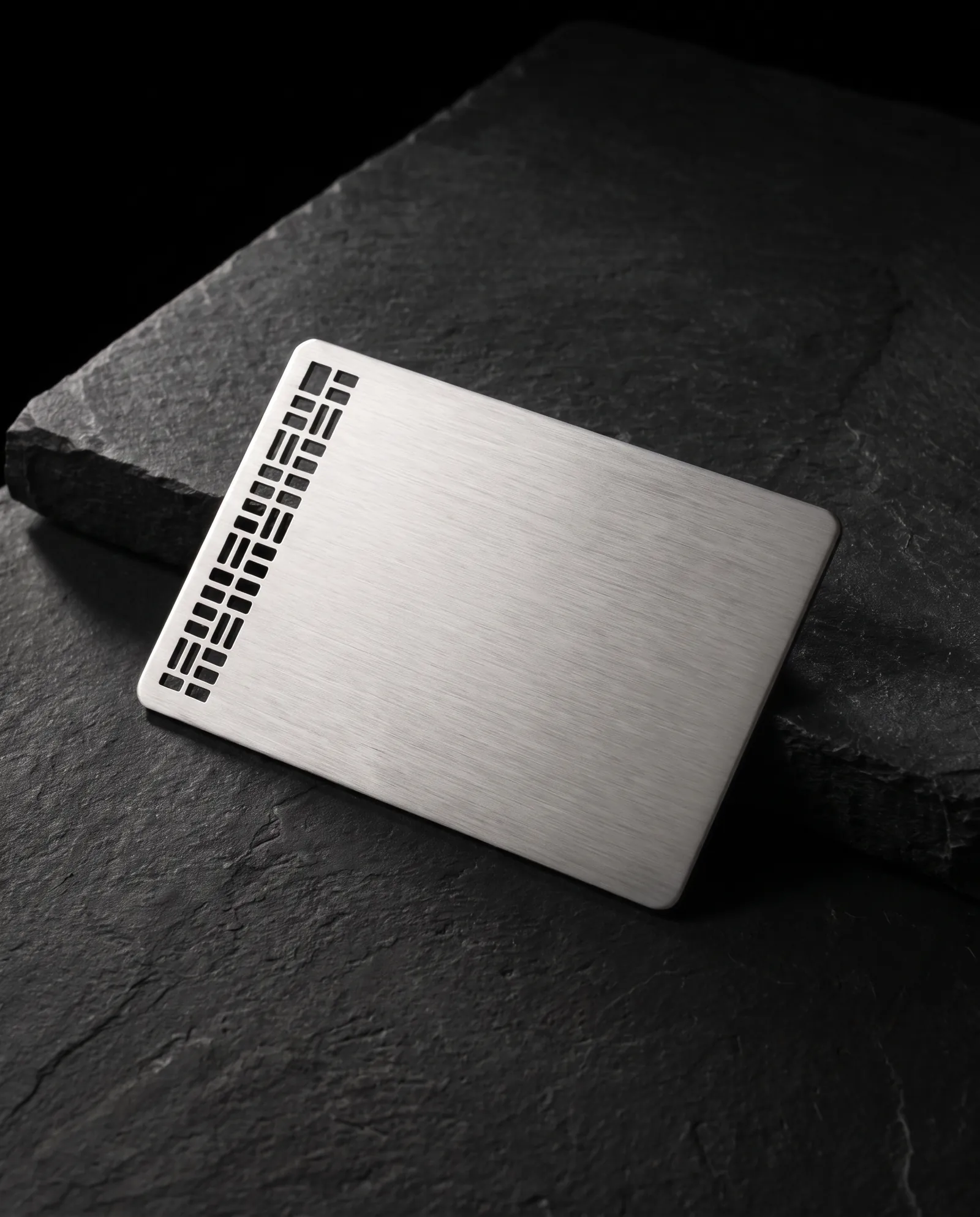
Laser cutouts
Here the laser goes all the way through, leaving a window the light falls through. On a table, a cut-out card throws its own shadow. It's the most architectural thing you can do to a card. The rule is structure: anything floating inside a cut (the middle of an O, the island of a monogram) falls out unless a small bridge ties it back, and we draw those bridges with you, because where they land changes how the mark reads. Keep cut-outs at least 2 mm from the edge, and leave enough steel that the card stays rigid; we'll tell you if a pattern takes too much. We check every cut-out design before production.
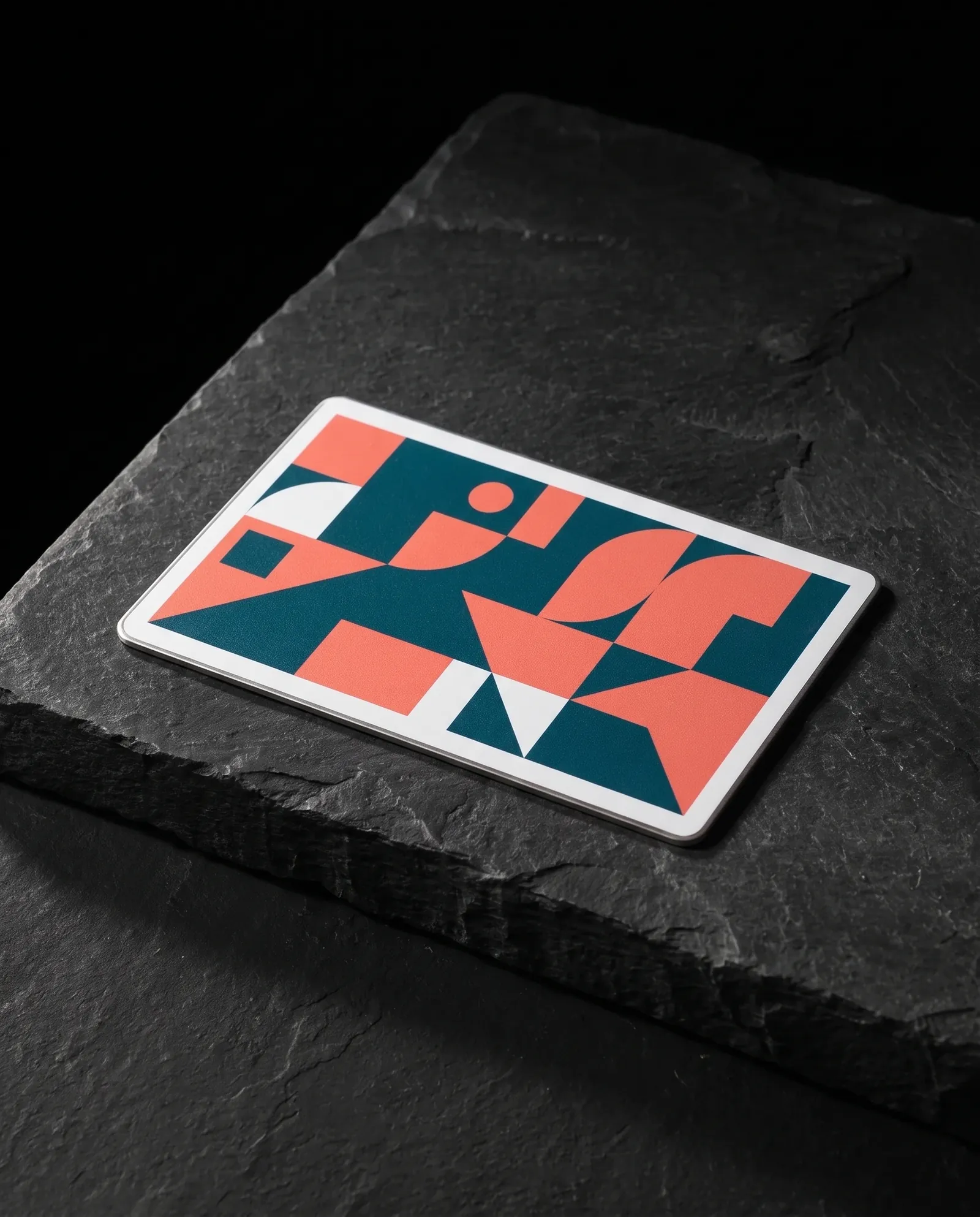
Color printing on metal
When the design needs real color (a gradient, a photo, a full-color logo), we print it onto the metal with UV-cured ink. It's the only way to get tone onto a metal card. The steel stays visible around and through the color, which gives printed areas a faint shimmer you don't get on paper: cooler on silver, warmer on gold. White PVD is the truest base when color accuracy matters. We match brand colors as closely as the process allows and show you on the proof. A common premium build: color on the front, contact details engraved on the back, one cut-out accent.
What metal can't do
The fastest way to be disappointed by a metal card is to send it a design made for paper. Four things that don't carry over:
- No foil stamping, letterpress or paper embossing. Those are paper processes: a hot die or an inked plate pressing into a soft sheet. Steel doesn't give. The metal versions: a mirror-polished panel for a "foil" look, a deep etch for a "deboss".
- No painted edges. Paint on a steel cut edge chips in a wallet. Edges stay bare steel; if you want a colored border, it goes on the face as a thin rim.
- No gradients in engraving. A laser mark is on or off. Gradients and photos need color printing.
- Mirror fights small type and QR codes. The reflection drowns fine engraving and confuses phone cameras. Put type and QR on a matte or brushed area.
"Gradient gold looks gorgeous in a render. On steel it's either polished or it isn't. So we design for that, and it sings."
Metallic business card design: what translates to steel
"Metallic business card" means two different things. One is a paper card with metallic foil: shiny, light, endlessly flexible in design. If that's what you want, see our metallic foil business cards. The other is a card made of metal, and designing for it is a different job. What translates:
| Paper idea | On metal it becomes |
|---|---|
| Gold foil logo | Engraving through gold or black PVD to bright steel, or a mirror-polished panel |
| Blind deboss | An etched recess |
| Brand color flood | The PVD color itself (choose the metal that matches), or UV color print |
| Fine hairline type | Bolder type: at least about 1.5 mm cap height, 0.3 mm lines |
| Photo or gradient | UV color printing |
| Edge painting | A color rim on the face; the steel edge stays bare |
| Die-cut shape | Laser cut-outs inside a standard card shape |
Design rules, in short:
- Keep it simple and bold.
- Use the metal as the background color.
- Leave 2 mm of safe space at the edges (bleed is 1 mm on metal).
- Let one technique carry the idea.
the full metal design requirements
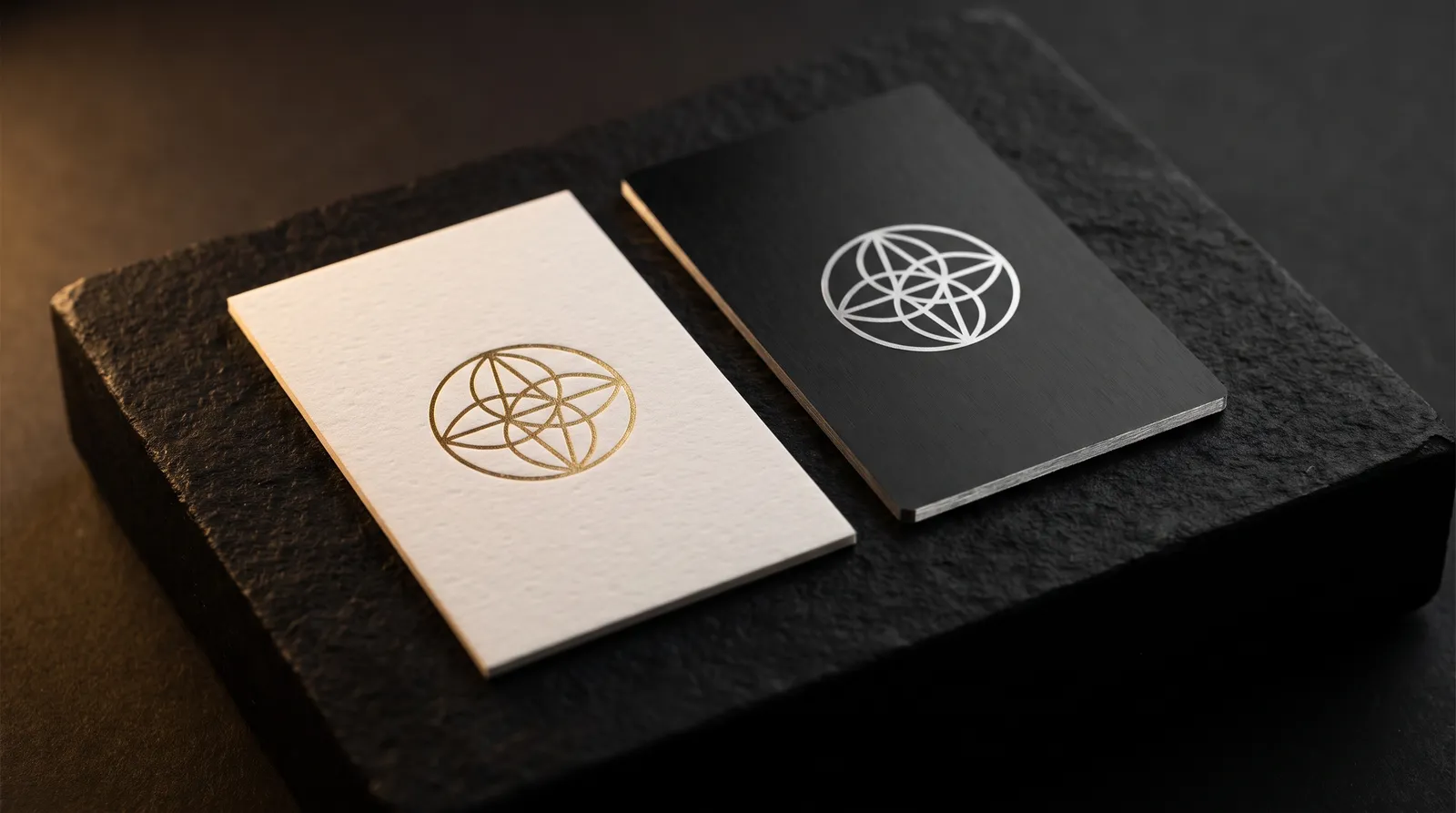
Surface finishes: matte, brushed, and mirror
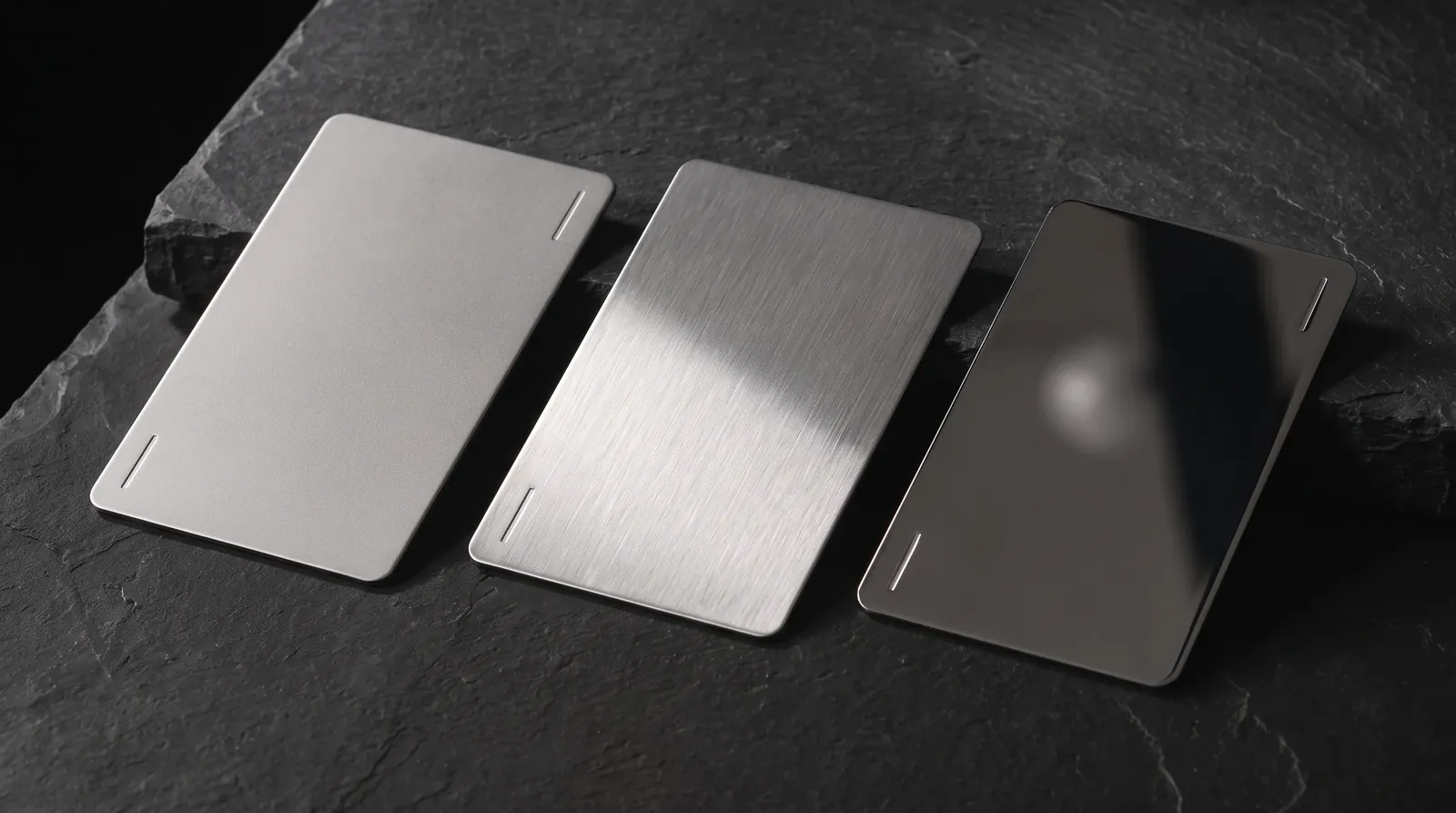
Matte
Smooth and non-reflective. The color reads evenly with no hot spots, so it's the most legible surface for text-heavy designs and for QR codes. Matte is quiet: the card announces itself by weight, not shine. It's the base price.
Brushed
Fine parallel grain across the whole face, like the side of a good watch bracelet. The grain throws a soft band of light that slides as you tilt the card. It's the finish I recommend most: it reads unmistakably as metal in person and in photos, engraving cutting across the grain stands out, and it hides fingerprints. Brushed and mirror cost the same, a small step above matte.
Mirror
Polished until it reflects your face. Nothing is more dramatic under good light. The trade-offs are real: fingerprints show at once, light scratches show over time, and fine engraving is harder to read because everything around it reflects too. Use mirror for bold, simple marks.
Who orders metal business cards
Metal suits people who hand over a card rarely and on purpose:
- Real estate agents and brokers, where the card is part of the presentation at a showing or closing.
- Private and luxury services: trainers, private chefs, wealth advisors, concierge. The card should match the price of the service.
- Creative professionals, for whom the card is a small portfolio piece.
- Founders and executives who want the handover itself to start a conversation.
- Events and memberships: VIP invitations, member cards, launch keepsakes. Here the card is the experience.
Who metal isn't for:
- people who hand out 30+ cards a week;
- teams of 15+ (the total climbs fast; premium paper with foil or embossing is the better team buy);
- designs that live or die on a full-bleed photo.
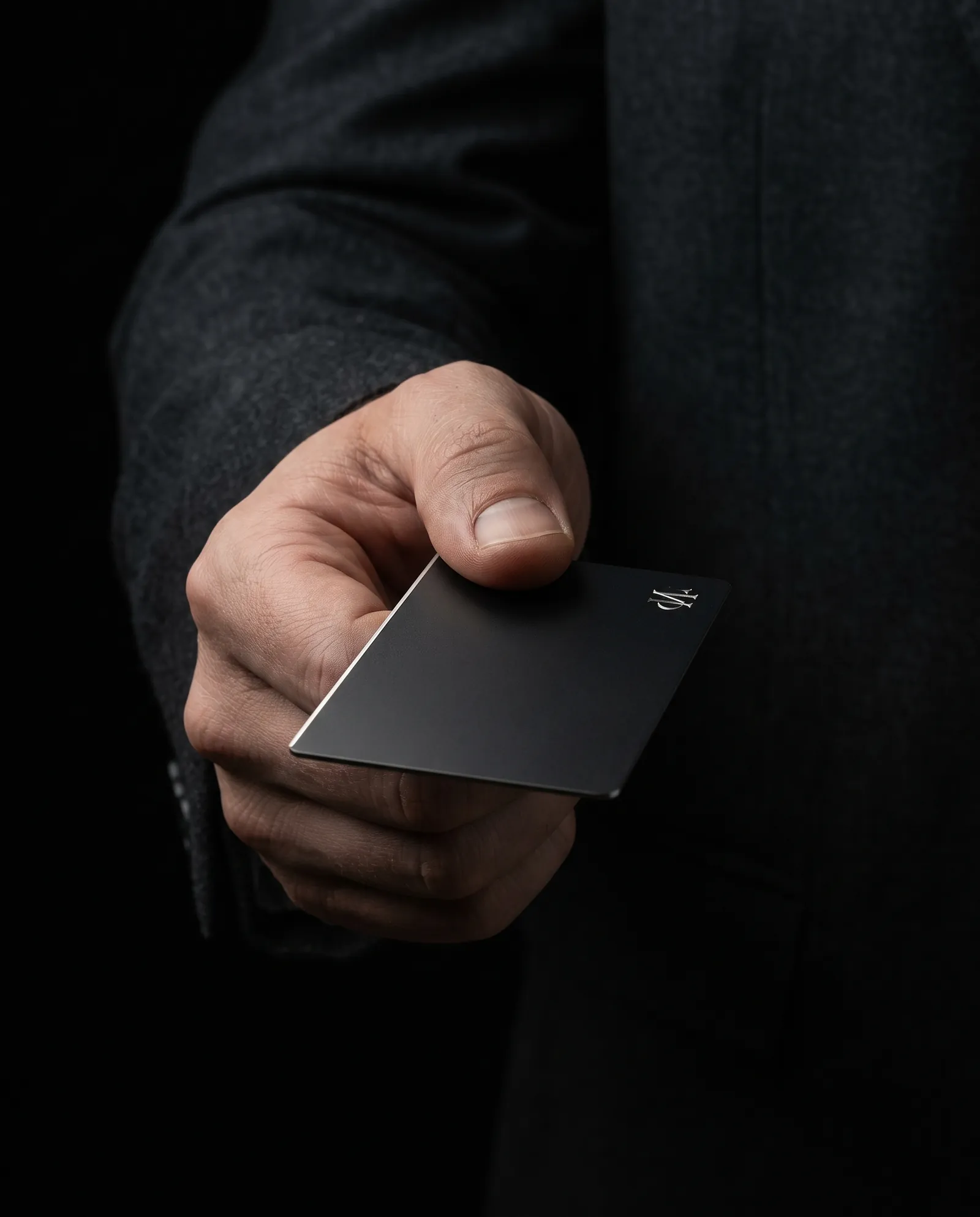
Real metal cards we've designed
Public house exercises from our case studies, not client work, each with its spec.

Design exploration
Forty-one ways to cut steel
Forty-one metal cards across satin stainless, matte black, brushed gold and copper: cut-throughs that survive a wallet, enamel set into an etched recess, and mirror broken by matte so the type holds still.
Laser engraved, laser cut, enamel fill · stainless, black, gold, copper.

Design exploration
Where the antenna goes
NFC across metal, plastic and wood. The steel builds show a PVC inlay window, a frosted edge strip and a honeycomb cut-through over the antenna.
Matte black and copper metal · NFC construction.
See your logo in steel
Upload your logo and our Studio shows you a concept on a black stainless card in a few minutes, with honest notes on what engraves cleanly and where a cut-out needs a bridge. A concept is a picture, not a print file: a person rebuilds your artwork and proofs it before anything is cut.
What to expect from the production process
Metal cards take about three weeks after you approve your proof, plus transit. It's an estimate, not a delivery date. Laser time, coating, cutting, printing and inspection all scale with quantity, so 1,000 cards isn't the same job as 100. Tell us your date before you order and we'll say honestly whether it's realistic.
The file review
Metal is stricter than paper. A person checks every file before production: cap height about 1.5 mm (6 pt) and up, lines 0.3 mm and up, cut-outs bridged and 2 mm from the edge, and engraving, cutting and printing on separate layers. Most paper designs need some adjustment. We make it at no charge and tell you what changed; if a design needs real restructuring, we talk first. metal file requirements
The proof
Before anything is cut, you get a digital proof showing what will be engraved, cut and printed, and where. You approve it, or we revise until it's right.
Shipping and packaging
Metal is heavy. A box of 100 cards at 0.5 mm is about 1.8 kg (4 lb) of steel before packaging, and about 2.9 kg at 0.8 mm. Cards ship in protective packaging so they don't scratch each other. Shipping is free within the continental US. We ship to 30+ countries; other destinations are quoted at checkout.
Adding NFC to metal cards
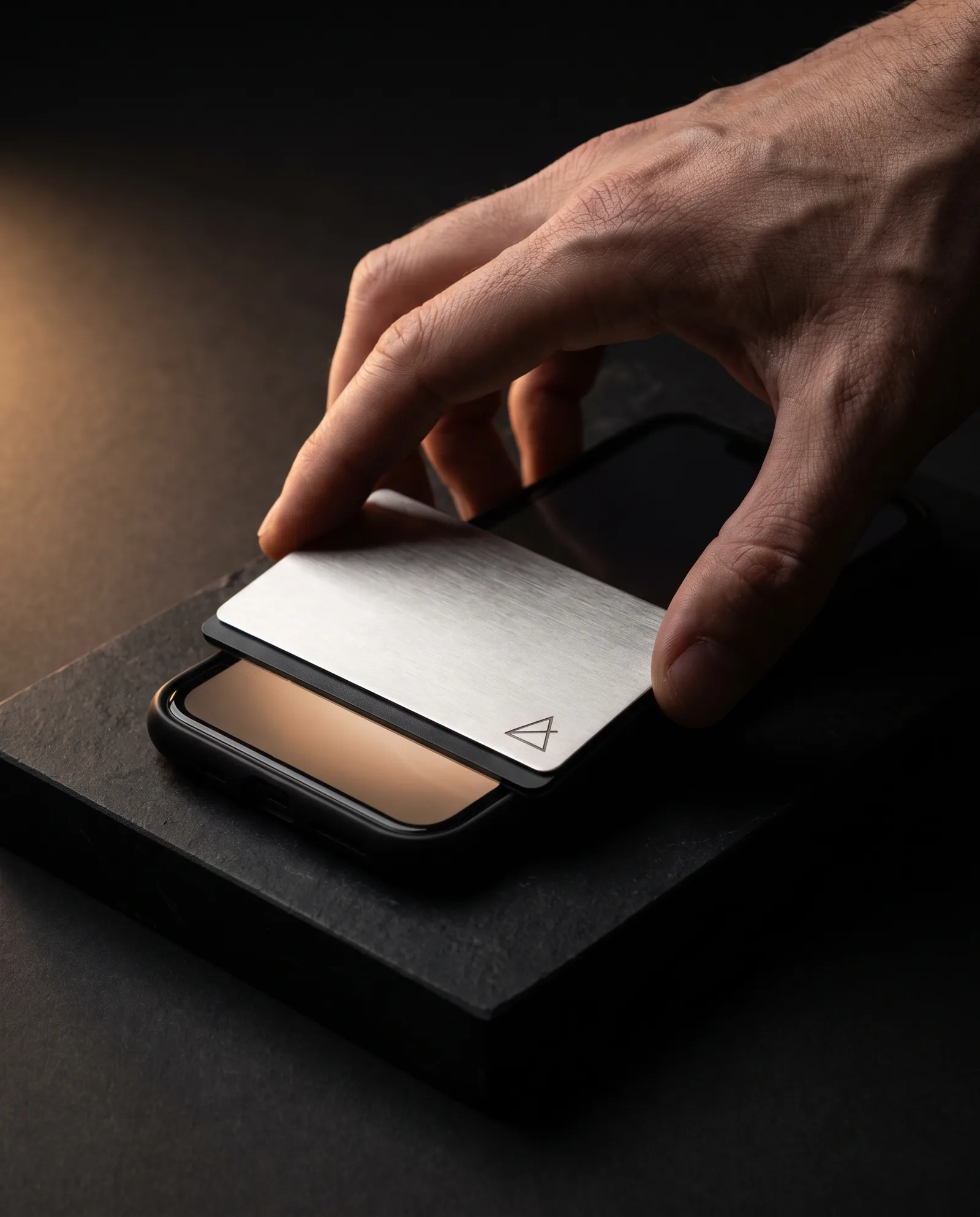
NFC lets a phone open your link with a tap. On metal it starts with an honest fact: solid steel blocks the signal. So our metal NFC business cards bond a stainless front to an NFC-enabled printed back. The chip sits in the back layer, and phones read it from that side. All-steel looks are possible with a pocket or window that lets the signal out; we quote those individually. NFC metal cards start at US$ 229 for 25.
The chip holds a link (a digital card, LinkedIn, a booking page), and you can change where it points without replacing the card. A phone reads it only from a few centimetres away, when someone chooses to tap.
metal NFC business cardsHow the chip gets inside a metal NFC card: five constructions comparedNFC metal card guide
Pricing overview
Metal business cards start at US$ 230 for 5 and cost US$ 475 for 100 in silver stainless steel, engraved, with a free proof and free shipping within the continental US. For every quantity, color, finish and add-on, see how much do metal business cards cost.
Metal vs premium paper: an honest comparison
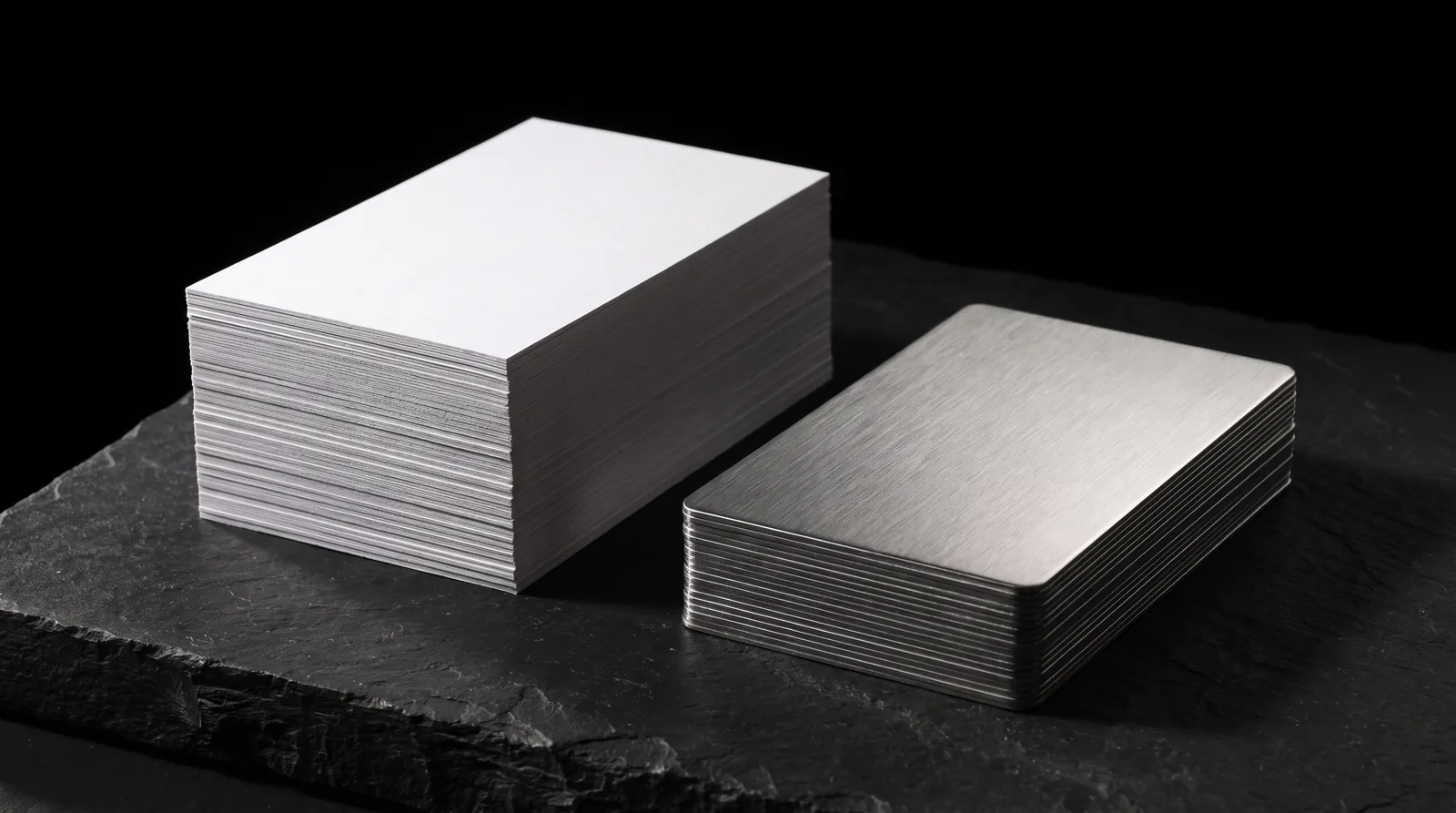
Metal isn't an upgrade from paper. It's a different object with a different job. Premium paper is a world of craft: how foil catches light, how letterpress bites into cotton, how an embossed logo feels under a thumb. It offers far more finishes than metal, and it costs a fraction as much per card. Metal is a world of material surprise: weight, cold, rigidity, the sound it makes on a table.
A cotton card with gold foil and a blind emboss says "I care about craft." A gold metal card says "I care about impact." I'd keep a paper run for everyday handouts and a small metal run for the people who matter.
metal vs paper business cardsfoil business cardsletterpress business cards
Feel the steel before you choose.
Our US$ 8 sample pack includes real stainless steel, so you can feel the weight, the cold and the engraving first. It comes with a US$ 10 credit toward your first order.
Common questions
What are metal business cards made of?
Stainless steel, or sometimes aluminum, cut to credit-card size (85.6 × 54 mm). Silver cards are bare steel. Black, gold, rose gold, copper-tone, white and iridescent cards are steel with a PVD coating. Designs are laser engraved, cut through or UV printed in color.
How much does a metal business card weigh?
A 0.5 mm stainless steel card weighs about 18 g, roughly three or four plastic credit cards, or about ten times a standard paper business card. A 0.8 mm card weighs about 29 g. A box of 100 at 0.5 mm is about 1.8 kg of steel.
Are copper business cards real copper?
Not ours. They're stainless steel with a copper-tone PVD coating. Solid copper is soft and darkens as it oxidises; the coating keeps the warm copper color for years on a card that doesn't bend. Brass tones are coatings too.
How long do metal business cards last?
For years. Stainless steel doesn't rust or bend, and PVD coatings are very hard and don't flake like paint. Mirror finishes pick up fine scratches over time if they're carried loose with keys or coins; matte and brushed hide wear best.
Can I use my existing business card design on metal?
Usually, with changes, because metallic business card design on steel works differently from foil on paper. The metal color becomes your background, foil elements become engraving or a polished area, full-color artwork moves to UV color printing, and text smaller than about 1.5 mm cap height gets enlarged. A person adapts and proofs every file at no extra charge.
Can metal business cards be foil stamped, letterpressed or embossed?
No. Those are paper processes that press a die or plate into a soft sheet, and steel doesn't give. On metal, a mirror-polished area gives the shine of foil, an etch gives the look of a deboss, and engraving through a PVD coating gives crisp two-tone contrast.
Do metal cards set off metal detectors?
They can. One card in a wallet rarely matters, but a stack of steel cards in a bag may be flagged at airport screening. If you fly often, carry a few and ship the rest ahead.
Are metal business cards waterproof?
Yes. Stainless steel and PVD coatings shrug off rain, spills and humidity. If your card has a printed NFC back, that layer is the part to keep dry and flat.
What size are metal business cards?
Credit-card size: 85.6 × 54 mm (3.375 × 2.125 in), the ID-1 standard used for bank cards and IDs. They fit standard wallets and card holders. A US paper business card is 3.5 × 2 in.
Can I order just a few cards to try?
Yes, from 5 cards at US$ 230. The per-card price is high at that size because setup is shared by so few cards, but it's an easy way to test metal before ordering 100.
Do you ship internationally?
Yes, to 30+ countries. Shipping is free within the continental US; other destinations are quoted at checkout.
How much do metal business cards cost?
From US$ 230 for 5 and US$ 475 for 100 in silver stainless steel, engraved, with a free proof. Full price tables are in our guide to how much metal business cards cost.