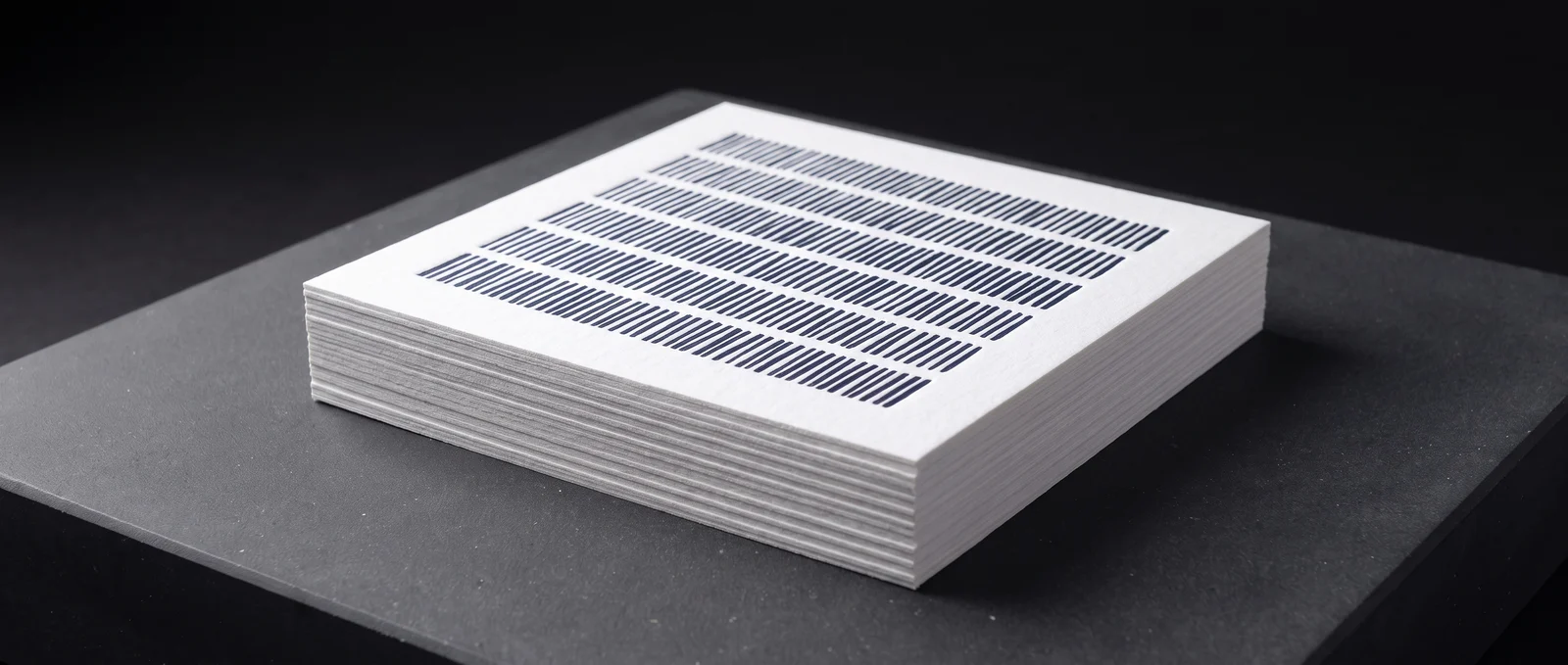
Ink pressed into the paper.
A polymer or metal plate is inked and pressed into a soft sheet, leaving colour sitting in a visible impression rather than on top of a flat surface.
Start with the finish
See what letterpress does with your own brief.
Free · about two minutes
White cotton·32pt·Coral letterpress
White cotton·32pt·Two-colour letterpress
Single-ply cotton·Front and back
White vs ecru cotton·One ink
How it is made
One plate per colour, one pass per colour, and the press is slow: this is the technique where you feel the hour rate. It wants a soft, bulky, uncoated sheet; the thicker and softer the stock, the deeper the bite it will take without cracking. Heavy solid coverage is the enemy: large flat areas show mottling and fight the impression, so letterpress rewards line work, type and restraint. Two colours means registration, and hairlines that straddle two plates are where jobs go wrong.
Letterpress inks are translucent. A light ink on a dark sheet will not read: it sinks toward the paper colour. White type on black stock is a WHITE FOIL STAMP, not “white letterpress”, and calling it letterpress is how customers end up disappointed at proof. On any non-white sheet, expect the ink to shift toward the paper's own colour.
What the screen cannot show
A screen cannot show the depth of an impression or the way translucent ink shifts into a sheet. Every image here fixes one light angle and one paper colour; the sample in your hand is the honest proof.
Hold the finish in your hand: order the sample kit →What it runs on
| Substrate | Verdict | Why |
|---|---|---|
| Uncoated & 100% cotton | Excellent | 100% cotton and cotton blends take the cleanest, deepest bite. |
| Colour-through (dyed) stock | Excellent | Takes a deep impression, but remember the ink is translucent : light ink on a dark dyed sheet reads grey. Use foil for light-on-dark. |
| Recycled, kraft & inclusion stock | Excellent | Inclusion-bearing stocks take a good bite; flecks read through fine detail, so hairlines stay generous. |
| Coated silk & matte stock | No | A coated sheet is hard and sealed: the plate can't sink and the ink sits on the surface and scuffs. |
Minimums and specs
- Minimum rule
- 0.15 mm (0.4 pt)
- 0.3 mm reversed
- Minimum type, positive
- 7 pt
- Minimum type, reversed
- 10 pt
- Colour passes
- 1 plate / colour
- Deepest bite
- 600 gsm+
- Usually duplexed
Choose the process by the outcome
- Light colour on dark stock
- Foil or opaque screen.
- Photographic image
- 4-colour process, never letterpress.
- Impression with no colour
- Blind deboss.
Pairs well with
Blind deboss
A die presses the artwork into the sheet with no ink and no foil. The only thing you see is the depth: the surface reading differently where it's been compressed.
Edges and thickness
Paint adds colour, foil adds reflection, and duplex or triplex adds real plies. Choose the edge and construction together, not as interchangeable effects.
Foil stamping
A heated die transfers a metallic film onto the stock under pressure. Not printed, not simulated: a layer of metal with an impression around it.
Seen in
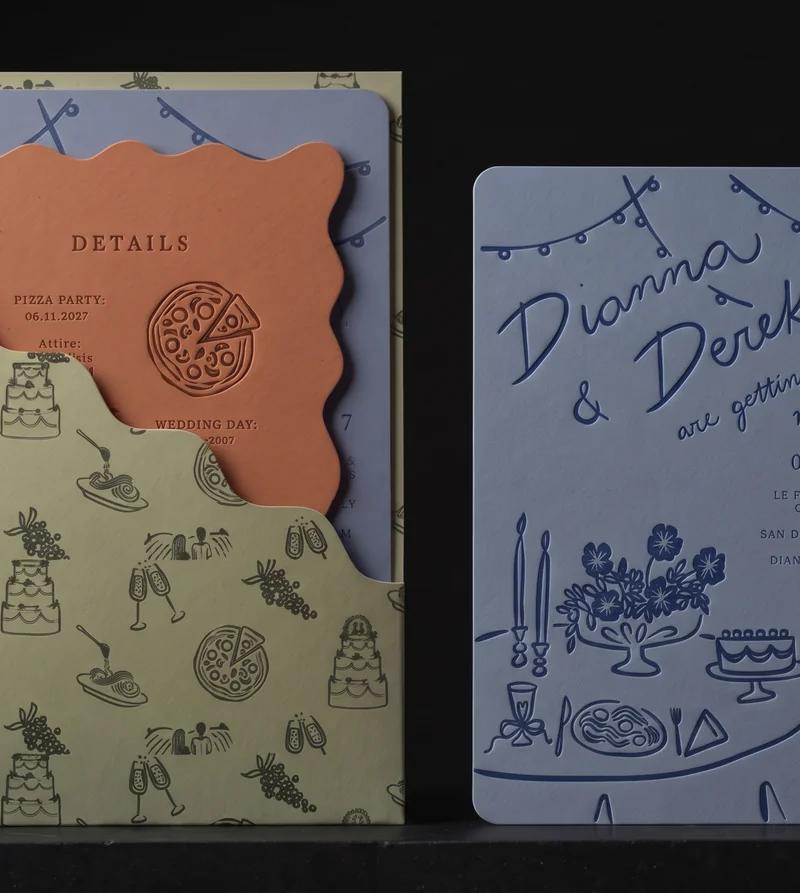
Dianna & Derek
Three colour-drenched pieces, one hand-mixed ink each, and one bold cut. Then the one we would have cut.
Read the project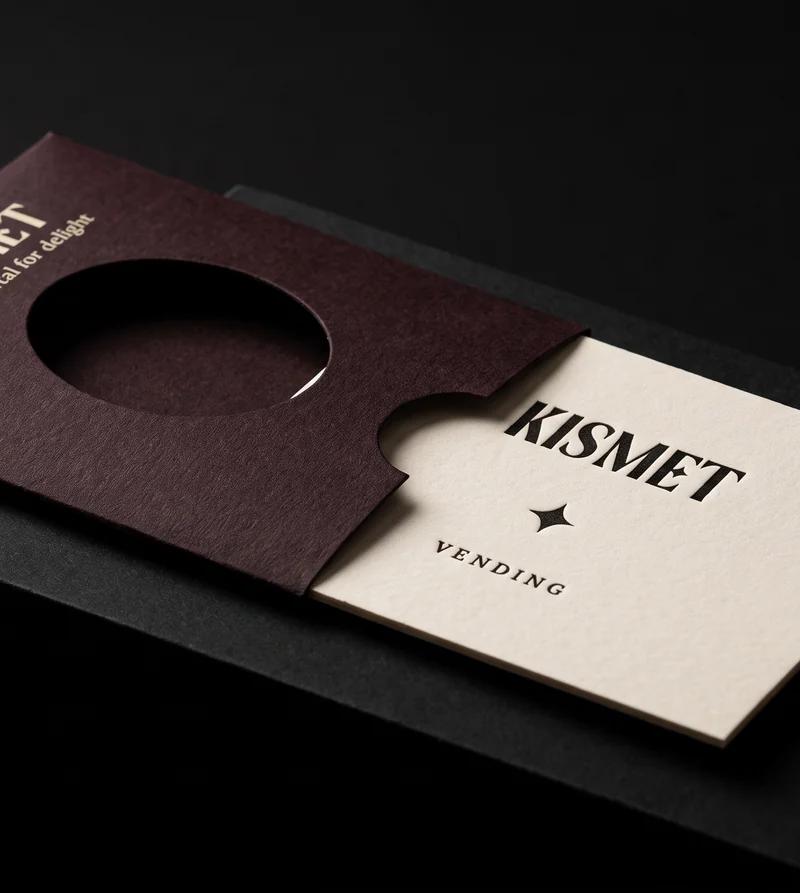
Kismet Vending
A card worth keeping, thin enough to fall out of a vending machine.
Read the project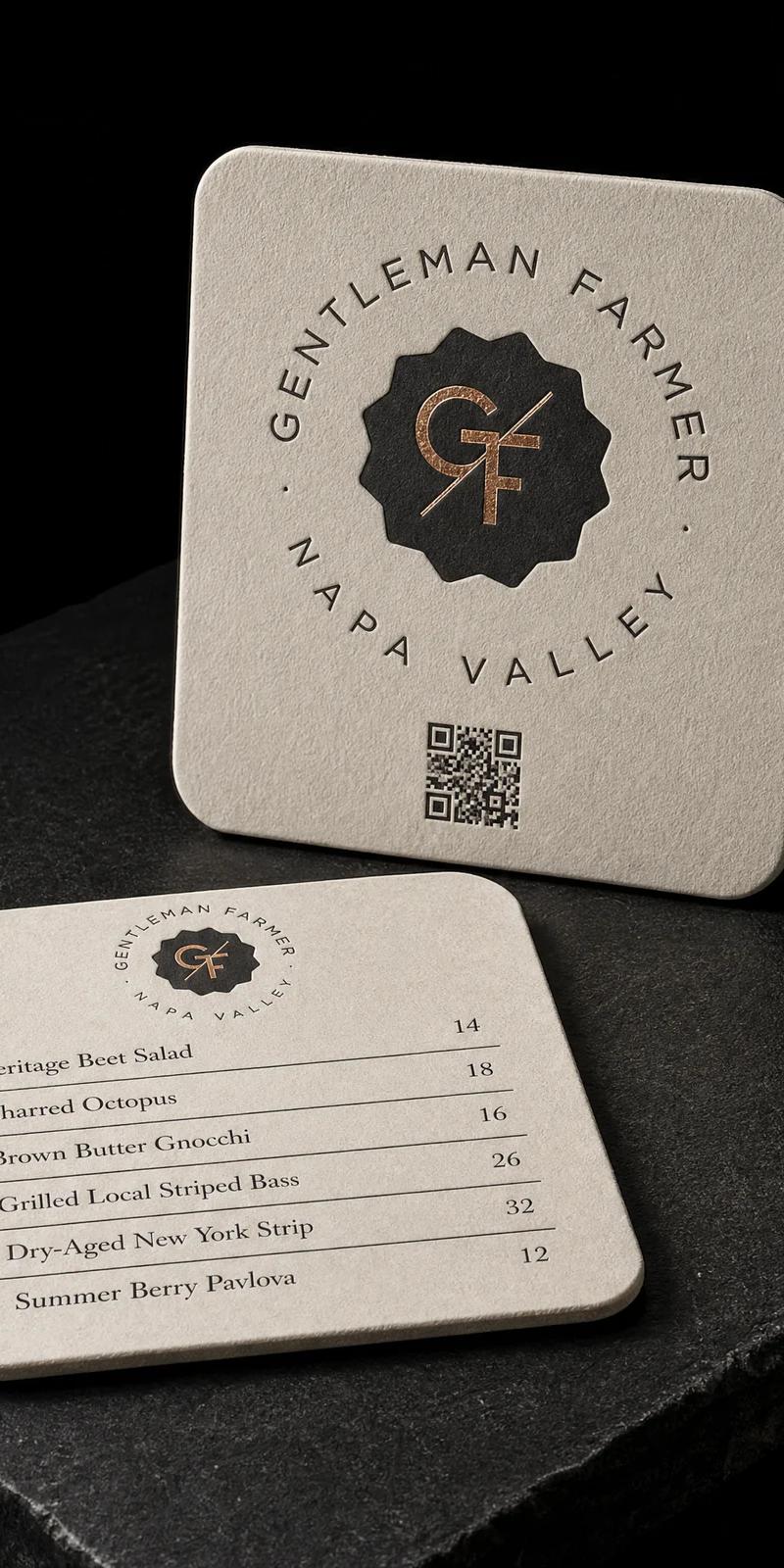
Gentleman Farmer Wines
Match a card they already loved. On a different object.
Read the project
Studio Álvarez Interiors
A logo that could only ever be printed one way.
Read the projectCommon questions
- Can letterpress print white on black paper?
- Not honestly. Letterpress inks are translucent, so white sinks grey. Use an opaque white foil stamp.
- Why does the ink change on coloured paper?
- The sheet shows through the translucent ink, shifting it toward the paper colour.
- What makes the impression deeper?
- A thicker, softer sheet. Heavy cotton and duplex boards take depth without bruising the reverse.
- Does letterpress handle photographs?
- No. It rewards type, line work and restrained solid shapes; photographs belong to four-colour process.