32pt and 48pt
Thick Business Cards
32pt and 48pt cards that register in the hand before anyone reads a word. Paint the edges, foil them, or let a black core show through.
Standard from 126 US$ for 500 · Custom from 185 US$ for 250
Standard ships 3–4 business days after proof approval; Custom about 3 weeks (estimates).
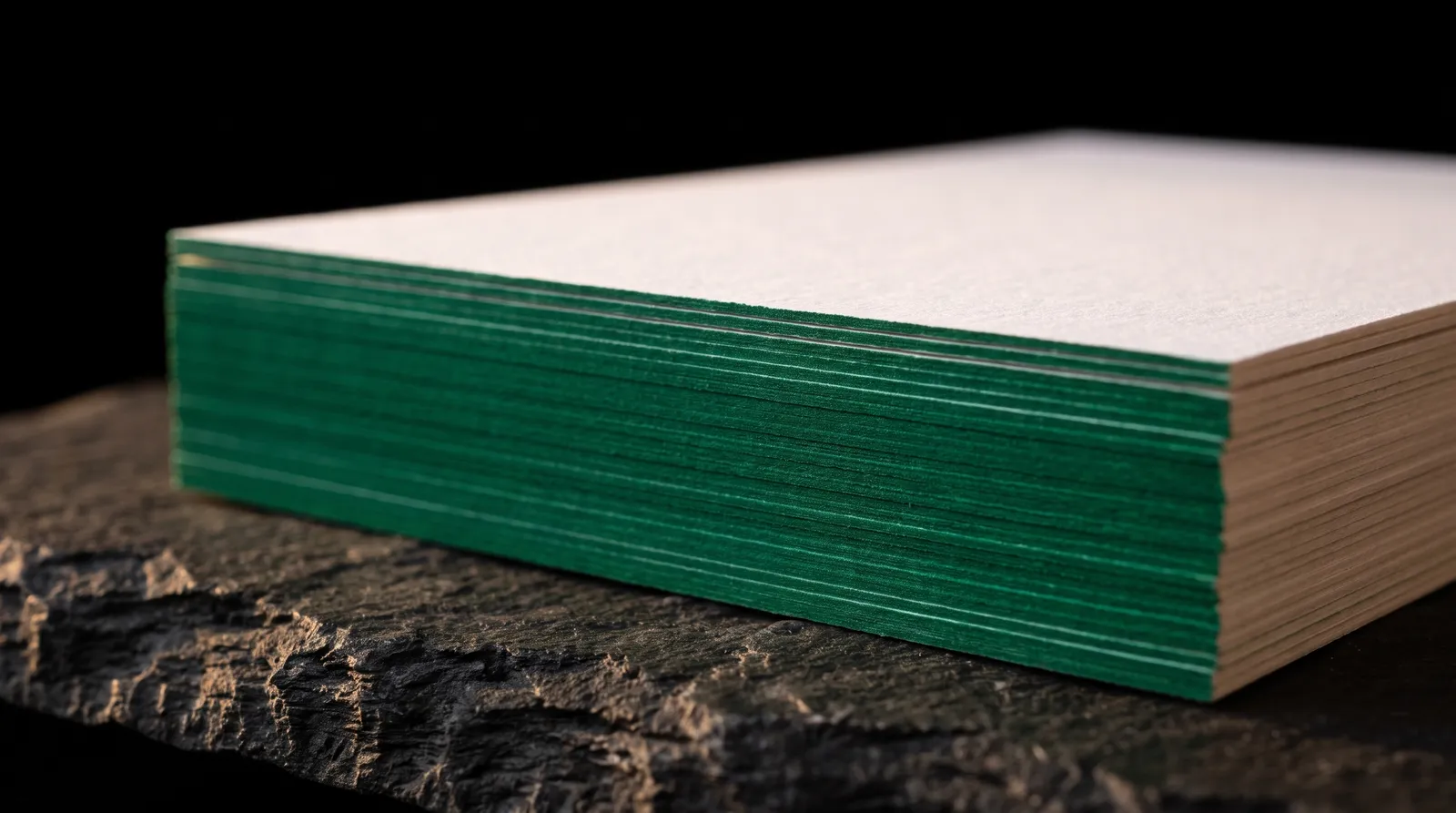
- Free design proof. A person checks your file before anything prints.
- 32pt to 48pt. Cotton, silk, soft touch or a three-layer black core.
- Edges done properly. Six Standard edge colours, or Pantone-matched on Custom.
- If you're not happy, we reprint. How reprints work
Thick business cards are printed on heavy cardstock: 32pt or more. That's about 0.8 mm, close to a credit card, against the 14–16pt most printers use by default. We make them two ways. Standard cards ship in 3–4 business days after proof approval, on 32pt uncoated stock or a white-black-white triplex. Custom cards take about three weeks after proof approval and run 32pt or 48pt cotton, silk or soft touch, with foil, letterpress, deboss and painted or foil edges. One note before you choose: thickness on its own is weight. The card earns the extra cost when the edge or the face does something too.
Three ways to go thick
Two fast cards from a fixed menu, and one you build. If you're not sure, start with the third: it's the only one that takes foil and the softer cotton sheet.
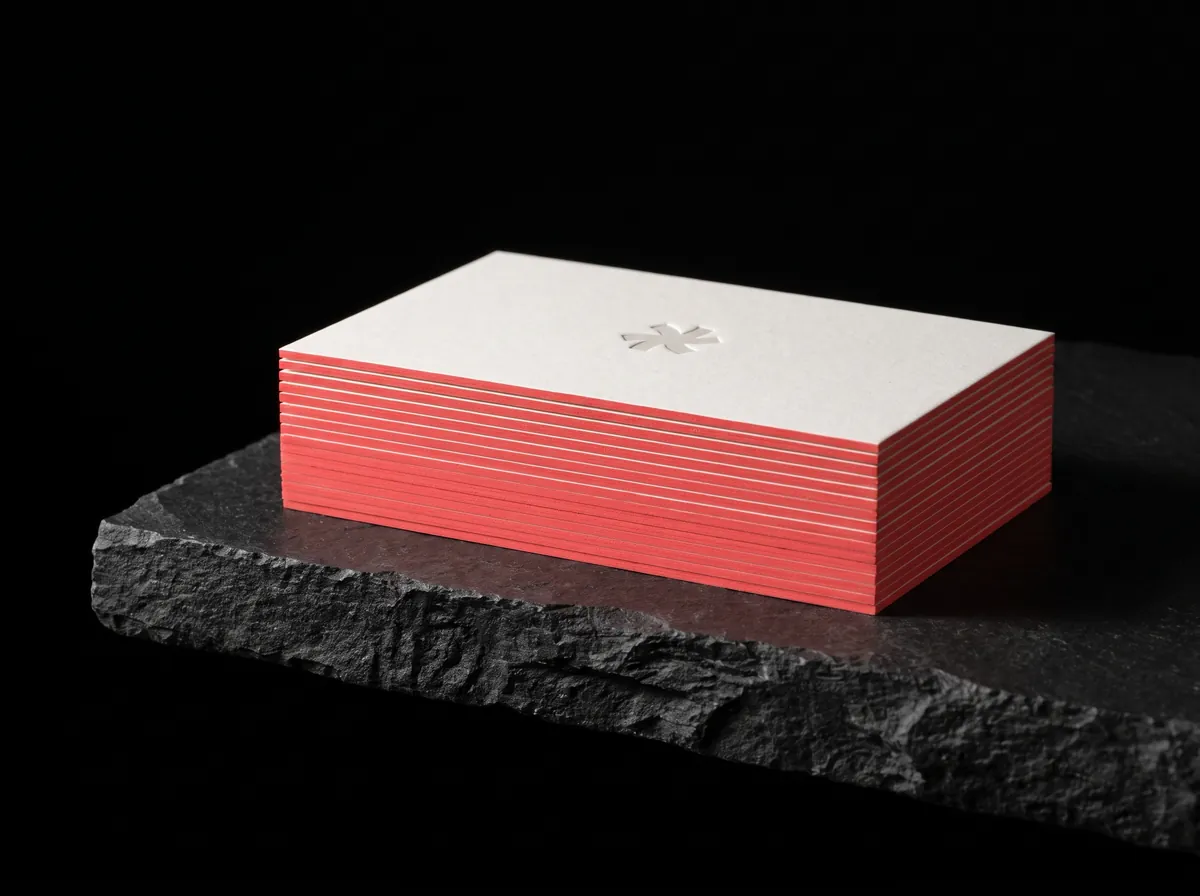 Standard
Painted Edge Business Cards
From 165 US$ for 250Ships in 3–4 business days after proof approval (estimate)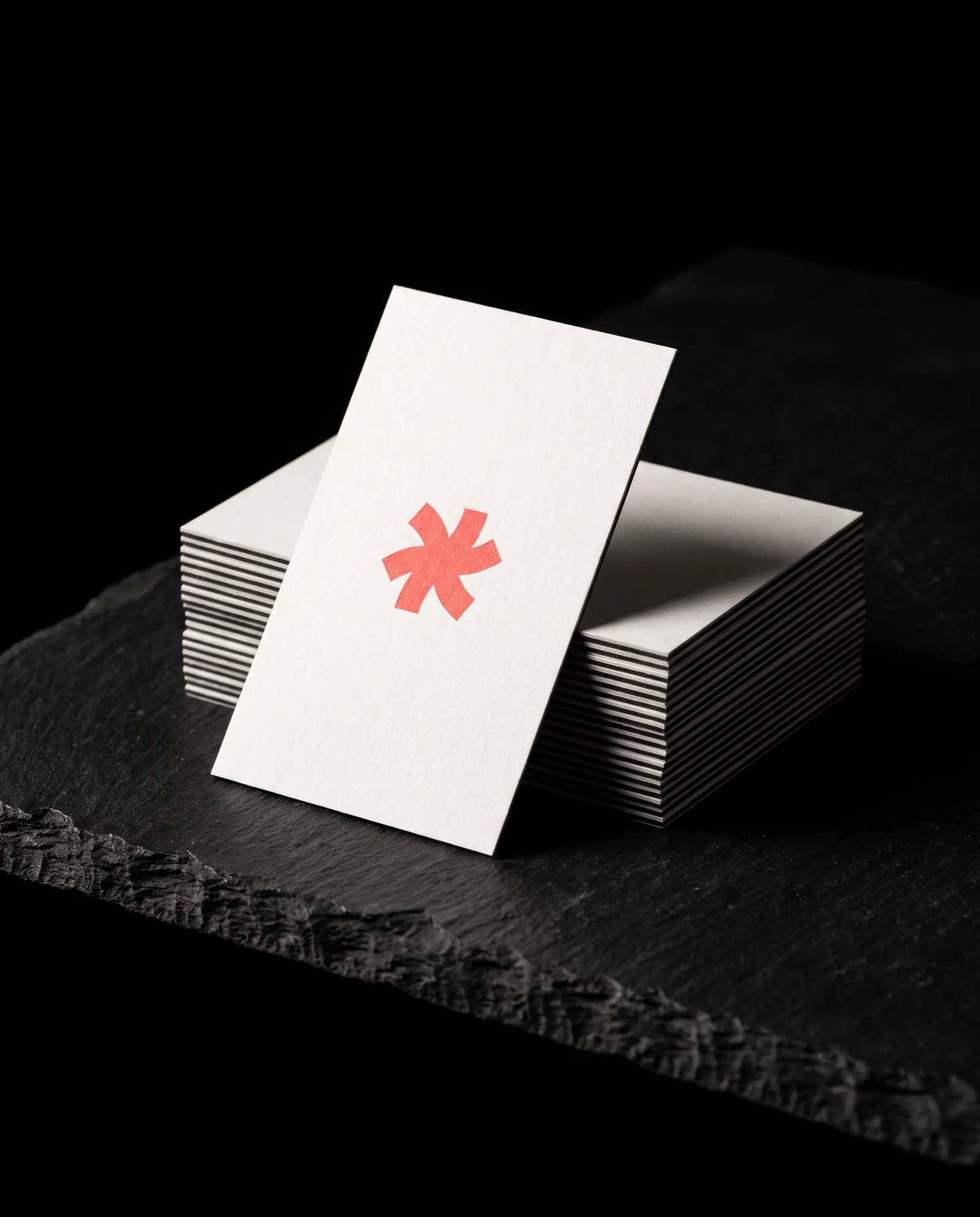 Standard
Layered Black Core Business Cards
From 126 US$ for 500Ships in 3–4 business days after proof approval (estimate)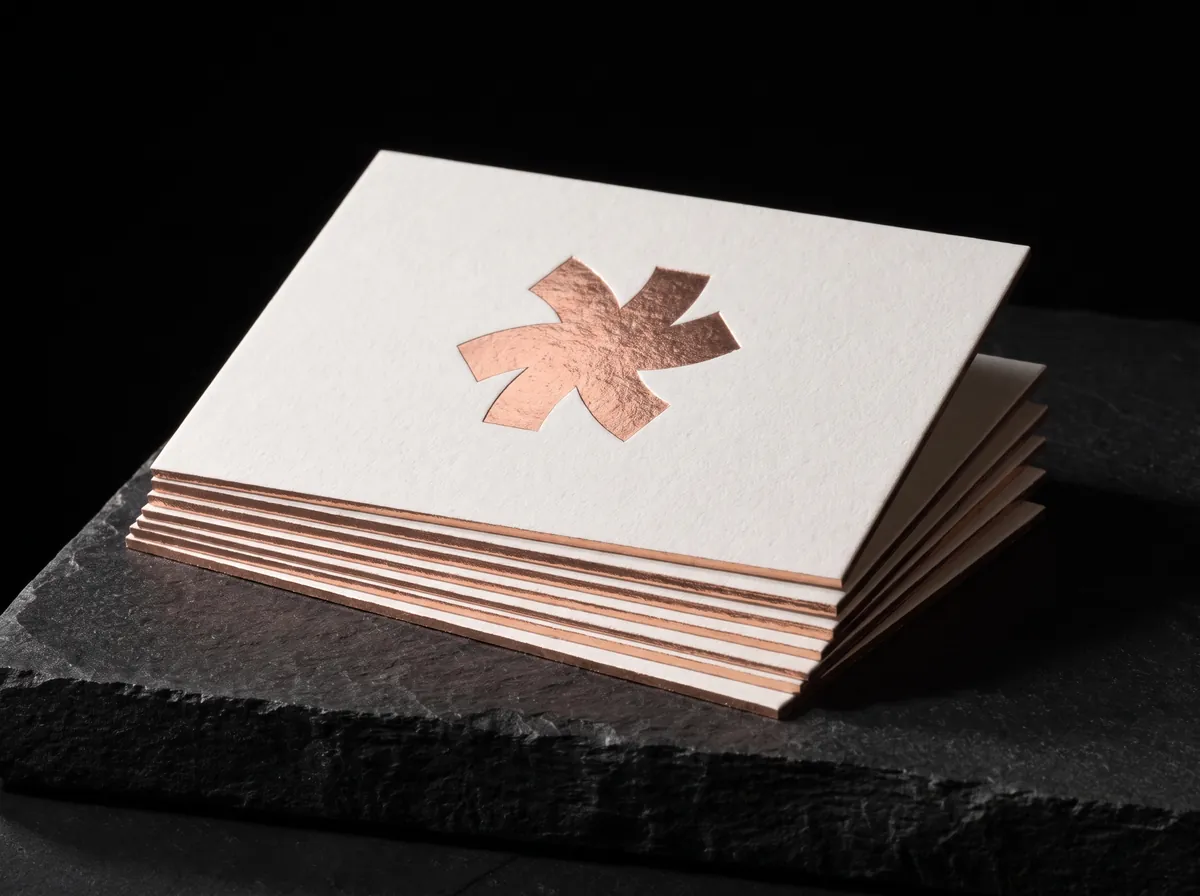 Custom
Custom Thick Business Cards
From 185 US$ for 250About 3 weeks after proof approval (estimate)
32pt vs 48pt: what the numbers feel like
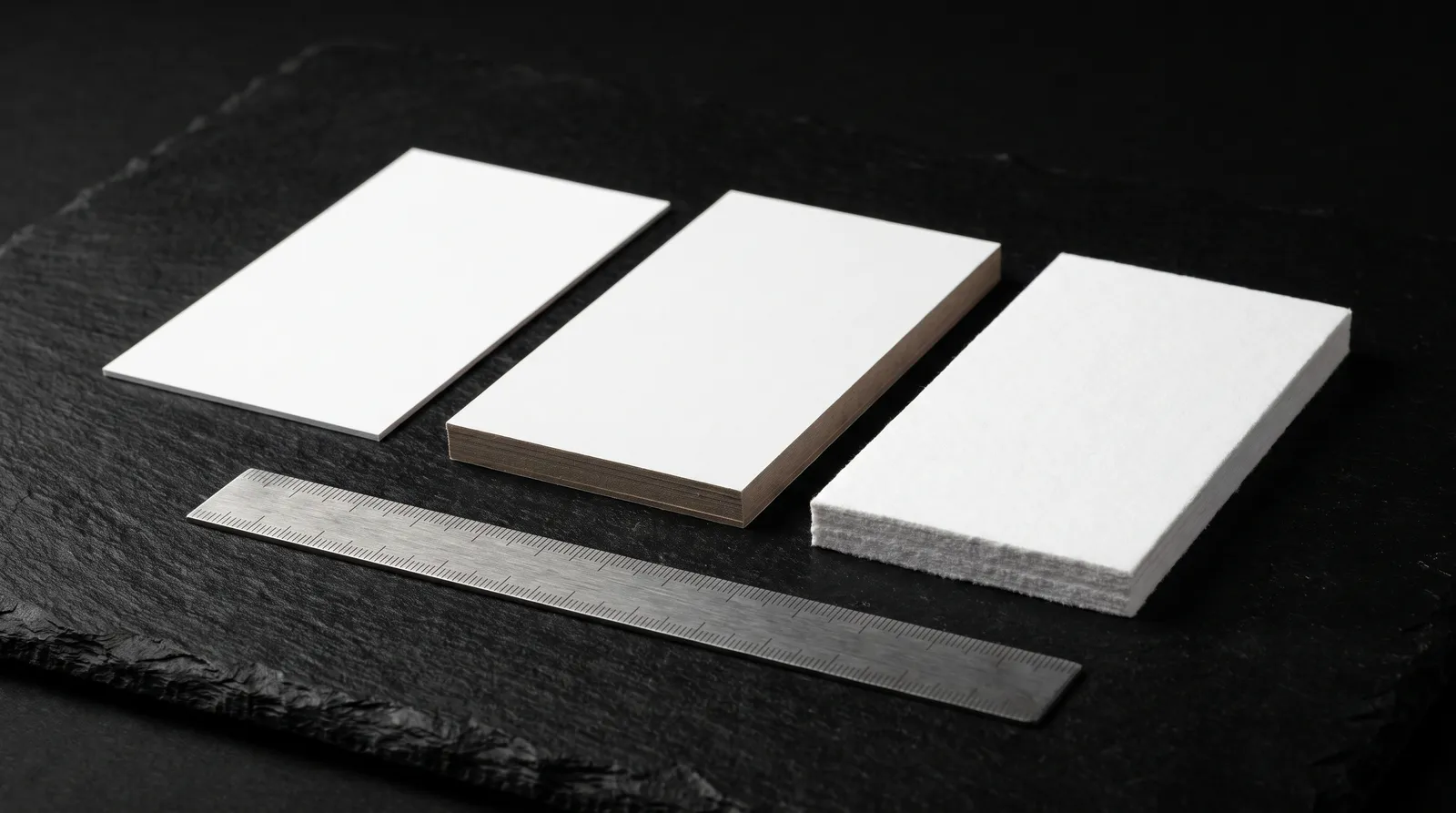
A point is a thousandth of an inch. 32pt is about 0.8 mm, close to a credit card: rigid, and it stops flexing between your fingers. 48pt is about 1.2 mm, roughly one and a half credit cards. It doesn't bend at all, and the edge reads as a band of colour. We start most people at 32pt. 48pt is harder to slide into a wallet, so save it for the statement card. More on business card thickness.
Cotton, silk or soft touch
The same 32pt card feels different under each surface, and each surface takes different finishes. Pick the paper for the finish you want, not the other way round.
Cotton
Uncoated, with soft visible fibre and a warm off-white tone. It drinks light rather than reflecting it. Cotton is the sheet for impression: letterpress and deboss press into it and you can find the shape with your thumb, and hot foil leaves a slight bite. It won't take spot UV, because the varnish soaks in and never cures. On cotton we give you the same gloss contrast with a clear foil instead. Our recommendation for most thick cards.
Silk laminate
Bright white with a smooth, satin film. Clean and crisp for photography and exact colour. It takes hot foil and spot UV well. It won't take an emboss or letterpress: a laminate is a stiff film, so the impression cracks or flattens. If you want both, we bond a cotton sheet to a silk one.
Soft touch
Bright white under a velvety matte film that feels like suede and resists fingerprints. Hot foil and raised spot UV look their best here, against the matte. Same rule as silk: no emboss, no letterpress.
Bright white uncoated (Standard)
The paper behind our 32pt Standard painted-edge card. Clean and slightly toothy. If your design prints a dark colour edge to edge, the cut edge shows the white core, so pair it with a painted edge.
What works on which thick paper
| Finish | Cotton | Silk laminate | Soft touch |
|---|---|---|---|
| Hot foil | Yes, with a slight bite | Yes | Yes |
| Letterpress | Yes | No (moves to a cotton sheet) | No (moves to a cotton sheet) |
| Blind emboss or deboss | Yes | No | No |
| Spot UV, flat or raised | No. We use clear foil for the same effect | Yes | Yes |
| Painted edge | Yes. Paint bonds best here | Yes. Can wear at the corners over time | Yes. Can wear at the corners over time |
| Edge foil | Our press team confirms it per job | Yes | Yes |
Which thick card is right for you?
32pt Painted Edge (Standard)
- Thickness
- 32pt
- Paper
- Bright white uncoated
- Edge
- Painted, 6 colours
- Face finishes
- Full-colour print
- Sizes
- Standard, square
- Production time
- Ships in 3–4 business days after proof approval
- From
- 165 US$ for 250
- Best for
- A clean card with a flash of colour on the side
Layered Black Core (Standard)
- Thickness
- 32pt
- Paper
- Uncoated triplex: white, black, white
- Edge
- Black core shows on every edge
- Face finishes
- Full-colour print only
- Sizes
- Standard, square, mini
- Production time
- Ships in 3–4 business days after proof approval
- From
- 126 US$ for 500
- Best for
- Contrast built into the paper, no extras
Custom Thick
- Thickness
- 32pt or 48pt
- Paper
- Cotton, silk laminate or soft touch
- Edge
- Pantone-matched paint, edge foil, or plain
- Face finishes
- Hot foil, spot UV on silk and soft touch, plus print
- Sizes
- Standard, square, mini
- Production time
- About 3 weeks after proof approval
- From
- 185 US$ for 250
- Best for
- Cotton, foil, 48pt and anything combined
Letterpress on thick cotton is its own product: see letterpress business cards.
Thick business card prices
At 500 cards, thick business cards with us run from 126 US$ for a Standard triplex to 465 US$ for 48pt cotton before any finishing. Hot foil or letterpress on thick cotton costs more, because each foil colour and each ink is its own die or plate and its own press pass. Every price below is live from our configurator.
Base cards (print, no finishing)
| Card | Line | 250 | 500 | 1,000 |
|---|---|---|---|---|
| 32pt bright white uncoated, painted edge | Standard | 165 US$ | 202 US$ | 292 US$ |
| 32pt triplex, black core | Standard | – | 126 US$ | 171 US$ |
| 32pt silk laminate | Custom | 185 US$ | 270 US$ | 425 US$ |
| 32pt soft touch | Custom | 205 US$ | 290 US$ | 455 US$ |
| 32pt cotton | Custom | 215 US$ | 310 US$ | 485 US$ |
| 48pt cotton | Custom | 320 US$ | 465 US$ | 755 US$ |
Larger runs (2,000 and 5,000) are on the Custom Thick configurator.
Custom add-ons (shown at 250; the configurator prices every quantity)
| Add-on | At 250 | Note |
|---|---|---|
| 48pt instead of 32pt | +105 US$ | |
| Hot foil, one colour | +70 US$ | Each extra colour or side is its own die and pass |
| Spot UV | +60 US$ | Silk and soft touch only. On cotton we use clear foil |
| Painted edge | +45 US$ | Pantone-matched |
| Edge foil | +65 US$ | Square or rounded corners |
| Rounded corners | +10 US$ | Works with edge foil too |
Finished thick builds (own product pages)
| Build | 250 | 500 | 1,000 | Page |
|---|---|---|---|---|
| Hot foil on 32pt cotton, one colour, front | 310 US$ | 410 US$ | 620 US$ | Custom hot foil |
| Letterpress on 48pt cotton, one location | 340 US$ | 535 US$ | 920 US$ | Letterpress |
What moves the price
- Weight. 48pt costs more than 32pt in paper and in cutting.
- The paper. Cotton costs a little more than silk or soft touch.
- Each foil colour on each side. Gold on the front and gold on the back is two dies and two passes. Consolidating locations is the easiest saving.
- The edge. Paint is applied by hand to a clamped stack. Edge foil is a separate process again.
- Quantity. Setup is the same for 250 or 1,000 cards, so the per-card price drops fast as the run grows.
Our recommendation
For most people: 32pt cotton with a Pantone-matched painted edge, about 260 US$ for 250. It's thick enough to feel deliberate, it still fits a card case, and the edge does the talking. Add one hot foil colour if the mark deserves it. If budget is the limit, the Standard triplex gets you a 32pt card with a built-in edge for 126 US$. Save 48pt for the card that has to be the statement.
Custom orders ship free within the continental US. Taxes and duties, where they apply, are shown at checkout.
Edges: paint, foil or a coloured core
Once a card is thick enough, the edge becomes a surface. It's the stripe you see when the card sits in a stack or between two fingers, and it's usually the detail people notice second and remember first. There are three ways to use it.
Painted edges
We clamp the stack tight and paint the exposed edges as one surface, so the colour runs clean round all four sides. Standard offers six edge colours. Custom edges are mixed to your Pantone, so the edge can match the foil or the logo exactly. Because it's a hand process, expect tiny card-to-card variation you'd only see under a loupe. Paint bonds best to uncoated cotton. On silk or soft touch it sits on the cut paper core rather than the film, and it can wear at the corners with heavy handling. More on painted edges.
Foil edges
Metallic foil on the edge instead of paint: gold, silver, rose gold and more. It works with square or rounded corners, and it reads best on 32pt or heavier, ideally 48pt, because the gleam is only as wide as the card is thick. On soft cotton fibres the foil can take unevenly, so our press team confirms cotton edge foil before we promise it. See gold edge gilding.
A coloured core
Bond three sheets with a coloured one in the middle and the edge colour is built in: no paint, nothing to wear. Our Standard triplex has a black core and is print-only. On Custom, the core colour and the faces are your choice, and the faces can take foil.
The landmine
If you print a dark colour edge to edge on white paper, the cut edge shows a thin white line. Either paint the edge to match or choose a paper that's coloured all the way through.
Foil, letterpress and deboss on thick stock
Thick stock is the best canvas we have for pressed finishes. A heavy sheet takes a deeper bite without buckling, and the extra caliper hides the back of an impression better than a thin card can. Here's what each process does on a thick card, and the rule that comes with it.
Hot foil
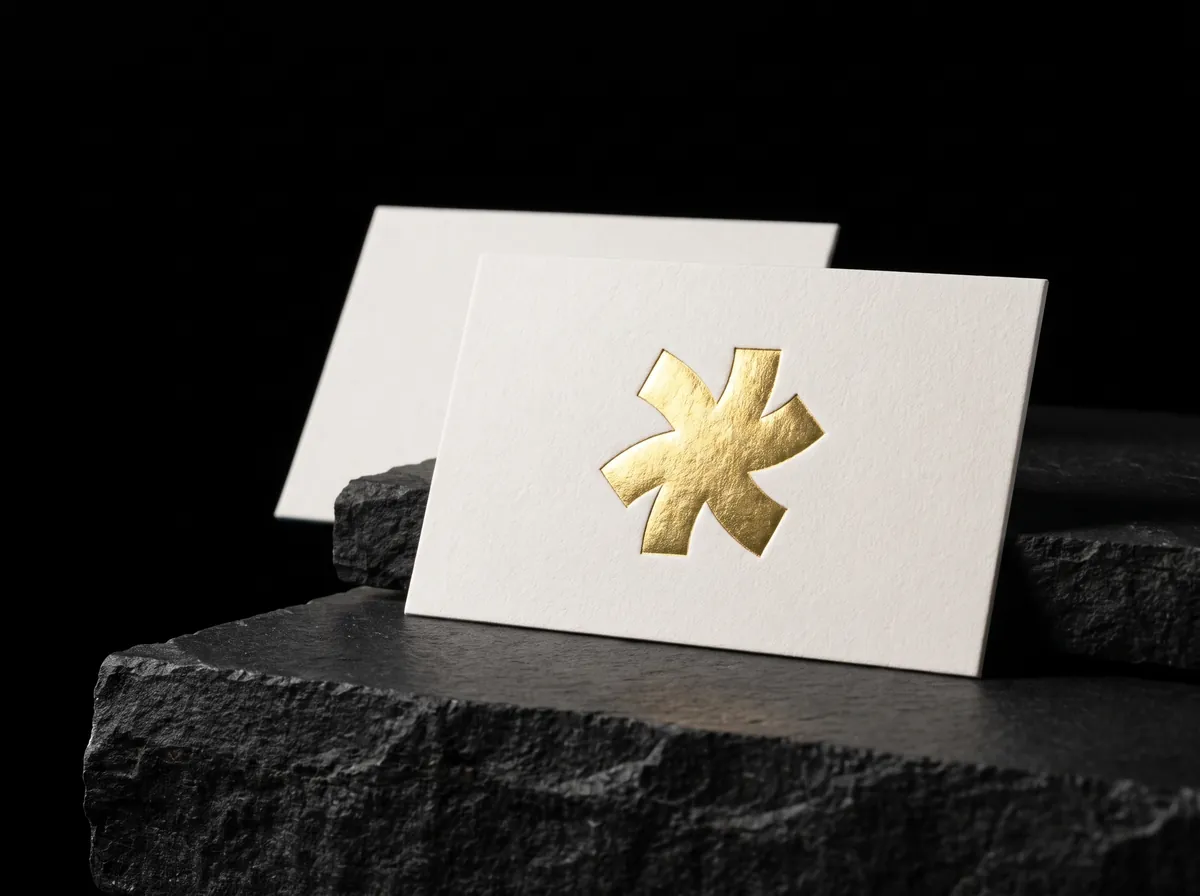
Heat and pressure transfer a metallic or pigment film through a metal die. On cotton it leaves a slight bite you can feel. Fine detail survives foil: lines hold to 0.1 mm; we design to 0.15 mm with gaps around 0.25 mm, and a gradient becomes one solid foil tone. For white or a pale colour on a dark card we use white pigment foil, because ink sinks into dark paper. See foil business cards.
Letterpress
An inked plate pressed hard into soft cotton, so the ink sits at the bottom of the impression. Fine lines and type look their best. Big solid areas print with a soft, suede-like mottle, which some people love and some don't. Light ink on dark paper looks chalky, so light-on-dark becomes foil. See letterpress business cards.
Blind emboss and deboss
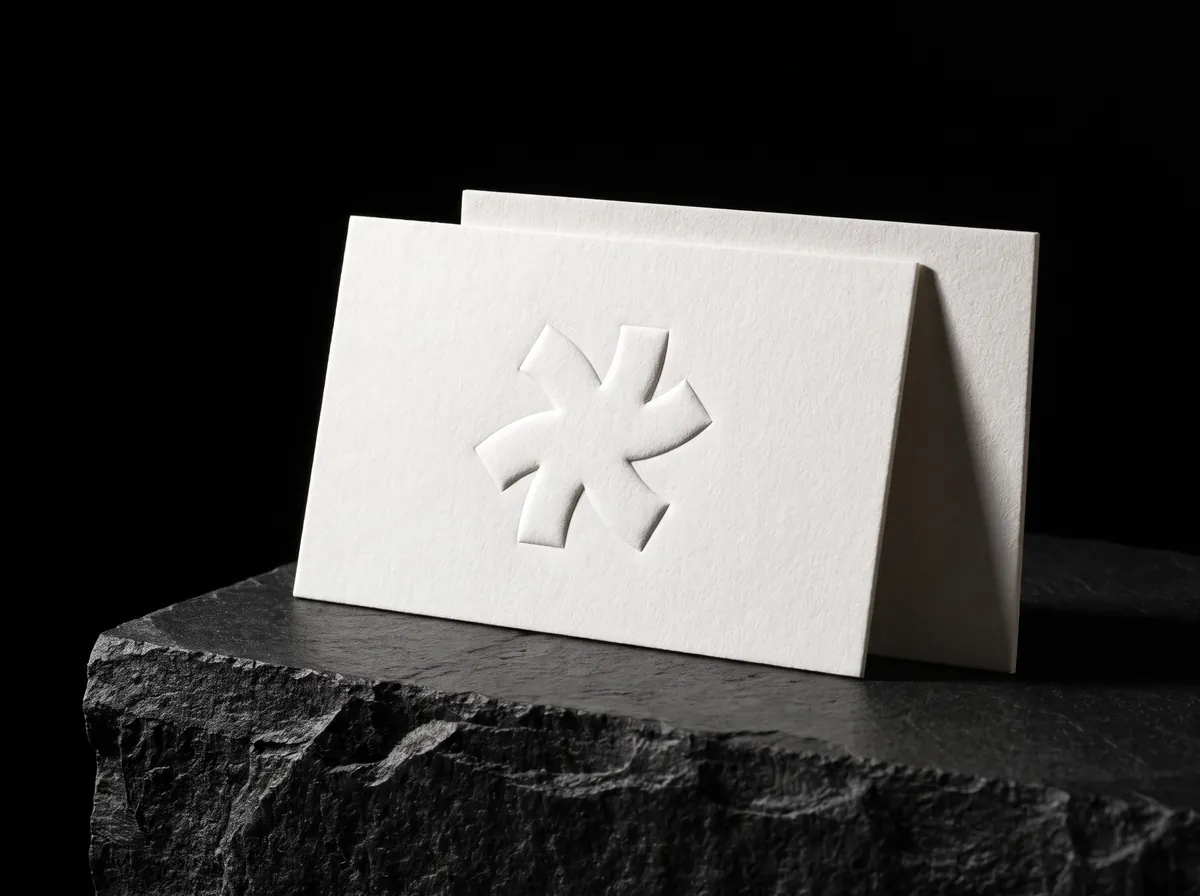
No ink, just a shape pressed up or down, read by its shadow. On a single sheet a deep impression mirrors through to the back, so if the back carries type we bond two sheets or keep the impression lighter. On our thick papers that means cotton: laminated stocks won't take an impression. See embossed business cards.
Spot UV
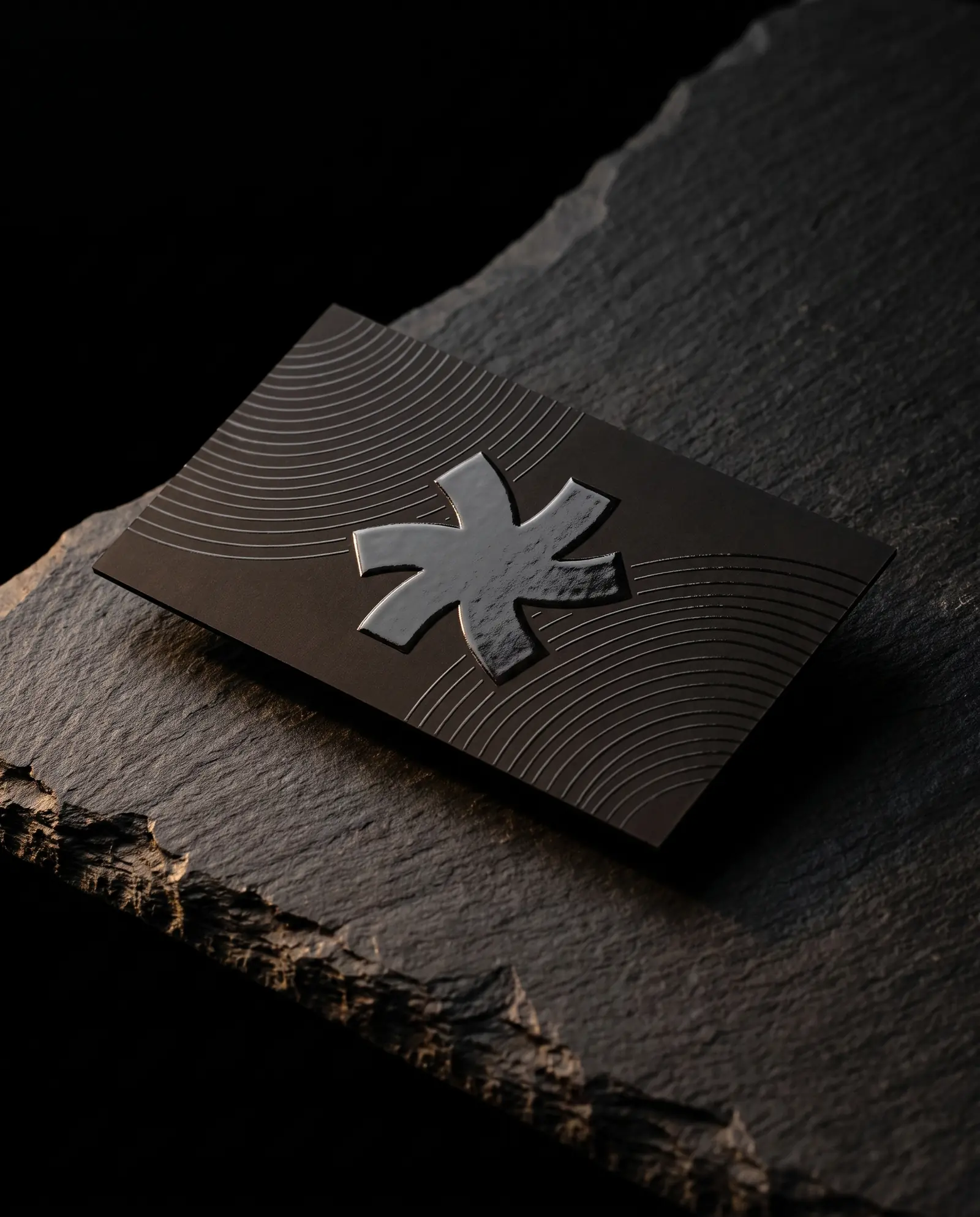
A clear gloss on chosen elements, flat or raised, against a matte field. Spot UV works on silk, soft touch and cotton. See spot UV business cards.
The strongest thick cards usually lean on one or two of these, not five.
How a thick card order works
- 1
Pick a Standard card or start a Custom build. If you have a date, tell us first. It decides which path can realistically make it.
- 2
We check your file. A designer rebuilds the artwork for each process: foil and paint get their own separations, fine lines are thickened to what the press can hold, and small text moves to ink where it needs to.
- 3
You approve a proof. Nothing prints until you do.
- 4
We produce. Standard ships in 3–4 business days after approval. Custom takes about 3 weeks. Transit is on top. These are estimates, not delivery guarantees.
- 5
We ship. Transit time depends on where you are and sits on top of production.
If you're not happy, we reprint. How reprints work. If anything feels unclear before you order, book a 15-minute call and we'll walk through it with your artwork open.
Feel the thickness first
Screens can't show weight. Our sample kit has cards at several thicknesses, plus letterpress, blind emboss, painted edges and raised spot UV, so you can hold 32pt next to a standard card before you choose. It's 8 US$ with free shipping within the continental US, and you get a 10 US$ credit on your first order.
Specific specs, priced
Deeper reads on one material and one technique at a time, with the constraints and the spec we'd start you on.
- Painted edge business cards. Our fastest thick card: 32pt stock with a stripe of colour on every edge.
- Neon painted edges. Fluorescent Pantone paint on white 32pt cotton: quiet face, loud edge.
- Painted edges on 48pt cotton. Where the edge stops being a stripe and becomes a band.
- Edges on black cotton. Jet-black cotton with a coloured edge, framed like a matboard.
- Gold edge gilding. Foil on the edges instead of the face, with square or rounded corners.
Thick business card questions
Are thicker business cards better?
Thicker cards feel more deliberate in the hand, survive pockets and wallets better, and give the edge enough width to carry colour or foil. They also take pressed finishes like letterpress and deboss more cleanly, because the sheet can absorb the impression. But thickness isn't automatically better: a 48pt card is harder to fit in a wallet or card case, and it costs more. For most people 32pt is the sweet spot. Go to 48pt when the card is meant to be the statement piece.
What is the thickest business card you can get?
Our thickest standard paper card is 48pt cotton, about 1.2 mm, or roughly one and a half credit cards. Three-layer builds bond sheets together for a similar weight with a coloured core on the edge. Metal cards are thinner but much heavier. If you need something thicker than 48pt, ask us for a custom quote and we'll tell you straight whether the extra thickness earns its place.
What thickness of cardstock is best for business cards?
For a thick card, 32pt (about 0.8 mm) is the best balance: rigid, close to a credit card, and still easy to carry. 48pt (about 1.2 mm) is for statement cards and deep letterpress. A standard business card is 14–16pt, which feels light next to either. If you want to understand the scale in detail, our guide to how thick a business card is covers every weight from 14pt up.
What's the difference between 32pt and 48pt business cards?
32pt is about 0.8 mm thick and 48pt is about 1.2 mm, so 48pt is half as thick again. In the hand, 32pt feels rigid and 48pt feels like a solid object that won't bend at all. On the edge, 32pt shows a clear line of paint or foil and 48pt shows a band. 48pt costs more and fits fewer cards in a case, so we recommend 32pt for most people and 48pt for a deliberate statement.
How thick are Vistaprint business cards?
According to Vistaprint's own product pages (checked October 2026), their standard card is 14pt, Premium Plus is 18pt and Ultra Thick is 32pt, with a UV gloss front and a matte back. For comparison, our Standard thick cards are 32pt, and our Custom cards go up to 48pt cotton, with hot foil, letterpress and painted or foil edges available on the thick sheet itself.
Will a 48pt card fit in a wallet or card holder?
It will fit a wallet slot, but snugly, and a card case holds roughly a third as many 48pt cards as standard 16pt ones. That's the trade-off for the weight. If your cards live in wallets and get handed out in volume, 32pt is the practical choice: it's close to a credit card and slides in like one.
Can thick business cards be foiled, embossed or letterpressed?
Yes, on the right paper. Hot foil works on cotton, silk and soft touch. Letterpress, blind emboss and deboss need an uncoated sheet, which on our thick range means cotton, because laminated stocks won't take an impression. Spot UV works on silk, soft touch and cotton. Our Standard thick cards are print-only, so foil and impression work runs on Custom, in about three weeks after proof approval.
Do painted edges chip or rub off?
Painted edges hold up well in normal use. Paint bonds best to uncoated cotton, where it soaks into the fibres. On silk or soft touch it sits on the cut core and can wear at the corners over time with heavy handling. Because the edges are painted by hand on a clamped stack, expect very slight variation from card to card. If durability matters most, a three-layer card with a coloured core has nothing to wear off at all.
What is a triplex business card?
A triplex card is three sheets bonded into one thicker card. The middle sheet shows as a coloured stripe on every edge, so the edge colour is built into the paper rather than painted on. Our Standard triplex is 32pt, white on both faces with a black core, and print-only. Custom three-layer builds let you choose the colours and add foil to the faces.
How much do thick business cards cost?
At 500 cards, our thick cards start at 126 US$ for the Standard triplex and 202 US$ for the 32pt Standard painted edge. Custom cards at 500 run 270 US$ on 32pt silk, 310 US$ on 32pt cotton and 465 US$ on 48pt cotton, before foil, edges or other finishing. The price table on this page shows every card at 250, 500 and 1,000.
How long do thick business cards take?
Standard ships in 3–4 business days after proof approval (estimate). Custom cards take about 3 weeks after proof approval. Transit is extra and depends on where you are. These are estimates, not delivery guarantees, so if you have a date, tell us before you order and we'll tell you honestly which path can make it.
Can I feel the thickness before I order?
Yes. Our sample kit includes cards at several thicknesses, plus letterpress, blind emboss, painted edges and raised spot UV, so you can hold 32pt against a standard card. It costs 8 US$ with free shipping within the continental US, and you get a 10 US$ credit toward your first order.
Cotton, silk or soft touch: which thick paper should I choose?
Choose cotton if you want texture and impression: it takes letterpress, deboss and hot foil with a slight bite. Choose silk laminate for bright white, crisp photography and spot UV. Choose soft touch for a velvety matte feel with foil or raised spot UV against it. Silk and soft touch can't be embossed or letterpressed. If you're unsure, 32pt cotton is our default recommendation.
Want the whole picture? See our luxury business cards.
Paper first? Read about our cotton paper.
More ideas: minimalist business cards
Who orders these: contractors, roofers and crews whose cards live in a truck. See our construction business cards.