Individuelle Festkartonagen, foliengeprägt und blindgeprägt in Kleinauflagen
Custom rigid boxes are 2 mm greyboard wrapped in paper and built before they ship, so they arrive solid and never flat. We press real hot foil and blind deboss into that wrap, in runs small enough for a launch or a client gift list. Once a foil or deboss die is involved, runs usually make sense from about 100 boxes; shorter pilot runs are quoted on request. Most rigid box projects we've built have landed around 1.295 €–1.845 € for the run. Production takes about three weeks after proof approval, with a prototype first.
Preis anfragen
Etwa 3 Wochen nach Freigabe des Proofs, geschätzt. Fracht wird mit Ihren Kartons kalkuliert.
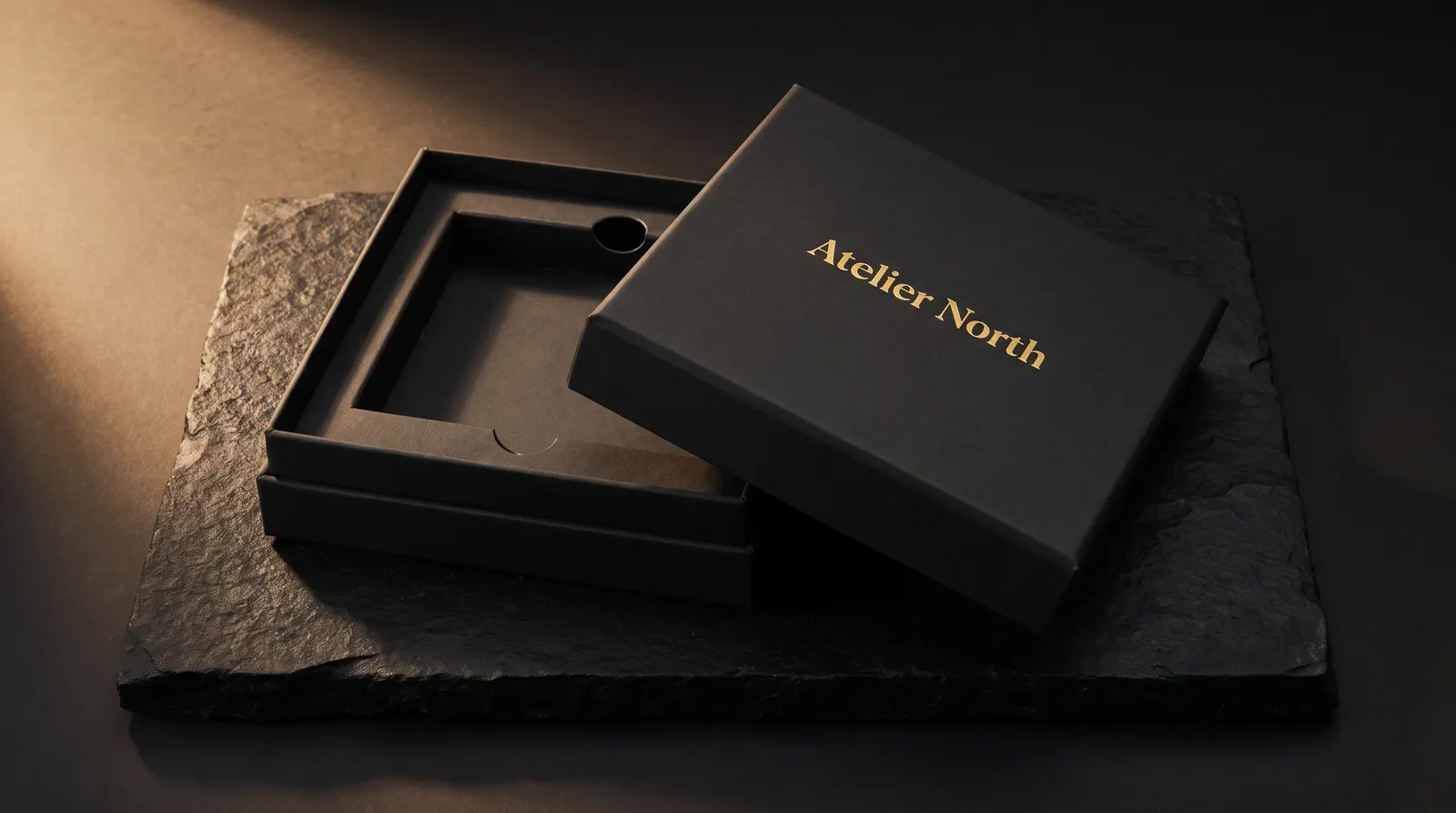
Custom Foil Stamped Magnetic Gift Boxes 7x5x2 in, Collapsible Rigid
7 x 5 x 2 in collapsible rigid box, magnetic flap, wrapped board, hot foil on the lid. A paid sample comes first, credited on 250+.
From 1.695 € for 100 boxes · 4.495 € for 500
Preis anfragenPreis per Schnellangebot. Ein Mensch antwortet, meist am selben Tag.
Custom Foil Stamped Magnetic Gift Boxes 10x8x3 in, Collapsible Rigid
10 x 8 x 3 in collapsible rigid box, magnetic flap, wrapped board, hot foil on the lid. A paid sample comes first, credited on 250+.
From 2.595 € for 100 boxes · 7.745 € for 500
Preis anfragenPreis per Schnellangebot. Ein Mensch antwortet, meist am selben Tag.
Zuerst kommt ein kostenpflichtiges Muster, das ab 250 Stück angerechnet wird.
Magnetboxen zum Festpreis finden Sie unter Magnetboxen Seite. Alles andere hier wird für Ihr Produkt individuell kalkuliert.
Ein Mensch prüft jeden Proof.
Konstruktion, Stanzkontur und Gestaltung, bevor etwas in den Druck geht.
Erst Prototyp, dann Auflage.
Sie halten die Konstruktion in den Händen, bevor wir den Auftrag fertigen.
Fracht wird mit Ihren Boxen angeboten.
Fertige Boxen werden nach Volumen versandt. Die Fracht ist daher im Auftrag ausgewiesen, nicht darin versteckt.
Was individuelle Festkartonagen kosten und wie wenige Sie bestellen können
If you've searched for custom rigid boxes, you've seen per-box prices under a dollar. Before you compare, check what that number includes: the setup, the finishing and the freight are where a real box run's cost sits. We'd rather show you the whole number up front.
Most custom rigid box projects we've built have landed around $1,400–$2,000 for the full run. That's context, not a quote. Six things set your number:
| Cost driver | Why it moves the price |
|---|---|
| Size | More board, more wrap paper, and a bigger carton to ship. Built boxes ship by volume, so size drives freight more than weight does. |
| Quantity | The structure, the dieline and every die cost the same for 20 boxes as for 200. More boxes spread that setup thinner. |
| Wrap paper | A coloured uncoated sheet or natural kraft costs less than a printed wrap with soft-touch lamination. |
| Foil and deboss | Each foil colour is its own die and its own press pass, per location. One foil on the lid is the efficient build; foil on the lid and the base means a second die and a second pass. |
| Interior and insert | A printed lid liner and a paperboard tray each add a part and a step. |
| Freight | Quoted with the job. A box that arrives built can't be flattened for the trip. |
Wie klein eine Auflage sein kann
Small runs are welcome. Once a foil or deboss die is part of the build, runs usually make sense from about 100, because below that the die and press setup land on very few boxes and each one gets expensive. Shorter pilot runs are quoted on request; we've built one of eight boxes for a launch, with a printed wrap and no foil die. Tell us the quantity you actually need. We'll price that number, not one that suits us.
Stilarten für feste Schachteln und ihre jeweiligen Kompromisse
Wählen Sie zuerst die Bauart, dann die Veredelung. Die Bauart bestimmt, wie sich die Box öffnet, und den Großteil der Kosten. Wenn Sie unsicher sind, beginnen Sie mit der zweiteiligen festen Box aus Deckel und Boden. Daran denken die meisten bei einer festen Geschenkbox, und ihr Deckel ist die beste Fläche für Folie.
| Style | How it opens | The honest trade-off | Use it for |
|---|---|---|---|
| Two-piece lid & base (our default) | The lid lifts straight off and slides down slowly over the base. | The fit has to be snug or the lid rubs the base and scuffs it. We set the fit on the prototype. | Gifts, launch kits, anything kept on a shelf |
| Shoulder-neck | The lid sits on a raised inner collar, so a band of the inside shows when it's closed. | A third built part, so more cost. Worth it when the reveal is the point. | Fragrance, jewellery, limited editions |
| Book-style magnetic | A hinged front flap closes with a soft snap from magnets hidden under the wrap. | Magnets and a hinge add cost, and the flap needs a clean fold line, so foil stays off the spine. | Presentation and PR kits that get opened more than once |
| Drawer | A tray slides out of a wrapped sleeve, pulled by a ribbon or a thumb notch. | A wrapped sleeve and a wrapped tray, and the tray has to slide freely without rattling, so the fit is tight work. We set it on the prototype. | Small objects, card sets, sample kits |
| Collapsible rigid | Ships flat and folds up into a rigid box, held by magnets or locking tabs. | Much cheaper freight and storage, but it never feels quite as solid as a rigid set-up box that arrives already built. | Large runs, or boxes you store before packing |
Every style here is a built box that needs an outer carton to go through the post. If the box has to travel on its own, it's a mailer, not a rigid box. Not sure it should be rigid? Compare all box structures. Book-style with a magnetic flap? See magnetic closure boxes.
Bezugspapiere und Karton, die Quelle der Haptik
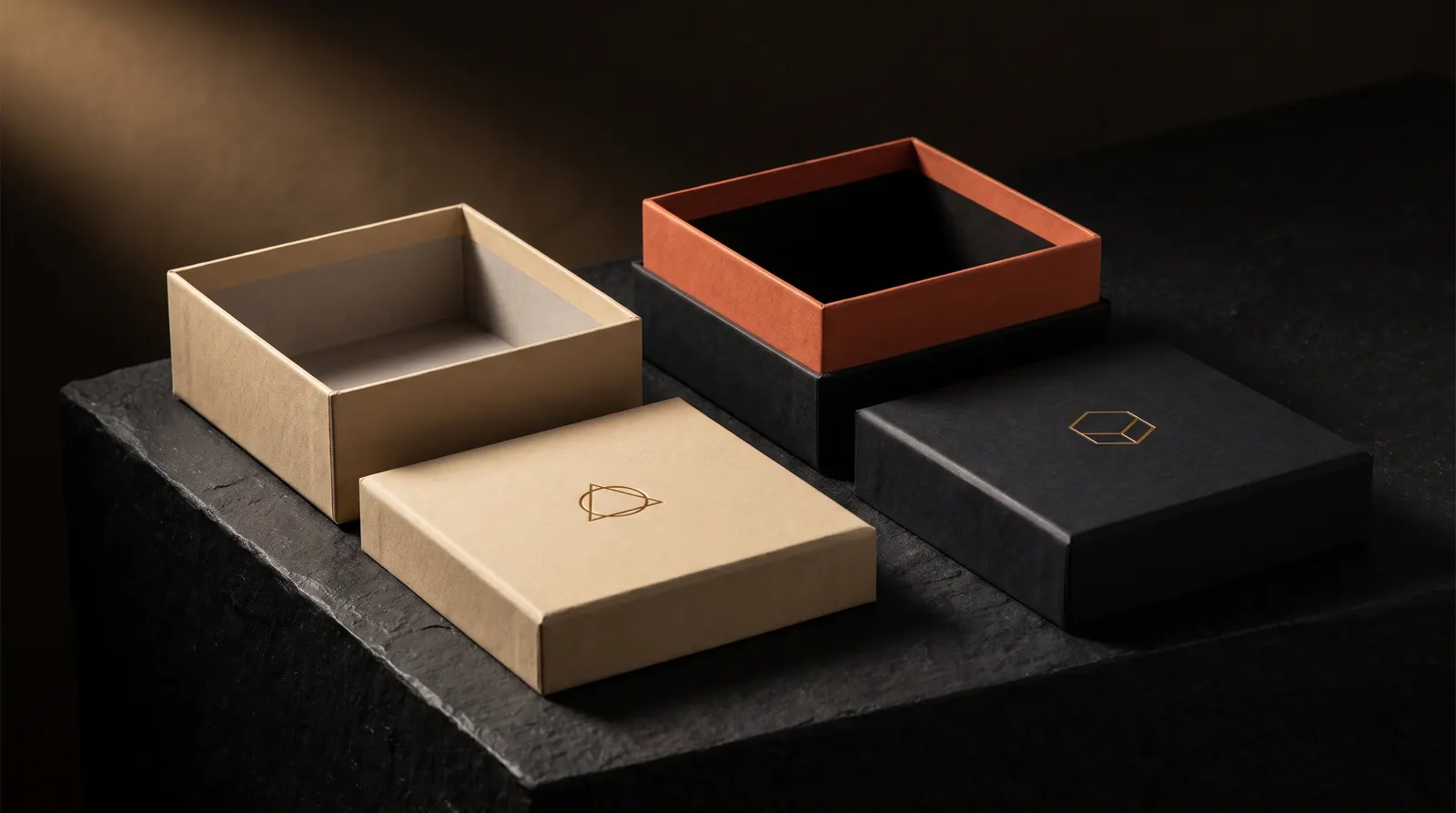
Every rigid box starts as 2 mm greyboard: dense, flat, and stiff enough that the lid drops rather than flexes. Heavier board is available on request. On luxury rigid boxes the board is never the surface anyone sees. A sheet of paper, the wrap, covers it and turns in at every edge, and a grey core showing anywhere is a fault, never a look. See rigid box board.
The wrap is where the feel lives, and it decides which finishes the box can take.
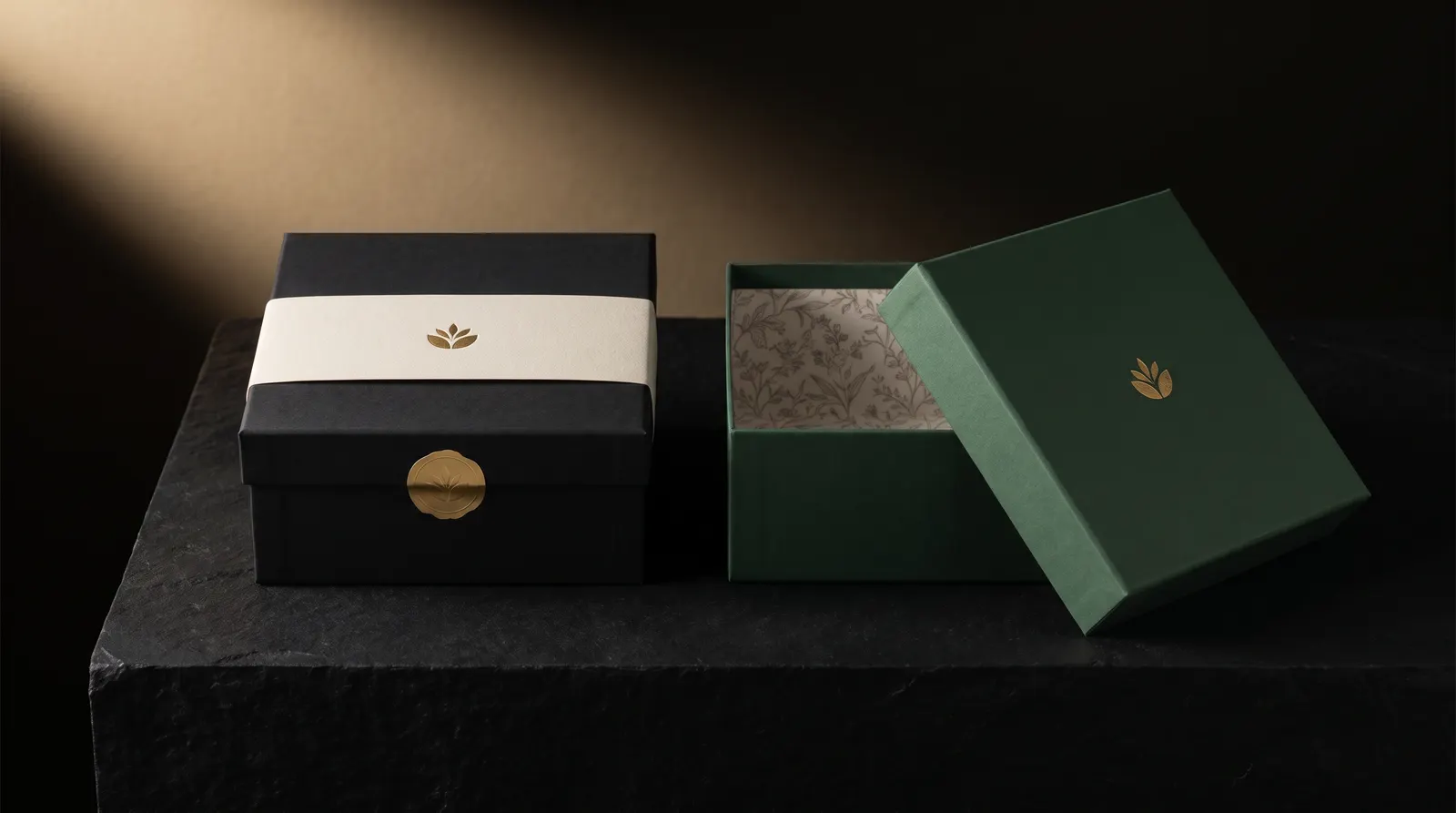
- Uncoated colour papers. Soft, slightly toothy sheets in a deep range of shades, like the sand Colorplan on our Vlada box. They take foil cleanly and hold a deboss crisply. Our first recommendation.
- Natural kraft. Brown, fibrous, honest. Ink sinks into it and turns flat and muddy, so we use foil. Black hot foil on kraft is the least expensive build that still feels like a gift.
- Black and dark uncoated. Dramatic, and foil sings on it. A blind deboss on black is very quiet, though, because a blind impression reads only by its shadow. If the mark has to be read, we put foil in the impression.
- Printed wrap with soft-touch lamination. Full-colour artwork, then a laminate with a suede-like drag under the fingers. Foil bonds well to it. Deboss doesn't: an impression won't seat in soft-touch laminate, so if you want both, the deboss moves to an uncoated wrap.
The landmine on dark soft-touch: on a deep navy or near-black soft-touch box, every fingerprint and every courier scuff shows. We plan around it with a lighter base colour, foil where hands won't land, and a proper outer carton. If the box has to be black and spotless, choose a black uncoated wrap instead.
Folienveredelte und geprägte Schachteln: was der Bezug verträgt
Every foil and every impression on a rigid box is pressed into the wrap while it's still a flat sheet, before it goes round the board. Press a wrap after it's assembled and it lifts off the board and the impression goes slack.
- Hot foil. A metal film pressed onto the wrap with heat and a die. Metallic and opaque pigment foils read on any colour of paper, dark ones included, which makes foil our default for a logo on a lid. Fine detail survives foil: lines hold to 0.1 mm; we design to 0.15 mm and adjust only below-floor lines, preserving your mark. Foil is one flat tone, so a gradient logo becomes a clean single colour. Black foil on a black wrap reads as a sheen, not contrast: lovely for a quiet mark, wrong for anything that has to be read. We keep 40 foils on the shelf.
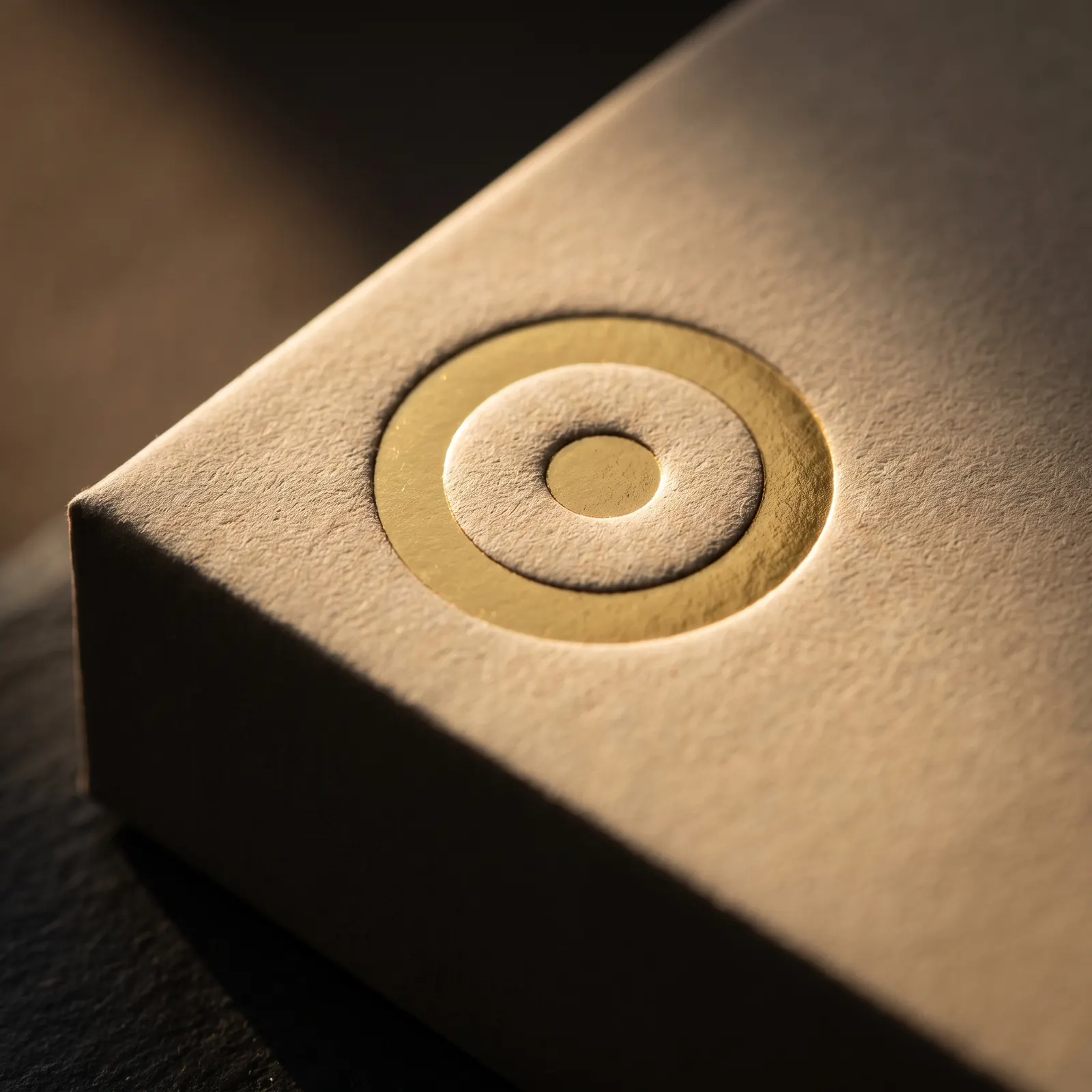
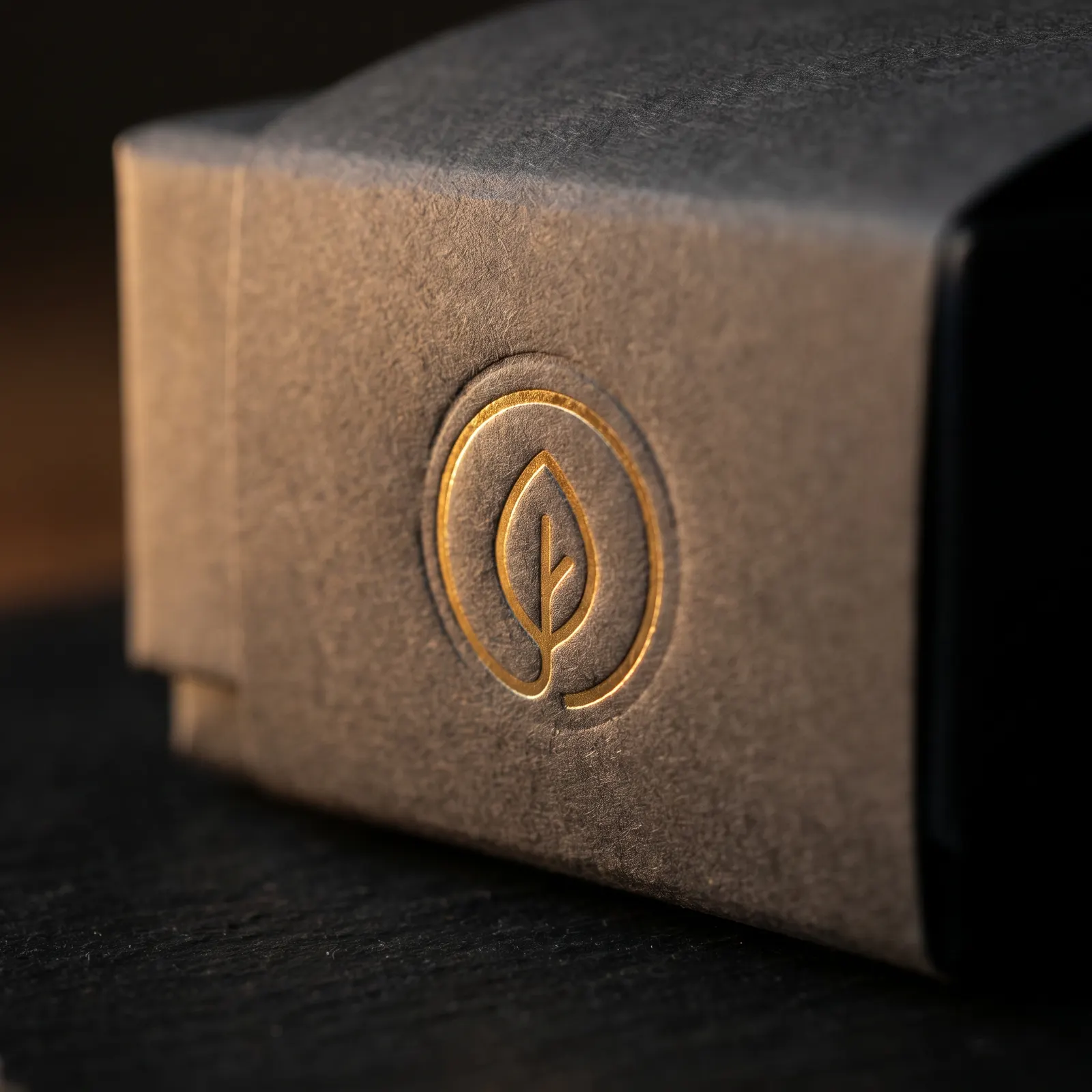
- Blind deboss and emboss. The mark pressed into or out of the paper, with no ink and no foil. It needs an uncoated wrap that can take the shape, and it reads only by its shadow, so strokes stay at least 0.5 mm and text 10 pt or larger. Of all our box finishes, it's the quietest and the most tactile.
- Foil and deboss together. The foil sits at the bottom of a pressed recess, so you see the metal and feel the edge. When foil and impression share one shape, we cut a single combination die so they line up exactly. With black foil on a box wrap we keep the impression shallow, because a deep one makes the foil bridge across the recess instead of sitting in it.
- Printed interiors. A flood colour or a line of copy inside the lid, seen only once the box is open. It's one of the least expensive surprises a box can carry.
- Spot colour. Your brand colour mixed to Pantone for the wrap, the interior and the insert card. We match to the Uncoated book on uncoated papers and the Coated book on coated ones, because the same ink looks different on each, and we tell you on the proof if a colour shifts.
Two rules you'll see on your proof: foil and impressions stay at least 3 mm away from every edge and turn-in, because they crack where the wrap folds round the board. And any QR code prints in flat ink, never foil, so every phone can read it.
Drei Wege zur individuellen Festkartonage
Wir kalkulieren zuerst eine Box mit allen Extras und zeigen Ihnen dann, was jeder Verzicht einspart. So fällt es meist aus.
| Build | What's in it | Price |
|---|---|---|
| Full build | Shoulder-neck or book-style magnetic box, foil and deboss in one combination die on an uncoated colour wrap, printed lid interior, paperboard tray, matching foil insert card. | Quoted. Upper end of $1,400–$2,000 or above, depending on size and quantity |
| Our recommendation | Two-piece lid and base, one foil on the lid of an uncoated colour wrap, paperboard tray. | Quoted. Most projects land within $1,400–$2,000 |
| Leanest custom box | Two-piece lid and base in natural kraft, one black foil on the lid, plain interior, tissue. | Quoted. Lower end of $1,400–$2,000 |
One foil on an uncoated wrap and a paperboard tray is where most of the feel comes from per dollar. Add the deboss and the printed interior if the number allows. Skip soft-touch on a dark box unless you're fine with the scuffs.
Don't need a custom box at all? If you already have a stock box you like, a foil belly band makes it yours from $295 for 100. It's the honest alternative when the box isn't the product.
Einlagen, die das Produkt ohne Schaumstoff halten
In rigid box packaging, an insert's job is to keep the product still and present it at the right height when the lid comes off. Our first suggestion is a paperboard tray: a recess cut to the product, a finger notch to lift it out, wrapped to match the box. It looks cleaner than foam, and it's paper like the rest of the box. Foam comes in only when the product is heavy or fragile enough to need it.
Send us the product, or its exact dimensions and weight, and we'll draw the tray around it. The prototype shows you the fit before anything is printed.
Then there's the card on top. A printed insert card in the same foil as the lid is the cheapest way to tie the whole box together. See packaging inserts and hang tags for the pieces that go inside.
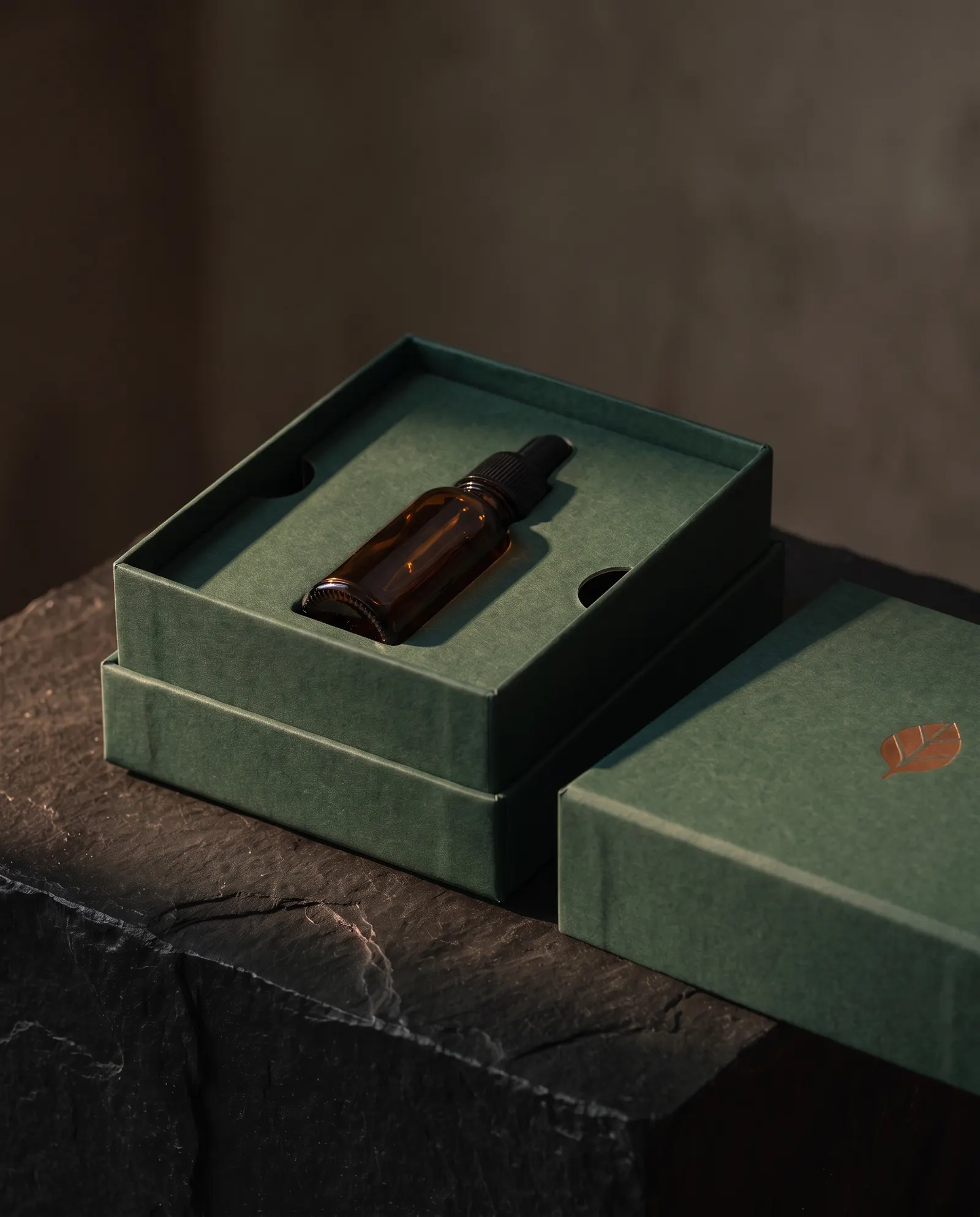
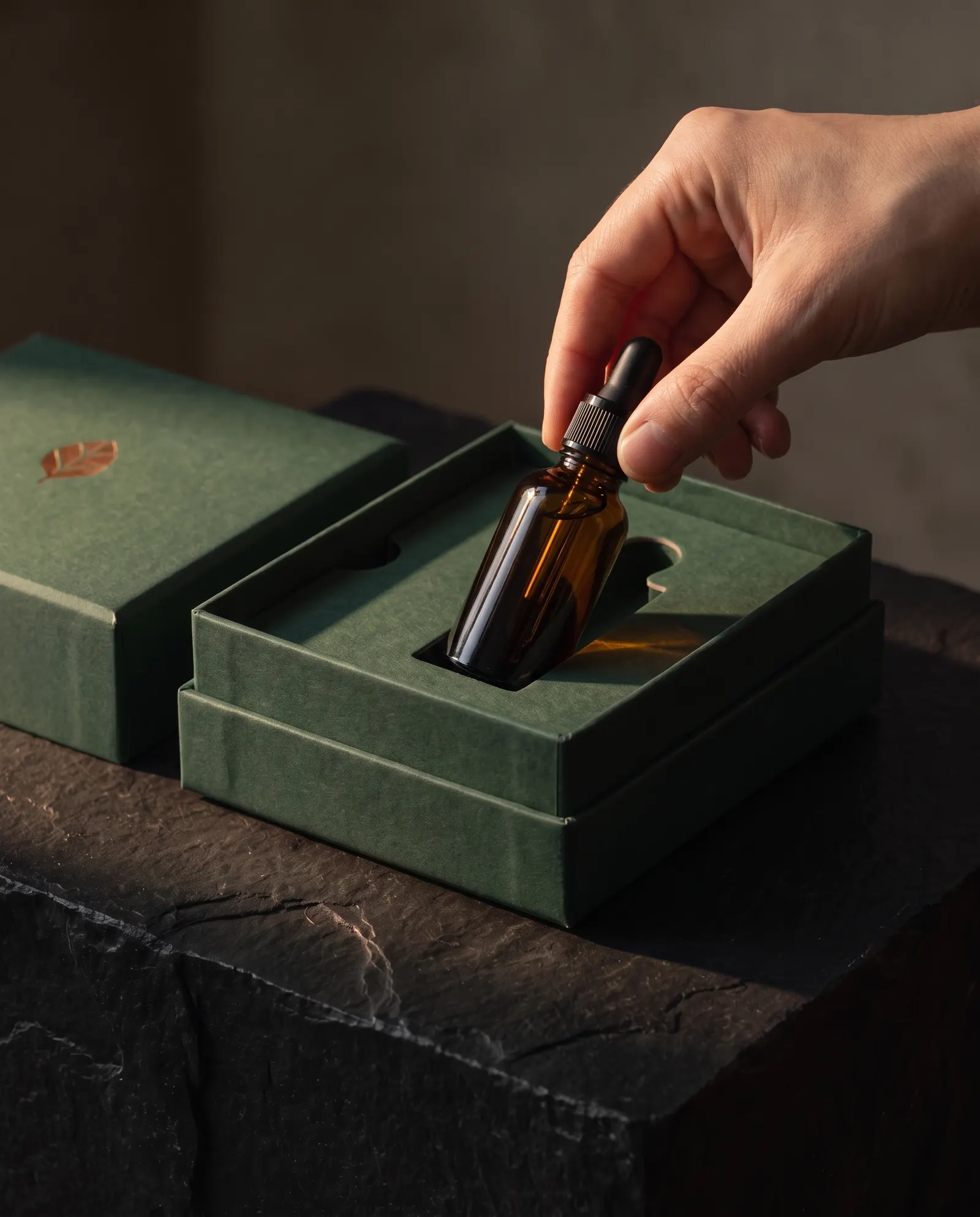
So entsteht eine maßgefertigte Festkartonage
1
Nennen Sie uns zuerst das Datum.
When the boxes need to be in hand decides which path is possible.
2
Dann das Produkt.
Its dimensions and weight, the quantity, and how the box travels. You don't need a dieline; we draw it.
3
Wir legen die Struktur fest.
Style, board, wrap, closure and insert, drawn as a dieline to your product's real size. You can start this in the Studio and see concepts first.
4
Sie halten einen Prototyp.
A plain physical sample of the structure, so you check the fit and the opening before anything is printed.
5
Druckdaten auf unserer Stanzkontur.
You build on our template in vector, with foil and deboss on their own named layers, or our packaging artwork team builds it for you.
6
Sie geben den Proof frei.
A person walks through structure, artwork and finishes with you. Nothing goes to production until you approve.
7
Produktion, dann Versand.
About three weeks of production after proof approval, then freight.
Every timeline here is an estimate, not a guarantee. For a launch or a holiday gift, start about eight weeks before you need the boxes in hand. See turnaround and shipping and proofing.
Spezifikationen für individuelle Festkartonagen
| Spec | What we offer |
|---|---|
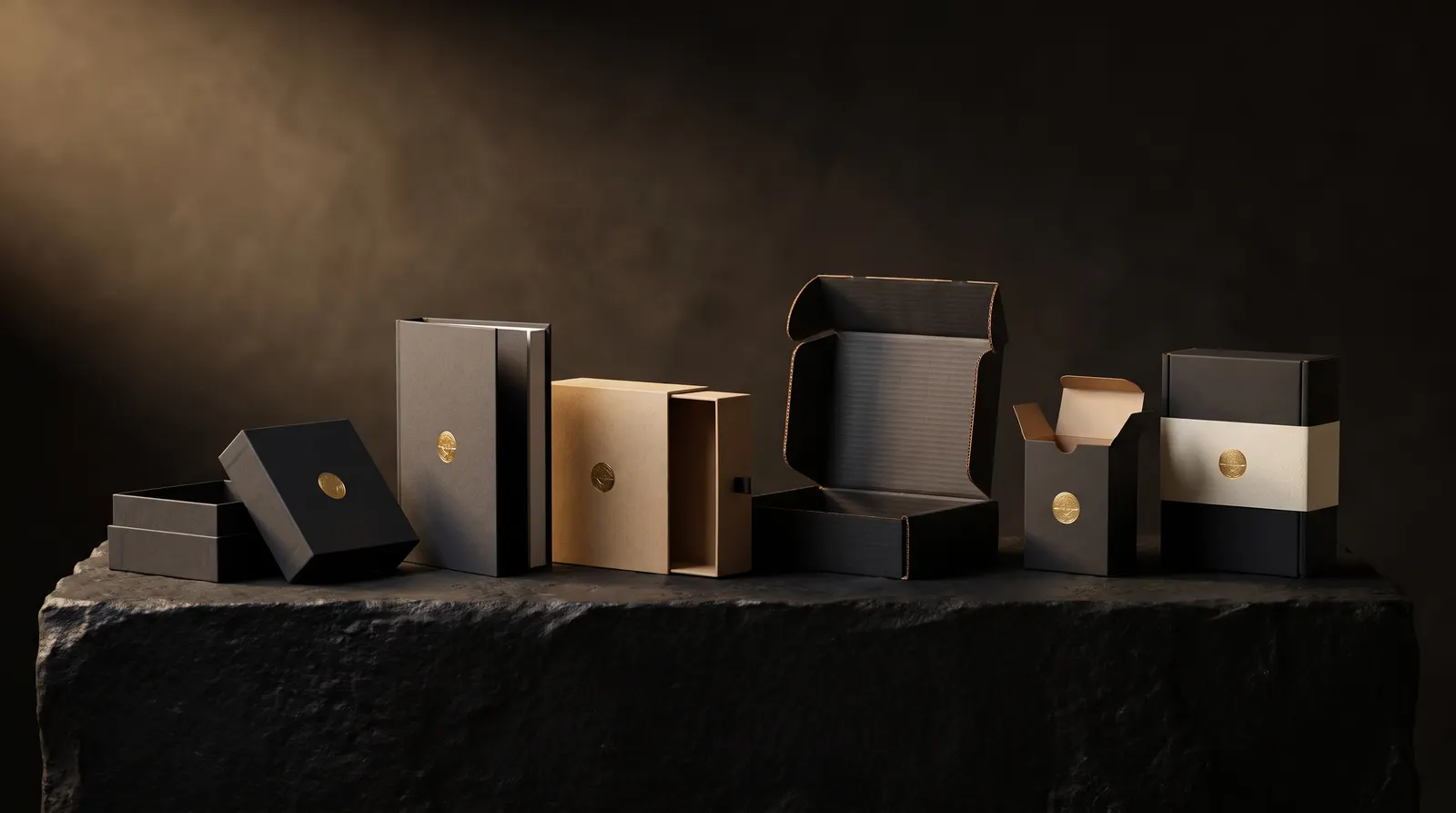
| Styles | Two-piece lid & base, shoulder-neck, book-style magnetic, drawer, collapsible |
| Board | 2 mm greyboard as standard; heavier on request |
| Wraps | Uncoated colour papers, natural kraft, black uncoated, printed wrap with soft-touch or matte laminate |
| Size | Built to your product's dimensions; tell us yours and we'll confirm |
| Hot foil | 40 shelf foils; one die per colour, per location; lines 0.15 mm target / 0.1 mm floor; gaps 0.25 mm target / 0.15 mm floor; foil text 7 pt or larger |
| Impression | Blind emboss, blind deboss, or foil and deboss together; uncoated wraps only (never soft-touch); strokes at least 0.5 mm, text 10 pt or larger |
| Interior | Plain, or printed lid and base liners |
| Inserts | Paperboard tray with a recess and finger notch; foam when the product needs it |
| Clearance | Foil and impressions at least 3 mm from every edge and turn-in |
| Codes | QR codes and barcodes in flat ink only |
| Files | Vector PDF on our dieline, each finish on its own named layer. Or we build the artwork for you |
| Proofing | Physical structural prototype, then a full artwork proof, checked by a person |
| Production | About three weeks after proof approval (estimate) |
| Shipping | Freight quoted with the job; ships built, inside outer cartons |
Unsere festen Boxen
Kundenprojekte und unsere eigene Verpackung. Jedes beruht auf einer einzigen Entscheidung, konsequent umgesetzt.

Kundenauftrag
Fletcher
A 9 × 12 × 4 in rigid box in natural kraft. One black hot-foil wordmark, given extra dwell so it holds on the rough kraft fibre, stamped flat before wrapping.
Kundenauftrag
Vlada
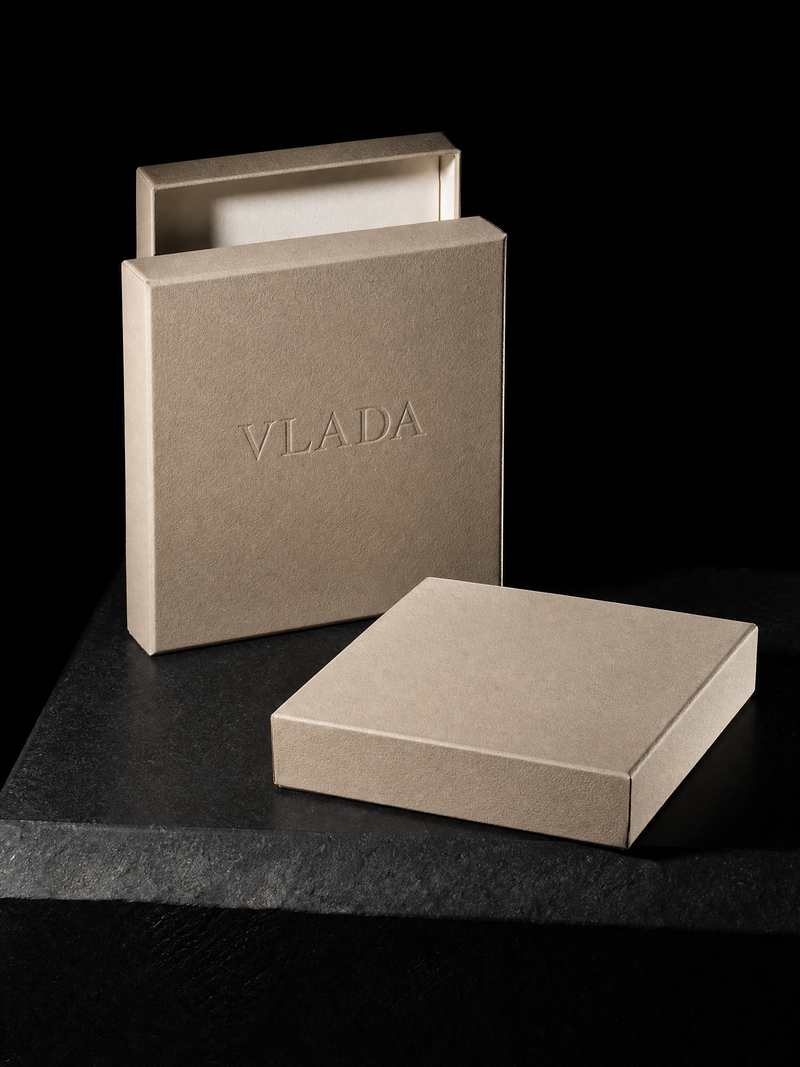
A 6 × 6 × 2 in rigid box in sand uncoated paper. One name, blind-embossed into the wrap before it went round the lid. No ink.
Unsere eigene Verpackung
Unsere Musterbox
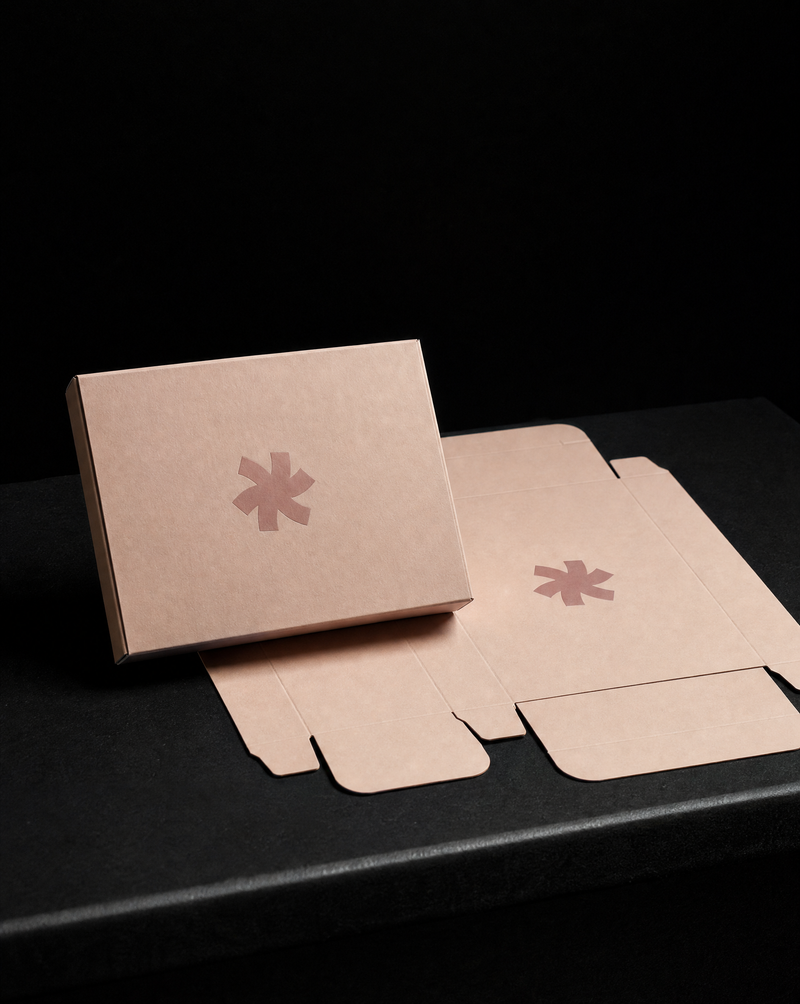
Eine Faltschachtel, keine feste Box, aber dieselbe Folienlogik: eine matte Blush-Folie auf durchgefärbtem Blush-Karton. Ein Werkzeug, eine Folie, keine Druckfarbe.
Fragen zu Festkartonagen, beantwortet
Wie hoch ist die Mindestbestellmenge für individuelle feste Boxen?
Kleine Auflagen sind willkommen. Sobald ein Folien- oder Blindprägewerkzeug Teil der Fertigung ist, lohnen sich Auflagen meist ab etwa 100, denn Werkzeug und Einrichtung kosten gleich viel, ob 20 oder 200 Schachteln entstehen. Sehr kleine Auflagen haben daher einen hohen Stückpreis. Kürzere Pilotauflagen kalkulieren wir auf Anfrage. Wir haben bereits acht Schachteln mit bedrucktem Bezug und ohne Folienwerkzeug gefertigt. Nennen Sie uns die Menge, die Sie tatsächlich brauchen, und wir kalkulieren genau diese.
Was kosten individuelle Festkartonagen?
Most custom rigid box projects we've built have landed around 1.295 €–1.845 € for the whole run. That's context, not a quote. Size, quantity, the wrap paper, how many foil colours and impressions, the insert, a printed interior and freight set your number. We price the full build first, then show you what each removal saves, so you can choose where the money goes.
Warum sind Festkartonagen teurer als Versandkartons?
A rigid box is 2 mm greyboard wrapped in paper and assembled before it ships, and it can't fold flat. You pay for the board, the wrap, the assembly and freight on a box that's mostly air. A mailer is one die-cut sheet of corrugated board that ships flat and folds up in seconds. The rigid box costs more because it's built, and that solidity in the hand is what you're paying for.
Wie lange dauern individuelle Festkartonagen?
Die Produktion dauert nach Ihrer Freigabe des Proofs etwa drei Wochen. Davor stehen die Konstruktion und ein physischer Prototyp, danach der Versand. Für einen Launch oder ein Weihnachtsgeschenk sollten Sie etwa acht Wochen vor dem Termin beginnen, an dem Sie die Boxen in den Händen halten müssen. Das sind Schätzungen, keine Garantien. Nennen Sie uns daher zuerst Ihren Termin, und wir sagen Ihnen ehrlich, ob er gut machbar ist.
Können Sie eine Soft-Touch-Festbox mit Folie veredeln oder blindprägen?
Folie ja: Heißfolie haftet gut auf Soft-Touch-Kaschierung. Blind- und Hochprägung nein. Die Kaschierung ist eine steife Folie, die keinen sauberen Abdruck annimmt. Die Prägung wird flach oder bricht. Wenn Sie eine Prägung wünschen, wechseln wir für die Box zu einem ungestrichenen Bezug, in dem sich eine Blindprägung präzise abzeichnet. Möchten Sie bei Soft Touch bleiben, setzen wir das Motiv nur in Heißfolie um. Noch ein Hinweis zu dunklem Soft Touch: Fingerabdrücke und Transportspuren sind sichtbar. Versenden Sie die Box daher in einem soliden Umkarton oder wählen Sie eine hellere Farbe.
Brauche ich eine Stanzkontur, um eine feste Box zu bestellen?
No. Send the product's dimensions and weight, or the product itself, and we draw the structure and the dieline around it. You approve a physical prototype of the structure first. Then you build your artwork on our dieline in vector, with foil and deboss areas on their own named layers, or our packaging artwork team builds it for you.
Was ist der Unterschied zwischen einer zweiteiligen Festkartonage und einer Schachtel mit Schulter und Hals?
Eine zweiteilige Festbox besteht aus Boden und Deckel, der sich gerade abheben lässt. Eine Box mit Schulter und Hals hat zusätzlich einen erhöhten inneren Kragen, den Hals, auf dem der Deckel sitzt. So bleibt bei geschlossener Box ein Streifen des Inneren sichtbar, und das Öffnen wirkt langsamer. Der Hals ist ein drittes gefertigtes Teil und kostet daher mehr. Wählen Sie diese Variante, wenn das Auspacken im Mittelpunkt steht. Sonst ist die zweiteilige Box die bessere Investition.
Lässt sich ein weißes oder goldenes Logo auf eine schwarze Festkartonbox bringen?
Ja, mit Folie. Farbe zieht in schwarzes ungestrichenes Papier ein und verschwindet fast. Ein weißes Zeichen entsteht daher mit weißer Pigmentfolie, ein goldenes mit Metallicfolie, beide deckend auf dunklem Papier. Zwei Hinweise: Schwarze Folie auf schwarzem Papier zeigt sich nur als Schimmer im Streiflicht, und eine Blindprägung auf Schwarz ist sehr zurückhaltend. Soll das Zeichen quer durch den Raum lesbar sein, wählen Sie eine helle Folie.
Starrbox, Magnetbox oder Versandkarton: Welche Box ist die richtige?
Choose a mailer if the box has to go through the post on its own; it ships flat and is its own shipper. Choose a rigid two-piece if the box is a gift or a keepsake and travels inside a carton. Choose a book-style magnetic box when it will be opened and closed many times, like a PR or presentation kit. Compare all three on individuelle Geschenkboxen.
Kann die Box zu meinen Visitenkarten und Hängeetiketten passen?
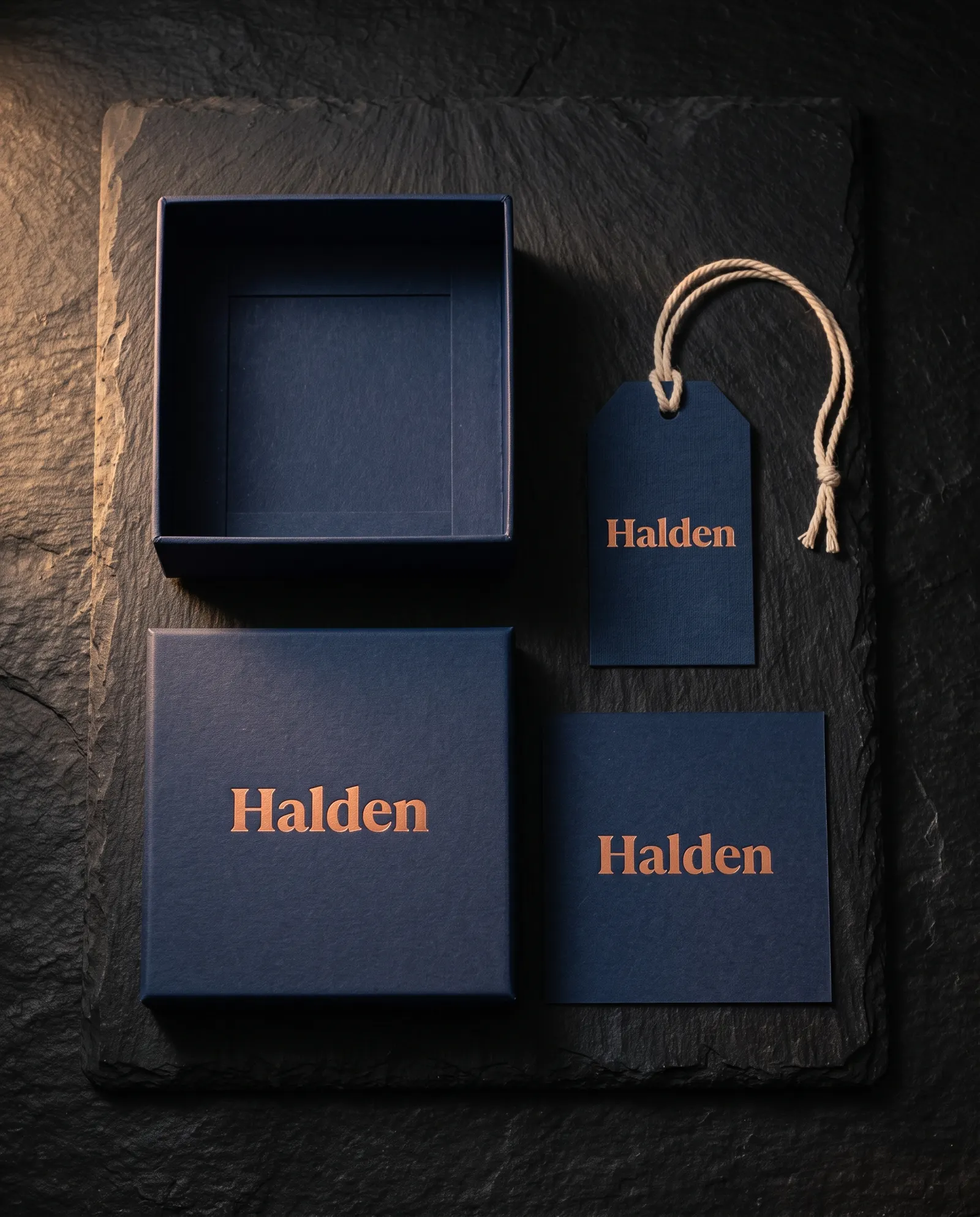
Yes, and it's one of the best reasons to make the whole kit with one studio. We use the same foil and the same paper language across the box, the insert card, the Hängeetiketten and the seals, and check them on one proof, so the gold on the lid is the same foil as the gold on the tag. Foil can look a shade different on a different paper, so we lay the pieces side by side on the proof. Send us your existing pieces and we'll match them where the structure allows. See how the box can match your tags and inserts.
Kann ich vor der Bestellung von Festkartonagen ein Muster sehen?
Yes. Our 9 € sample kit includes a foil swatch card with every foil we keep on the shelf, plus real papers and finishes like blind emboss. It's built around cards rather than boxes, but it's the quickest way to choose a foil in your own light. For the box itself, you approve a plain physical prototype of the structure before the run, so you check the fit and the opening in your hands before anything is printed.
Wie werden Festkartonagen versendet?
Die Fracht wird mit dem Auftrag kalkuliert. Feste Schachteln kommen fertig aufgebaut an. Sie werden daher nach Volumen statt Gewicht versendet, und Schachtelgröße und Menge bestimmen die Kosten. Sind Fracht oder Lagerplatz das Problem, wird eine faltbare feste Schachtel flach geliefert und erst beim Verpacken aufgefaltet.
Wie erhalte ich eine individuelle Festkartonage am kostengünstigsten?
Keep the structure simple and spend on one finish. A two-piece lid and base in natural kraft or an uncoated colour wrap, with one hot foil on the lid, is the leanest build that still feels like a gift. Skip foil on the base, a printed interior and a second foil colour; each adds a die or a step. A collapsible rigid box saves on freight and storage. And if a stock box already works, a foil belly band from 275 € for 100 makes it yours without a custom box at all.
Was kommt in die Box?
Senden Sie uns Größe und Gewicht des Produkts, die Menge und den Termin, zu dem Sie die Boxen benötigen. Wir melden uns mit einer Bauform, einer Veredelungsempfehlung und einem Preis, danach mit einem Prototyp zum Anfassen. Wenn Sie es lieber besprechen, vereinbaren Sie ein Gespräch.
Vor dem Druck von einem Menschen geprüft.