Custom packaging inserts
The card on top, and the tray underneath.
From 100 cards · $225
About 3 weeks after proof approval, an estimate.
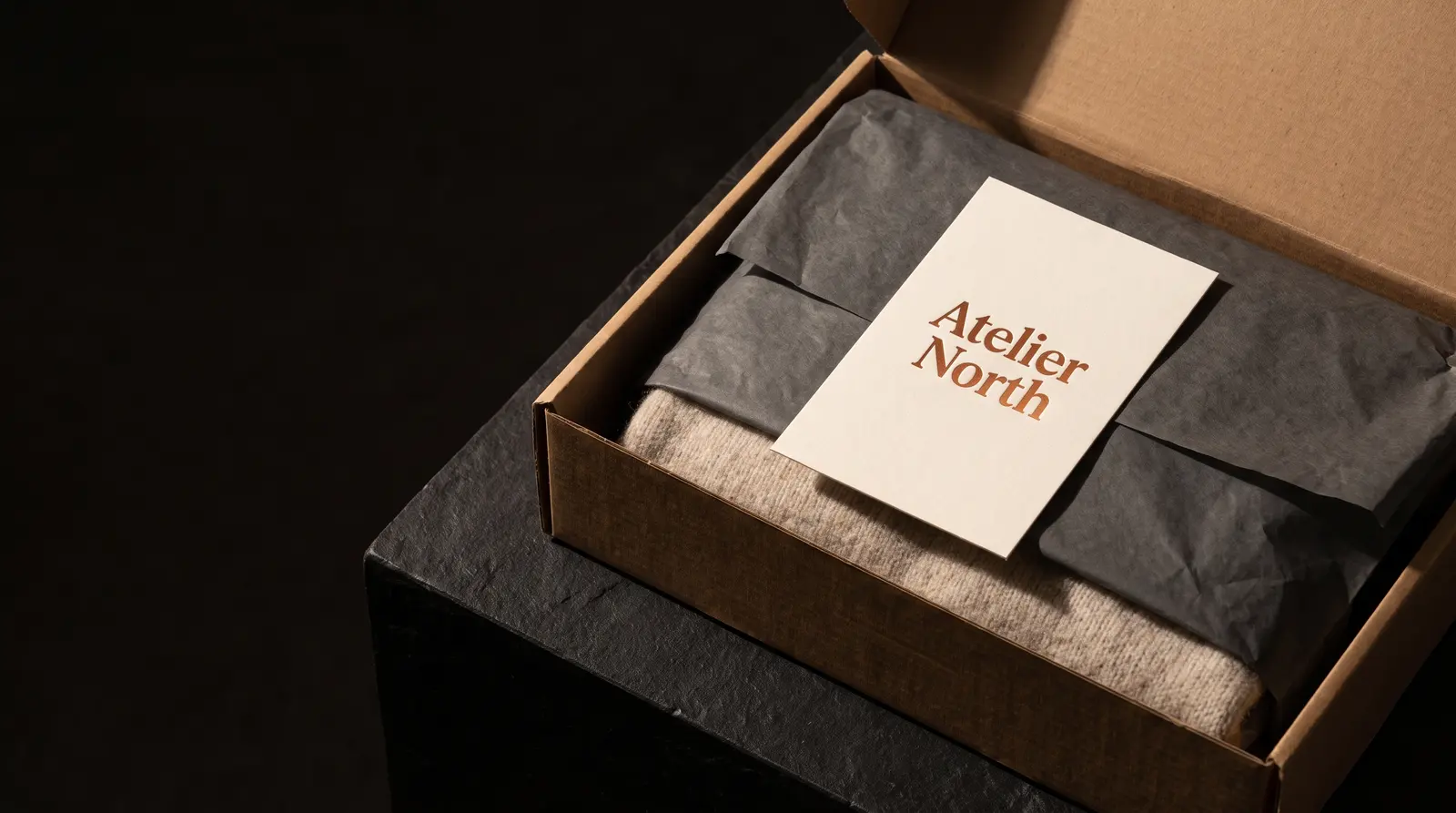
Packaging inserts are everything in the box besides the product. Most are printed product insert cards: a thank-you, care instructions, a reorder note, the story of how the thing was made. Some are structural, a paperboard tray that holds the product still so it arrives where you put it. We make both.
Our fixed-price insert card is 3.5 × 5 inches on 32pt cotton, about the thickness of a credit card, with your mark stamped in real hot foil. It starts at $225 for 100 cards. Printed inserts take about 3 weeks of production after you approve the proof, then transit. That's an estimate, not a guaranteed in-hand date. Structural inserts are quoted with the box they sit in.
- From 100 cards · $225
- 32pt cotton · real hot foil
- Free proof before anything prints
- About 3 weeks after proof approval (estimate)
Foil insert cards, fixed price
Packaging insert cards, priced up front: one card, one foil, no back printing. These are insert cards for packaging, not postcards with a foil effect. Pick the cotton, pick the foil, pick the quantity. A person checks your artwork before anything is stamped, and you approve a free proof.
Packaging inserts · Buy now
Custom Foil Thank You Insert Cards, 3.5x5 Cotton
3.5×5 flat, 1 foil, 32pt cotton. Free shipping within the continental US.
$395
250 cards · $1.58 each
About 3 weeks of production after proof approval (estimate)
- Free proof. Nothing prints until you approve it.
- Want a human (or our AI art director) to check your artwork first? Ask our team or try the Studio.
Price-Lock Promise
You pay the price you see for the spec you ordered. If our artwork review finds a cheaper spec that suits your design better, we'll suggest it and refund the difference. Any upgrade is charged only if you approve it. If we can't print your artwork well on the ordered spec and you don't want to change it, you get a full refund before anything prints.
Need printing on the back, a different size or a second foil? That's a custom insert. Start it in the Studio or ask for a quote and we'll price it the same day.
What to put on a packaging insert card
Start with one job per card. An insert that tries to thank, instruct, upsell and tell the founder story all at once ends up as small type nobody reads. These are the jobs that earn the space:
- Thank-you. One line in your own voice, signed. On the fixed-price card that line is foil too, so keep it short and at 7 pt or larger. On a custom card it can go in ink, and the foil stays on your mark.
- Care instructions. How to wash it, store it, refill it. This is the card people keep, so it earns the better paper.
- Reorder or review. A short URL or a QR code. QR codes always print in flat dark ink, never foil, because foil and gloss glare under a phone camera. That means a QR code needs the printed back, which makes it a custom insert. We size codes to at least 2 cm with a clear margin so they scan at arm's length.
- Founder note. A few sentences on why the thing exists. Works best on the back, with your mark alone on the front.
- A discount for next time. Fine, but keep it off the card you want people to keep. A separate, cheaper slip does that job.
The honest constraint: foil is for marks and short lines, not paragraphs. Foil lines thinner than 0.6 mm break up on press, and foil text smaller than 7 pt fills in. Anything smaller, and every QR code, goes in ink on the back.
Business thank you cards that go in the box
Most business thank you cards are a postcard with "Thanks for your order!" in a script font. Ours are custom thank you cards for business built the same way as the insert above: 32pt cotton, your mark in hot foil, stiff enough that it stands up in the box instead of curling under the tissue. If you're buying thank you cards for small business orders and ship a few hundred a month, 250 cards at $395 is a sensible first order. It's enough to learn which line customers actually mention back to you before you commit to more.
Looking for wedding thank-you cards? Those live on our wedding thank-you cards page, matched to the invitation suite.
Papers and finishes for insert cards
The fixed-price card is 32pt cotton with one foil. Everything below is available as a custom insert, quoted.
| Option | What it is | The rule we design around |
|---|---|---|
| Cotton | Soft, toothy, uncoated. Takes foil and impression with real depth. Pearl white, ecru, blush, sage, navy, black. | Foil on cotton shows a slight bite and a soft texture in large solids. Big foil panels get checked before we promise a mirror finish. |
| Colorplan | Dyed-through colored paper, smooth, many colors. | Ink on colored paper shifts darker. For light colors on a colored card we use foil. |
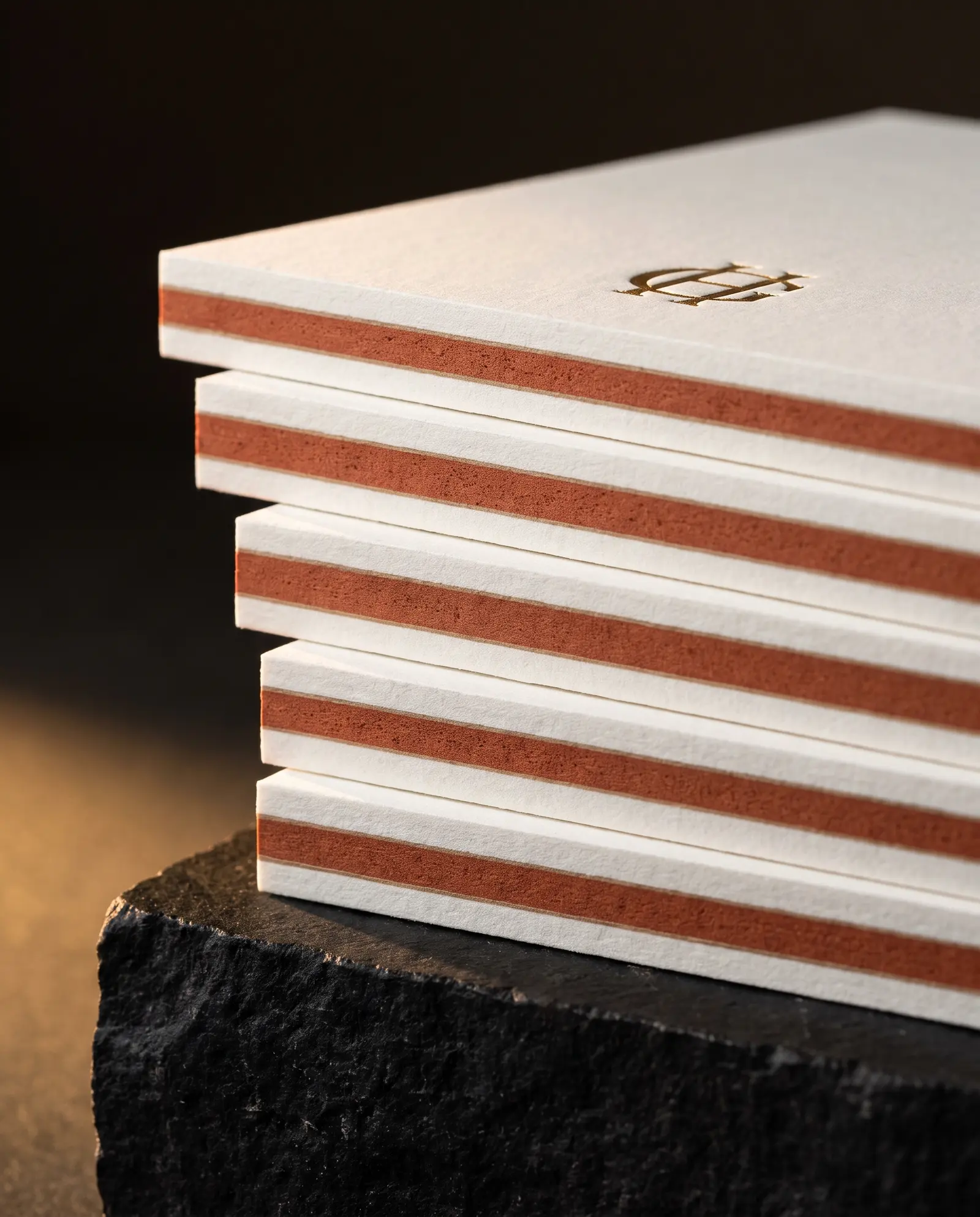
| Duplex and triplex | Two or three sheets bonded into one card, each pressed before bonding. | The join shows on every edge: a fine seam in a duplex, a colored stripe when a colored sheet sits in the middle (triplex). Bonding also stops a deep impression on the front from showing on the back. |
| Hot foil | Gold, silver, rose gold, copper, black or white foil pressed with heat and a metal die. | One flat tone per foil; a gradient becomes one solid color. Foil lands on bare paper, never on top of ink. White on dark cotton is white pigment foil, never white ink. Black foil on black cotton reads as a quiet sheen, not contrast. |
| Letterpress | Ink pressed into the sheet, so you feel each line under your thumb. | Letterpress ink is translucent, so it's for light paper. Light ink on dark cotton turns chalky; we use foil there. |
| Blind deboss | Your mark pressed into the paper with no ink or foil. | Reads by shadow. On black cotton it's very quiet; add foil in the impression if it needs to be read. |
| Painted edges | Color applied to the edge of a clamped stack. | Any thickness can be painted; thicker cards show a bolder line. Foil stops 3 mm short of a painted edge so the paint line stays clean. On black or dark cotton we foil the edge instead; dark cards are never edge-painted. |
| Foil edges | Metallic foil on the edge. | Square or rounded corners. Edge foil on cotton is something our press team confirms per job. |
| Rounded corners | A die-cut corner radius. | Works with foil edges. Painted edges on rounded corners are confirmed before we promise them. |
If you're choosing one upgrade, make it a triplex with a colored core. It's the detail people notice when they pick the card up, and because the front and back are separate sheets, you can print the back without the front's impression showing through.

Insert card sizes and which mailer they fit
Measure the inside of your mailer before you pick a size. A 32pt card doesn't bend, so a card that's a hair too big won't flex its way in; it rides on top of the product or creases the tissue.
| Size | Inches | Where it fits |
|---|---|---|
| 3.5 × 5 (fixed-price card) | 3.5 × 5 | Most mailer boxes and padded mailers; our default. |
| A7 | 5.25 × 7.25 | Apparel and flat-lay boxes with room on top. |
| A6 | 4.13 × 5.83 | European mailers and slim boxes. |
| 4 × 6 | 4 × 6 | Shoe and shirt boxes, gift boxes. |
| Custom die-cut | Your shape | Jewelry boxes, tins, anything round. Shapes larger than 5 × 7 inches get their own cutting-die quote. |
Not sure? Send us the inside dimensions of your box and we'll tell you which size sits flat with a few millimetres to spare. Full dimensions for every format are in our stationery and specialty size guide.
Structural packaging inserts: trays that hold the product still
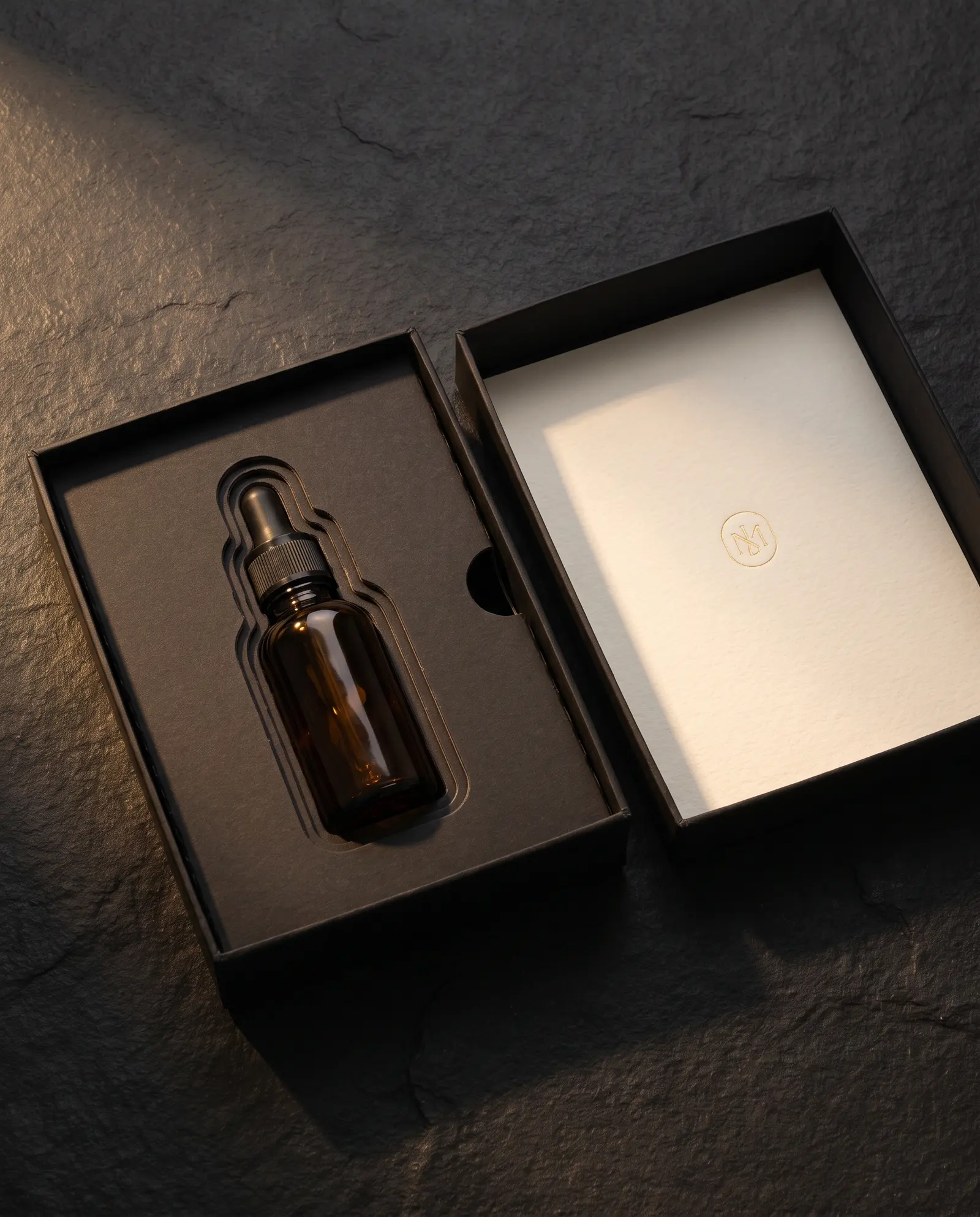
The other half of "packaging inserts" is structural: the tray, recess or divider that keeps the product from sliding around in transit. If you searched for custom box inserts or cardboard inserts for packaging, this is that. We build them in paperboard by default, with a recess cut to your product, a finger cut-out so it lifts out cleanly, and dividers when there's more than one piece in the box. Paperboard looks finished, takes the same wrap or foil as the box, and recycles with it. We only use foam when the product genuinely needs it.
Structural inserts are quoted with the box they sit in, because the tray is sized to the box's inside dimensions and checked on the box prototype. That means they're scheduled with the box, and boxes ship by freight quote. Any foil or emboss on the tray stays at least 3 mm off folds and scores, because finishes crack across a fold.
See custom rigid boxes, custom magnetic boxes and all custom boxes for the boxes the trays go into.
Three ways to build your insert card
Here's how we'd price it: with everything first, then scale back to what the card actually needs.
| Build | What you get | Price | Best for |
|---|---|---|---|
| The foil card | 3.5 × 5, 32pt cotton, one hot foil on the front, blank back. | From $225 for 100 | A thank-you or a brand mark with nothing else to say. |
| The working insert (what we'd recommend) | The foil card, plus care, reorder or QR details printed in ink on the back. | Get a price | Most brands. The front stays clean; the back does the work. |
| The keepsake | Triplex cotton with a colored core or a painted edge, foil plus blind deboss on the front, printed back. | Quoted | Jewelry, fragrance and gift launches where the card is part of the product. |
Start with the working insert. A foil-only card is beautiful and says one thing. Most brands have three things to say, and the back is where they fit.
Custom printed tissue paper for the same box
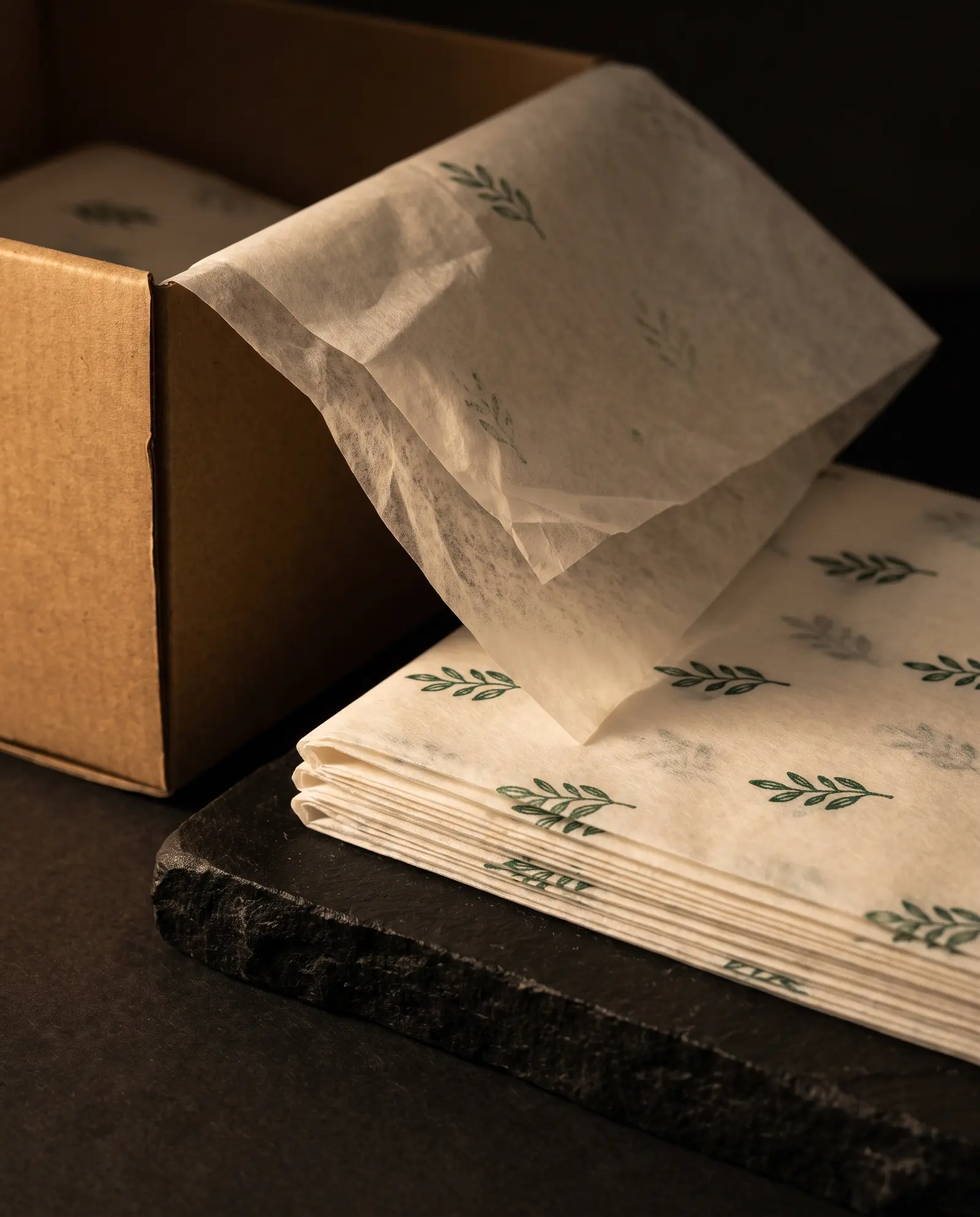
We also print the tissue that wraps the product: 17gsm sheets in 20 × 30 or 15 × 20 inches, one or two spot colors, as a repeat pattern or a single logo, from 500 sheets. It's quoted, and it ships with your inserts or your boxes so everything arrives together. One honest note: tissue is thin enough to show what's underneath, and spot colors print a touch lighter on it than on card. We'll match your color as closely as tissue allows and show you on the proof.
Match the insert to your hang tags and seals
The insert is usually the first piece of a matched kit. Our hang tags use the same 32pt cotton and the same house foils, from $249 for 100. Our foil seals close the mailer in the same foil, from $195 for 250. Order them together and we check them side by side so the gold on the seal is the gold on the card. To close the tissue itself, use custom foil stickers. One caution worth knowing up front: the same foil looks a little brighter on smooth sticker stock than on textured cotton, because the cotton fibers break up the reflection. We'll show you that on the proof rather than promise an identical look.
More pieces: belly bands · all custom packaging · packaging artwork design
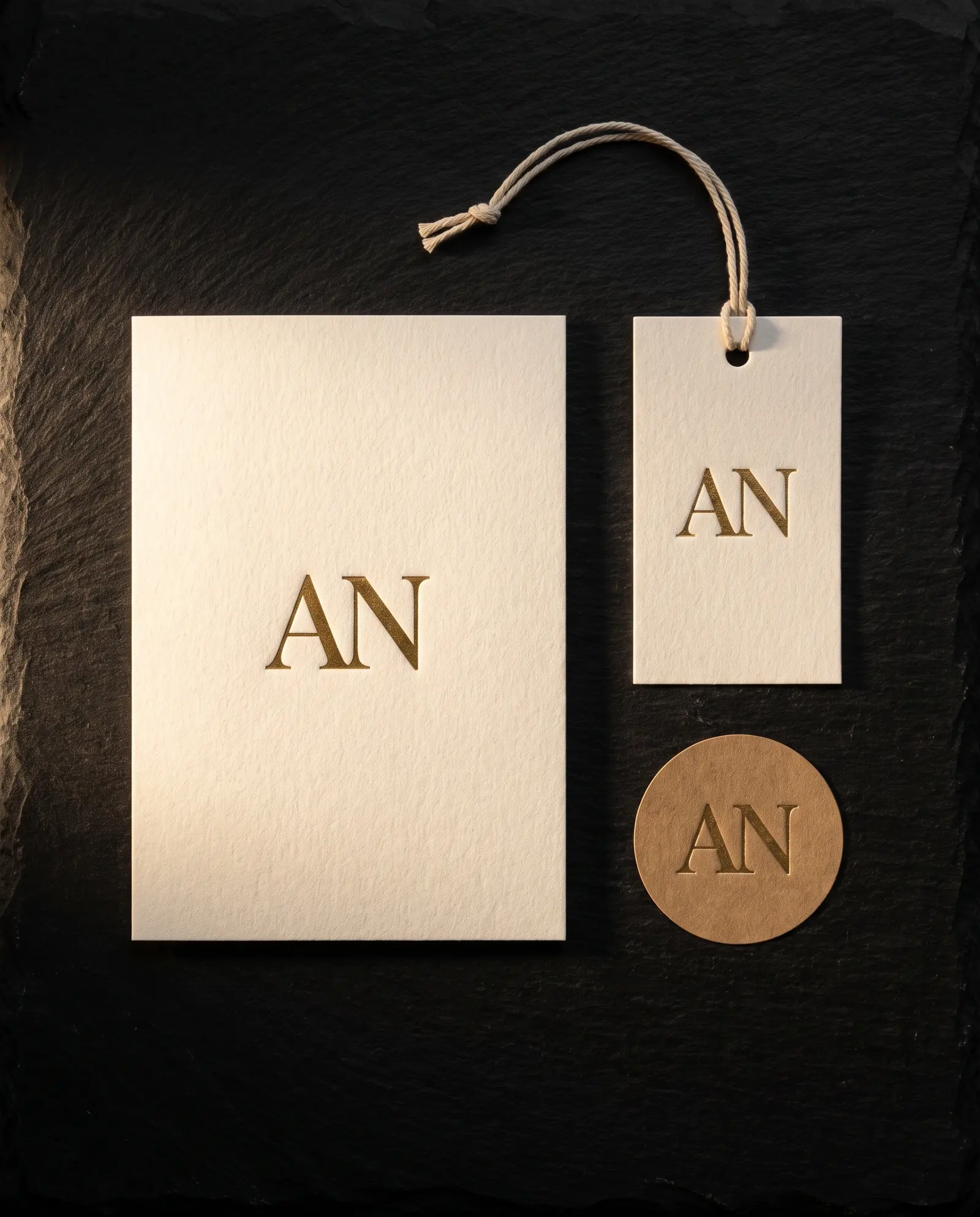
Insert cards we've made
Client job
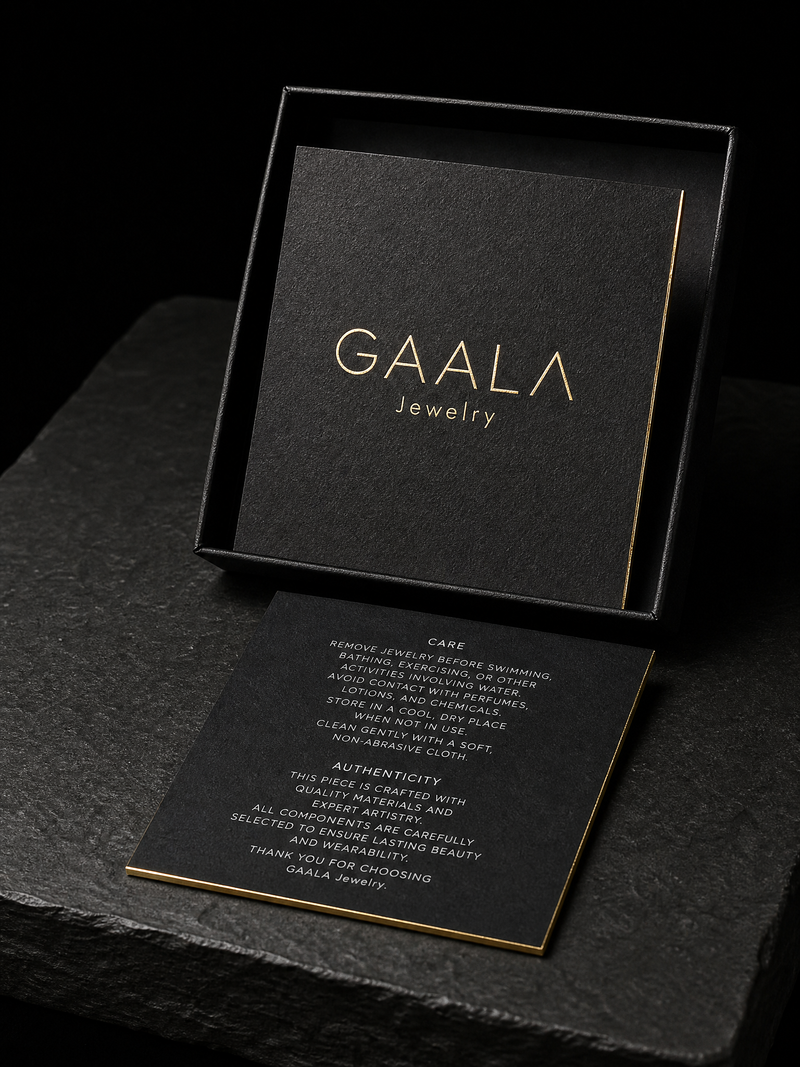
GAALA Jewelry insert card
A square 85 × 85 mm insert on 32pt black cotton with a gold foil wordmark and gilded edges, made to match the weight of the jewelry it travels with. On black cotton every stroke of the wordmark stays at 0.6 mm or heavier, so the foil lays clean across the fibers instead of breaking up.
Client job
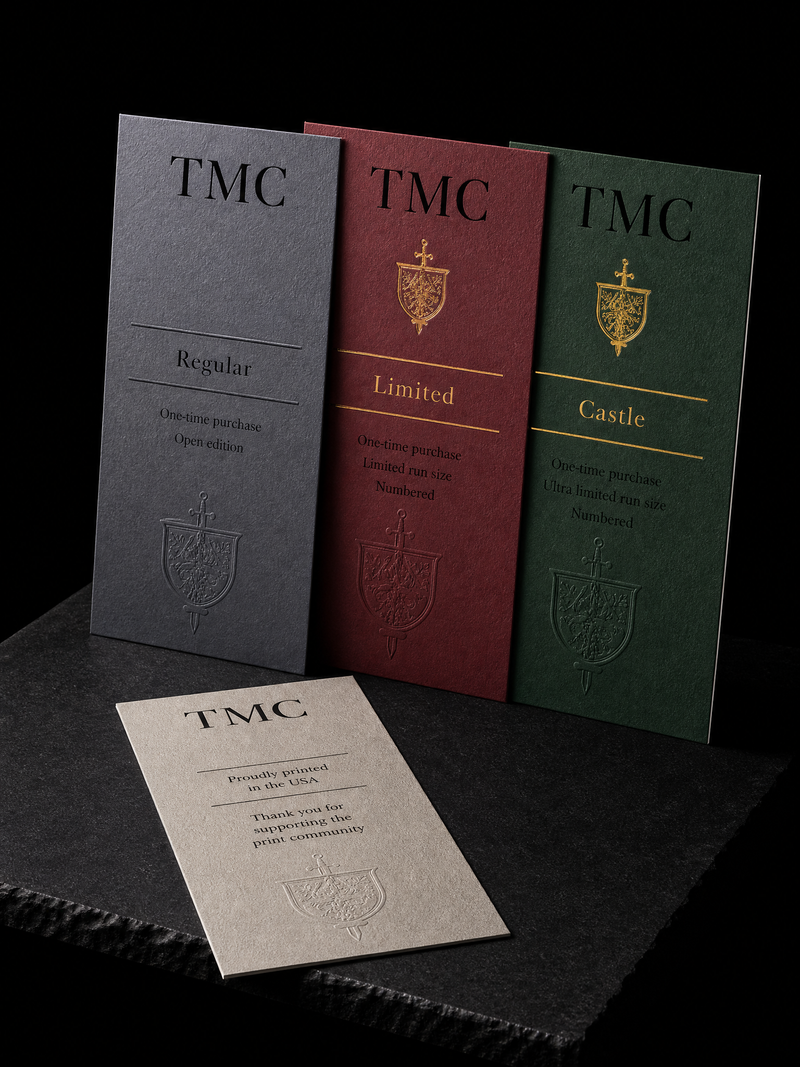
TMC tiered box inserts
Three 4 × 6 box inserts for three product tiers on 16pt silk: one layout, three Pantone floods, and a small gold foil crest only on the top two tiers, so the foil marks where the price goes up.
How ordering an insert works
1
Choose.
Order the fixed-price foil card above, or describe the insert you want in the Studio.
2
Send your artwork.
Upload it at checkout or later. If it isn't press-ready, our designers rebuild it as clean vector files, or add design help for $95.
3
Approve a free proof.
A person checks every line, foil weight and QR code first. Nothing is stamped until you approve.
4
Production.
About 3 weeks after proof approval, an estimate, not a guarantee.
5
Delivery.
Fixed-price insert orders ship free within the continental US.
If the cards need to be in the box for a launch date, tell us the date before you order. We'll say honestly whether it's realistic. Rush moves your order up the queue; it doesn't guarantee a delivery day.
Feel the cotton before you order
Our sample kit is $8 and comes with a $10 credit toward your first order. It's built around business cards, not inserts, but it holds the cotton our insert cards are made from and a hot foil swatch card with every foil we keep on the shelf (the fixed-price card uses six of them), so you can hold the foil against the paper in your own light before you choose.
Packaging insert questions, answered
What are packaging inserts?
Packaging inserts are anything you put in a box besides the product. There are two kinds. Printed inserts are product insert cards: a thank-you, care instructions, a reorder or review prompt, a founder note. Structural inserts are trays, recesses and dividers that hold the product still in transit. We make printed insert cards on 32pt cotton with hot foil, and paperboard trays quoted with our custom boxes.
What should I put on a packaging insert card?
Give each card one job. The most useful are a short thank-you in your own voice, care instructions, a reorder or review link, and a founder note on the back. Keep foil for your mark and short lines, since foil text needs to be 7 pt or larger. Put small text and any QR code in ink on the back, which makes it a custom insert rather than the fixed-price foil card.
What is the minimum order for custom insert cards?
100 cards for our fixed-price foil insert card. Custom printed inserts in other sizes or builds also start at 100. Printed tissue starts at 500 sheets. Structural trays are quoted with the box, so the box quantity sets the minimum.
How much do custom packaging inserts cost?
Our 3.5 × 5 foil insert card on 32pt cotton is $225 for 100, $395 for 250 and $575 for 500, with one hot foil on the front. Printed backs, other sizes, duplex cotton, painted edges and structural trays are quoted, because each one changes the materials and press passes.
How long do packaging inserts take?
About 3 weeks of production after you approve the proof, plus ground transit. That's an estimate, not a guaranteed in-hand date. Structural trays are scheduled with the box they go in. If you have a launch date, tell us before you order and we'll say honestly whether it's realistic.
Can you print on the back of the insert card?
Yes, as a custom insert. The fixed-price card is foil on the front with a blank back. For care text, a reorder URL or a QR code on the back, start in the Studio or ask for a quote. Small text and QR codes print in ink, not foil, so they stay sharp and scannable.
Will a 3.5 × 5 insert card fit my mailer box?
It fits most mailer boxes and padded mailers, which is why it's our fixed-price size. A 32pt card doesn't bend, so check the inside dimensions of your box first. If your box is tight, A6 or a custom die-cut size may sit better; send us the dimensions and we'll tell you.
Can you add a QR code to a packaging insert?
Yes. QR codes always print in flat dark ink on a light area, never in foil, deboss or gloss, because those glare or blur under a phone camera. We size them to at least 2 cm with a clear margin and scan the code at proof before anything prints.
Do you make custom box inserts and trays?
Yes, alongside our custom boxes. Custom box inserts are the trays, recesses and dividers that hold the product still. We build them in paperboard by default, with a recess cut to your product, a finger cut-out and dividers where needed. They're quoted with the box, because the tray is sized to the box's inside dimensions and checked on the box prototype.
Do you make custom foam inserts?
We design in paperboard first, because it looks finished, takes the same wrap or foil as the box and recycles with it. When a fragile product genuinely needs foam, tell us and we'll quote it with the box.
Can my insert cards match my hang tags and foil seals?
Yes. Our hang tags use the same 32pt cotton and house foils, and our foil seals use the same foil colors. Order them together and we check them side by side. The same foil looks slightly brighter on smooth seal stock than on textured cotton, and we'll show you that on the proof.
Can I see samples before ordering inserts?
Yes. Our sample kit is $8 with a $10 credit toward your first order. It's built around business cards, but it includes the cotton our inserts use and a hot foil swatch card with every foil we keep on the shelf, so you can judge paper and foil in your own light.
Do you still print custom tissue paper?
Yes. We print 17gsm tissue in 20 × 30 or 15 × 20 inch sheets, in one or two spot colors, from 500 sheets. It's quoted and ships with your inserts or boxes. Ask for a quote with your logo and the sheet count you need.
Why do foil insert cards cost more than printed ones?
Real hot foil needs a metal die made from your artwork and its own press pass with heat and pressure, and 32pt cotton is a heavy, soft sheet about the thickness of a credit card. Digital foil effects skip the die, which is why they cost less; they sit on the surface instead of being pressed in. The die and setup are spread across the run, so the price per card drops as you go from 100 to 250 to 500.
Are packaging inserts worth it?
Only if the card has a job. A care card people keep, a reorder link or a short thank-you in your own voice earns its place. A card that repeats your logo and nothing else usually doesn't, and in that case the money is better spent elsewhere in the box. Start with 100 or 250, see what customers mention back to you, then decide.
Start with the card people keep
Tell us what's in the box and when it ships. We'll recommend the insert, show you the proof, and keep it matched to everything else you send.