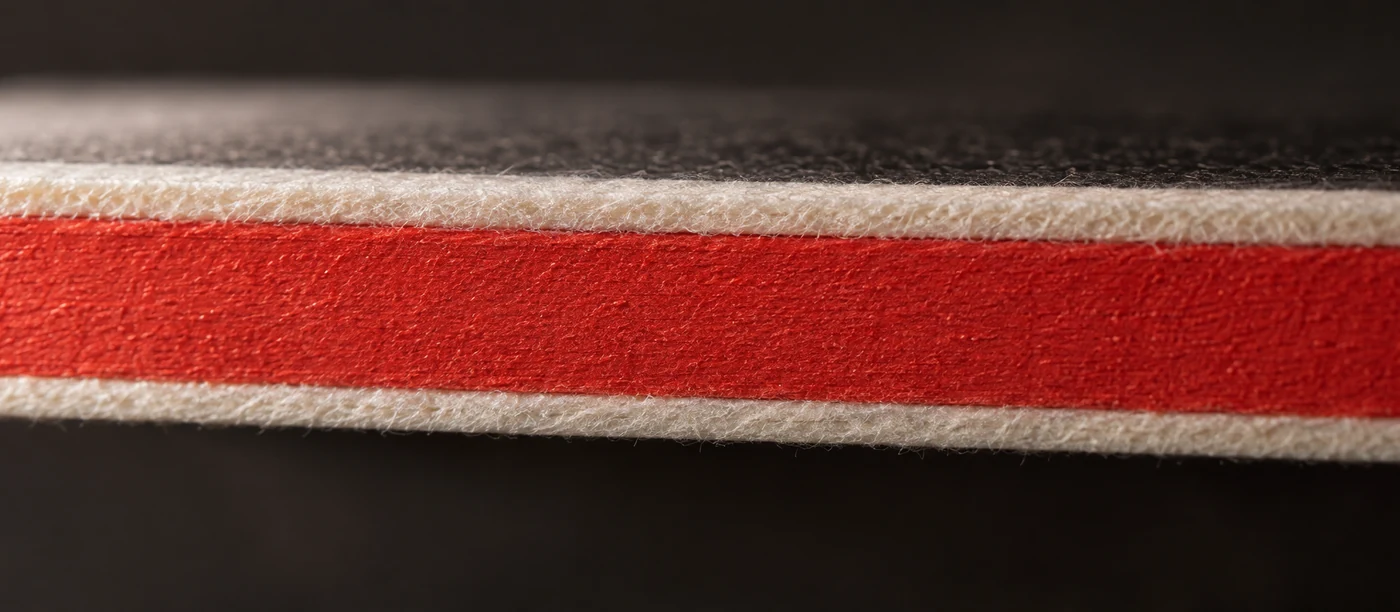
A narrow line of colour, all the way around.
Edge paint is applied after cutting while the pieces are held tightly as one stack. It can run on single-ply and text-weight paper as well as thick cards.
Start with the finish
See what painted edges does with your own brief.
Free · about two minutes
White uncoated·32pt / 0.8mm·Red painted edge
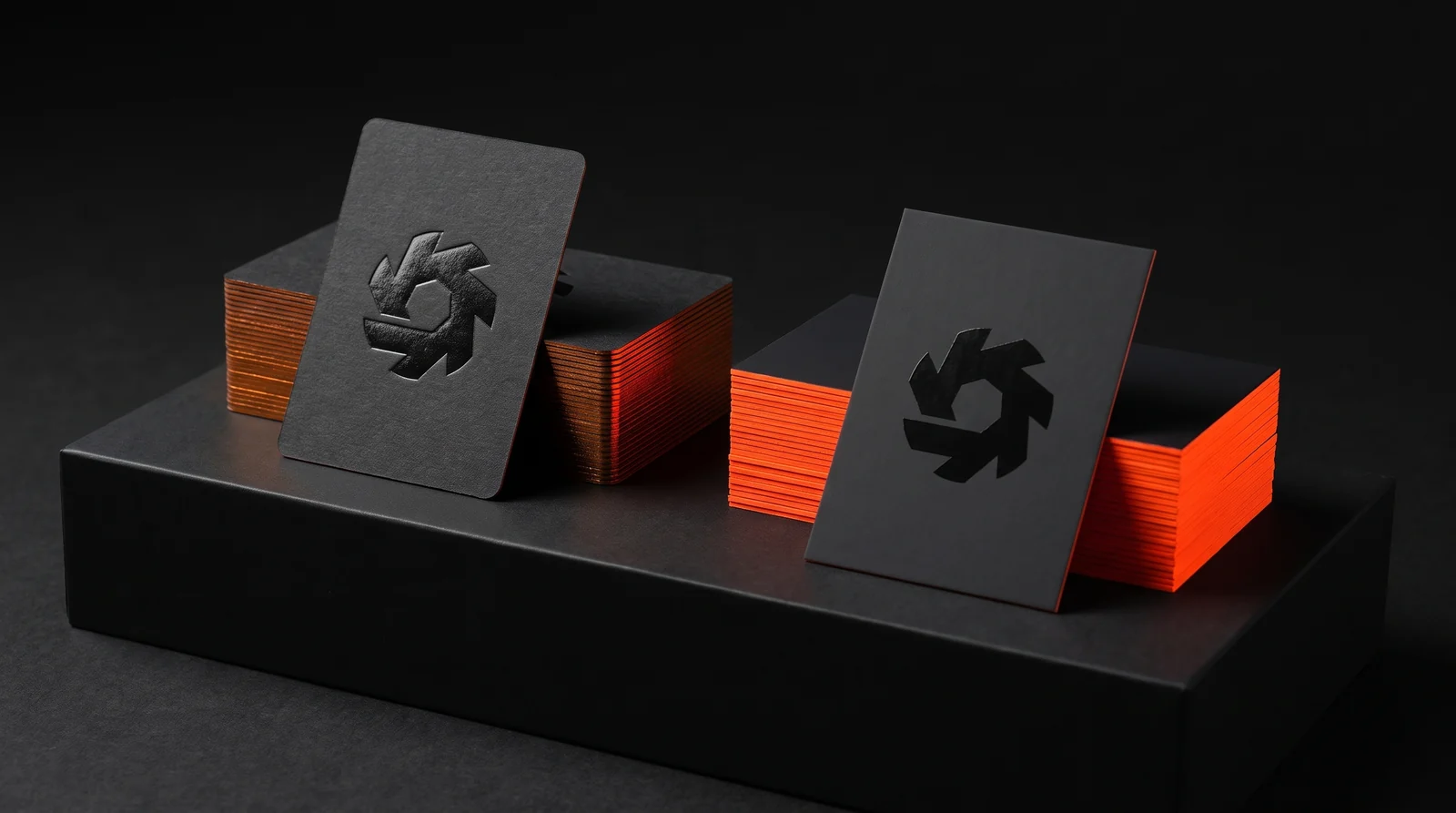
Bright white uncoated·32pt / 0.8mm·Black painted edge
Thick paper board·Gold edge paint
Thick paper board·Blue edge paint
What it's like to run
The finished pieces are clamped square in a vise, coated as a block, cured and separated. The whole stack becomes one continuous paintable surface, so the process works on single-ply and even text-weight paper as well as thick cards. The line on each thin piece is finer, but there is no 32pt production minimum. Invitations, menus, tags, notecards and paper components can all take it when the cut edge accepts the coating.
Paint the edge for contrast. On a dyed-through sheet, matching the existing edge adds cost and no visible information.
What the screen cannot show
A screen enlarges the edge into a stripe. In the hand it is a narrow flash that appears as the piece turns; the sample pack shows the real scale.
Hold the finish in your hand — request a sample pack →What it runs on
| Substrate | Verdict | Why |
|---|---|---|
| Uncoated & 100% cotton | Excellent | Porous cut edge drinks the colour and holds it — cotton is the reason edge painting looks the way it does. |
| Thick board, duplex & triplex | Excellent | The thicker the board, the more edge there is to see. Below about 16pt there's barely a line. |
| Recycled, kraft & inclusion stock | Excellent | Absorbs beautifully; expect the fibre to soften the colour a step. |
| Colour-through (dyed) stock | Good, tested | You can, but a dyed sheet already has a coloured edge — painting it usually fights the stock. |
| Coated silk & matte stock | Good, tested | The cut edge is sealed, so colour sits on top and can chip. Cotton or uncoated board is safer. |
Minimums and specs
- Minimum caliper
- No fixed minimum
- Single-ply and text-weight paper can be painted as a clamped stack
- Coverage
- Full perimeter
- Colour
- One solid colour
- Best edge
- Absorbent paper
Choose the process by the outcome
- Metal reflection
- Edge gilding or edge foil.
- Colour through every fibre
- Dyed-through stock.
- Two visible layers
- Contrasting duplex or triplex construction.
Price context
Quantity, stock behaviour and handling drive the estimate. There is no die, but every stack is clamped, coated, cured and separated; unusual shapes require testing because every cut edge must remain reachable.
Get this finish costed →Pairs well with
Edge painting
Paint applied to the cut edges of a tightly clamped stack after trimming, so every piece can carry a line of colour around its perimeter.
Duplex and triplex
Duplex bonds two printed plies into one piece. Triplex adds a third, often a contrasting core that turns the cut edge into a deliberate line.
Foiled edges
A reflective metallic layer is applied to the trimmed perimeter of a thick piece. It reads as a flash when the stack moves, not as a painted stripe.
Seen in
Common questions
- Are painted edges only for business cards?
- No. Single-ply and text-weight invitations, menus, tags and notecards can be painted because the pieces are clamped and treated as one stack.
- Can a single edge be painted?
- No. The pieces are coated as a clamped stack, so the process covers the full perimeter.
- Can a die-cut shape be edge painted?
- Sometimes. Smooth, accessible contours can work; tight internal corners and small cut-outs need a production test.