Luxury holiday cards you can feel
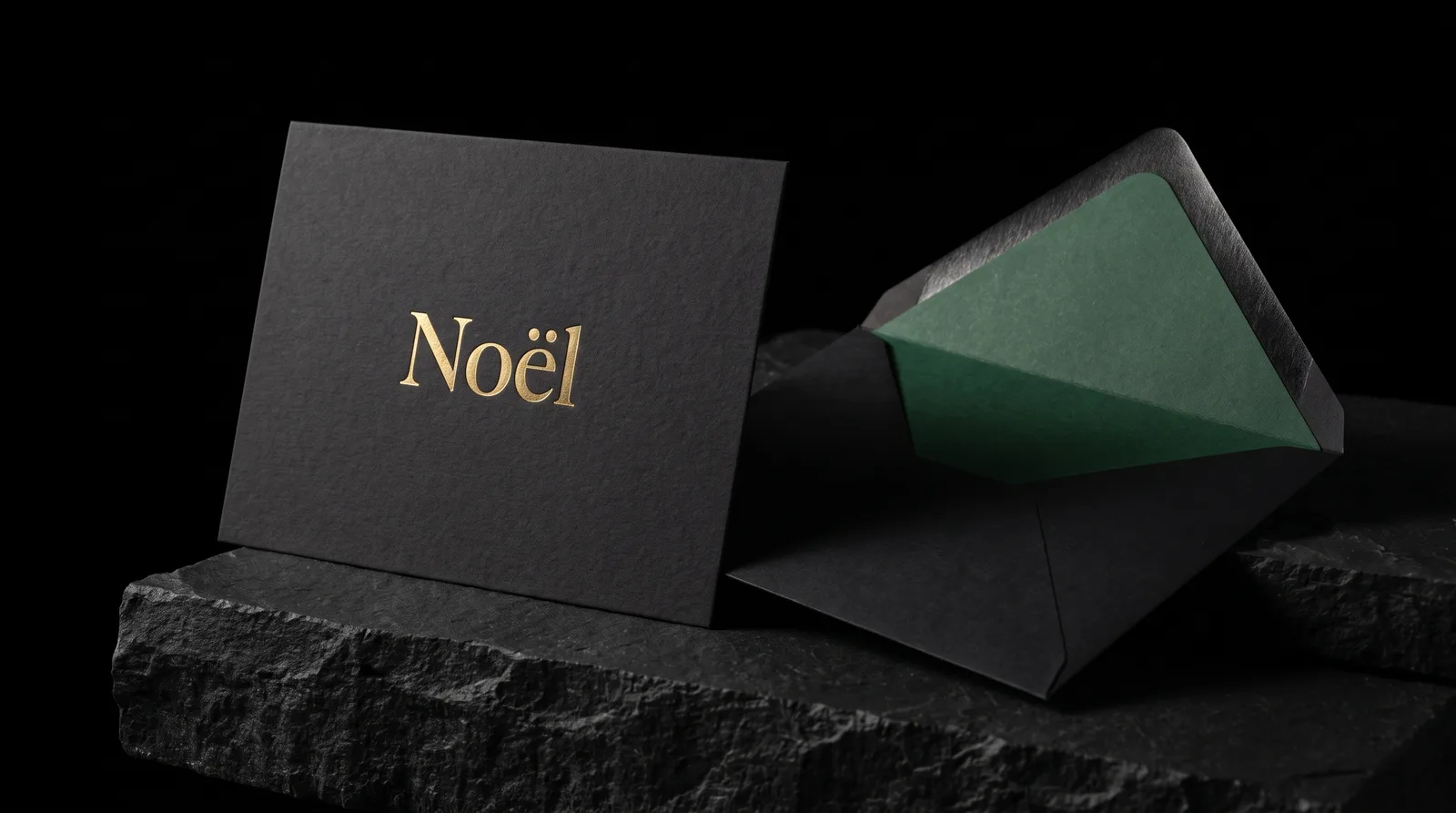
Our luxury holiday cards are pressed, not just printed: letterpress bitten into thick cotton, hot foil on black stock, blind emboss and painted edges. They're custom holiday cards, made to your design for Christmas, Hanukkah or the New Year. Pressed cards take about three weeks of production after you approve the proof, so if you want them before the holidays, now is the time to start.
See directions in minutes. A person checks every finish before you pay.
Free digital proof on every Custom card. Nothing goes to press until you approve it.
When to order letterpress and foil holiday cards
Approve your proof by Friday, October 30 if you want pressed cards in hand around the start of December. Friday, November 6 is the last date we'd recommend for letterpress or foil, and it may need faster shipping. After that, our Standard cards can still get there. Every date below is an estimate based on typical production and carrier times, not a guarantee.
| Card | Comfortable: approve your proof by | Typically arrives (estimate) | Last call: approve your proof by | Typically arrives (estimate) |
|---|---|---|---|---|
| Custom (letterpress, hot foil, emboss, cotton) | Fri Oct 30 | around Nov 30 – Dec 4 | Fri Nov 6 | around Dec 7 – 11, faster shipping may be needed |
| Standard (fixed-spec, fast production) | Fri Nov 20 | early December | Wed Dec 9 | around Dec 15 – 17, faster shipping recommended |
| New Year cards (Custom) | Fri Dec 4 | early January, for a send between about Jan 4 and Jan 15 | — | — |
- Custom cards take about three weeks of production after you approve the proof, plus shipping. Standard cards take about four business days of production, plus shipping.
- Proof rounds usually take one to three business days each, so start a week before the date you're aiming for.
- Carriers slow down in December, and production pauses around Thanksgiving and Christmas. Earlier is always calmer.
- Last-call cards land close to the Postal Service's own recommended mail-by dates for Christmas delivery. If they need to go back out in the mail, use the comfortable dates, or plan to hand them out or send them as New Year cards.
- Sending for Hanukkah? It begins at sundown on Friday, December 4 this year, so work from the comfortable dates.
- Outside the US? These dates are for US delivery. Tell us where the cards are going and we'll give you a date for that address.
- Rush buys your job priority in the queue. It doesn't buy a guaranteed delivery date, and we won't sell it as one.
Tell us the date you need them in hand and we'll give you a straight answer before you pay.
Two ways to order luxury holiday cards
There are two lanes. Custom is where the craft lives: letterpress, hot foil, emboss and painted edges on cotton or black stock, designed with you and proofed by a person. Standard is a short, fixed-spec menu of thick printed cards with fast production, for when the calendar has run away from you. If the card is going to people who'll keep it, and you have the time, we'd do Custom.
| Custom | Standard | |
|---|---|---|
| What it is | Made to your design. Letterpress, hot foil, blind emboss or deboss, painted edges, duplex | Fixed-spec, fast production. Full-colour print on thick card, with a painted edge or a black core |
| Paper | 32pt cotton (white, natural or ecru), black uncoated 32pt, 48pt duplex, Colorplan | 32pt uncoated (painted edge) or 32pt triplex with a black middle layer |
| Size | 5x7 flat with an A7 envelope; folded, A2 and square on request | 5x7 flat with an A7 envelope |
| Finishes | Any foil we stock, letterpress in Pantone-matched ink, blind emboss, painted edges in a matched colour | Print only. The edge colour comes from a set palette. Square corners |
| Design | We design it with you, then a person rebuilds the file for press | Your artwork, checked and set up by us |
| Production time | About 3 weeks after proof approval, plus shipping (estimate) | About 4 business days after proof approval, plus shipping (estimate) |
| From | Get a price for 50 | Get a price for 50 |
| Best for | Cards people keep on the mantel, family cards, New Year cards | Late orders and larger lists where speed matters more than impression |
Our pick for most people: Custom, one matte gold foil on 32pt black stock, flat 5x7. It's the simplest build that still feels pressed the moment someone picks it up.
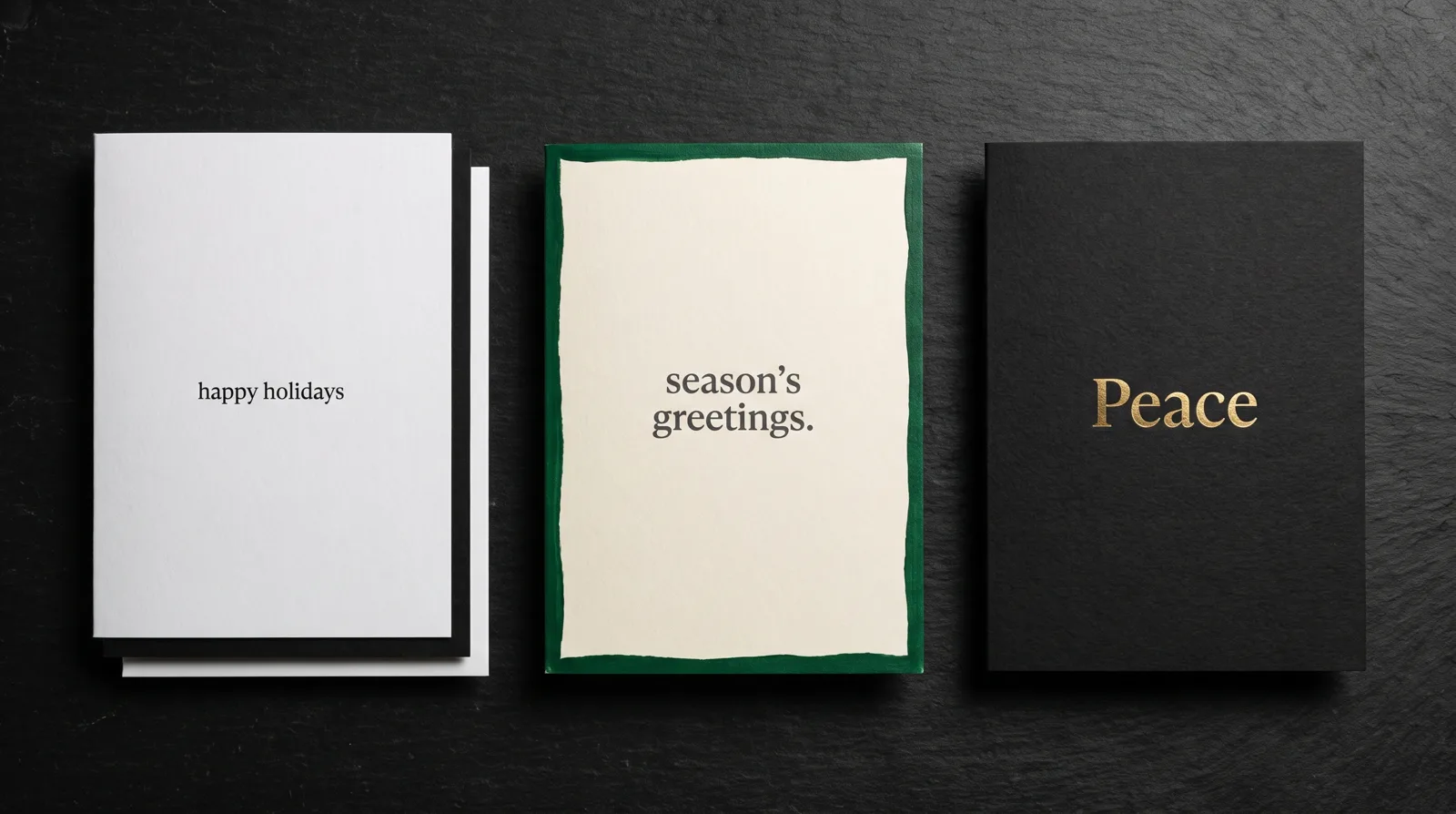
Letterpress, foil and embossed holiday cards, explained by touch
Each finish is a physical process with its own rules. Here is what each one feels like in the hand, and the one thing we'll always tell you about it before you pay.
Letterpress holiday cards
An inked plate is pressed hard into soft cotton, so the ink sits down in the paper with a softly pillowed edge. Run your thumb across a letterpress holiday card and you find every line. It suits fine type, a short greeting and a monogram, and it's at its best on white, natural or ecru cotton.
The honest part: letterpress ink is see-through, so light ink on dark paper looks chalky. On black stock we use foil instead. Large solid areas print with a soft, suede-like texture rather than a flat field of colour; some people love that, and if you don't, we'll make the colour from the paper instead. Each colour is its own plate and press pass, so one colour is the sweet spot.

Foil Christmas cards and gold foil holiday cards
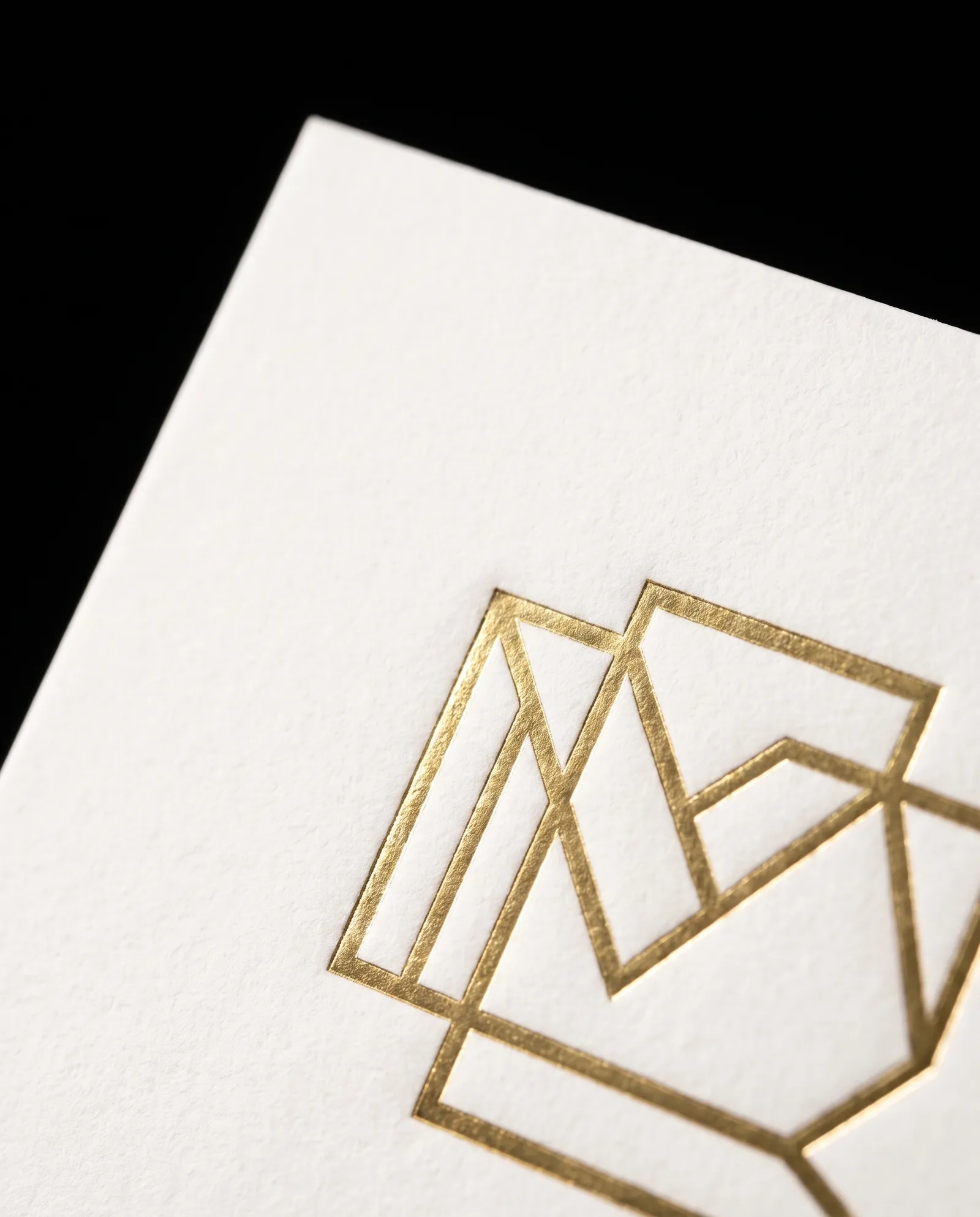
Hot foil is a metal or pigment film pressed onto the paper with a heated die. On cotton it leaves a slight bite; on black stock, gold, copper and silver sit up and catch the light the way ink never can. Matte gold is the quiet choice and the easiest to read; bright gold is the one that shows across a room. For white type on black, we use white pigment foil, which stays opaque where white ink would sink in.
The honest part: a foil die is one solid shape, so a gradient becomes one flat tone. Lines finer than about 0.6 mm break up on press, so we thicken them, and small type in foil starts at about 7 point. Black foil on black paper is a beautiful sheen you see at an angle, not something you can read at a glance.
Embossed Christmas cards and blind deboss
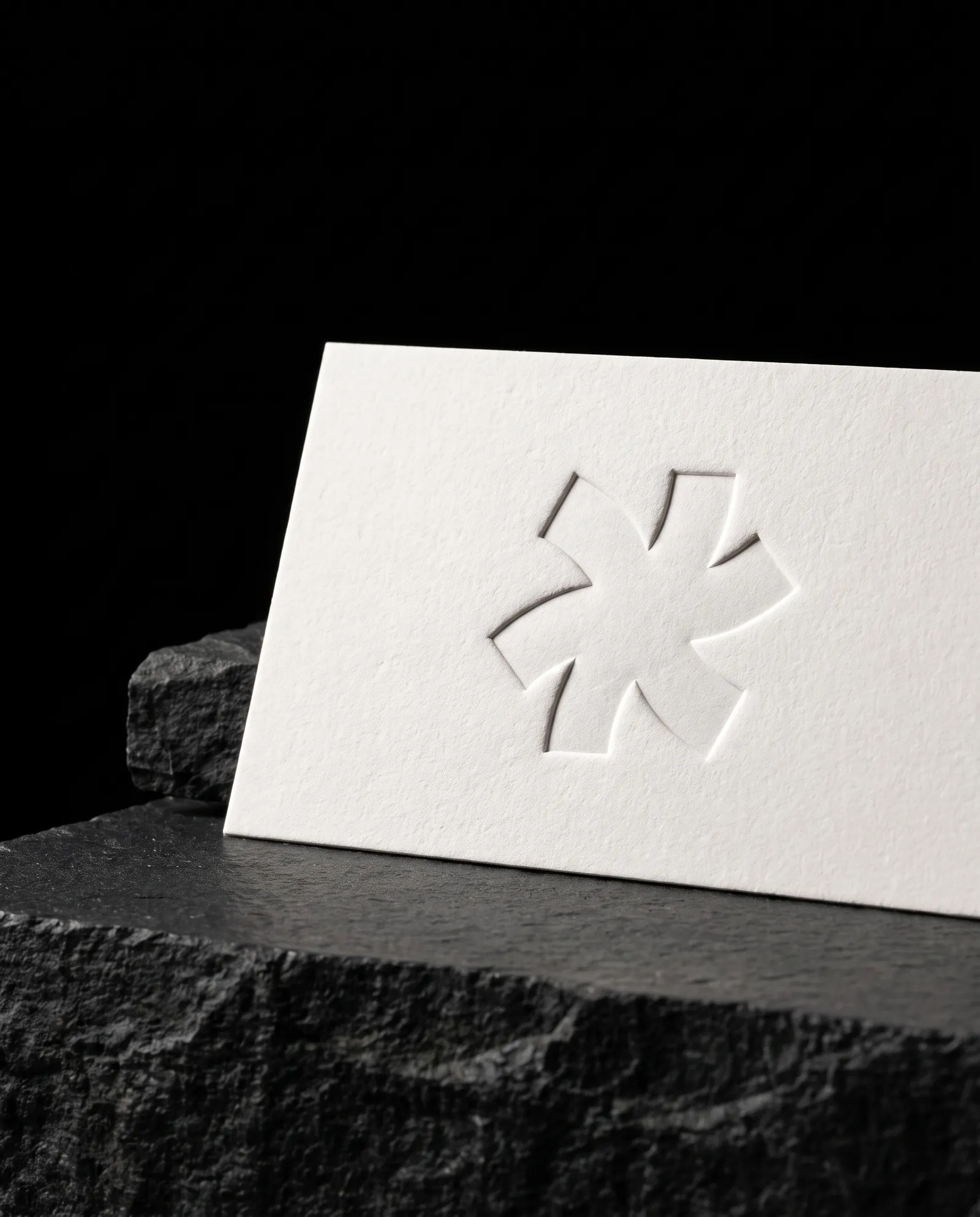
The paper is pressed between a metal die and its counterpart, so the design rises up off the sheet (emboss) or sinks into it (deboss). With no ink at all it's called blind, and it reads only by its shadow: a wreath, a monogram or a single word that appears when the light moves. Foil and emboss can share one combination die, so the foil lands exactly on the raised shape.
The honest part: on a single sheet, an emboss or a deep letterpress bite leaves a mirror image on the back, which is the side people write on. If the back matters, we bond a second sheet behind it so it stays smooth (that's a Signature build), or we keep the impression lighter. On black paper a blind impression is very quiet; if it has to be read, we put foil in it.
Painted and foiled edges
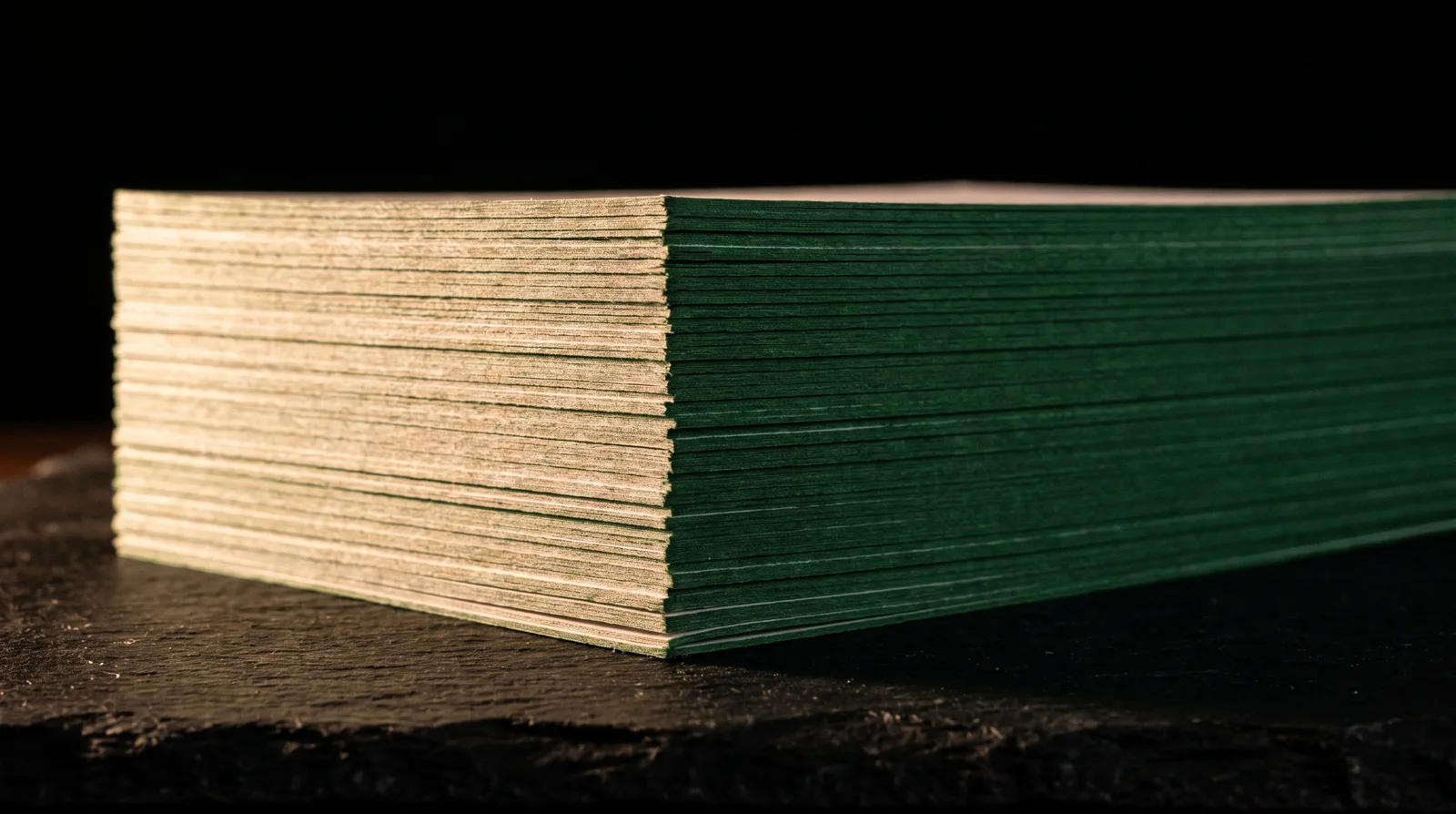
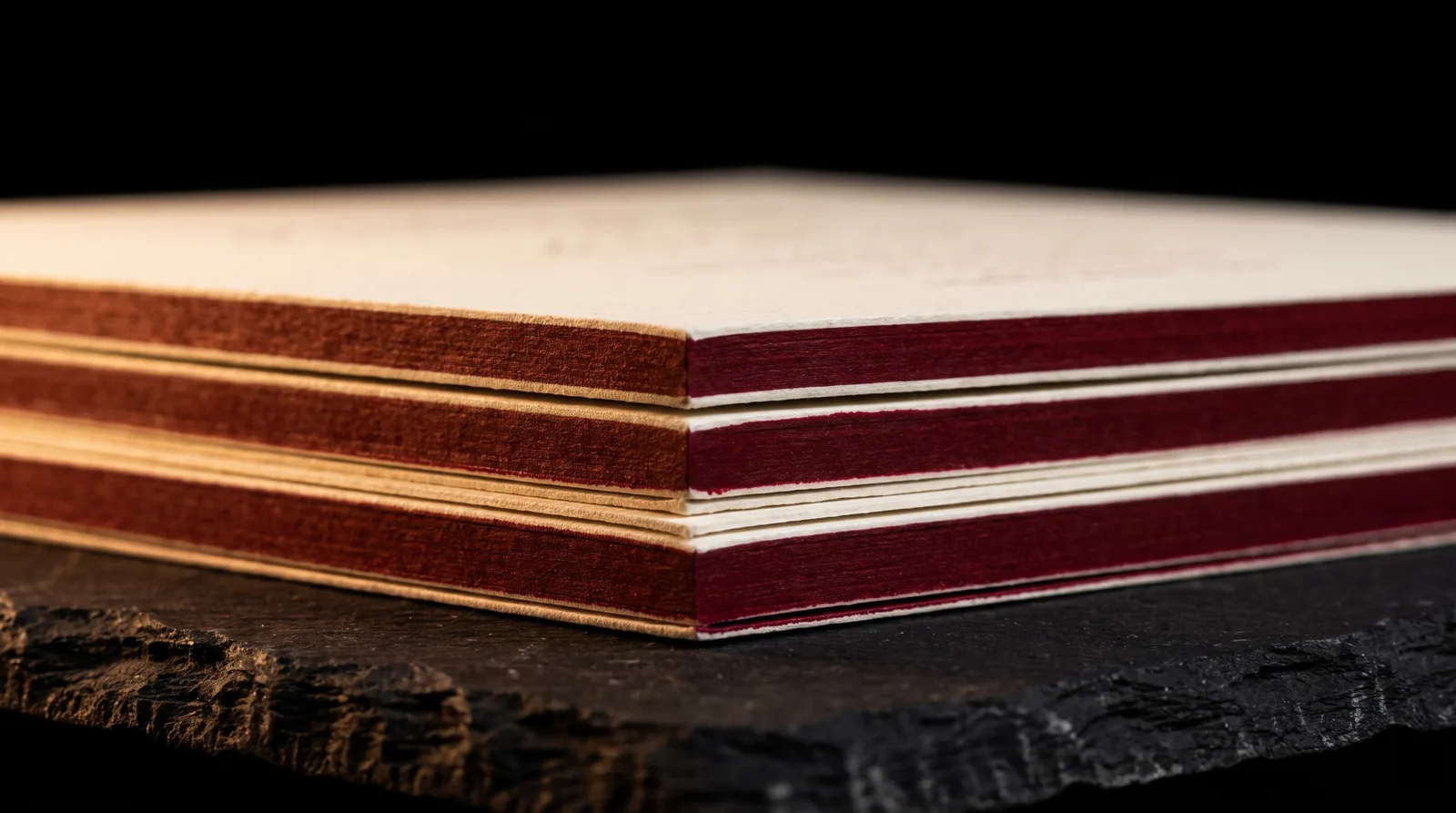
The cards are clamped into a tight stack and the edge is painted as one surface, then separated. On thick cotton you get a clear line of colour around every card, matched to the ink or foil on the front: deep green, oxblood, gold. Gilded (foiled) edges give a metal gleam instead.
The honest part: a card has one edge, so it's painted or foiled, never both. Foiled edges need square corners, because foil breaks at the curve of a rounded corner. Foil on the edge of soft cotton can take unevenly, so our press team confirms it before we promise it. We also keep foil on the front about 3 mm away from a painted edge so the line stays clean.
The paper does half the work
Many printed holiday cards are 14 to 16 point coated stock. Ours start at 32 point, roughly the thickness of a credit card, and the paper is chosen for the finish: cotton for letterpress and emboss, black for foil, duplex when both sides need to stay clean.
| Paper | Thickness | What it's for | What to know |
|---|---|---|---|
| Cotton, white, natural or ecru | 32pt (about 0.8 mm) | Letterpress, blind emboss, foil. The softest bite and the warmest feel | Natural leans slightly warm. Spot UV won't cure on cotton; we use clear foil for gloss instead |
| Black uncoated | 32pt | Gold, copper, silver and white pigment foil | Ink sinks into black paper, so light colours on black are always foil |
| Duplex (two sheets bonded) | 48pt (about 1.2 mm) | A different colour on each side, a two-tone edge, impressions on both faces | Dramatic in the hand, and heavier in the post |
| Colorplan | varies by colour | A coloured ground for one foil, like forest green with gold | Coloured paper darkens light or see-through inks, so foil is usually the move |
What we'll tell you before you pay
Most of what disappoints people about pressed cards is avoidable if someone says it early. So we say it early. These are the rules we design around on every holiday card.
- Gradient foil prints as one flat tone. A die is one solid shape. If the gradient is the idea, we print it and keep foil for a solid element.
- Spot UV doesn't cure on cotton. It soaks in. On cotton we give you the same gloss contrast with clear foil.
- Light ink disappears on black. Letterpress and printed inks are see-through. White on black is white pigment foil.
- A painted edge and a foiled edge can't share a card. Foiled edges need square corners, because foil breaks at the curve of a rounded corner.
- Raised foil is a different thing from hot foil. Raised foil is built up on a laminated card; it can't go on cotton. On cotton, the equivalent is hot foil pressed into the sheet.
- Photos look soft on cotton. Cotton drinks ink. A photo card wants a smooth, coated sheet, which is a different product (see the FAQ).
- An impression shows on the back of a single sheet. Emboss and deep letterpress leave a mirror image behind them. If you'll write on the back, we bond a second sheet or press lighter.
- Big letterpress solids look textured. It's the character of the process, not a fault. If you want a flat field of colour, we'll make it from the paper.
- AI previews are direction, not proof. Our Studio tool shows you ideas fast. A person rebuilds every file for press, and you approve a proof before anything is made.
What luxury holiday cards cost
Custom holiday cards are quoted to your design, envelopes included; tell us your quantity and date and we'll price it for you. Standard holiday cards are priced the same way until the live price list carries them. The bigger the run, the lower the price per card, because the plates, dies and setup are shared across every card.
| Build | What's in it | 50 | 100 | 250 |
|---|---|---|---|---|
| Custom Pressed (recommended) | One hot foil colour or one letterpress colour, one side, on 32pt cotton or 32pt black | Get a price | Get a price | Get a price |
| Custom Signature | Foil plus blind emboss, or two letterpress colours, or 48pt duplex with a painted edge. Coloured envelope with a liner | Get a price | Get a price | Get a price |
| Custom Atelier | Die-cut shapes, foil on both sides, foil on the envelope. Built to brief | Quoted | Quoted | Quoted |
| Build | What's in it | 50 | 100 | 250 |
|---|---|---|---|---|
| Black core | 32pt triplex: white faces with a black middle layer that shows on every edge. Full-colour print, square corners | Get a price | Get a price | Get a price |
| Painted edge | 32pt uncoated, full-colour print, edge colour from a set palette (including metallic gold, red, black and metallic green) | Get a price | Get a price | Get a price |
- Shipping is shown before you pay. Standard shipping is calculated at checkout.
- Prices update from our live price list. Where a build shows "Get a price", tell us your quantity and date and we'll quote it for you before you pay anything.
- What moves the price: each extra foil colour or letterpress colour is its own die or plate and press pass; foil or impressions on both sides need a second set; liners and printed envelopes are priced per envelope.
If you're sending fewer than 150 cards, Custom Pressed is the one we'd buy. Spend the difference on the envelope before a second foil colour.
Family and personal holiday cards
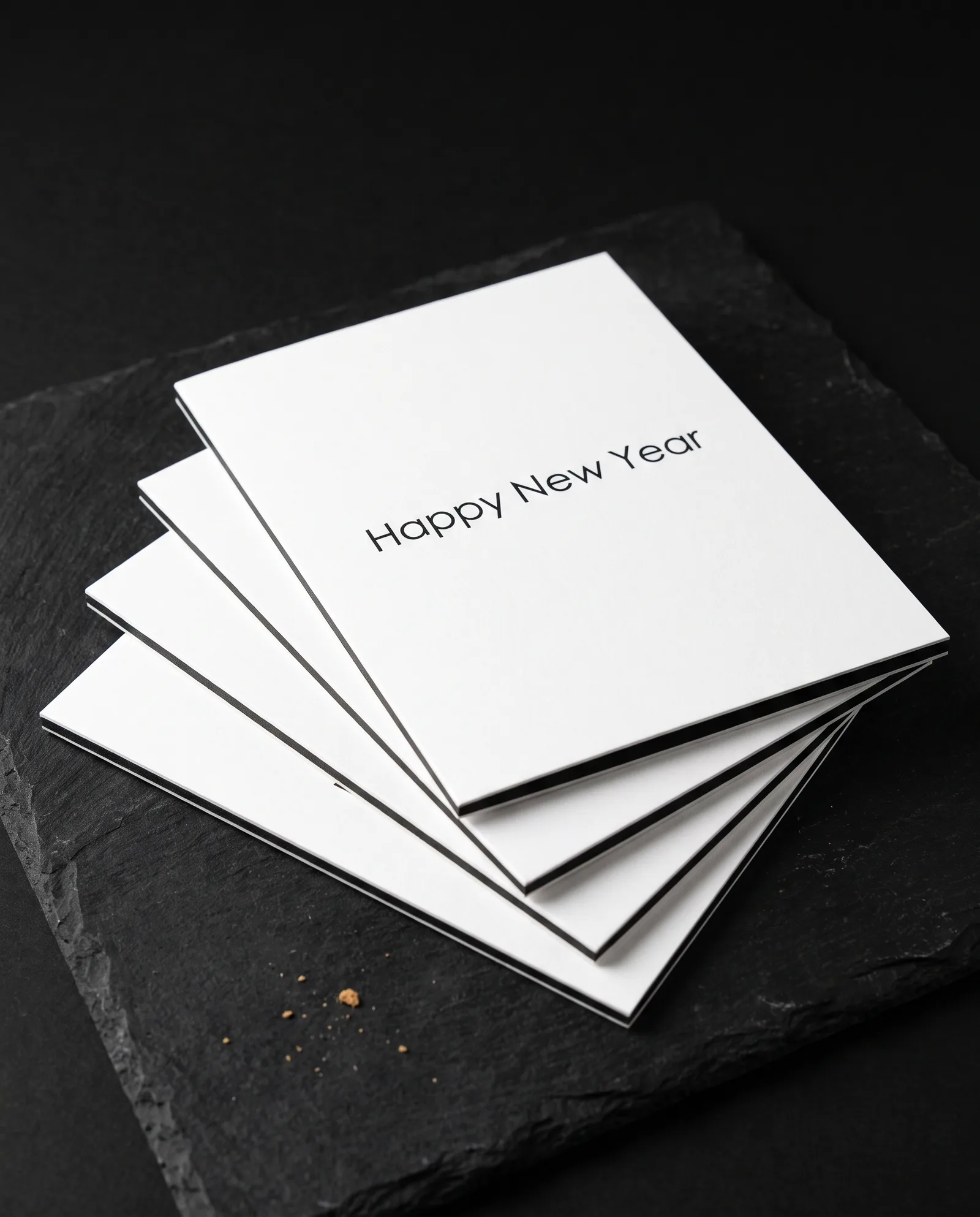
Yes, we make holiday cards for families and individuals, not only for companies, and they're personalized Christmas cards with no photo needed. The ones that work best are simple: a family name or monogram in foil or letterpress, one short line, and space to write by hand. A 5x7 flat card on cotton gives you the writing room; a folded card keeps the inside private.
Some ideas we come back to:
- A monogram or family name in matte gold foil on black, or letterpress on ecru cotton.
- Your return address on the envelope flap, printed or in the same foil as the card, so the envelope matches before it's opened.
- One word, large. Peace, Joy, Noël, Shalom. A single pressed word on a thick card says more than a paragraph.
- Signed by hand. Uncoated cotton is easy to sign by hand. If you write with a fountain pen, try it on a sample first, because soft cotton can feather wet ink.
We don't make photo cards. A photograph needs smooth coated paper to look sharp, and on cotton it prints soft. If a photo matters to you, tell us; we'll confirm what's possible for your build before you pay.
Christmas, Hanukkah and New Year cards
We make cards for whatever you celebrate, and for people who'd rather say "season's greetings". The process is the same; only the words and colours change. Luxury Christmas cards lean on gold foil, deep green and oxblood. Hanukkah cards suit silver or white pigment foil on navy or black. New Year cards give you the most freedom, because they don't have to arrive before a holiday at all.
Why a New Year card is often the better move
If December has got away from you, a New Year card is the card we'd make. It arrives in the first or second week of January, when the mailbox has gone quiet. It also gives Custom production the full three weeks it needs. Approve your proof by Friday, December 4 for an early-January send (estimate).
Envelopes, liners and the details around the card
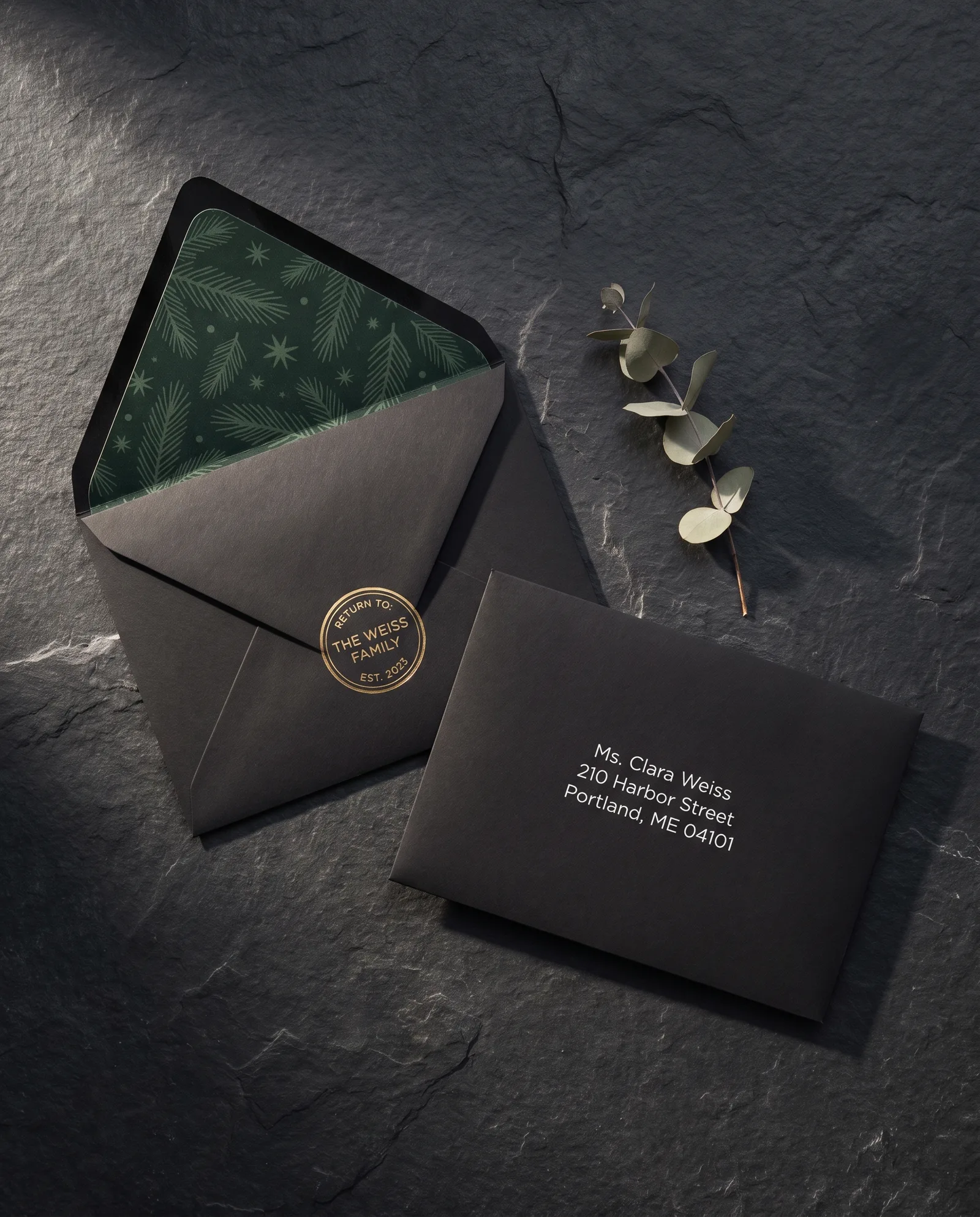
Every holiday card comes with a matching A7 envelope. On Custom cards, the envelope can do as much work as the card: a coloured envelope, a printed or solid liner that flashes when the flap opens, a return address on the flap in print or foil, or a wax seal. These are options, priced in your quote.
| Option | Custom | Standard |
|---|---|---|
| A7 envelope | Included | Included |
| Coloured or kraft envelope | Yes | Ask us |
| Envelope liner, printed or solid | Yes | No |
| Return address on the flap, printed | Yes | Yes |
| Return address on the flap, in foil | Yes | No |
| Recipient addresses printed from your spreadsheet | Yes | Yes |
| Wax seal | Yes | No |
- Addresses print exactly as you supply them, so check the spreadsheet before you send it. We proof one sample envelope.
- Ink won't show on a black envelope, so a return address goes in gold or white pigment foil, and printed recipient addressing needs a lighter envelope.
- A thick or square card can need extra postage. We'll tell you at proof what the finished card and envelope weigh, so you can buy the right stamps.
Sending holiday cards for your company?
If the cards carry a logo, go to a client list, or need team signatures and several delivery addresses, our business holiday cards page is built for that, with bulk pricing and the same order-by dates.
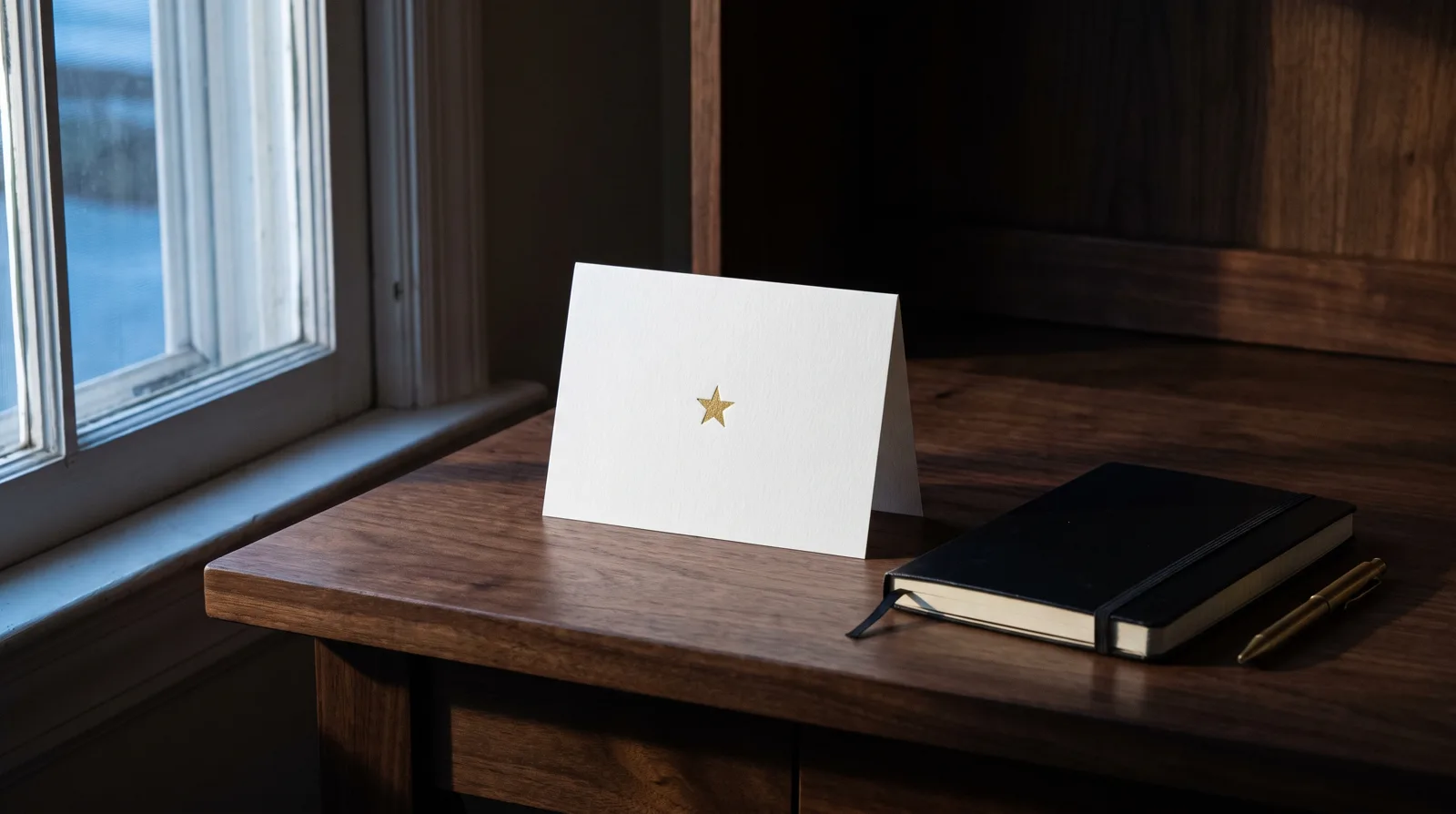
Holiday and notecard designs from our studio
These are studio design exercises, built to show what a single production idea does on paper. Each case study names the paper and finishes used, and you can start a card from the same materials.
How a custom holiday card gets made
A custom holiday card goes from idea to your door in five steps, and production is the one that sets the calendar.
- Tell us the date. Start in our Studio tool or send us a brief, and tell us when you need the cards in hand. That date decides which lane is realistic, and we'll say so before anything else.
- See directions. The Studio tool shows you a few ways to build the card, with the finish, paper and colour named. It's a preview, not the printed result.
- A person rebuilds it for press. Our design team redraws the artwork as clean, layered files, thickens any foil lines that would break up, and sets small type in a size the process can hold.
- You approve a proof. You get a free digital proof. Nothing goes to press until you approve exactly what you'll receive.
- We make and ship it. About three weeks of production for Custom, about four business days for Standard, then shipping. Both are estimates; we'll give you the date for your order before you pay.
Feel the paper before you order
Our sample kit is $8, and it comes with a $10 credit toward your first order. It's built around business cards rather than holiday cards, but the papers, foils and finishes are the same ones we press holiday cards on, including a swatch card with every hot foil we keep on the shelf. If you're choosing between letterpress and foil, or between cotton and black, it settles the question faster than any screen.
Holiday card questions
When should I order luxury holiday cards?
For letterpress or foil, approve your proof by Friday, October 30 for cards in hand around the start of December. Friday, November 6 is the last date we'd recommend, and it may need faster shipping. Standard cards can still arrive in early to mid-December if you approve the proof by November 20 (comfortable) or December 9 (last call). Custom cards take about three weeks of production after proof approval and Standard about four business days, both plus shipping. These dates are estimates, not guarantees, and carriers slow down in December.
What's the difference between letterpress and foil holiday cards?
Letterpress holiday cards have the ink pressed down into soft cotton, so you feel it more than see it; letterpress suits fine type and quiet colour on white or cream paper. Hot foil is a metal or pigment film pressed onto the paper, so it shines and reads from a distance; it's the answer for gold, copper or white on black stock. Letterpress ink is see-through, so it can't do light colours on dark paper. Foil can't do gradients. The two can share a card, side by side, with the ink kept clear of the foil.
What makes a Christmas or holiday card "luxury"?
The most luxurious Christmas and holiday cards share three things you can feel: heavy paper (32 point cotton or thicker, about the thickness of a credit card), a pressed process (letterpress, hot foil or embossing rather than flat printing) and a design built for that process. Luxury Christmas cards also tend to come with a better envelope, a liner or a foil return address. Thickness alone isn't luxury; a pressed finish on the right paper is.
How much do luxury holiday cards cost?
Custom holiday cards are quoted to your design, envelopes included; tell us your quantity and date and we'll price it for you. The price per card falls as the quantity rises, because the plates and dies are shared across the run. Extra colours, foil on both sides, liners and printed envelopes add to the price, and your quote shows each one separately.
Can I add a family photo to my holiday card?
We don't make photo cards. A photograph needs smooth coated paper to look sharp, and on cotton it prints soft and slightly muted. Our holiday cards are built around foil, letterpress and embossing, which suit names, monograms and short greetings. If a photo really matters, tell us what you have in mind and we'll confirm what's possible for your build before you pay.
Is there a minimum order?
Custom and Standard holiday cards start at 50 cards. Below that, the setup for plates and dies makes each card very expensive; if you need fewer, ask us and we'll quote it honestly.
Are envelopes included?
Yes. Every holiday card comes with a matching A7 envelope. On Custom cards you can upgrade to a coloured envelope, add a printed or solid liner, put your return address on the flap in print or foil, or add a wax seal. Recipient addresses can be printed from your spreadsheet on both Custom and Standard.
Will the foil crack or rub off?
No, not in normal handling or in the post. Hot foil is bonded to the paper with heat and pressure, and on cotton it sits with a slight bite. What can go wrong is design, not durability: lines thinner than about 0.6 mm break up on press, and foil laid across a fold can crack. We thicken fine lines and keep foil about 3 mm away from folds and edges before you see the proof.
Can you match my colour?
Yes. Letterpress ink is mixed to a Pantone colour, matched to the uncoated Pantone book on cotton. If you send a screen colour, we match it to the nearest Pantone and tell you how far it moved. Foil comes from our stocked foils, and we'll name the closest one. Painted edges on Custom cards are matched to your ink or foil; Standard edges come from a set palette.
Do thick holiday cards need extra postage?
Sometimes. Thick, stiff or square envelopes can cost more to mail than a standard letter. We'll tell you at proof what your finished card and envelope weigh, so you can buy the right postage before you sign a single card.
Do you make Hanukkah and non-religious holiday cards?
Yes. We make cards for Christmas, Hanukkah, the New Year and plain "season's greetings". Silver or white pigment foil on navy or black works well for Hanukkah. Hanukkah begins at sundown on Friday, December 4 this year, so use the comfortable order-by dates.
What if I miss the December dates?
Send New Year cards. A card that arrives in the first or second week of January lands in a quiet mailbox, and it gives Custom production the full three weeks it needs. Approve your proof by Friday, December 4 for an early-January send (estimate). Standard can also still help for cards you'll hand out in person.
Can I see samples before I order?
Yes. Our sample kit is $8 and comes with a $10 credit toward your first order. It's built around business cards, but it uses the same papers, foils and finishes as our holiday cards, including a swatch card with every hot foil we stock. Every Custom order also gets a free digital proof before anything is made.
Can I order holiday cards for my company here?
You can, but our business holiday cards page is built for it, with logos, team signatures, bulk pricing and several delivery addresses. It uses the same order-by dates as this page.
Ordering for work? See business holiday cards.
Tell us the date you need them in hand
Send us your quantity and your in-hand date. We'll tell you straight whether Custom makes it, what Standard can do instead, and what it costs, before you pay anything.