Coming soon · now taking custom orders
Envelopes worth opening.
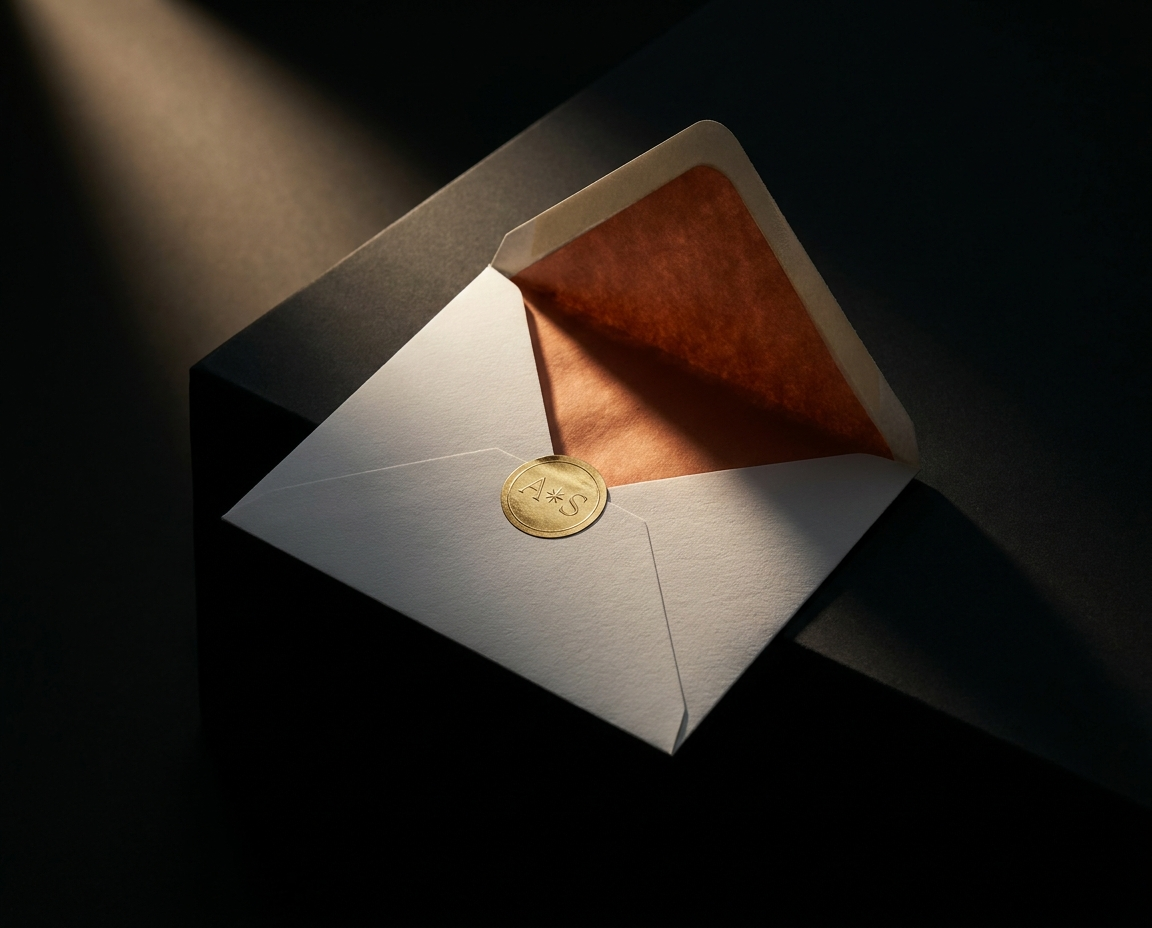
#10, A7, square — lined, coloured or foil-stamped, with wax-seal alternatives. Designed to match the invitation or brand suite inside, held to the same standard as the piece they carry.

Reviewed by a human
before anything prints
What's possible
The first thing they touch.
Standard #10, A7 and square, plus bespoke sizes on cotton and Colorplan — with liners, painted edges, foil monograms and stamped seals. Every envelope is designed alongside the piece it carries.
#10, A7 & square
Standard business and invitation sizes, plus bespoke.
Lined interiors
Patterned, coloured or metallic liners.
Foil & letterpress
Return addresses and monograms, stamped in foil.
Wax-seal & foil seals
Real wax or foil seals, matched to the suite.
Why Peppermint
A human guides every custom order.
A human verifies everything
We confirm your files, materials and finishes will print before you ever pay.
Access to exotic materials
Papers, foils and techniques most printers can't or won't offer.
A free proof, every time
Approve exactly what you'll get — nothing goes to press until it's right.
Custom envelopes FAQ
Yes — envelopes are the first thing your guest or client touches, so we design them alongside the piece inside. Same paper family, same foil, same colour. A specialist confirms the pairing before press.
#10 business, A7 invitation, square, and bespoke sizes on request. We can convert most of our cotton and Colorplan stocks into custom envelopes, plus source premium blanks for liner and foil work.
Yes — patterned, coloured and metallic liners, all glued in-house. Popular for wedding suites and premium brand mailings where the moment of opening is part of the experience.
Real wax seals and stamped foil-seal alternatives — the modern, mail-safe option that looks like wax without the heat and weight. Both can be custom-designed to match your monogram or logo.
Need envelopes before we launch self-serve?
Tell us what you have in mind. We'll come back with ideas, real options and an exact quote — no obligation.
Design the envelope at the same time as the piece inside, not after it. It arrives first, it gets handled first, and a beautiful invitation in a thin white blank tells the recipient exactly where the budget stopped. We build envelopes in #10, A7, square and bespoke sizes, with liners, painted edges, foil monograms and real or stamped seals — held to the same standard as whatever is folded inside them.
The envelope should come from the same paper family as the piece it carries
Same stock family, same foil, same colour — a specialist confirms the pairing before anything goes to press.
We work in #10 business, A7 invitation and square, plus bespoke sizes on request. Most of our cotton and Colorplan stocks can be converted into envelopes, so the outside can match a letterpress invitation or a brand card exactly, down to the shade of the flap. When a job calls for a liner or heavy foil work, we also source premium blanks built for it. What a guest or a client touches before they read a word should already feel like part of the suite.
How ink and foil behave on an envelope depends on when we print it
There are two routes. Print the sheet flat and convert it into an envelope afterward, which allows coverage right to the edge and lets foil or letterpress land anywhere on the shape, including across what becomes the flap. Or print onto a made envelope, which means working around three layers of paper and a glue seam.
That seam matters. Press impression drops off where layers stack, so we keep deep letterpress bite and large foil areas away from those ridges. On dark Colorplan, process ink simply vanishes — foil or an opaque ink laid down with real pressure is what reads.
Liners and wax add bulk, and bulk changes how a piece mails
Liners are cut and glued in-house: patterned, coloured or metallic. Painted edges, foil monograms and stamped seals go on before the liner, because a lined envelope can't go back on press.
Here is the part nobody mentions until it's too late. A liner, a real wax seal and a thick invitation stack up into something rigid and lumpy, and rigid lumpy mail often falls outside what automated sorting equipment will take — which means hand-processing and a different rate. Stamped foil seals give you the look of wax without the heat or the weight. Test a finished, sealed sample before you commit.
Common questions
Not with process ink — CMYK is transparent and disappears into a dark sheet. The reliable methods are foil, which sits on the surface as a metallic or matte pigment layer, or an opaque ink pressed into the stock. Both read cleanly on deep Colorplan colours. We'll recommend one based on your artwork's line weight.