The seam can be the design.
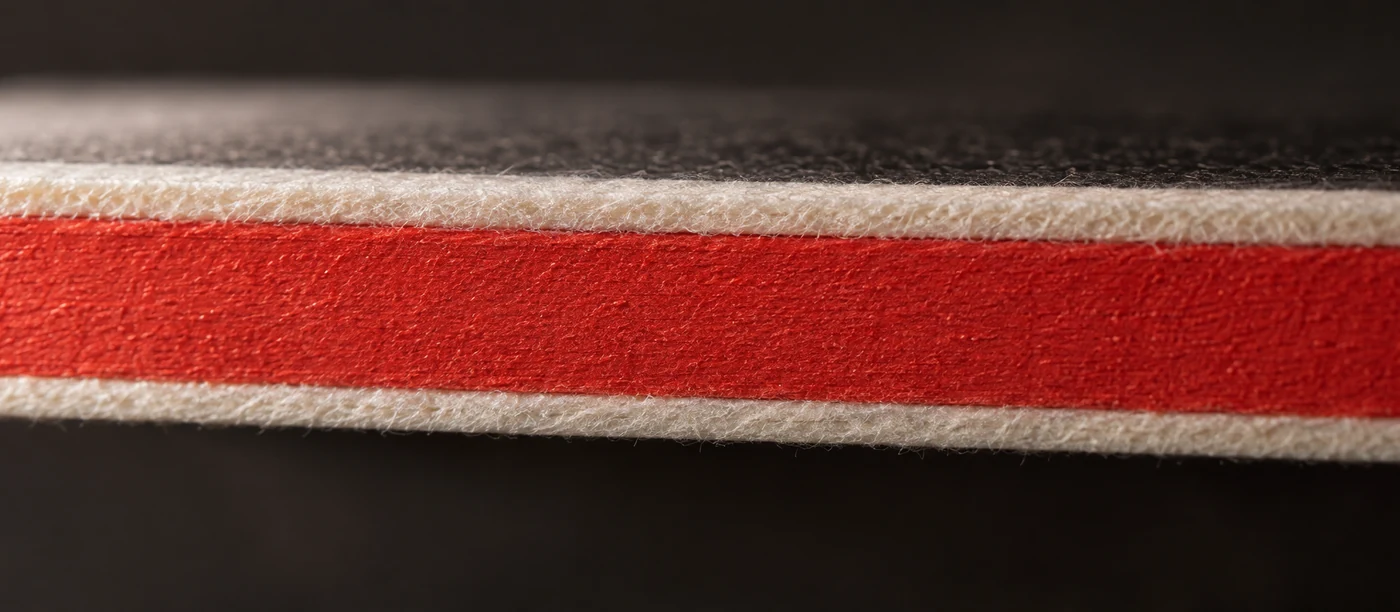
Duplex bonds two printed plies into one piece. Triplex adds a third, often a contrasting core that turns the cut edge into a deliberate line.
Start with the finish
See what duplex and triplex does with your own brief.
Free · about two minutes
Bonded uncoated plies·32pt·Duplex construction
Contrasting plies·48pt·Exposed seam
Bright white outer plies·32pt·Black edge
What it's like to run
Each face can be printed or impressed before bonding, which keeps a deep front impression from bruising the back. Two 16pt plies make 32pt. Three 16pt plies make 48pt, or two heavier plies can reach the same caliper with one seam instead of two. Registration is at the trim, not between wet printed sheets: the bonded board is cured, then cut as one object.
A contrasting core is not an effect painted onto the edge. It is a real third sheet, visible at every cut and priced as construction.
What the screen cannot show
A screen cannot communicate caliper. The sample pack lets you compare a 32pt duplex with a 48pt triplex and feel what the extra ply changes.
Hold the finish in your hand — request a sample pack →What it runs on
| Substrate | Verdict | Why |
|---|---|---|
| Thick board, duplex & triplex | Excellent | This is the construction itself: two plies for duplex, three for triplex. |
| Uncoated & 100% cotton | Excellent | The standard route to deep, clean impressions on each face without reverse bruising. |
| Colour-through (dyed) stock | Excellent | Contrasting dyed plies turn the seam into a deliberate edge detail. |
| Coated silk & matte stock | Excellent | Bonds cleanly when grain and moisture are balanced before trimming. |
Minimums and specs
- Duplex example
- 16 + 16 = 32 pt
- Triplex example
- 16 + 16 + 16 = 48 pt
- Face finishing
- Before bonding
- Core
- Structural ply
- Not printed edge colour
Choose the process by the outcome
- One very thick homogeneous sheet
- Heavy cotton board.
- A narrow colour line
- Contrasting triplex core.
- Solid edge colour
- Edge paint after bonding.
Price context
Every ply adds stock, alignment, adhesive, curing and trimming. Duplex is the efficient route to 32pt; triplex earns its cost when the core is visually or structurally necessary.
Get this finish costed →Pairs well with
Painted edges
Edge paint is applied after cutting while the pieces are held tightly as one stack. It can run on single-ply and text-weight paper as well as thick cards.
Foiled edges
A reflective metallic layer is applied to the trimmed perimeter of a thick piece. It reads as a flash when the stack moves, not as a painted stripe.
Blind deboss
A die presses the artwork into the sheet with no ink and no foil. The only thing you see is the depth — the surface reading differently where it's been compressed.
Common questions
- What is the difference between duplex and triplex?
- Duplex has two bonded plies; triplex has three, often with a contrasting core.
- Does deep emboss show on the back of a duplex piece?
- The face can be impressed before bonding, so the backing ply hides the reverse mark.
- Is the coloured core edge paint?
- No. It is a real sheet running through the construction.