Metal caught on the edge.
A reflective metallic layer is applied to the trimmed perimeter of a thick piece. It reads as a flash when the stack moves, not as a painted stripe.
Start with the finish
See what foiled edges does with your own brief.
Free · about two minutes
Thick paper board·Gold edge finish
Duplex board·48pt / 1.2mm·Exposed seam
Bright white board·32pt / 0.8mm·Square trimmed edge
What it's like to run
Edge gilding lays metallic material over a prepared, square perimeter; edge foil uses a transfer film and pressure. The vocabulary varies by construction, but the physics does not: the edge needs enough caliper to become a surface, and the stack must be cut square. Thick cotton and duplex boards give the metal room to read. Thin, ragged or heavily textured edges break the reflection.
Metallic edge work magnifies trimming. A seam, nick or wandering corner that disappears under paint can flash under foil.
What the screen cannot show
A screen physically cannot show this finish. It is a reflection, not a colour, and every image on this page is light hitting a surface at one chosen angle.
Hold the finish in your hand — request a sample pack →What it runs on
| Substrate | Verdict | Why |
|---|---|---|
| Thick board, duplex & triplex | Excellent | The broad, square edge gives the metallic layer enough surface to read cleanly. |
| Uncoated & 100% cotton | Excellent | Works at 32pt and above; 48pt gives a stronger reflective line. |
| Coated silk & matte stock | Good, tested | Only on a thick bonded construction with a clean, square cut edge. |
| Colour-through (dyed) stock | Good, tested | Works, but choose a contrasting metal or the edge disappears into the stock. |
Minimums and specs
- Preferred caliper
- 48 pt / 1.2 mm
- Practical floor
- 32 pt / 0.8 mm
- Edge
- Square and sealed
- Coverage
- Full perimeter
Choose the process by the outcome
- Flat solid edge colour
- Edge paint.
- A coloured seam
- Contrasting duplex or triplex.
- Metal on the face
- Hot foil stamping.
Price context
The finish is handling-led: squaring, preparation, application and separation. A thicker, simpler perimeter is more predictable than a thin or intricate one.
Get this finish costed →Pairs well with
Painted edges
Edge paint is applied after cutting while the pieces are held tightly as one stack. It can run on single-ply and text-weight paper as well as thick cards.
Duplex and triplex
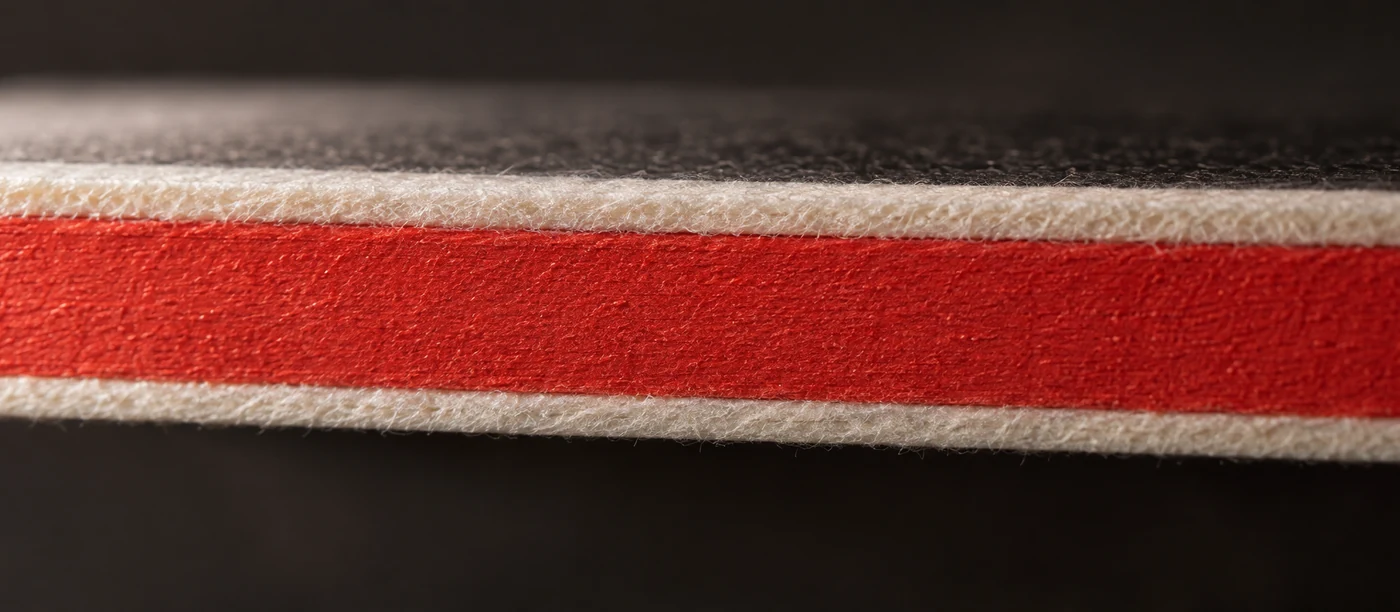
Duplex bonds two printed plies into one piece. Triplex adds a third, often a contrasting core that turns the cut edge into a deliberate line.
Foil stamping
A heated die transfers a metallic film onto the stock under pressure. Not printed, not simulated — a layer of metal with an impression around it.
Common questions
- Is edge foil the same as edge paint?
- No. Paint is a solid colour; edge foil or gilding reflects light as metal.
- How thick should the piece be?
- 32pt is the practical floor and 48pt gives the reflection more surface.
- Can shaped pieces have foiled edges?
- Simple exterior shapes may work after testing. Tight internal cuts and rough contours do not gild cleanly.