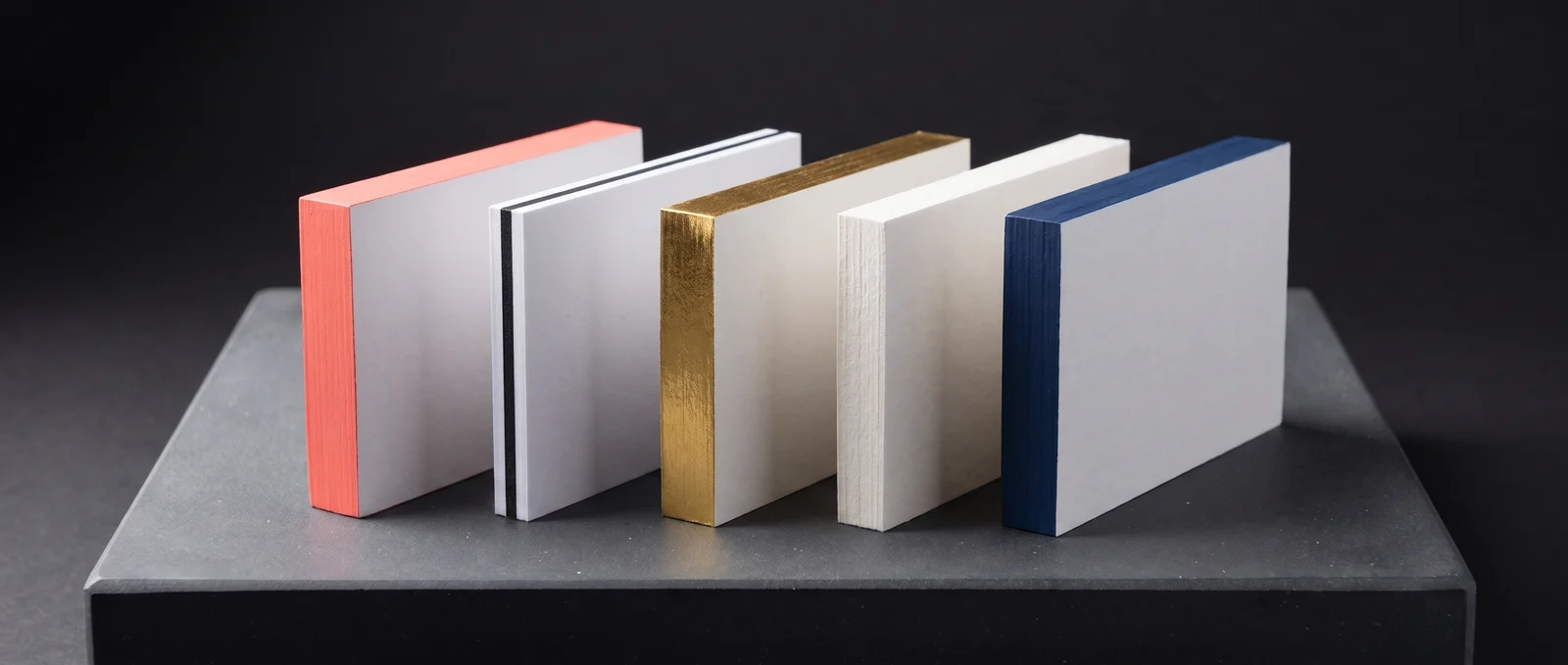
Edges and thickness, four ways to build it.
Paint adds colour, foil adds reflection, and duplex or triplex adds real plies. Choose the edge and construction together, not as interchangeable effects.
Start with the finish
See what edges and thickness does with your own brief.
Free · about two minutes
How it is made
Painted edges put a solid colour around light paper. Foiled edges catch light as metal and are the answer for dark or black stock. Duplex bonds two plies; triplex bonds three, with a real core between the faces.
Thickness ladder: a single ply keeps a fine edge; two 16pt plies make 32pt duplex; three 16pt plies make 48pt triplex. Heavier plies can reach the same caliper with fewer seams.
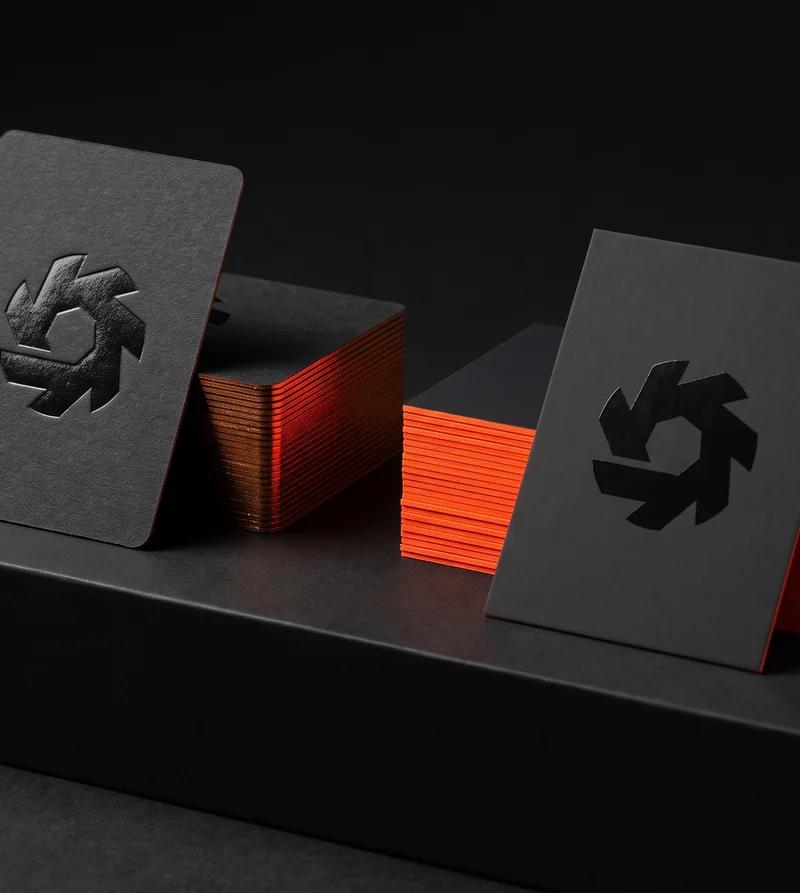
Dark or black stock edges are foil-stamped only, never painted. A coloured core is a real ply, not edge colour.
What the screen cannot show
Edge colour is a narrow physical surface, and a screen enlarges it into something it is not. The sample pack lets you judge the real line at actual thickness, including the seam on duplex stock.
Hold the finish in your hand: order the sample kit →What it runs on
| Substrate | Verdict | Why |
|---|---|---|
| Uncoated & 100% cotton | Excellent | Porous cut edge drinks the colour and holds it : cotton is the reason edge painting looks the way it does. |
| Thick board, duplex & triplex | Excellent | The thicker the board, the more edge there is to see. Below about 16pt there's barely a line. |
| Colour-through (dyed) stock | Good, tested | You can, but a dyed sheet already has a coloured edge : painting it usually fights the stock. |
| Stainless & brass | No | There is no absorbent edge : polishing is the equivalent. |
| Clear & frosted plastic | No | Paint peels off a cut plastic edge. |
Minimums and specs
- Single ply
- One sheet
- Duplex
- 16 + 16 = 32 pt
- Triplex
- 16 + 16 + 16 = 48 pt
- Dark stock edges
- Foil only
Choose the process by the outcome
- Metallic edge
- Edge foiling / gilding.
- Colour through the whole sheet
- Dyed-through stock.
- Two colours meeting at the edge
- Duplex with contrasting plies.
Pairs well with
Painted edges
Edge paint is applied after cutting while the pieces are held tightly as one stack. It can run on single-ply and text-weight paper as well as thick cards.
Foiled edges
A reflective metallic layer is applied to the trimmed perimeter of a thick piece. It reads as a flash when the stack moves, not as a painted stripe.
Duplex and triplex
Duplex bonds two printed plies into one piece. Triplex adds a third, often a contrasting core that turns the cut edge into a deliberate line.
Seen in
Common questions
- Is a coloured core the same as edge paint?
- No. A core is a real structural ply, visible at the cut. Paint coats the cut perimeter.
- How do 32pt and 48pt constructions differ?
- Two 16pt plies make 32pt duplex. Three 16pt plies make 48pt triplex; heavier faces can achieve the same caliper with fewer seams.