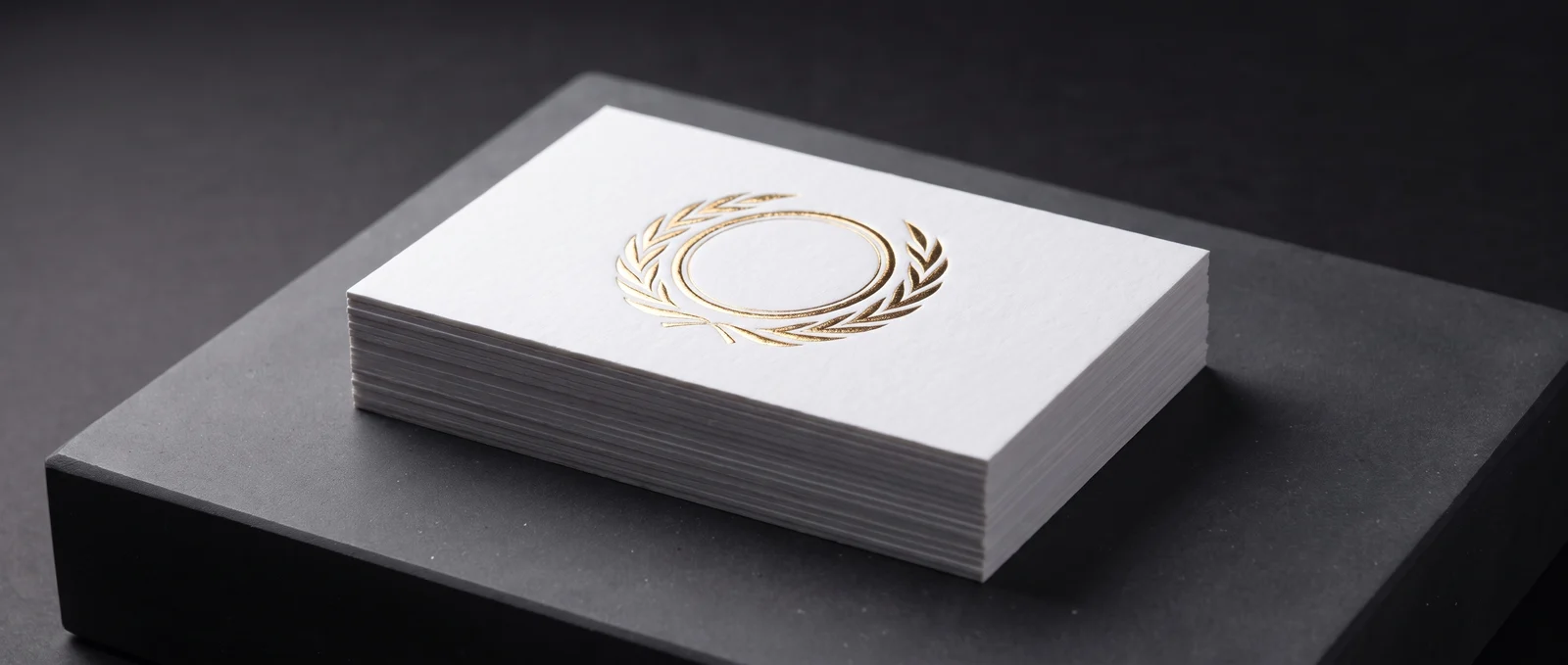
Metal, raised into relief.
Foil supplies the reflection; emboss supplies the height. The two operations register to the same artwork but solve different physical jobs.
Start with the finish
See what emboss registered to foil does with your own brief.
Free · about two minutes
How it is made
The metallic film is transferred with a heated die, then a matched male-and-female relief tool raises the foiled shape. That means two tool functions even when supplied as a combination set. Registration is judged at the shoulder of the relief, not by a digital overlay; very fine foil outlines around tall embossing are the failure case. The raised front produces a mirrored recess on the reverse unless the face is embossed before duplexing.
This is the hardest finish here because shine and relief expose different errors. We do not publish a universal numeric tolerance: artwork, relief height, stock stretch and tool construction decide what can hold, so every job receives a production proof.
What the screen cannot show
A screen physically cannot show this finish. It is a reflection, not a colour, and every image on this page is light hitting a surface at one chosen angle.
Hold the finish in your hand: order the sample kit →What it runs on
| Substrate | Verdict | Why |
|---|---|---|
| Uncoated & 100% cotton | Excellent | Soft fibre takes both the foil impression and the raised relief cleanly. |
| Colour-through (dyed) stock | Excellent | Opaque metal gives contrast while the dyed sheet carries the relief shadow. |
| Coated silk & matte stock | Good, tested | Foil releases sharply, but relief must stay shallow enough to avoid cracking the coating. |
| Thick board, duplex & triplex | Excellent | Emboss the face ply before bonding to preserve a clean reverse. |
Minimums and specs
- Tooling
- Foil die + relief pair
- Registration
- Artwork-specific proof
- Reverse face
- Mirrored recess
- Clean reverse
- Emboss before duplexing
Choose the process by the outcome
- Metal without height
- Flat hot foil.
- Height without metal
- Blind emboss.
- Recessed metal
- Foil deboss / single-die impression where artwork permits.
Pairs well with
Foil stamping
A heated die transfers a metallic film onto the stock under pressure. Not printed, not simulated: a layer of metal with an impression around it.
Blind deboss
A die presses the artwork into the sheet with no ink and no foil. The only thing you see is the depth: the surface reading differently where it's been compressed.
Duplex and triplex
Duplex bonds two printed plies into one piece. Triplex adds a third, often a contrasting core that turns the cut edge into a deliberate line.
Seen in

Common questions
- Is foil emboss one tool or two?
- It needs a foil-transfer die and matched relief tooling, even when supplied as a combination set.
- Will the emboss show on the back?
- Yes as a mirrored recess unless the embossed face is backed by a second ply after pressing.
- What registration tolerance should artwork use?
- There is no honest universal number. Relief height, stock stretch and tool construction are reviewed on the actual artwork.