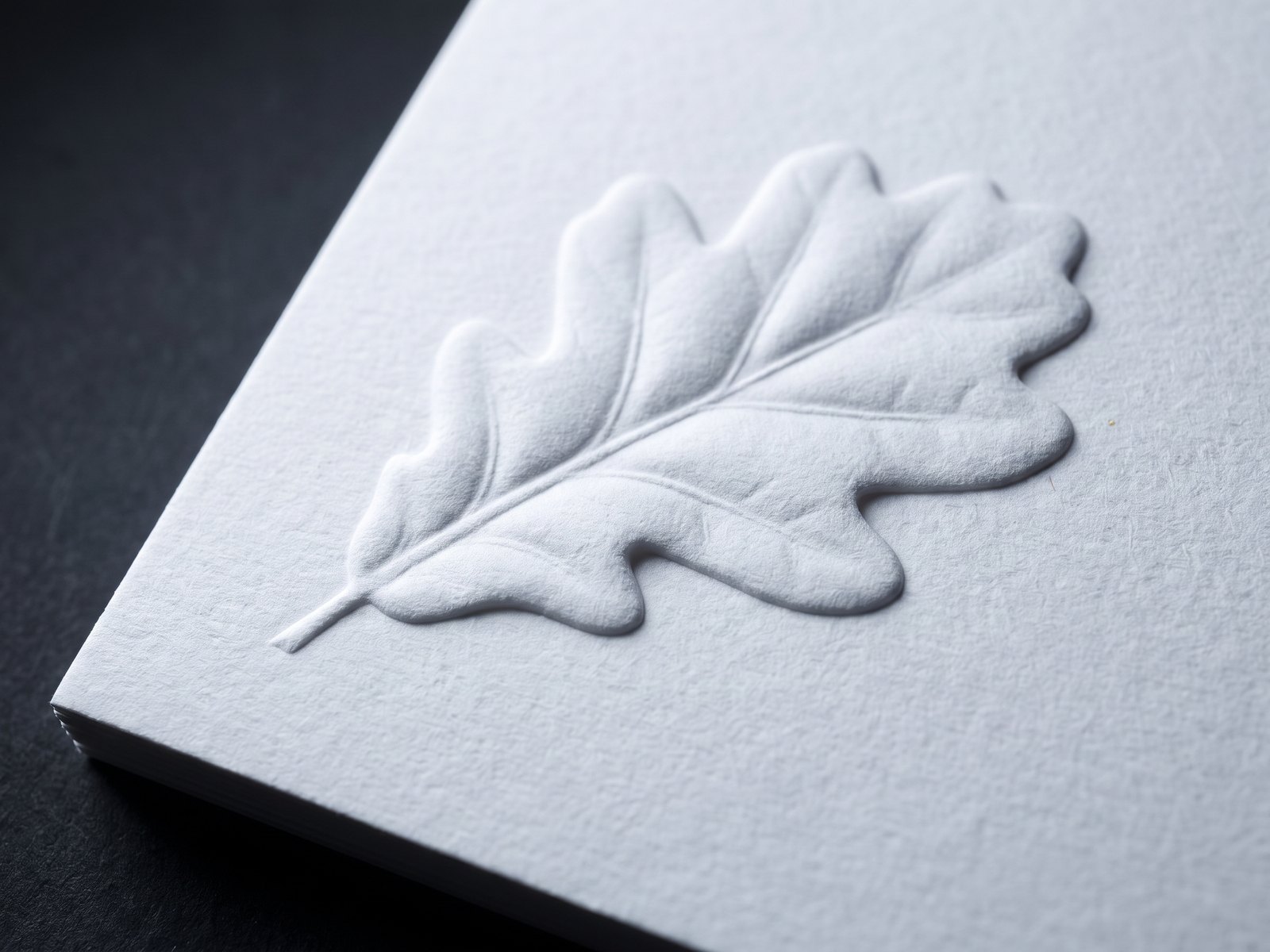
Sculpted emboss, soft relief.
Multi-level dies raise the sheet at different heights, shaping a softer relief than a single flat emboss. Thick cotton gives the form room to develop.
Start with the finish
See what sculpted emboss does with your own brief.
Free · about two minutes
How it is made
Matched multi-level dies shape several heights and rounded transitions in the sheet. Thick cotton is the best starting point because its soft fibre can carry the relief.
The emboss shows through a single ply as a mirrored recess. Emboss the face before duplexing when the back must stay clean, or use a deboss instead.
What the screen cannot show
A photograph cannot convey height, friction or edge quality. Order the sample kit to compare finishes in your hand.
Hold the finish in your hand: order the sample kit →What it runs on
| Substrate | Verdict | Why |
|---|---|---|
| Uncoated & 100% cotton | Excellent | Thick soft cotton supports multi-level relief; single ply shows the mirrored reverse. |
| Colour-through (dyed) stock | Good, tested | Stock must be thick and soft enough to stretch without splitting. |
| Thick board, duplex & triplex | Excellent | Emboss the face before bonding to hide reverse show-through. |
| Stainless & brass | No | Paper relief tooling is not a sheet-metal process. |
| Clear & frosted plastic | No | Plastic does not hold this soft paper relief. |
Minimums and specs
- Tooling
- Multi-level matched dies
- Best stock
- Thick cotton
- Single-ply reverse
- Shows through
- Clean back
- Duplex or deboss instead
Choose the process by the outcome
Pairs well with
Duplex and triplex
Duplex bonds two printed plies into one piece. Triplex adds a third, often a contrasting core that turns the cut edge into a deliberate line.
Blind deboss
A die presses the artwork into the sheet with no ink and no foil. The only thing you see is the depth: the surface reading differently where it's been compressed.
Common questions
- How is sculpted emboss different from flat emboss?
- Sculpted emboss uses multi-level dies to create different heights and softer transitions, rather than raising the whole shape to one level.
- Will sculpted emboss show on the back?
- Yes on single ply. Emboss the face before duplexing to hide the mirrored recess, or choose deboss if a recessed mark suits the design.