How to address wedding invitations, assemble the suite and mail it
By Austin Terrill, founder and creative director of Print Peppermint · Updated
How to address wedding invitations: write the outer envelope formally, with titles and full names, the street spelled out, and no initials or nicknames. Put first names, children and "and Guest" on the inner envelope, or on the outer one if you're only using one. Then assemble one complete suite, seal and all, and have it weighed at a post office counter before you buy a single stamp. Square envelopes, wax seals, ribbon and thick, stiff cards can each add the USPS non-machinable surcharge, which is 0,49 $US per envelope at USPS prices effective 12 July 2026.
I spec our suites on 32-point cotton, about as thick as a credit card and soft enough to take a deep impression. That weight is the whole point, and it's also why the post office matters more for our couples than for anyone mailing a flat card. So this guide covers the etiquette, then the physics: the order the cards go in, how thick an envelope can get before it stops being a letter, and what to say at the counter. Every postage figure here is quoted from USPS with the date I checked it. Rates change, so treat the post office's scale as the final word, not this page.
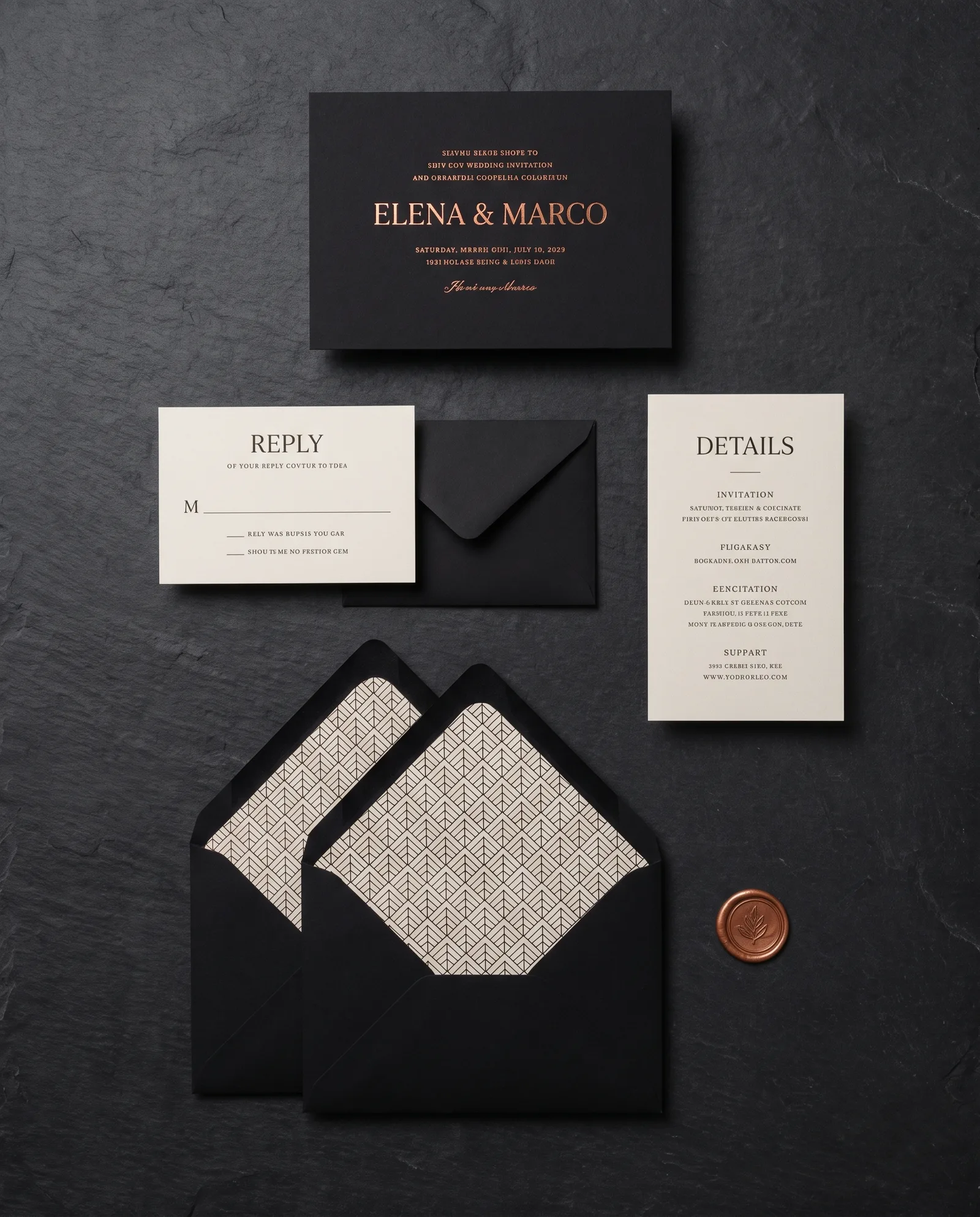
How to address wedding invitations, household by household
The outer envelope is the formal one: titles, full first and last names, middle names written out or left off (never an initial). The inner envelope, if you use one, drops first names and says exactly who is invited, which is where the children and the plus-one go. These are the forms most US stationers and planners work to. They're conventions, and a warm, modern version is always fine if it fits how you and your guests actually talk.
Mr. and Mrs. James Ortega
1408 Cedar Lane
Hudson, New York 12534
Outer envelope: formal names, full address, stamp top right.
Mr. and Mrs. Ortega
Sofia
Leo
Inner envelope: names only, unsealed, no stamp.
| Household | Outer envelope | Inner envelope | Notes |
|---|---|---|---|
| Single guest, no plus-one | Ms. Nora Diaz | Ms. Diaz, or Nora | Only the person named is invited. |
| Married couple, shared last name | Mr. and Mrs. James Ortega, or the modern Ana and James Ortega | Mr. and Mrs. Ortega, or Ana and James | Always invite both members of a married couple. |
| Married couple, different last names | Ms. Ana Rivera and Mr. James Ortega | Ms. Rivera and Mr. Ortega | List the person you know best first, or go alphabetical. |
| Unmarried couple living together | Ms. Priya Shah and Mr. Daniel Cole, on one line or two | Ms. Shah and Mr. Cole | Both names connected by "and". |
| Same-sex couple | Mr. Marcus Reed and Mr. Daniel Cole, or Ms. Leah Park and Ms. Nora Diaz | Mr. Reed and Mr. Cole, or Leah and Nora | Same rules as any couple: shared or separate surnames as they use them. |
| Family with young children | Mr. and Mrs. James Ortega | Mr. and Mrs. Ortega, then each child's first name on its own line | Children's names go on the inner envelope. With one envelope, list them on the outer one under the parents. "The Ortega Family" is common on relaxed invitations, but it leaves open who's invited; if only some children are, name them. |
| Children 18 and over living at home | Their own invitation: Ms. Sofia Ortega | Ms. Ortega, or Sofia | Adult children traditionally get their own envelope. |
| Single guest with a plus-one | Mr. Theo Grant | Mr. Grant and Guest, or the guest's name if you know it | "and Guest" belongs inside, not on the outer envelope. |
| One doctor in a couple | Dr. Ana Rivera and Mr. James Ortega | Dr. Rivera and Mr. Ortega | Spell out "Doctor" for very formal suites. |
| Two doctors | The Doctors Ortega, or Drs. Ana and James Ortega | The Doctors Ortega | "The Doctors Ortega" is the more formal of the two. |
| Judge, elected official or clergy | The Honorable Ruth Hale; The Reverend Paul Kim | Judge Hale; Reverend Kim | Use the title they use socially. |
| Military officer | Captain Owen Marsh, United States Navy | Captain Marsh | Write the rank in full. |
Forms follow common US etiquette; see the Emily Post Institute's guide to addressing wedding invitations for more cases. Checked 1 October 2026.
The rules for the outer envelope
- Abbreviate titles only. Mr., Mrs., Ms. and Dr. are fine. Write out Street, Avenue, Apartment and Boulevard.
- State names either way. Spelled out or the two-letter postal code. USPS accepts both (DMM 602.1.3), so pick one and stay consistent.
- The ZIP code is the line that gets it there. Check every one. A beautiful envelope with a wrong ZIP goes on a long detour.
- Numbers as numerals in the street address. "1408 Cedar Lane", not "Fourteen hundred eight".
- Spell-check names against something the guest wrote. A text message, an email signature, their own wedding invitation. Never your memory.
Where the return address goes
The back flap is the wedding tradition, and it's where we print yours. USPS doesn't require a return address on a stamped letter, and its rule about the front upper-left corner applies to mail with a service endorsement, which an invitation doesn't have (DMM 602.1.5–1.6). Use one anyway: it's how an undeliverable invitation finds its way back to you. Use the address where you want gifts and replies to arrive, because that's where guests will send them.
Inner and outer envelopes: do you need both?
No. The inner envelope is a tradition from when the outer one arrived grubby from the post. Today it does one useful job: it lets you name exactly who is invited, children and plus-one included, without crowding the outer envelope. It's unsealed, has no stamp and no address, just names.
My take: if your guest list has a lot of "and Guest" and families with children, an inner envelope saves awkward conversations. If it's mostly couples and single friends you know well, skip it, put the names on the outer envelope, and spend the money on a second foil colour or a liner instead. One more thing to know: an inner envelope adds a layer of paper and a little weight, and on a thick cotton suite that can be the difference between one postage rate and the next.
Our three suites are built around a single outer envelope. If you want inner envelopes, ask in the Studio and we'll price them with the rest of the suite.
Printed, handwritten or calligraphy: three ways to address the envelopes
There are three honest options, at three very different costs in money and evenings.
| Option | What it costs | What it looks like | Best for |
|---|---|---|---|
| You write them | Pens and two or three evenings for 100 envelopes | Personal, and as neat as your handwriting | Small guest lists and couples who enjoy it |
| Printed guest addressing | Included in our Signature suite; priced on request for Essential and Classic | Every envelope identical, names in flat ink, matched to your invitation's typeface | Most couples. This is what I'd do. |
| A calligrapher | About 2,50 $US to 6,00 $US per envelope, according to Minted | The envelope becomes a piece of the design | Couples who want the envelope to be the showpiece |
I recommend printed addressing for most suites, for a dull reason: consistency. The hundredth envelope looks like the first, the typeface matches the invitation, and the names are proofed before anything prints. If the envelope is the moment you care most about, hire a calligrapher and order 15 to 20 percent extra envelopes for practice and mistakes.
Two things that change the plan
- Names in foil cost per name. Foil is stamped with a metal die, and every different name needs its own small die. That's why we print guest names in flat ink and quote personalised foil on its own.
- Dark envelopes need a different answer. Light ink on a black envelope sinks into the paper and looks chalky; on dark stock we use foil for light colours, and per-name foil brings you back to the point above. If you love a black outer envelope, tell us early and we'll work out the addressing with you before the proof. A dark ink on a light envelope is the easiest to read, for your guests and for the sorting machines.
Envelopes can only be printed or pressed in certain areas, and not right to the edge, so we place your return address and guest addresses on your envelope template before the proof.
Getting your guest list ready for printed addressing
Send it as a spreadsheet, one row per household, with these columns: outer envelope names exactly as they should print; inner envelope names (if used); street address; apartment or unit; city; state; ZIP code; country. Fill the names column the way you want it to read, titles and all. We set what you give us, so the spreadsheet is where the etiquette decisions get made.
How to assemble wedding invitations, card by card
Stack the cards largest at the bottom, smallest on top, every printed side facing up, so the guest sees the words the moment the flap lifts. Then wrap, seal and check. Here's the order I use (it follows the classic Emily Post sequence):
- 01
Liner first. If your liners come separate, glue each one into its envelope before you stuff anything. The liner sits under the flap and should stop a few millimetres short of the gum line so the flap still seals.
- 02
Invitation at the bottom, face up. If you use a vellum or tissue overlay, it sits directly on the invitation.
- 03
Details card on top of it, face up. If you have more than one enclosure, go in size order, smallest on top.
- 04
Reply set on top. Stamp and address the reply envelope first, then tuck the reply card face up under its flap, or sit it on top of the envelope.
- 05
Wrap it. A belly band or vellum wrap goes around the whole stack. Ribbon and twine look lovely and add bulk; see the postage section before you commit.
- 06
Into the envelope. Slide the stack in so the printed side faces the back flap. With an inner envelope, the stack goes in the inner one (unsealed), and the inner envelope goes into the outer one with the guests' names facing the flap.
- 07
Seal and check. Match the inner names to the outer envelope one last time, then seal.
Before you stuff a hundred, lightly pencil a number on the back of each reply card and note it against your guest list. Someone always sends one back without writing their name.
Wedding invitation postage: what it costs right now
A finished suite almost never mails on one plain stamp. Weight adds an ounce or two, and the shape or contents can add the non-machinable surcharge on top. Here are the USPS retail prices that matter, so you can do the sum before the post office does.
| What you're mailing | Price per piece |
|---|---|
| Letter up to 1 oz (one Forever stamp) | 0,82 $US |
| Letter up to 2 oz | 1,11 $US |
| Letter up to 3 oz | 1,40 $US |
| Letter up to 3.5 oz (the letter maximum) | 1,69 $US |
| Non-machinable surcharge, added to any of the above | +0,49 $US |
| Square or unusually shaped envelope under 1 oz (0,82 $US + 0,49 $US) | 1,31 $US |
| Postcard (thin card stock only; see below) | 0,65 $US |
| Large envelope (flat), from | 1,69 $US |
| International letter up to 1 oz, any country | 1,75 $US |
Prices from USPS Notice 123 (effective 12 July 2026) and USPS First-Class Mail, checked 1 October 2026. USPS changes prices periodically; check current USPS prices or the post office scale before you buy stamps.
A worked example
Say your finished suite weighs between 1 and 2 ounces and the counter clerk calls it non-machinable because it's stiff. That's 1,11 $US plus 0,49 $US, so 1,60 $US on the outer envelope, plus 0,82 $US on the reply envelope: 2,42 $US per household. For 100 households, budget about 242 $US for postage before anything goes to guests abroad. If the same suite is flexible and rectangular, it's 1,11 $US plus 0,82 $US, or 193 $US for 100. The difference is the surcharge, and it's worth knowing which side of it you're on.
Stamp the reply envelope
Yes, the reply envelope needs a stamp, and you buy it. A guest who has to find a stamp is a guest who replies late. One Forever stamp (0,82 $US) covers a standard reply envelope with a single card. Guests abroad can't use a US stamp, so give them an online way to reply (see mailing abroad).
Save the date postcards on thick stock
The postcard price only applies to cards up to 4¼ × 6 inches and no thicker than 0.016 inch (DMM 101.6.2). Our 32-point cotton is about 0.032 inch, twice that. So a pressed save the date mailed as a postcard pays at least the letter price, and a foil card sent bare through the sorting machines can come out scuffed. Send it in an envelope.
The non-machinable surcharge, and what triggers it on a wedding suite
The surcharge exists because some envelopes can't run through USPS's sorting machines and have to be handled by people. USPS lists the triggers in its Domestic Mail Manual, section 101.1.2. Here's what each one means on a wedding suite:
| USPS trigger | What it looks like on a wedding suite |
|---|---|
| Aspect ratio (length ÷ height) under 1.3 or over 2.5 | Square envelopes always. A standard A7 invitation envelope (7¼ × 5¼ in) is 1.38 and passes. An A2 reply envelope (5¾ × 4⅜ in) is 1.31, so it passes, but only just. Sizes for every envelope are in our envelope size guide. |
| Too rigid: won't bend around an 11-inch turn under belt tension | Thick cotton stacks, duplex invitations, acrylic, wood or metal pieces. |
| Uneven thickness (items that make it lumpy) | Wax seals, brooches, ribbon bows, dried flowers, a charm on the belly band. |
| Clasps, strings, buttons or similar closures | Twine or ribbon tied around the outside of the envelope, button-and-string envelopes. |
| An exterior that isn't paper, or any plastic wrap | Acrylic or plastic outer envelopes, and clear plastic sleeves. Translucent vellum is paper, so a vellum wrap or envelope doesn't trip this one. |
| Delivery address running parallel to the short side | Vertical calligraphy layouts that turn the address sideways. |
USPS's own page puts it plainly: square, vertical, lumpy and rigid envelopes "must be hand-canceled" and pay the surcharge "even if they weigh less than 1 oz" (usps.com, checked 1 October 2026).
The thick-paper landmine
Most etiquette guides skip this one, and it's the one that matters for pressed suites. A letter can be no thicker than ¼ inch, about 6.4 mm (DMM 101.1.1). A single 32-point cotton card is about 0.8 mm. Seven or eight of them in one envelope reach the limit before you count the envelope paper or a seal. Past ¼ inch, the suite is priced as a large envelope (from 1,69 $US), and a large envelope that is rigid or lumpy pays package prices. A suite of an invitation, details card and reply set sits well under the limit. A suite with a duplex invitation, three enclosures, an inner envelope and a wax seal may not. Thickness is also what makes a suite stiff, so a heavy cotton suite under ¼ inch can still be called rigid. That's a judgement made at the counter, so take a finished one in and ask.
Acrylic, wood and metal invitations
They're rigid by nature. In a letter-size envelope they pay the non-machinable rate at best. Larger than a letter, a rigid piece pays package prices. Price one at the counter before you plan to mail a hundred, or keep the acrylic or metal piece for something guests receive in person, like place cards or a welcome gift.
Wax seals: beautiful, and the most common reason a suite costs more to mail
Real wax is lovely, and it's lumpy by definition, so plan on the surcharge and hand-cancelling for every envelope that carries one, inside or out. It can also crack in transit. For anything mailed, my recommendation is a stamped foil seal: it's flat, it reads like wax across a room, and on its own a flat paper seal isn't one of the triggers on USPS's list. The rest of the envelope still has to pass: shape, stiffness and thickness. Our custom foil seals start at 195 $US for 250. Keep real wax for things that never see a sorting machine: hand-delivered menus, a seal on the place-card box, a short VIP list.
Weighing, stamps and hand-cancelling: your mailing day
Do it in this order and you'll only stand in line twice.
- Assemble one complete suite. Every card, the liner, the wrap, the seal, an inner envelope if you're using one. If guests abroad get an extra map or card, assemble one of those too.
- Take it to the counter, not the self-service kiosk. Ask the clerk to weigh and measure it and tell you whether it's machinable. Ask for the price for that weight, with or without the surcharge.
- Mail one to yourself. Same day, same stamps. When it comes back, you'll see how it travelled and how the postmark looks.
- Buy the stamps. Outer envelopes at the rate you were quoted, plus a Forever stamp for every reply envelope.
- Stamp the top right corner. Press stamps down firmly; thick cotton has a soft surface.
- Bring the batch back to the counter and ask for hand-cancelling. Non-machinable envelopes have to be hand-cancelled anyway (usps.com), and most counters will hand-cancel the rest on request. The request itself isn't a priced USPS service; what you pay is the postage, plus the surcharge if the envelope triggers it. If you're bringing 150 envelopes, call the branch first and ask when it's quiet.
Wedding invitation stamps
Any combination of stamps that adds up to the right amount works. USPS sells a non-machinable stamp for square and unusual envelopes (1,31 $US) and two-ounce stamps; branches don't always stock the designs you want, so buy online or a few weeks early. If you want vintage stamps to match your palette, that's fine too: unused older US stamps are still valid at their face value, so add them up to the current rate.
Mailing invitations to guests abroad
An international letter starts at 1,75 $US for up to an ounce, to any country, and the same 0,49 $US non-machinable surcharge applies to letters that trigger it (USPS Notice 123, checked 1 October 2026). Heavier suites cost more and the price depends on the country, so weigh one at the counter. One Global Forever stamp covers the 1-ounce price.
Three things I'd do:
- Mail them about two weeks before everyone else's. International post is slower and less predictable.
- Let them reply online. A US stamp on the reply envelope won't work from abroad. Put your wedding website or a QR code to the RSVP page on the details card. QR codes always print in flat dark ink, never in foil or embossing, so every phone can read them.
- Write the country in capitals as the last line of the address. Use the local address format for the rest. Your guest can tell you exactly how it should read.
Or let us print the addresses
Our Signature suite includes printed guest addressing, envelope liners and a seal, on top of the invitation, reply set and details card. Send the spreadsheet, we set every envelope in your invitation's typeface, and you check the names on the proof before anything prints. For 100 guests it's 4 190 $US. Production takes about three weeks after you approve the proof, then shipping. That's an estimate, not a promise, so work back from your mail date and leave yourself a week or two to stamp and post. You still do the stamps and the trip to the post office, and now you know exactly what to ask for.
Addressing and mailing questions
How do you address a wedding invitation to a married couple?
On the outer envelope, write both names with titles: "Mr. and Mrs. James Ortega", or the modern "Ana and James Ortega". If they use different last names, write "Ms. Ana Rivera and Mr. James Ortega". On the inner envelope, use titles and last names only, such as "Mr. and Mrs. Ortega", or first names for close family. Always invite both members of a married couple.
How do you address a wedding invitation to a family with children?
Address the outer envelope to the parents, for example "Mr. and Mrs. James Ortega". On the inner envelope, write "Mr. and Mrs. Ortega", then each invited child's first name on its own line. If you're not using inner envelopes, list the children on the outer envelope below their parents. Children aged 18 or over traditionally get their own invitation, even if they live at home.
How do you address an invitation when a guest can bring a plus-one?
Address the outer envelope to your guest alone, for example "Mr. Theo Grant". Write "Mr. Grant and Guest" on the inner envelope, or the guest's name if you know it. With a single envelope, either name both people if you know who's coming, or include a short handwritten note inviting your guest to bring someone. Writing "and Guest" on the outer envelope is considered impersonal.
Do wedding invitations need inner and outer envelopes?
No. Inner envelopes are a tradition, not a requirement. They're useful when you need to say exactly who is invited, such as children or a plus-one, without crowding the outer envelope. The inner envelope is unsealed, has no stamp and carries names only. It also adds paper and weight, which can push a thick suite into a higher postage rate.
Where does the return address go on a wedding invitation?
On the back flap, by tradition, and that's where we print it. USPS doesn't require a return address on a stamped letter, and its rule about the front upper-left corner applies only to mail with a service endorsement. Include one anyway so undeliverable invitations come back to you, and use the address where you want replies and gifts sent.
Can you use abbreviations when addressing wedding invitations?
Only for titles. Mr., Mrs., Ms. and Dr. are fine; write out Street, Avenue, Apartment and Boulevard, and use full middle names or none, never initials. State names can be spelled out or written as the two-letter postal code, since USPS accepts both. Write house numbers as numerals and double-check every ZIP code.
How much postage do I need for a wedding invitation?
It depends on weight and shape, so weigh one finished suite at the post office first. At USPS prices effective 12 July 2026, a letter costs 0,82 $US up to 1 ounce, 1,11 $US up to 2 ounces and 1,40 $US up to 3 ounces, plus 0,49 $US if the envelope is non-machinable. Add a 0,82 $US Forever stamp for each reply envelope. Prices change, so check usps.com before you buy.
Do square wedding invitations need extra postage?
Yes. USPS treats square envelopes as non-machinable, because a letter's length divided by its height has to be between 1.3 and 2.5. A square envelope pays the 0,49 $US surcharge even under 1 ounce, so the minimum is 1,31 $US at USPS prices effective 12 July 2026. A standard rectangular A7 invitation envelope (7¼ × 5¼ inches) passes the test.
Do wax seals need extra postage?
Usually, yes. A real wax seal makes the envelope lumpy, which is one of the USPS triggers for the non-machinable surcharge (0,49 $US per envelope at USPS prices effective 12 July 2026), and it means hand-cancelling. Wax can also crack in the post. A flat stamped foil seal isn't on USPS's trigger list on its own, so for mailed invitations we recommend foil and keep real wax for pieces delivered by hand.
What does hand-cancelling mean, and does it cost extra?
Hand-cancelling means a postal clerk applies the postmark by hand at the counter instead of the envelope going through the cancelling machine. Envelopes that are non-machinable (square, rigid, lumpy) must be hand-cancelled anyway, and those pay the non-machinable surcharge whether or not you ask. For the rest, most post office counters will hand-cancel on request; the request itself isn't a priced USPS service, so ask at a quiet time if you're bringing a big batch.
Do I need to put a stamp on the RSVP envelope?
Yes. Stamp and address every reply envelope before you assemble the suites, so guests only have to fill in the card and drop it in a mailbox. One Forever stamp, 0,82 $US at USPS prices effective 12 July 2026, covers a standard reply envelope with one card. Guests abroad can't use US stamps, so give them an online way to reply.
How do you mail wedding invitations to guests in another country?
Use international postage: a letter starts at 1,75 $US for up to 1 ounce to any country, at USPS prices effective 12 July 2026, and heavier or non-machinable suites cost more. Weigh one at the counter. Mail international invitations about two weeks before the rest, write the country in capitals on the last line, and let those guests reply online, because a US stamp won't work from abroad.
What order do the cards go in a wedding invitation envelope?
Largest at the bottom, smallest on top, all printed sides facing up: the invitation first, any vellum or tissue on top of it, then the details card, then the reply card with its stamped envelope. Wrap the stack with a belly band or vellum if you're using one, then slide it in so the printed side faces the back flap and guests see the words as they open it.
Can thick or letterpress invitations cost more to mail?
They can. A letter can't be thicker than ¼ inch, and a 32-point cotton card is about 0.8 mm, so seven or eight cards reach the limit. Past that, USPS charges large-envelope prices, and rigid large envelopes pay package prices. A stiff cotton suite under ¼ inch can still be judged rigid and pay the 0,49 $US surcharge. Have one finished suite weighed and measured at the counter.
Can you write "and Family" on a wedding invitation?
You can, and "The Ortega Family" is common on relaxed invitations, but it leaves open exactly who is invited. If every child is welcome, it works. If only some are, or none, name the invited people instead: the parents on the outer envelope, and each invited child's first name on the inner envelope or under the parents' names. Children 18 or over usually get their own invitation.
Start with the names, and we'll handle the press
Tell the Studio your names, your date and roughly how many households you're inviting. Gus, our design assistant, sketches three directions in minutes, a person checks every finish, and you see the price before anything is printed. If you're weighing a square envelope or a wax seal, ask us. We'll tell you what it does to postage before you fall for it.