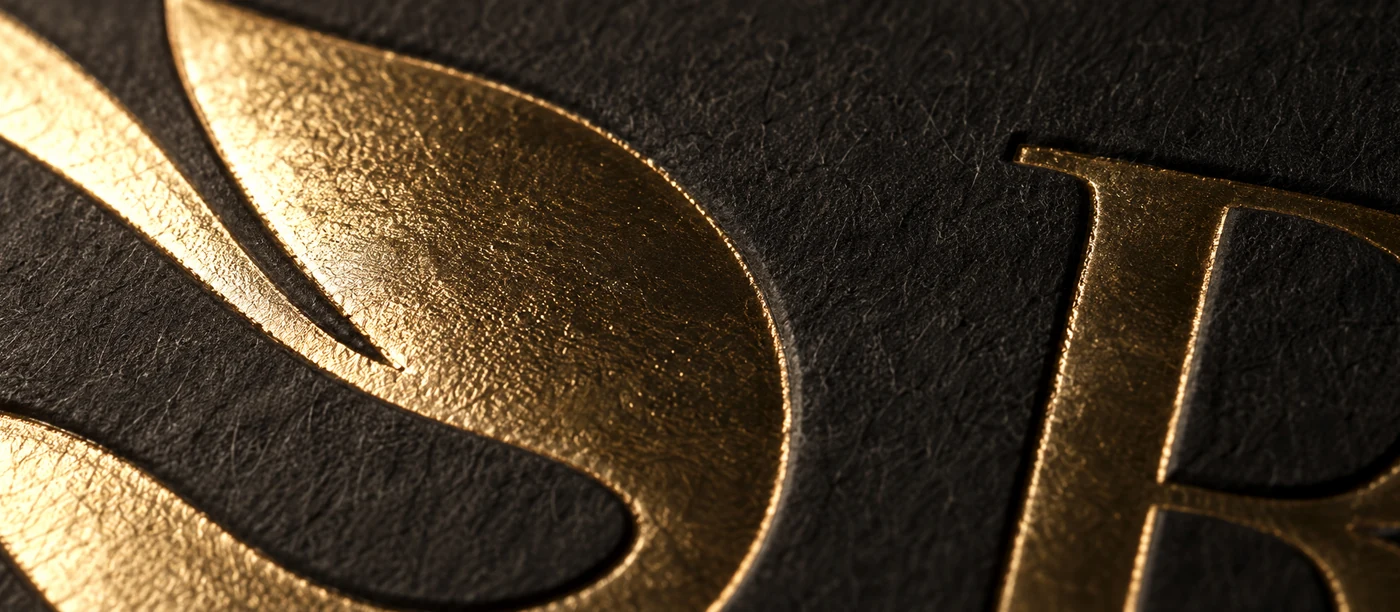
Real metal, pressed into the sheet.
A heated die transfers a metallic film onto the stock under pressure. Not printed, not simulated — a layer of metal with an impression around it.
Start with the finish
See what foil stamping does with your own brief.
Free · about two minutes
What it's like to run
Each colour is a separate pass with its own die and its own makeready. Two foils on one card is two set-ups and a registration tolerance of about a quarter millimetre between them — which is why designs that let the colours sit apart cost less to run beautifully than ones that interlock. Setup dominates at low volume: at 100 cards you're mostly paying for the die; at 1,000 the per-card cost falls off a cliff.
Foil is a reflection, not a colour. Matte gold and mirror gold look nearly identical on a screen and nothing alike in the hand.
What the screen cannot show
A screen physically cannot show this finish. It is a reflection, not a colour, and every image on this page is light hitting a surface at one chosen angle.
Hold the finish in your hand — request a sample pack →What it runs on
| Substrate | Verdict | Why |
|---|---|---|
| Uncoated & 100% cotton | Excellent | Soft sheet takes the die cleanly; the impression is part of the effect. |
| Colour-through (dyed) stock | Excellent | Metal on saturated ground is the highest-contrast thing we print. |
| Soft-touch laminated stock | Good, tested | Adhesion varies by film — we proof it. |
| Stainless & brass | Excellent | Metal-rated foil transfers cleanly with the correct heat and dwell settings. |
| Recycled, kraft & inclusion stock | Good, tested | Grips well, but husk and fibre inclusions break up fine lines. Keep the mark bold and expect a slightly broken edge as part of the look. |
Minimums and specs
- Minimum line / gap
- 0.6 mm (1.7 pt)
- Every foil series
- Minimum type
- 7 pt
- 8 pt recommended · 10 pt reversed · 12 pt high-contrast serif
- Foil-to-foil registration
- ±0.25 mm
- Tooling
- 1 die / colour / side
Design note. Gradients, photographs and halftones don't foil — it's a solid film, so artwork wants solid shapes and line work.
Choose the process by the outcome
- Metal on uncoated
- Hot foil — metallic ink goes grey on absorbent stock.
- All-over metal
- Metallic stock, cheaper than flooding a card with foil.
- Gloss on cotton
- Spot UV, or clear foil for a pressed satin shine.
Price context
Setup dominates at low volume because every colour needs its own die and makeready. Once the press is running, quantity becomes progressively better value; the estimator prices the actual stock, coverage and pass count rather than pretending there is one foil price.
Get this finish costed →Pairs well with
Blind deboss
A die presses the artwork into the sheet with no ink and no foil. The only thing you see is the depth — the surface reading differently where it's been compressed.
Edge painting
Paint applied to the cut edges of a tightly clamped stack after trimming, so every piece can carry a line of colour around its perimeter.
Letterpress
A polymer or metal plate is inked and pressed into a soft sheet, leaving colour sitting in a visible impression rather than on top of a flat surface.
Common questions
- Is foil a printed metallic colour?
- No. It is a metallic film transferred by a heated die, so it stays opaque and reflective on dark or absorbent stock.
- Why does a second foil colour cost more?
- It needs a second die, a second makeready and a second registered pass through the press.
- Can a photograph or gradient be foiled?
- No. Foil artwork is solid vector shape and line work; continuous tone belongs to a printing process.
- How close can two foil passes register?
- Plan around approximately ±0.25mm. Designs with air between colours run more consistently than interlocking shapes.