Design exploration · What if…? series
More Rooms Furniture Outlet
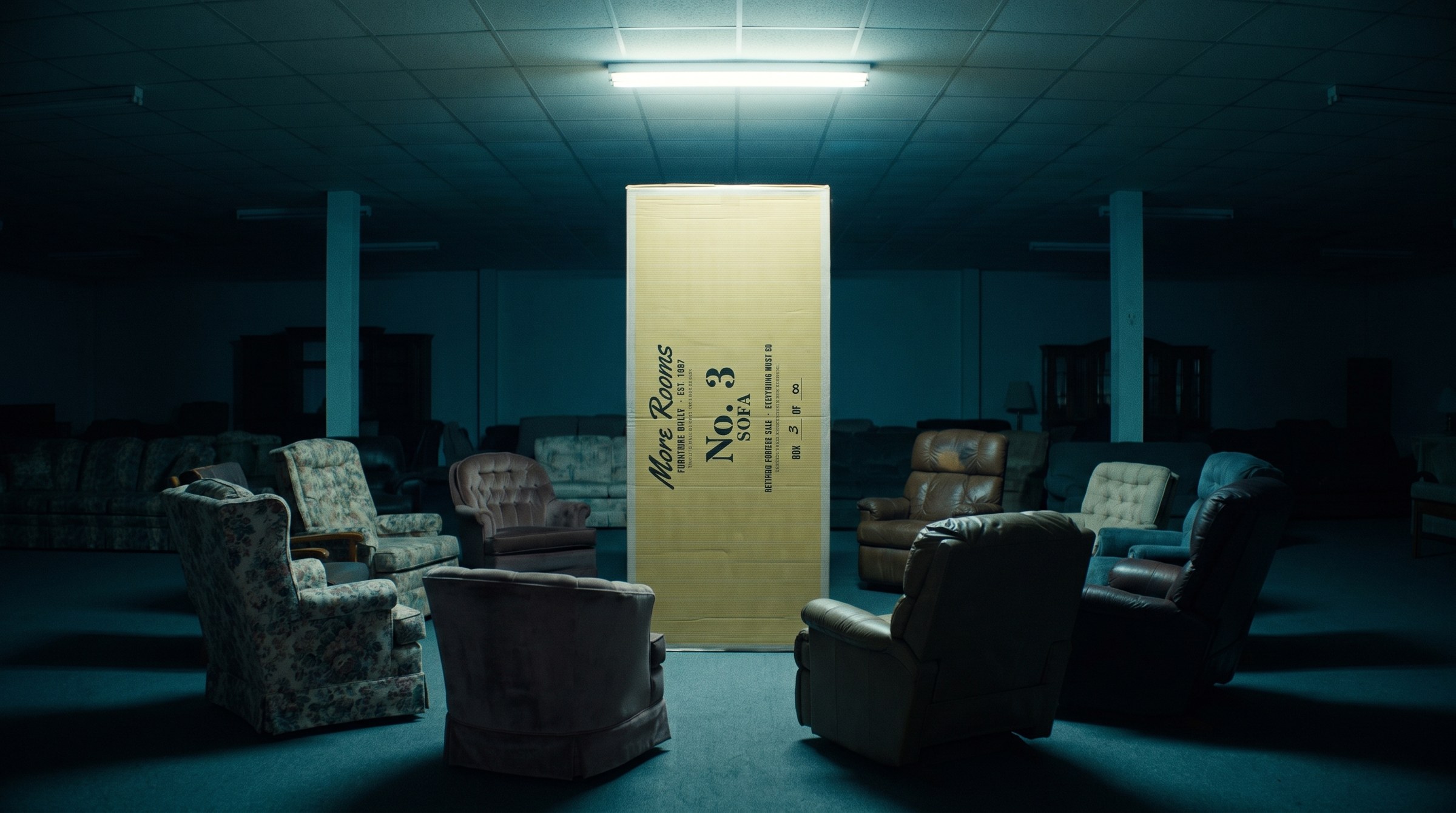
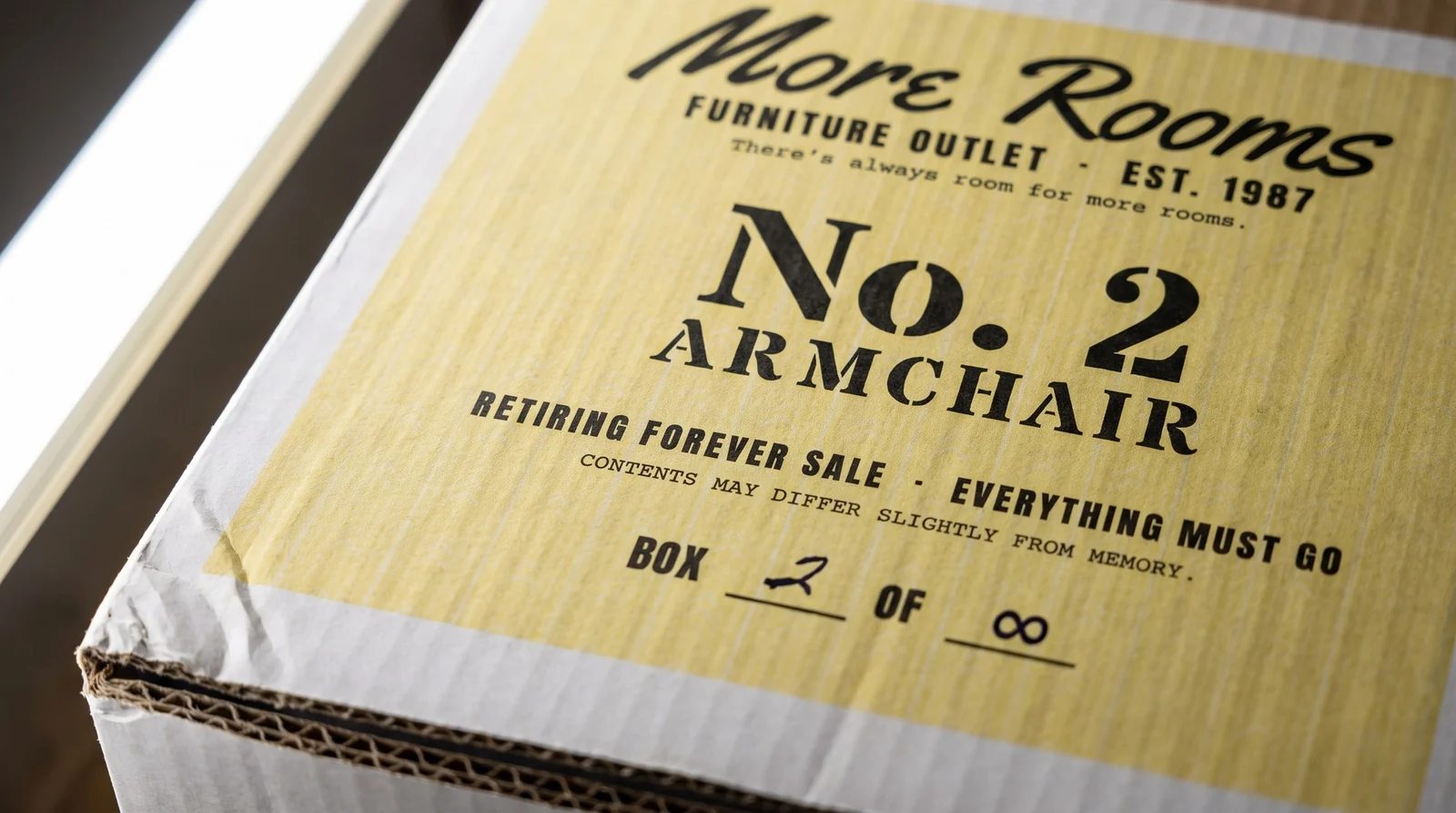
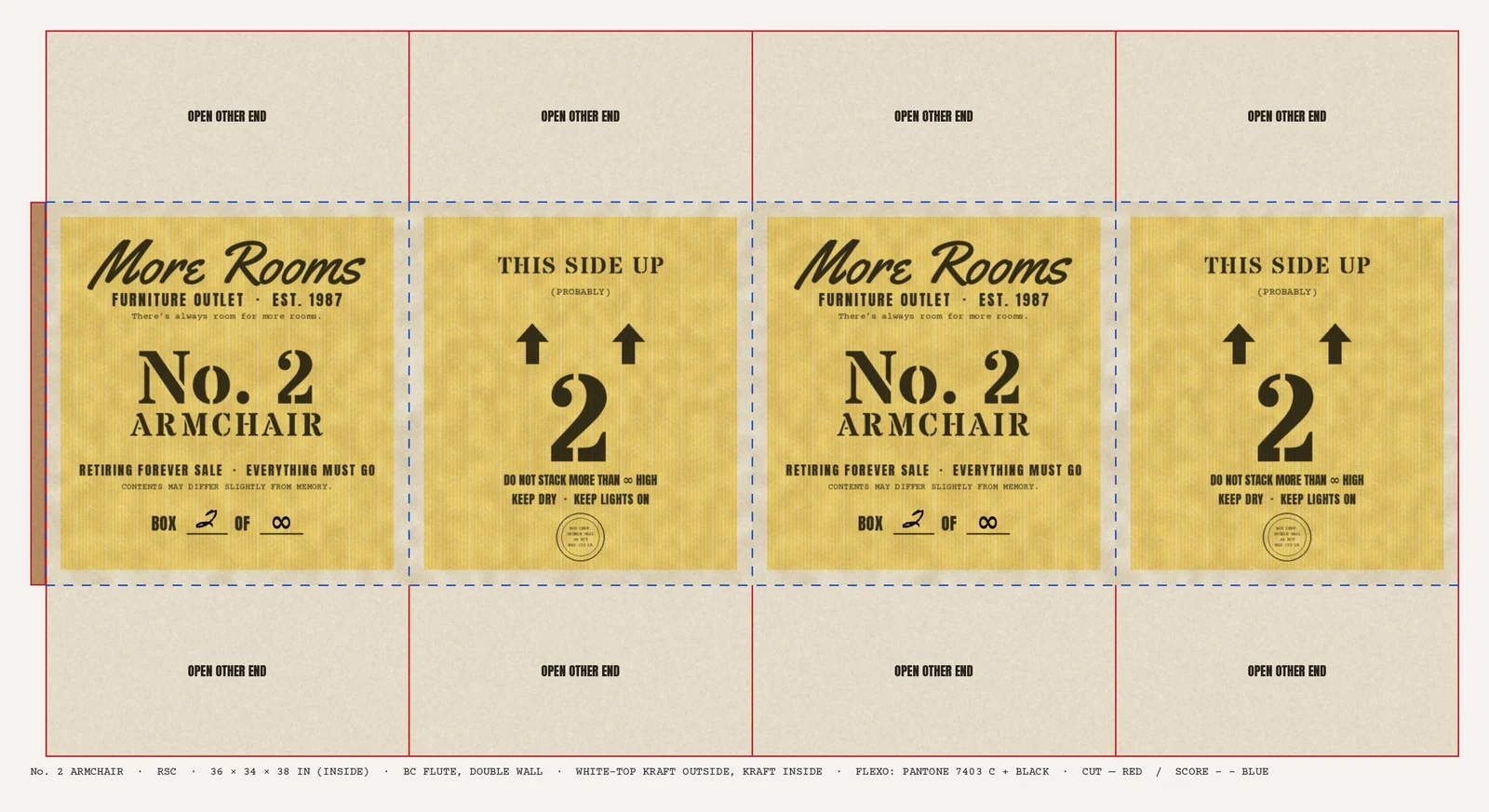
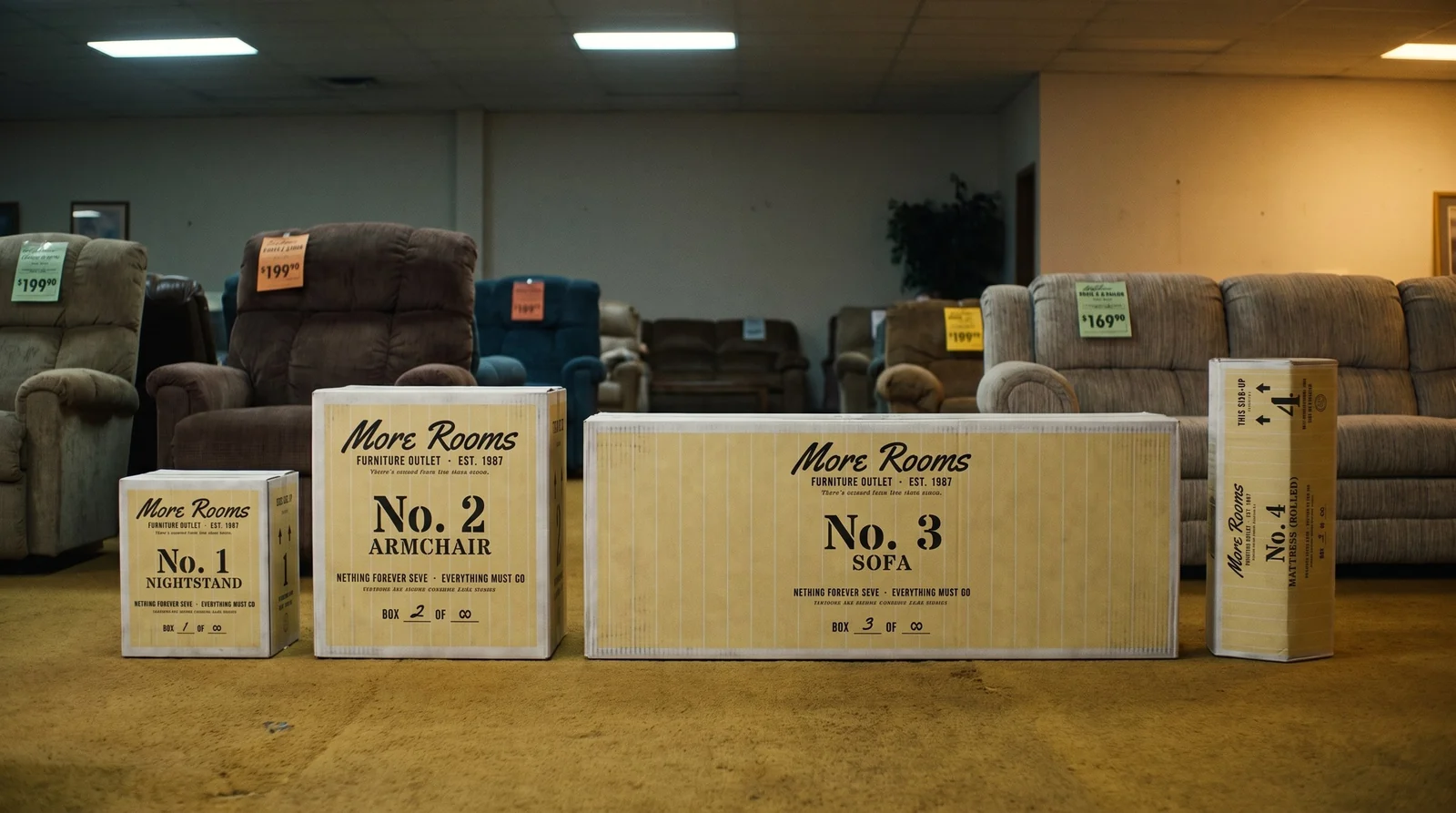
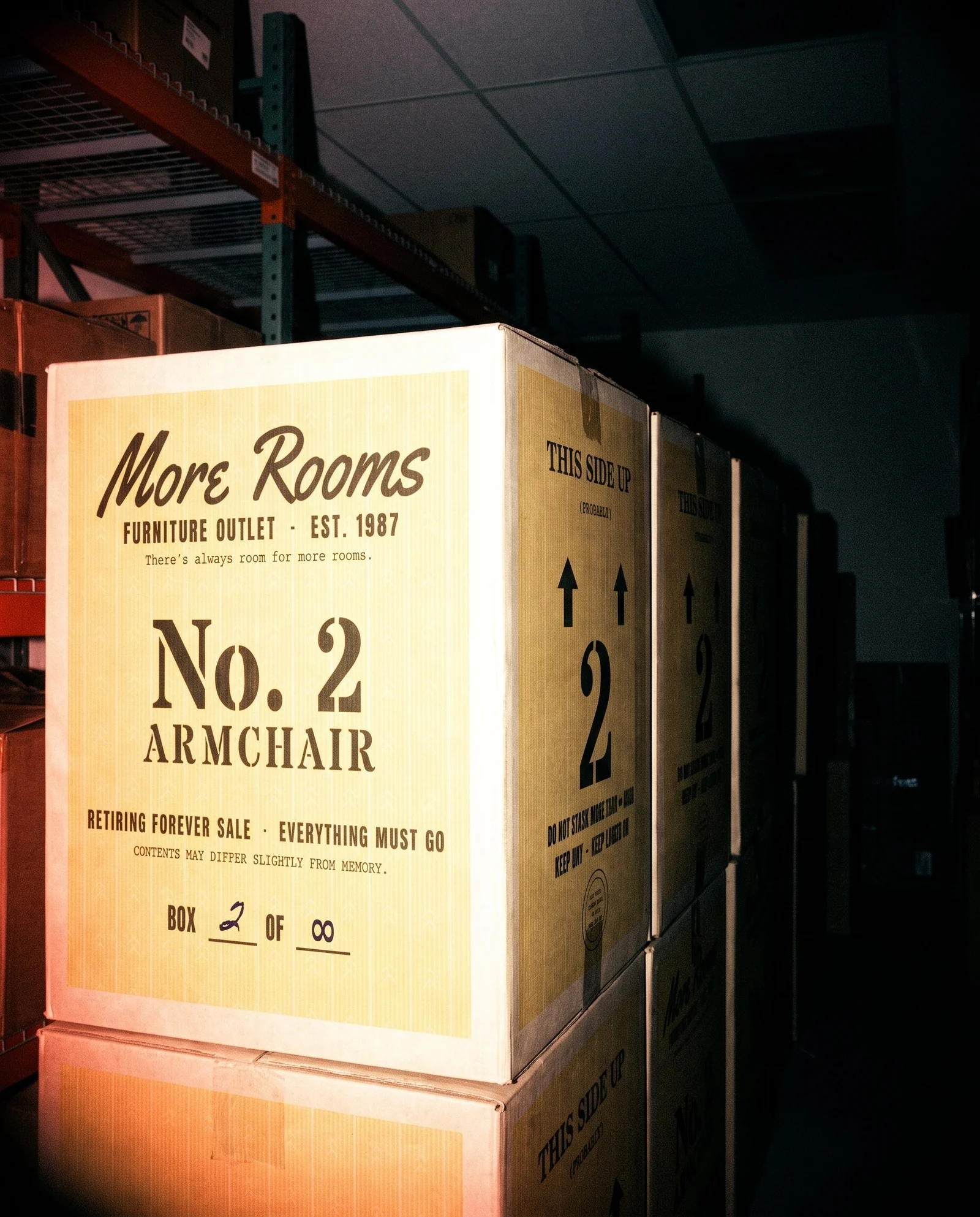
A design exploration: shipping boxes for a furniture store that might exist in the Backrooms. Four corrugated boxes, from a nightstand box to a 7-foot sofa box. Each is printed in two-colour water-based flexo on white-top corrugated board: a pale wallpaper yellow (PANTONE 7403 C) with faint knocked-out pinstripes, plus black. The inside of every box is printed too, so opening one feels like looking into a small empty yellow room.
The idea
A furniture store that never quite closes, and boxes that are slightly bigger on the inside.
Six rules
- 01A store that never closes. More Rooms Furniture Outlet, est. 1987, on day 4,018 of its Retiring Forever Sale. Slogan: "There's always room for more rooms." Every line…
- 02Wallpaper yellow, on purpose. A white-top liner outside, so a pale PANTONE 7403 C stays pale. The wallpaper pattern is knocked out of the flood rather than printed, so b…
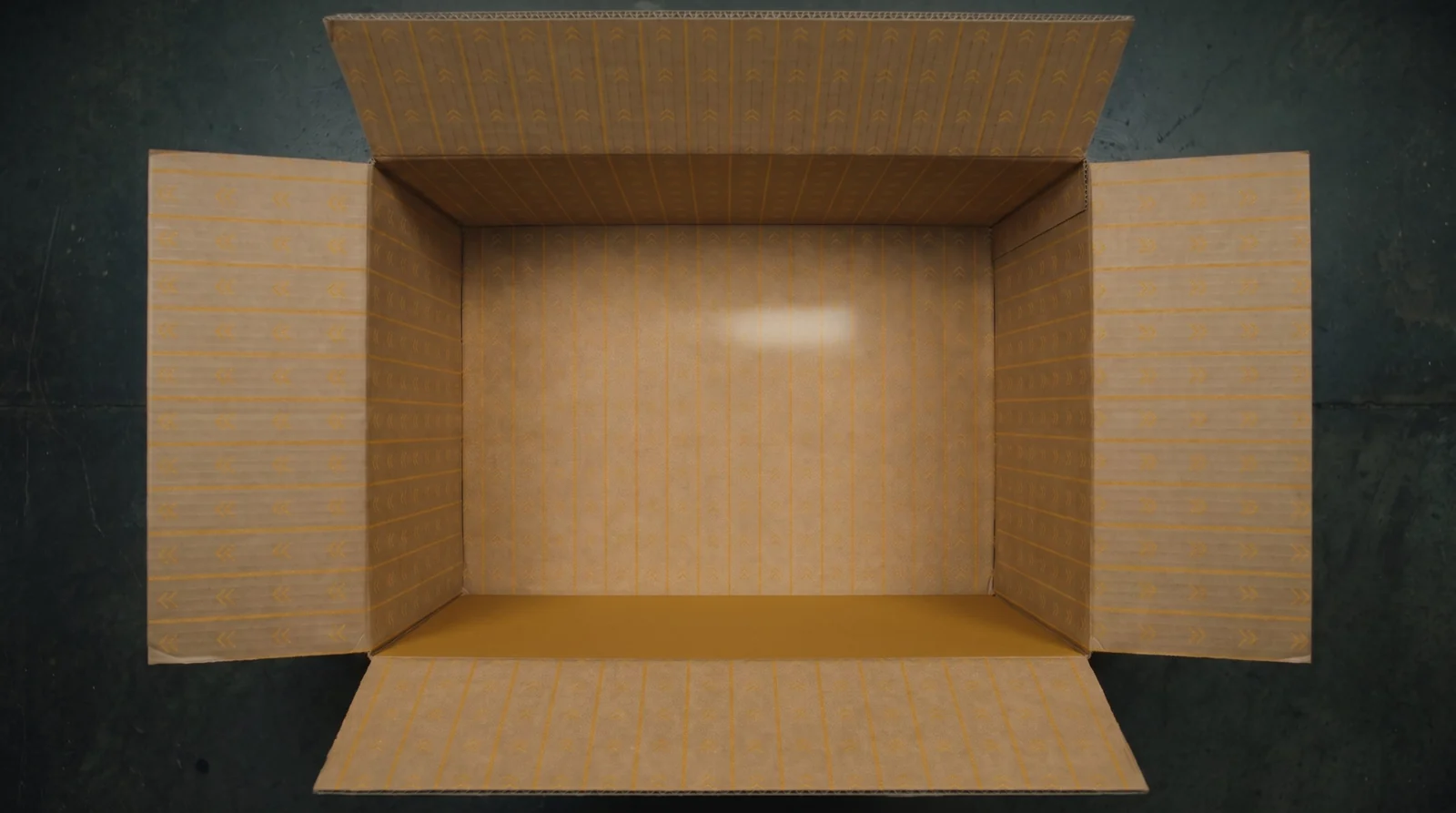
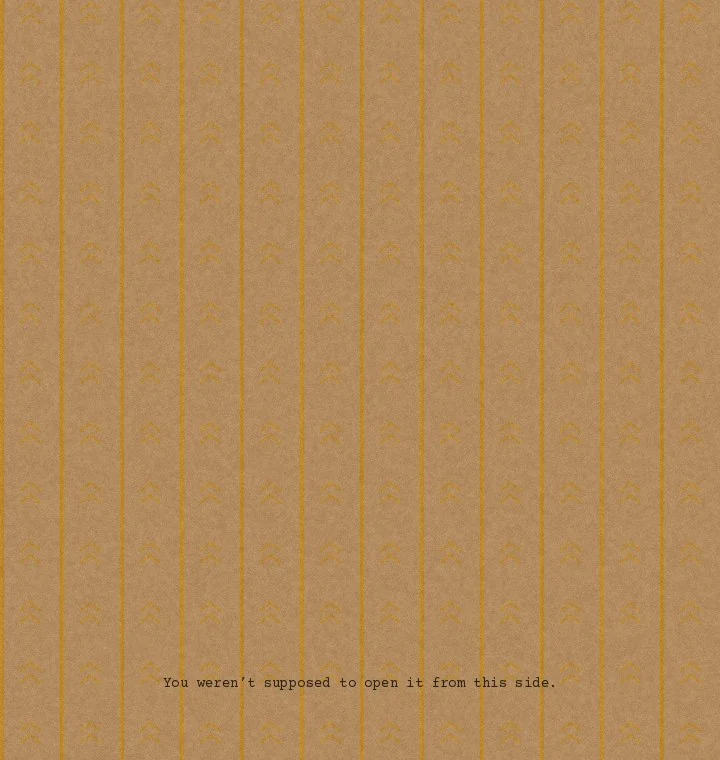
- 03Bigger on the inside. The kraft inside of every box carries the same yellow pattern, so looking in feels like looking down into a small empty room. Under the fla…
- 04Four boxes for everything that must go. Single-wall C flute for the nightstand. Double-wall BC for the armchair and the rolled mattress. For the sofa, a full-overlap box (FOL): it…
- 05Copy that's slightly wrong. "THIS SIDE UP (PROBABLY)". "DO NOT STACK MORE THAN ∞ HIGH". "KEEP DRY · KEEP LIGHTS ON". "CONTENTS MAY DIFFER SLIGHTLY FROM MEMORY". A "BOX…
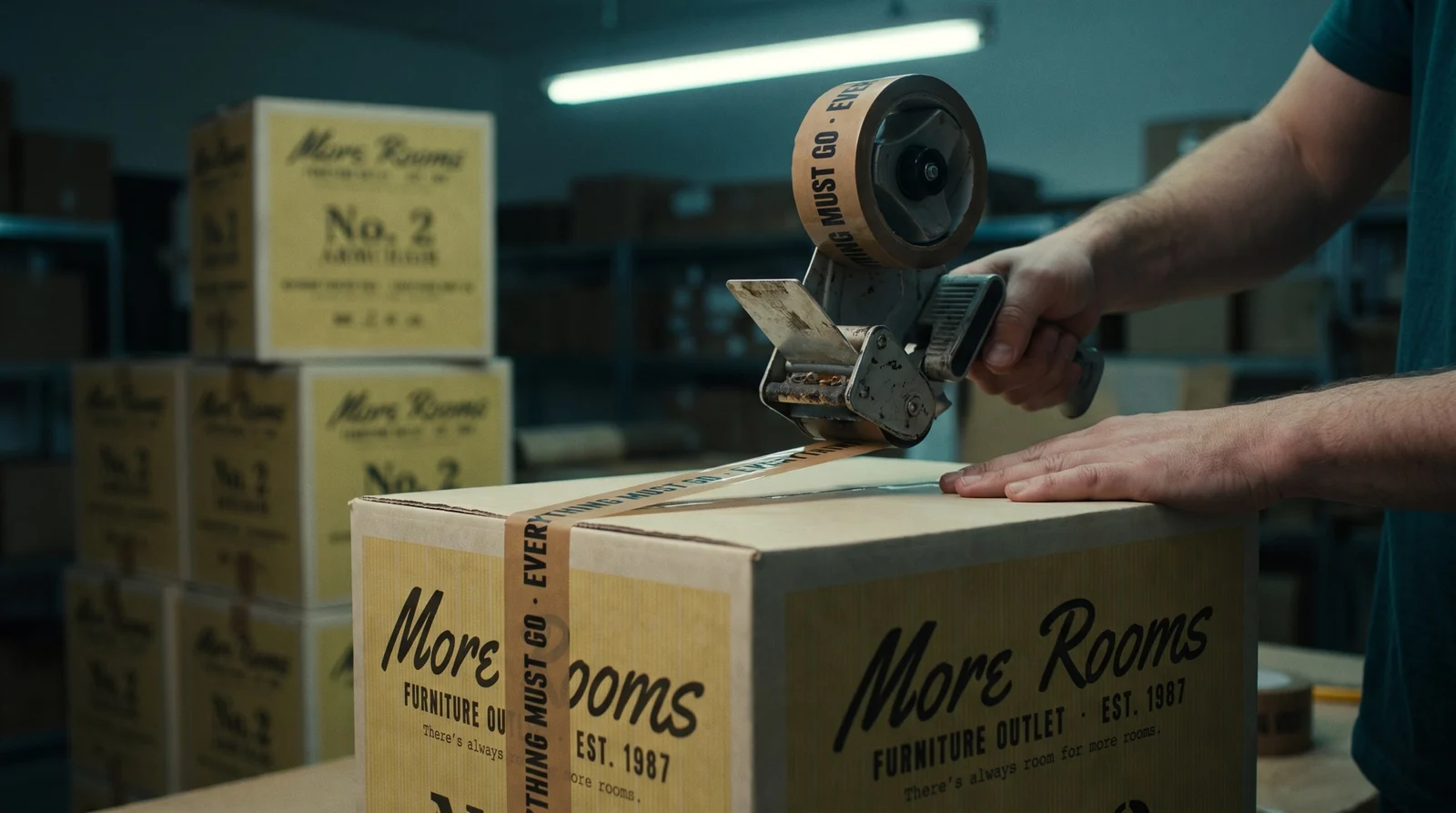
- 06Everything must go, on the tape. Custom printed kraft packing tape, black, repeating EVERYTHING MUST GO. Cheap, loud, and the first thing anyone touches.
The commission
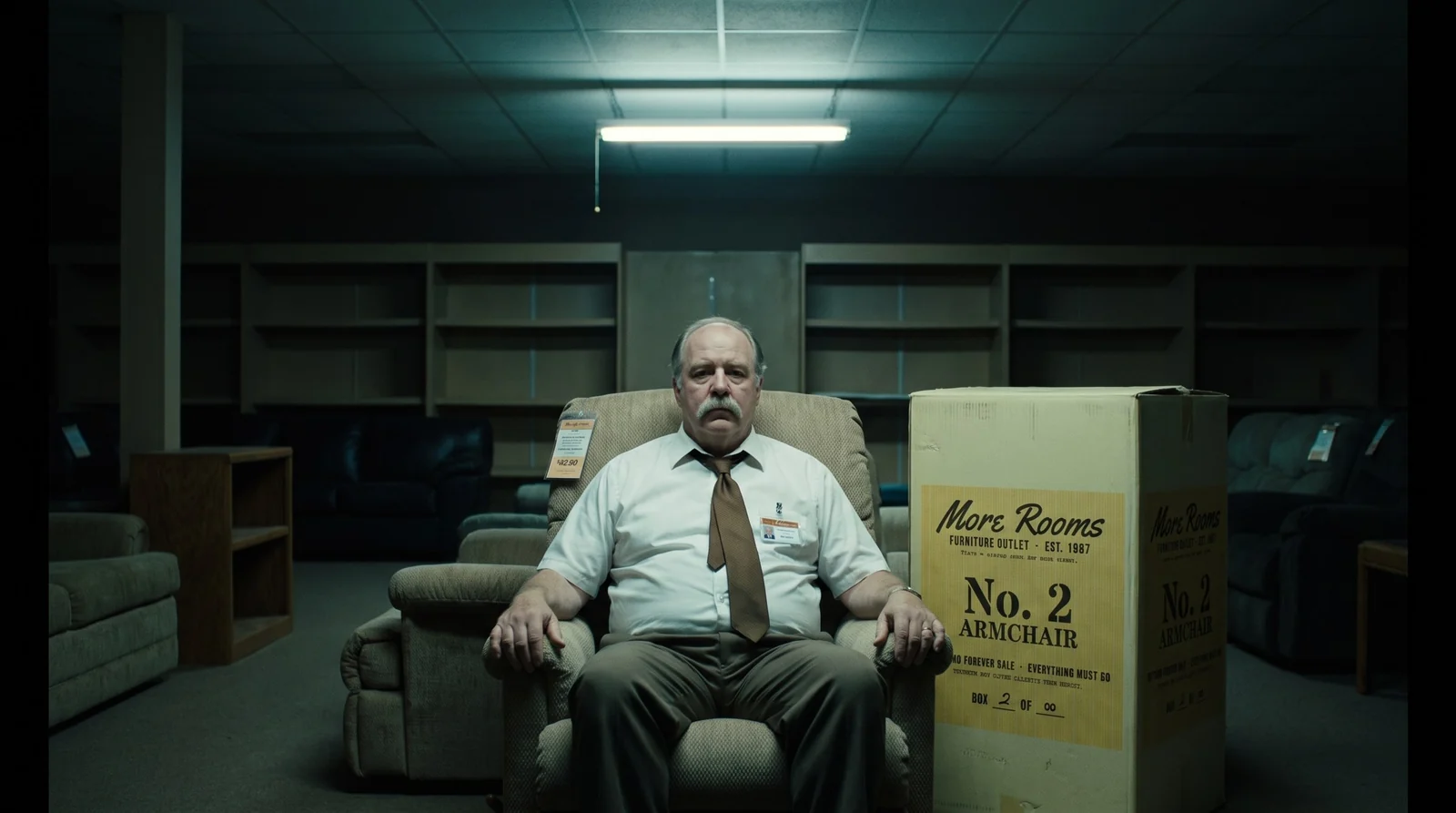
More Rooms Furniture Outlet has been retiring since 1996. The owner, Dale, sits in a recliner that still has its price tag. Business is fine. Business is always about to end. They ordered new boxes.
This one is for the people who came out of Backrooms (A24, 2026) and kept thinking about the furniture store. Theirs belongs to the film, so we made our own, one aisle over. The question was the same as always: if a store like that called us for boxes, what would we make?

Where each idea came from
**The yellow.** The film's endless rooms are a particular pale, fluorescent, almost-cream yellow, and we wanted the outside of the box to sit in that colour. On brown kraft the same ink turns mustard, so we moved the outside to a white-top liner and kept the kraft for the inside.
**The wallpaper.** We drew our own pattern: pinstripes with small stacked chevrons, knocked out of the flood. Up close it's just bare board; across a warehouse it reads as wallpaper.
**The furniture store.** In the film, the doorway is in a furniture store's basement. A dying furniture outlet is also a very real kind of client: it needs big boxes, lots of them, cheaply, and it has been "closing" for years.
**Remembered slightly wrong.** The film's spaces are copies with one detail off. Our handling marks do the same: every line is a real box convention, bent by one word.
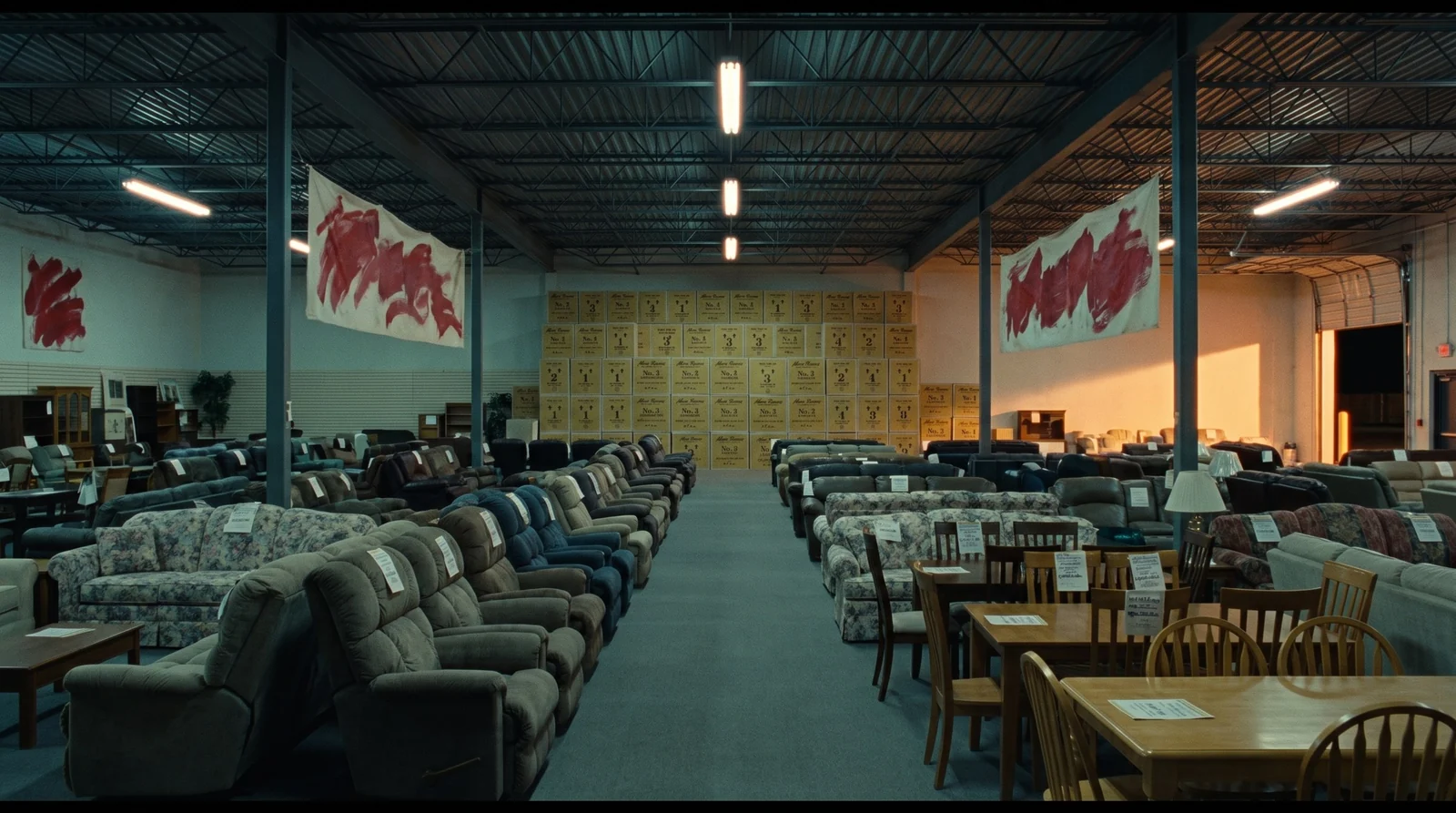
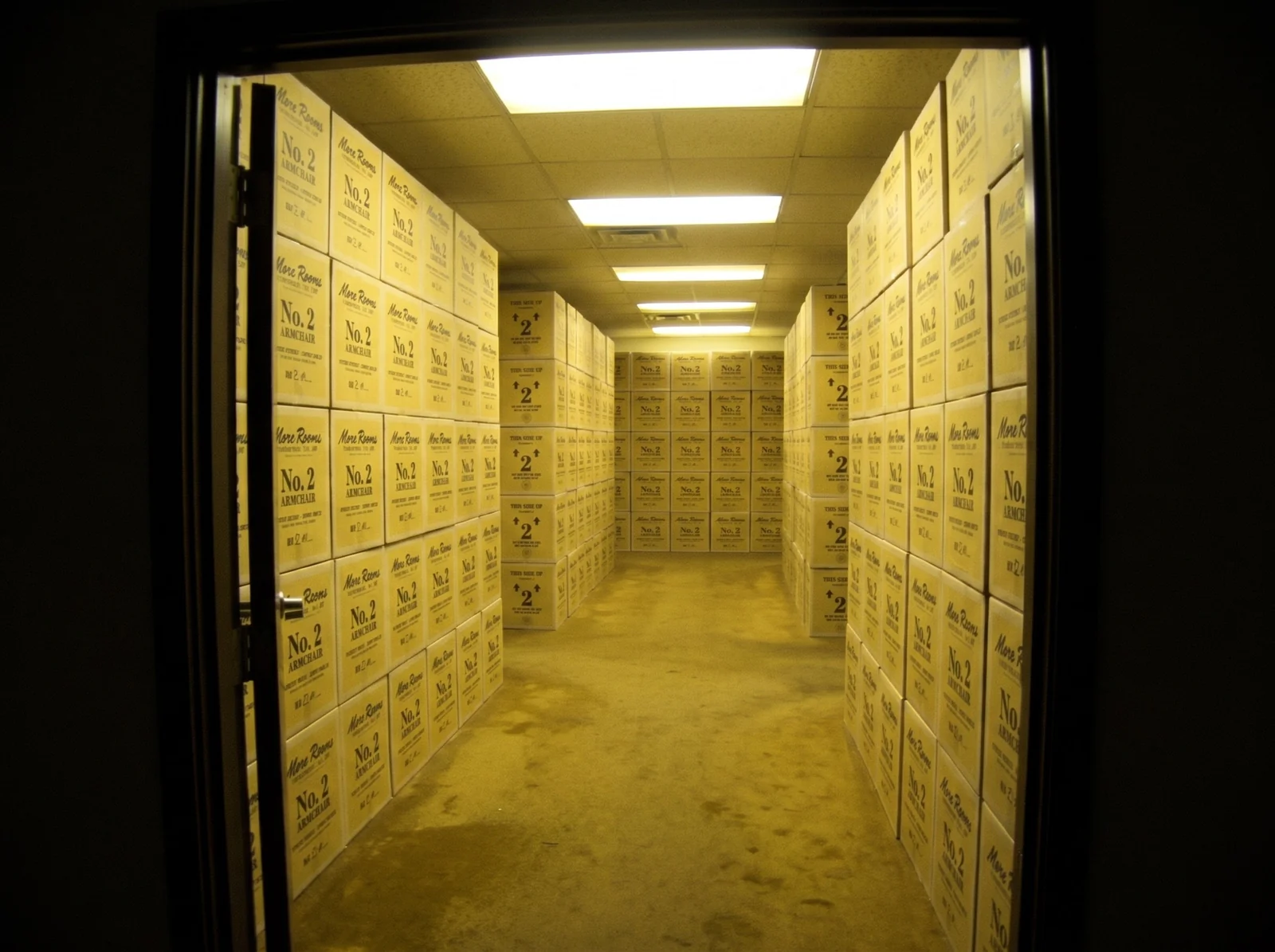
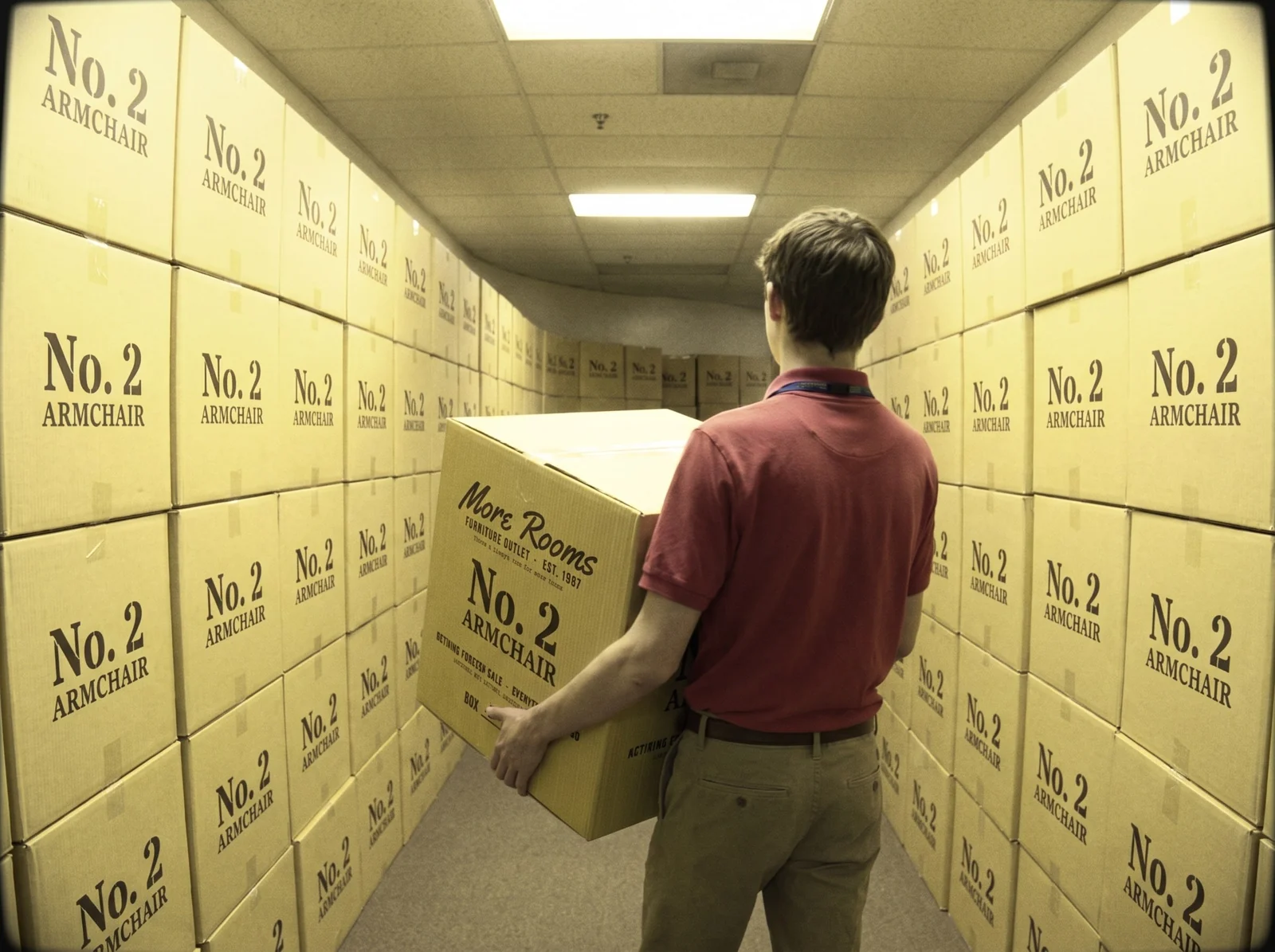
**Two cameras.** The film moves between clean, wide cinema and found camcorder footage, so ours does too: the showroom in widescreen, the stockroom on a 4:3 home camcorder.
**The music.** An old ballroom record, warped and looping under a fluorescent hum. It's an original track.
How we made the film
Two looks cut together. The showroom is shot like widescreen cinema: 2.39:1, still, symmetrical, teal shadows and one buzzing tube. The stockroom is a 4:3 home camcorder: soft, smeared, too yellow, walking somewhere it shouldn't.
As always, we started flat: real dielines, real flute and board grades, real ink colours. Only then did we build the rooms around the finished boxes. Sets, people and motion are AI-assisted.
Make your own
Shipping boxes, mailer boxes, retail cartons, printed tape: we print corrugated in spot colours, inside and out, from a run of a few hundred to a warehouse full. Bring us your Dale.
More from the What if…? series
Our design explorations start with a real material and print specification.
What if Hieronymus Bosch designed your wedding invitation? →
What if Alexander McQueen designed your wedding invitation? →
Start from these materials
Same paper, foil and finish, locked in — nothing of this piece artwork comes with it.
Questions
- Can you print on the inside of a shipping box?
- Yes. Inside printing is a separate pass on the inner liner. One colour is usually enough: a pattern, a message under the flap, or instructions.
- What's the difference between single-wall and double-wall corrugated?
- Single wall is one fluted layer between two liners, enough for lighter items. Double wall (BC flute) stacks two fluted layers, for heavy or bulky goods like furniture, and is rated higher in ECT for stacking strength.
- Why does yellow look different on brown boxes?
- Brown kraft shows through most inks, so pale colours turn darker and warmer. For a clean pale colour we print on a white-top liner; for a rugged look we print straight onto kraft.
- What is a full overlap (FOL) box?
- A box whose outer flaps overlap completely, giving a double layer of board top and bottom. It's a common choice for long, heavy items like sofas and tabletops.
- Is this connected to the film Backrooms?
- No. It's a design exploration inspired by the film. More Rooms Furniture Outlet and its people are invented, and we're not affiliated with or endorsed by A24 or the filmmakers.
- Can I order boxes like these?
- Yes. Every technique here is real: custom sizes, single and double wall, spot-colour flexo, inside print and printed tape. Order a sample pack, start a quote, or book a design consultation.
Inspired by Backrooms (A24, 2026), directed by Kane Parsons. More Rooms Furniture Outlet, its owner and its staff are invented. Not affiliated with or endorsed by A24 or the filmmakers. Art direction by Peppermint. The flat artwork is built on real corrugated board, flute and ink specifications; sets, people and motion are AI-assisted.