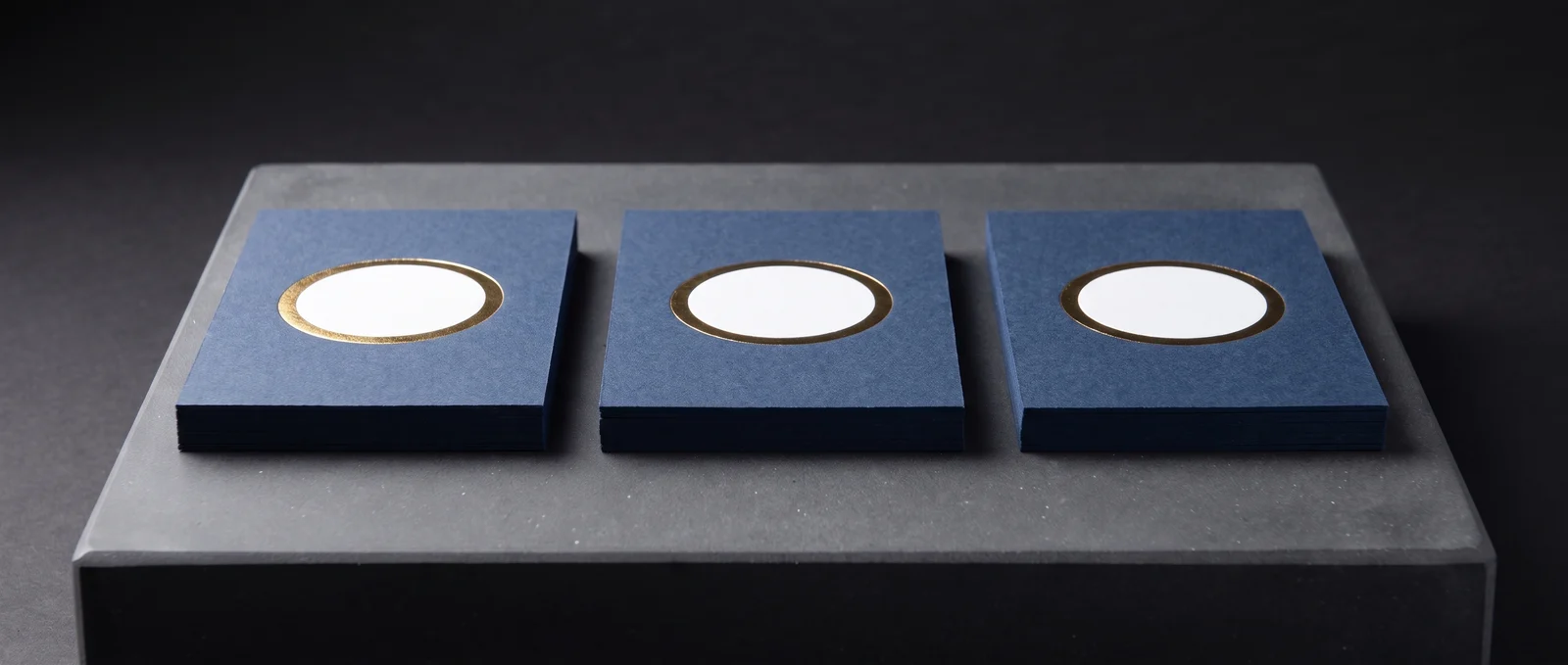
Two metals, two press passes.
Every foil colour has its own die, makeready and registered pass. The design succeeds when the colours cooperate with that physical tolerance.
Start with the finish
See what two-color foil does with your own brief.
Free · about two minutes
How it is made
The first colour is stamped, the sheet returns to the press, and the second die registers to the first. We run the broader or less registration-sensitive shape first and the finer accent second. Where two foils touch, trap or leave air; do not build hairline seams that require digital-perfect alignment. Each pass repeats setup, heat, pressure and spoilage, so the second colour is a real production operation rather than a menu surcharge.
Plan around approximately ±0.25mm pass-to-pass. Two separated foil fields look intentional; two interlocking hairlines advertise every microscopic movement.
What the screen cannot show
A screen physically cannot show this finish. It is a reflection, not a colour, and every image on this page is light hitting a surface at one chosen angle.
Hold the finish in your hand: order the sample kit →What it runs on
| Substrate | Verdict | Why |
|---|---|---|
| Uncoated & 100% cotton | Excellent | Soft sheet takes the die cleanly; the impression is part of the effect. |
| Colour-through (dyed) stock | Excellent | Metal on saturated ground is the highest-contrast thing we print. |
| Coated silk & matte stock | Excellent | Clean release and very sharp edges, but almost no impression : a coated sheet is hard, so you get shine without depth. |
| Soft-touch laminated stock | Good, tested | Adhesion varies by film : we proof it. |
| Thick board, duplex & triplex | Excellent | Thick board takes the deepest stamp of anything we run : all that ply absorbs the hit. |
Minimums and specs
- Registration
- ±0.25 mm
- Tooling
- 2 dies / side
- Press passes
- 2 / side
- Artwork
- Separate vectors
- One separation per foil
Choose the process by the outcome
- One shifting rainbow
- Holographic foil: one die and one pass.
- Metal plus flat colour
- One foil pass plus print.
- Two touching metals
- Build a deliberate trap or gap.
Pairs well with
Foil stamping
A heated die transfers a metallic film onto the stock under pressure. Not printed, not simulated: a layer of metal with an impression around it.
Foil on dark stock
Ink borrows its colour from the sheet below it. Foil does not: it lays an opaque metallic film over black, navy and saturated colour-through stocks.
Common questions
- Does two-color foil use one die?
- No. Each foil colour needs its own die and press pass.
- Which foil color runs first?
- Usually the broader or less registration-sensitive field, but heat, coverage and foil series can change the sequence.
- Can the two colors touch?
- Yes, with a deliberate trap or gap. A hairline butt join is not production-safe.