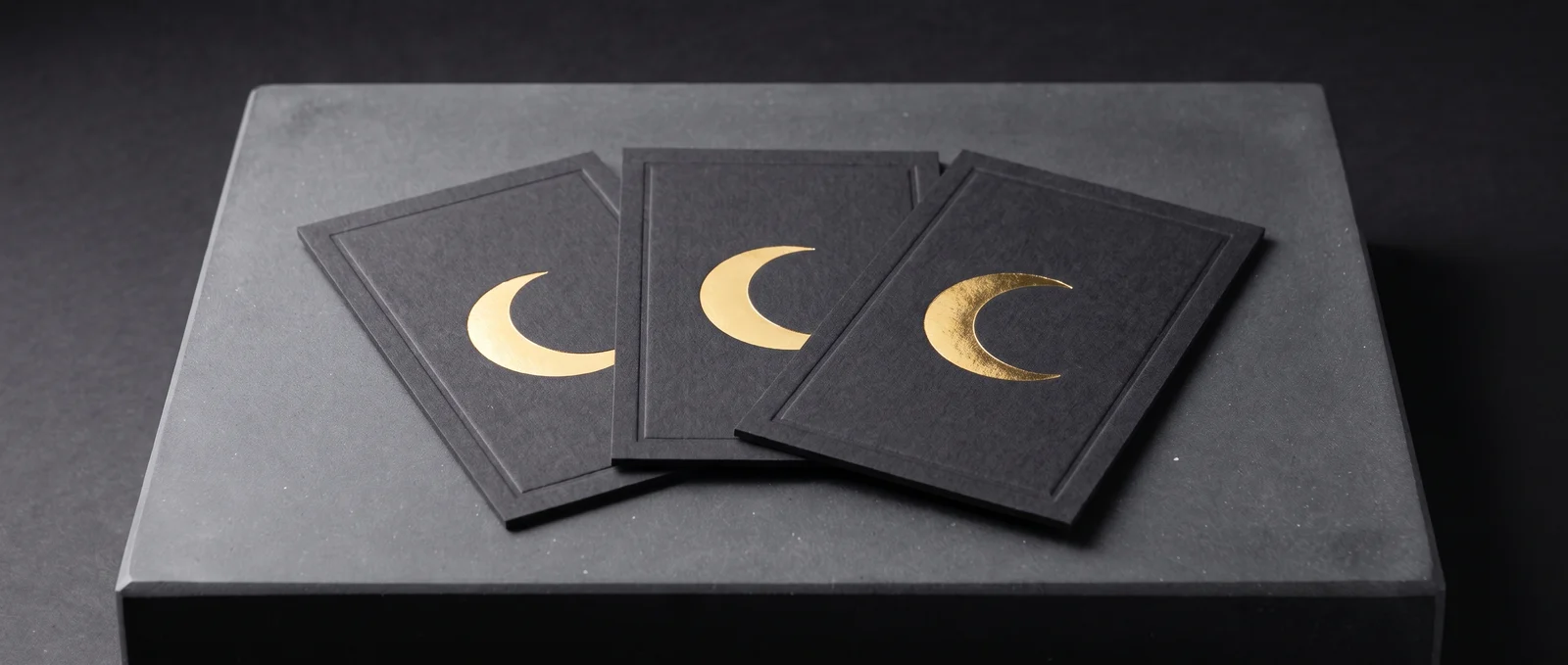
Light on dark is a metal problem.
Ink borrows its colour from the sheet below it. Foil does not: it lays an opaque metallic film over black, navy and saturated colour-through stocks.
Start with the finish
See what foil on dark stock does with your own brief.
Free · about two minutes
How it is made
Light ink on a dark uncoated sheet is filtered by the paper and falls grey. Adding more ink does not make it opaque; it fills detail and still shifts toward the stock. Hot foil is physically different: the die transfers a solid film that blocks the ground completely. The darkest papers therefore give foil its clearest contrast, provided the artwork is solid vector shape rather than a gradient or photograph.
White on dark stock is white foil stamp, never letterpress. Calling translucent ink ‘white letterpress’ promises a result the press cannot make.
What the screen cannot show
A screen physically cannot show this finish. It is a reflection, not a colour, and every image on this page is light hitting a surface at one chosen angle.
Hold the finish in your hand: order the sample kit →What it runs on
| Substrate | Verdict | Why |
|---|---|---|
| Colour-through (dyed) stock | Excellent | Metal on saturated ground is the highest-contrast thing we print. |
| Uncoated & 100% cotton | Excellent | Soft sheet takes the die cleanly; the impression is part of the effect. |
| Thick board, duplex & triplex | Excellent | Thick board takes the deepest stamp of anything we run : all that ply absorbs the hit. |
| Recycled, kraft & inclusion stock | Good, tested | Grips well, but husk and fibre inclusions break up fine lines. Keep the mark bold and expect a slightly broken edge as part of the look. |
| Clear & frosted plastic | Good, tested | Only with a plastic-rated foil at reduced heat. Standard paper foils either fail to grip or melt the sheet. |
Minimums and specs
- Minimum line / gap
- Lines 0.15 mm target / 0.1 mm floor; gaps 0.25 mm target / 0.15 mm floor
- Minimum type
- 7 pt
- 10 pt reversed
- Tooling
- 1 die / colour / side
- Ground
- Opaque film
- The sheet cannot show through
Choose the process by the outcome
- Flat light mark
- Opaque screen or UV white, where the substrate allows it.
- Reflective light mark
- Hot foil.
- All-over metallic sheet
- Metallic paper, not a foil flood.
Pairs well with
Blind deboss
A die presses the artwork into the sheet with no ink and no foil. The only thing you see is the depth: the surface reading differently where it's been compressed.
Edges and thickness
Paint adds colour, foil adds reflection, and duplex or triplex adds real plies. Choose the edge and construction together, not as interchangeable effects.
Seen in
Common questions
- Why can’t white letterpress print on black paper?
- Letterpress ink is translucent. The black sheet shows through and turns a pale ink grey; opaque white foil is the reliable process.
- Does foil need a white underprint?
- No. The film is already opaque.
- Can fine type hold on textured dark stock?
- Yes. Fine detail survives foil: we design to 0.15 mm and only adjust lines under 0.1 mm. We check the actual texture at proof.