COMPARISON
Metal Business Cards vs Paper — When Metal Actually Makes Sense
Metal and paper business cards serve different purposes. This guide covers when metal is worth the investment, when premium paper is the better choice, and why many professionals carry both.
By Austin Terrill · Print Peppermint · 12 min read
On this page
- What paper does that metal cannot
- What metal does that paper cannot
- When metal is the right choice
- When paper is the right choice
- The carry-both strategy
- A side-by-side comparison
- The bottom line
- Common questions
- Can I get the "metal card experience" on paper?
- Which is better for NFC?
- I have a full-color photographic design. Can I do that on metal?
- How do I decide how many of each to order?
- Can I use the same design on both metal and paper?
- Is one more eco-friendly than the other?
Metal and paper business cards are not competing products. They exist in different categories, create different impressions, and make sense in different situations. Framing it as "which is better?" misses the point — it's like asking whether a watch or a phone is better for telling time. Both work. The choice depends on what else you need it to do.
We produce both. We've made thousands of metal card orders and tens of thousands of paper card orders with foil, embossing, letterpress, edge painting, and spot UV. We have no incentive to push you toward either one — our margins are healthy on both. This guide is the honest version of the comparison.
What paper does that metal cannot
Paper business cards — specifically, premium paper cards with specialty finishes — operate in a world of craft, texture, and print technique. The artistry is in how materials interact: ink sinking into cotton fiber, metallic foil catching light against a matte surface, a letterpress die pressing type deep into thick stock, edge paint adding a stripe of color visible only when the card is held sideways.
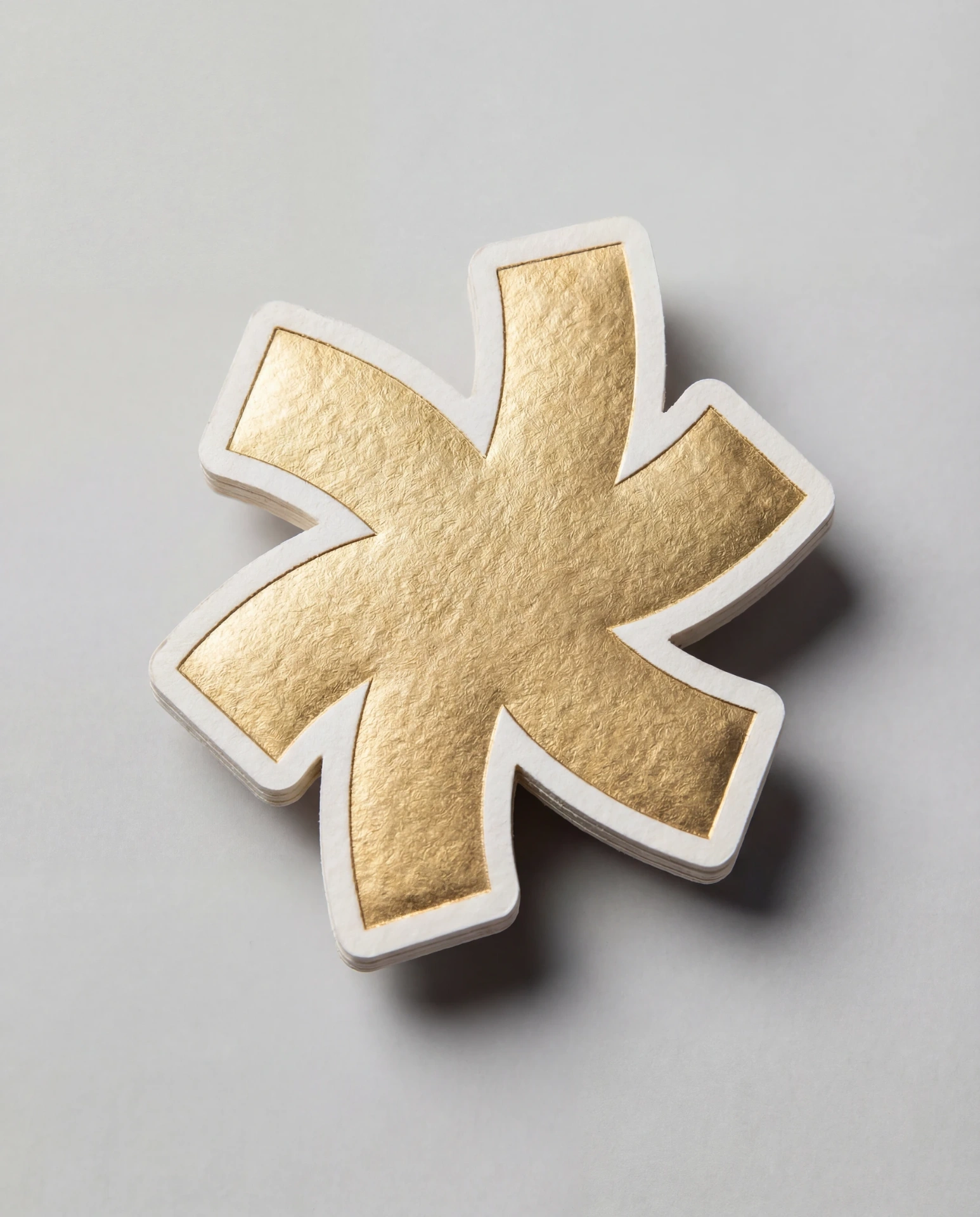
That world is broader on paper than on metal. Here's what paper gives you that metal doesn't:
A wider range of finishes. On paper, you have access to foil stamping (gold, silver, rose gold, holographic, copper, black — and each behaves differently on different papers), blind embossing and debossing (dimensional effects pressed into the paper surface), letterpress printing (ink pressed into cotton with visible depth), spot UV coating (glossy elements on a matte surface, creating a tactile contrast), raised UV (thicker, more sculptural gloss), and edge painting or edge foil (color or metallic edges on thick stock). These are distinct techniques, each with their own visual and tactile character.
Metal cards have three techniques: engraving, cutouts, and color printing. All three are impressive, but the range of expression is narrower. You can't emboss metal. You can't letterpress it. You can't create a matte-gloss tactile contrast on a metal surface.
Design versatility. Full-bleed photography, gradients, multi-color illustrations, detailed tonal artwork — all of this reproduces beautifully on smooth paper with lamination (silk or soft touch). On metal, photographic reproduction requires color printing, which is an additional production step. Engraving — the base metal technique — is line-based, not tonal. If your design depends on photographic imagery or subtle color work, paper is the more natural canvas.
More paper choices than metal choices. We offer metal in eight colors and three finishes. Paper? Dozens of stocks, each with different weight, texture, color, and behavior with different finishes. Cotton for warmth and texture. Silk laminate for vibrancy and smooth precision. Soft touch for velvety matte surfaces. Black stock for drama. Colored stock for embedded color. Each paper changes how every finish looks and feels on the card. The combination space on paper is vastly larger.
Lower cost at volume. A premium paper card order — 32pt cotton with gold foil on both sides — runs roughly $350 to $500 for 500 cards. That's $0.70 to $1.00 per card. A comparable metal order (silver brushed, engraved + cutouts) at 500 cards runs $1,750 to $2,000. That's $3.50 to $4.00 per card — 4 to 5 times the price.
At 1,000 cards, the gap widens: premium paper at $0.50 to $0.80 per card vs. metal at $2.35 to $4.60 per card.
If you hand out more than 10-15 cards per week regularly, the unit economics of metal become hard to justify unless the cards are going to people who directly influence your revenue.
Portability. A stack of 50 paper cards fits easily in a jacket pocket and weighs a few ounces. A stack of 50 metal cards weighs over a kilogram (about 2.5 pounds) and takes up the same pocket space but with noticeable heft. If you travel to conferences or events and carry cards with you, paper is more practical for volume.
What metal does that paper cannot
Metal delivers one thing that no paper card — regardless of how premium — can replicate: material surprise.
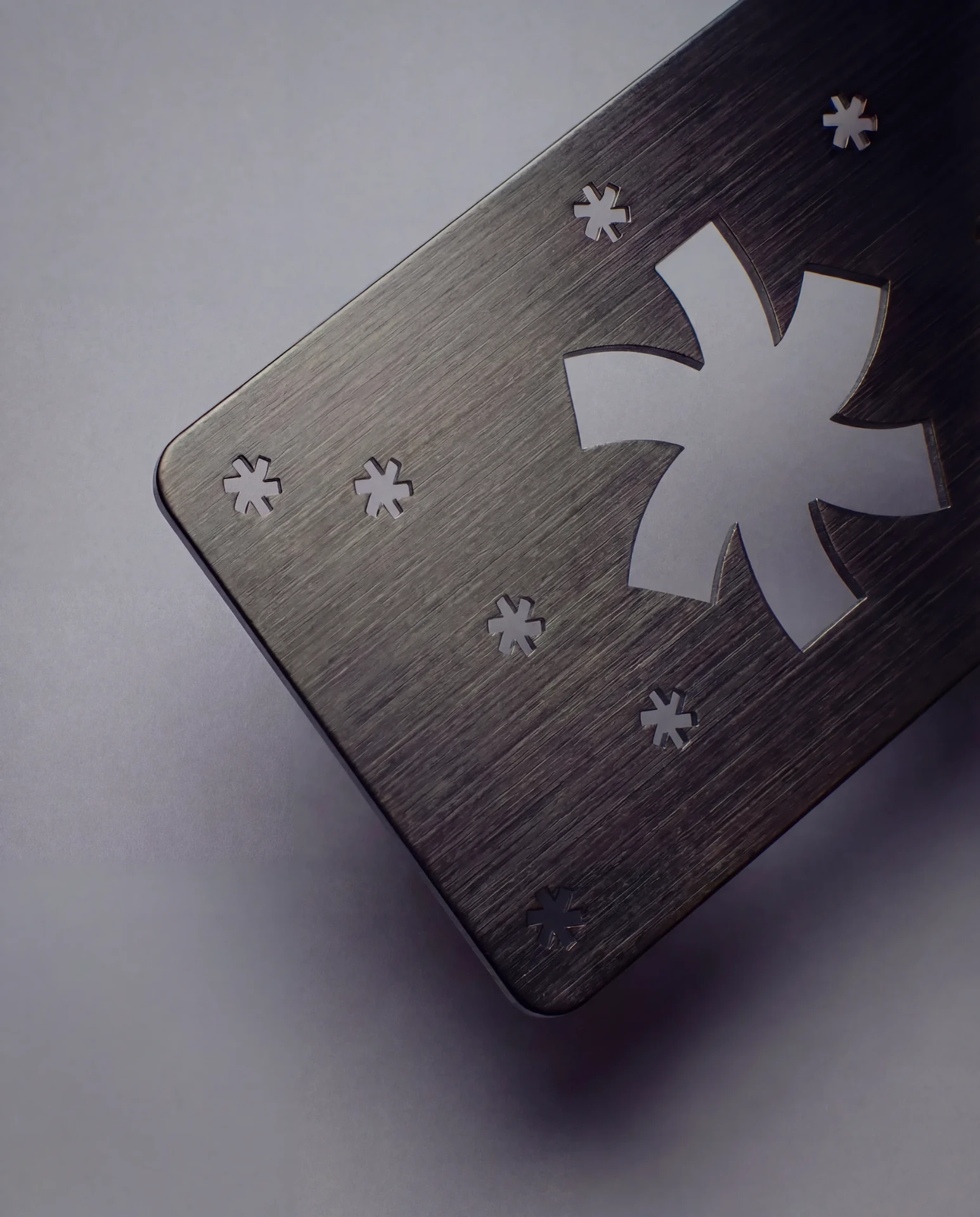
Weight. A 0.5mm stainless steel card weighs roughly 25 grams — five times the weight of a standard paper card. The weight registers the instant someone receives it. It's not a subtle difference you have to look for. It's immediate and undeniable. The card feels like an object, not a slip of paper.
Temperature. Metal is cool to the touch at initial contact. Paper is room temperature. The difference is small but sensory — it activates a different part of the recipient's attention. Combined with weight, it creates a "this is not what I expected" moment that resets the interaction.
Sound. Set a metal card on a glass table or a marble desk and it makes an audible tap. Slide it across a wooden surface and it glides differently than paper. These are minor details, but they contribute to the overall sensory experience of the handoff. The card announces itself.
Durability. Paper cards — even premium ones — bend, crease, stain, and show wear. A card that's been in someone's wallet for three months looks like it's been in someone's wallet for three months. A metal card in the same wallet looks the same as the day it was produced. Metal doesn't degrade from normal handling. It doesn't absorb moisture. It doesn't yellow. People keep metal cards because they still look good after months or years.
The conversation trigger. This is the practical business case for metal. When you hand someone a metal card, they comment on it. "Is this metal?" "This is heavy." "Where did you get this?" That comment becomes a conversation that might not have happened with a paper card. In sales, real estate, and professional services, that extra 30 seconds of dialogue can be the difference between a follow-up and a forgotten name.
Paper cards, even extraordinary ones, rarely trigger that reaction from someone who isn't in the design industry. A non-designer receiving a cotton card with blind embossing might notice it feels nice, but they're unlikely to comment on it. A non-designer receiving a metal card will almost certainly say something. The material transcends design literacy.
When metal is the right choice
Metal makes sense in specific situations. Not all situations, not most situations — specific ones.
High-value, low-frequency handoffs. You meet a potential client for a million-dollar deal. You sit across from an investor. You shake hands with someone whose business you want. In these moments, the card IS part of the pitch. Spending $5 on a single card that creates a memorable impression is proportional to the value of the interaction.
When the card's job extends beyond contact exchange. A paper card's job is done once the contact info is captured — after that, it goes into a drawer or gets photographed and discarded. A metal card keeps working. It sits on someone's desk. It gets shown to colleagues. It gets photographed and posted online. It becomes a conversation piece even when you're not in the room. If you need your card to represent you in your absence, metal does that.
VIP, event, and promotional use. Metal cards work beautifully as luxury event invitations, membership cards, gift enclosures, and limited-edition keepsakes. When the card itself is the product — not just a vehicle for information — metal's material impact justifies the cost.
When your brand identity demands it. Some brands communicate through material weight and permanence: luxury real estate developers, high-end jewelers, exclusive hospitality. If your brand's physical touchpoints are all heavy, substantial, and built to last, a paper card — no matter how premium — may feel inconsistent.
When paper is the right choice
Paper is the right choice more often than metal. That's not a criticism of metal — it's an acknowledgment that most business card use cases are about networking, not showmanship.
Volume networking. If you attend events, conferences, trade shows, or meetups where you hand out 10-30+ cards per outing, paper is the practical choice. At $0.70 to $1.50 per card with premium finishes, volume distribution is sustainable. At $4-7 per card for metal, it's not.
Team orders. A company ordering cards for 15 employees is spending $5,000 to $10,000+ for metal. The same order in premium paper with foil runs $1,500 to $3,000. For team standardization, paper is the economically rational choice — and with the right finishes (foil, emboss, edge paint), it's far from boring.
Design complexity. If your card features full-color photography, detailed illustration, gradient backgrounds, or more than 2-3 colors, paper reproduces it better. Silk laminate gives you true CMYK fidelity. Cotton gives you warmth and texture. Soft touch gives you a velvety tactile experience. Metal's strength is the material itself, not its ability to carry complex design — paper wins on design range.
When the finishes ARE the story. Some print finishes are so striking that they compete with metal's material impact. A 48pt cotton card with deep letterpress impression and edge painting. A soft touch card with raised spot UV creating a gloss-matte contrast you can feel with your eyes closed. Cotton with gold foil and blind emboss, where the foil catches light and the emboss catches shadow simultaneously. These are physical experiences that metal can't replicate — they're unique to paper and print technique.
Explore foil business cards → · Embossed and letterpress cards → · Thick cards with edge painting → · Spot UV on soft touch →
When restraint is the message. In conservative industries — law, finance, government, healthcare — the most powerful card is often the quietest one. Thick cotton stock with a subtle blind deboss of the firm logo. No foil, no color, no metal. Just quality paper, careful typography, and physical weight. The restraint communicates confidence. A metal card in the same context might read as trying too hard.
The carry-both strategy
A significant number of our metal card customers also order premium paper cards. This isn't indecision — it's strategic.
Metal cards for the meetings that matter most. The pitch to the investor. The introduction to a dream client. The dinner where you sit next to someone who could change your business. These are the moments where $5 per card is an absurd bargain for the impression it creates.
Paper cards for everything else. The conference. The networking happy hour. The trade show booth. The stack you leave with a receptionist. These are volume moments where the card needs to look sharp, feel premium, and carry your contact info — but it doesn't need to be a conversation piece.
The relationship between the two is additive. A metal card establishes a ceiling — a signal of the highest level your brand operates at. A premium paper card sits naturally below that ceiling, inheriting credibility. Someone who receives your paper card first and later learns about the metal version retroactively re-evaluates the brand. Someone who receives the metal card first and later sees the paper version recognizes consistency.
If budget requires choosing one: start with premium paper cards for daily use and order a small batch (50-100) of metal cards for high-value moments. The economics work beautifully — $350 for 500 premium paper cards plus $475 for 100 metal cards totals $825 and covers both your volume needs and your VIP needs for a year.
A side-by-side comparison
| Premium Paper | Metal | |
|---|---|---|
| Materials | Cotton, silk, soft touch, black stock, colored stock | Stainless steel (8 colors), aluminum |
| Finishes available | Foil (6 colors), emboss, deboss, letterpress, spot UV, raised UV, edge paint, edge foil, rounded corners, die-cut shapes | Matte, brushed, mirror surface finishes |
| Design techniques | CMYK printing, PMS spot color, foil stamping, embossing, letterpress | Laser engraving, laser cutouts, color printing |
| Card thickness | 16pt to 48pt (0.4mm to 1.2mm) | 0.5mm or 0.8mm |
| Weight per card | ~5g (16pt) to ~10g (48pt) | ~25g (0.5mm) to ~40g (0.8mm) |
| Cost per card (500 qty) | $0.36 to $1.60 | $2.35 to $4.94 |
| Production time | 5-8 days (Quick Ship) or 3 weeks (Studio) | 3 weeks |
| Durability | Bends, can stain, shows wear | Doesn't bend, waterproof, permanent |
| Best for | Volume networking, teams, complex designs, craft finishes | High-value meetings, VIP use, conversation starters |
| NFC option | Not available on paper | Available on all metals |
| Minimum order | 100 (Quick Ship) or 250 (Studio) | 5 |
The bottom line
If you hand out more than 10 cards per week, start with premium paper. Choose cotton with foil for warmth and elegance, soft touch with spot UV for modern tactile contrast, or thick stock with letterpress for editorial authority. These are genuinely impressive cards that serve you well in any professional context.
If you have specific meetings, clients, or moments where the card needs to do more than transfer contact info — where it needs to create a reaction, start a conversation, or represent your brand in your absence — that's what metal is for.
Most people don't need to choose between them. They need both, used intentionally.
Common questions
Can I get the "metal card experience" on paper?
Partially. A 48pt cotton card with edge painting and foil gives you physical weight (1.2mm thick), a metallic element (foil), and a premium material experience. It's the closest paper gets to metal's impact. But it still feels like paper — warm, fibrous, flexible. Metal's sensory signature (cool temperature, rigid, heavy for its size) is unique to the material.
Which is better for NFC?
Metal is currently your only option for NFC business cards from us. NFC chips can be embedded in metal, wood, and plastic cards. Paper cards don't support embedded NFC because the chip requires a rigid substrate. Learn about NFC metal cards →
I have a full-color photographic design. Can I do that on metal?
Yes, via color printing on the metal surface. The result looks different from paper — the metallic base shows through slightly, giving colors a different quality. Whether that's desirable depends on the design. For true photographic reproduction with maximum fidelity, silk laminate paper is still the best medium. For a unique look where the metal surface interacts with the printed colors, metal color printing can be striking.
How do I decide how many of each to order?
Estimate how many cards you hand out per month. The majority of that number should be paper (volume use). Then estimate how many high-value meetings you have per month — multiply by 12, add a buffer, and that's your metal order. For most professionals, that's 250-500 paper cards and 50-100 metal cards per year.
Can I use the same design on both metal and paper?
The same brand identity, yes. The exact same design file, usually not — metal requires vector artwork with layer separation for engraving, cutouts, and printing. Paper requires a standard print-ready file with CMYK colors and bleed. We handle both file formats and can adapt one design for both media. Metal design requirements →
Is one more eco-friendly than the other?
Paper cards are made from renewable materials (wood pulp or cotton) and are recyclable. Metal cards are made from stainless steel, which is recyclable but energy-intensive to produce. However, metal cards last indefinitely and are rarely discarded, while paper cards are frequently thrown away after the contact info is captured. The environmental calculus isn't straightforward. If a paper card gets thrown away after one use but a metal card sits on someone's desk for three years, the per-year environmental impact may be comparable.
Continue reading
METAL
Metal Business Cards: The Complete Guide
Read guide →PRICING
How Much Do Metal Business Cards Cost?
Read guide →METAL
Which Metal Business Card Color to Choose
Read guide →DESIGN
How to Design for Metal Business Cards
Read guide →METAL
NFC Metal Business Cards — Smart Cards That Make an Impression
Read guide →Ready to decide?
Request a Custom Quote →Tell us about your brand, your audience, and how you use your cards. We'll recommend the right approach — metal, paper, or both — with pricing.
Order a sample pack → · Book a consultation → · Peppermint Studio →