Custom foil labels, stamped on textured paper
Quoted to your spec, before you pay
About 3 weeks after proof approval, an estimate.
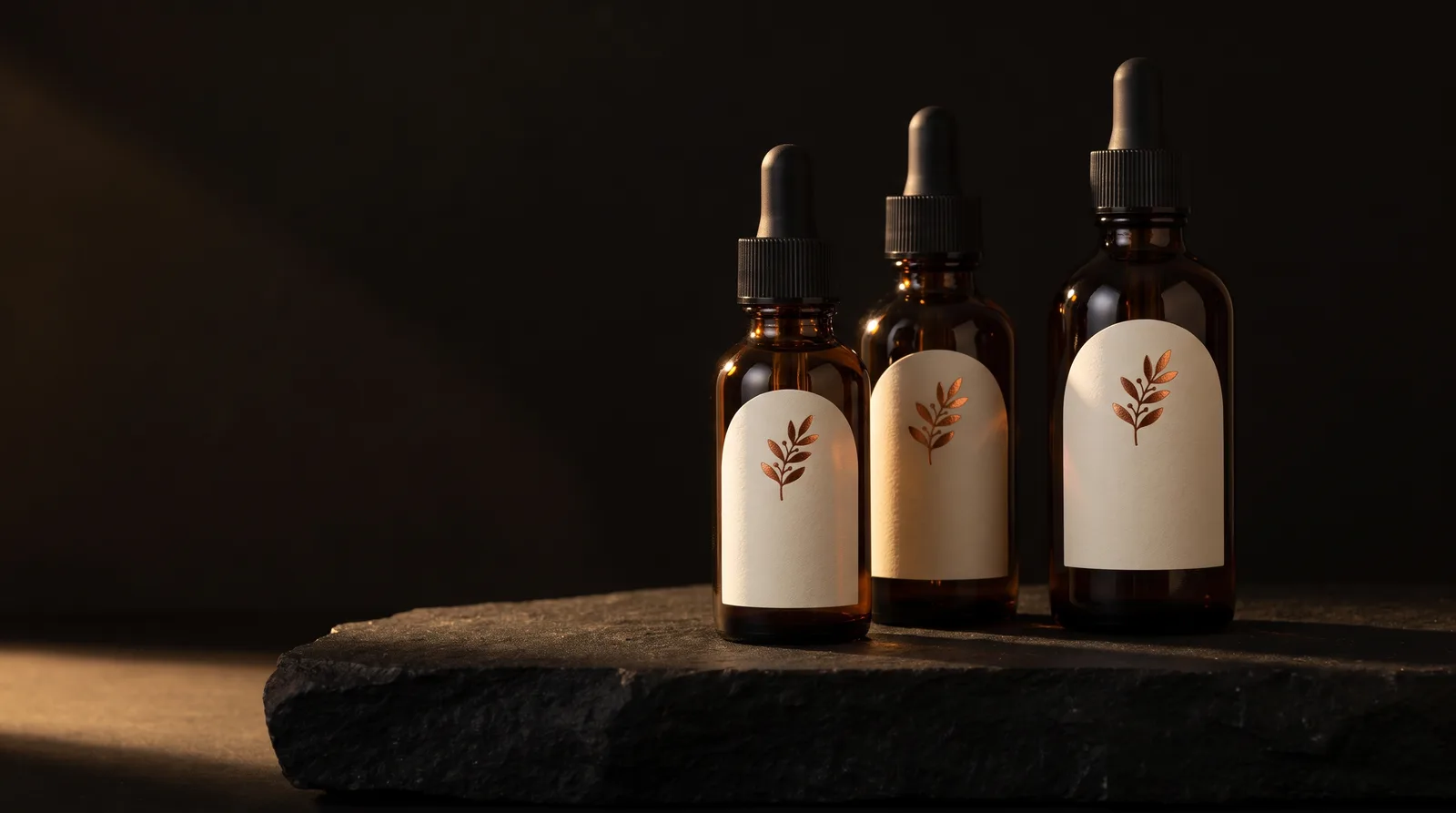
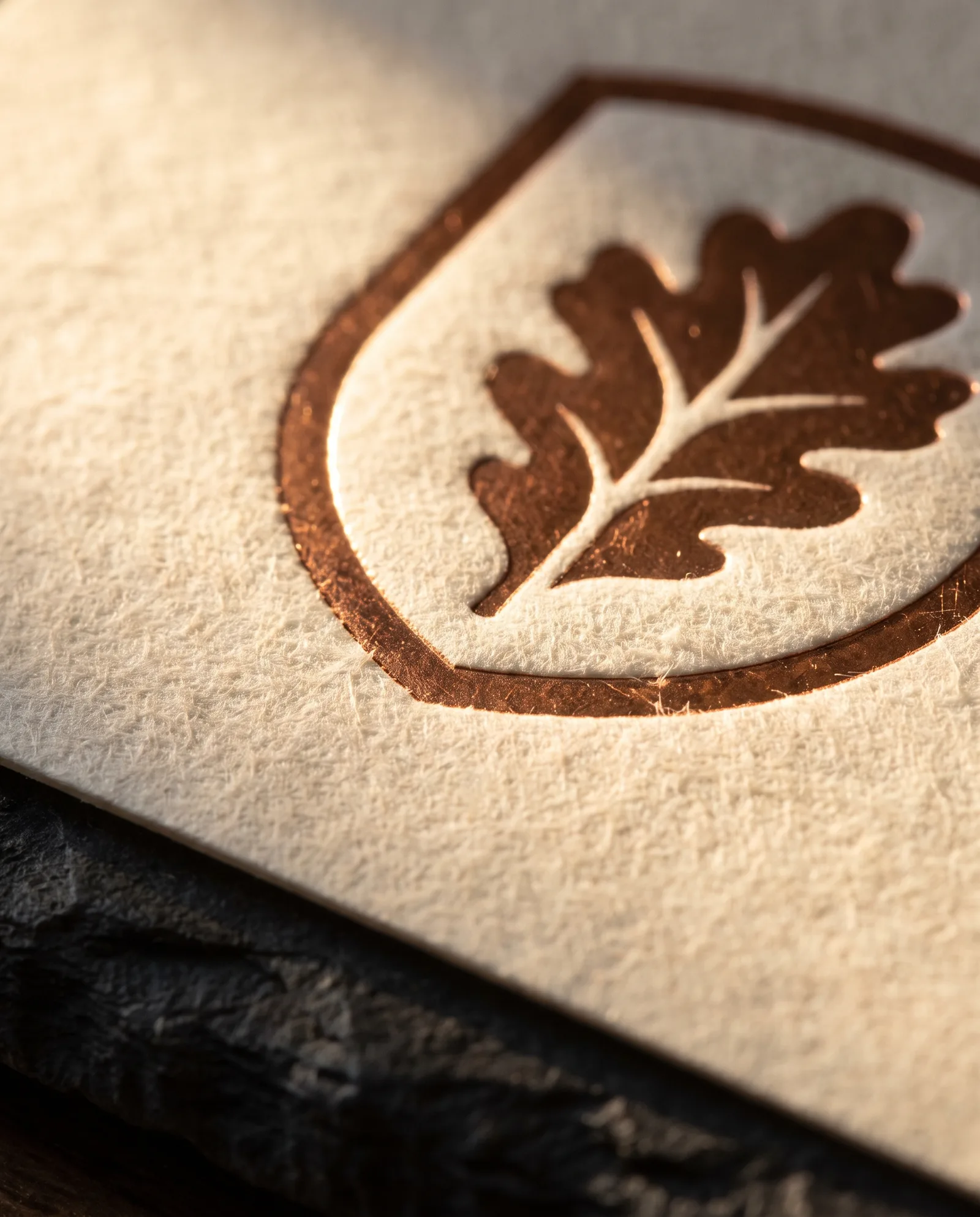
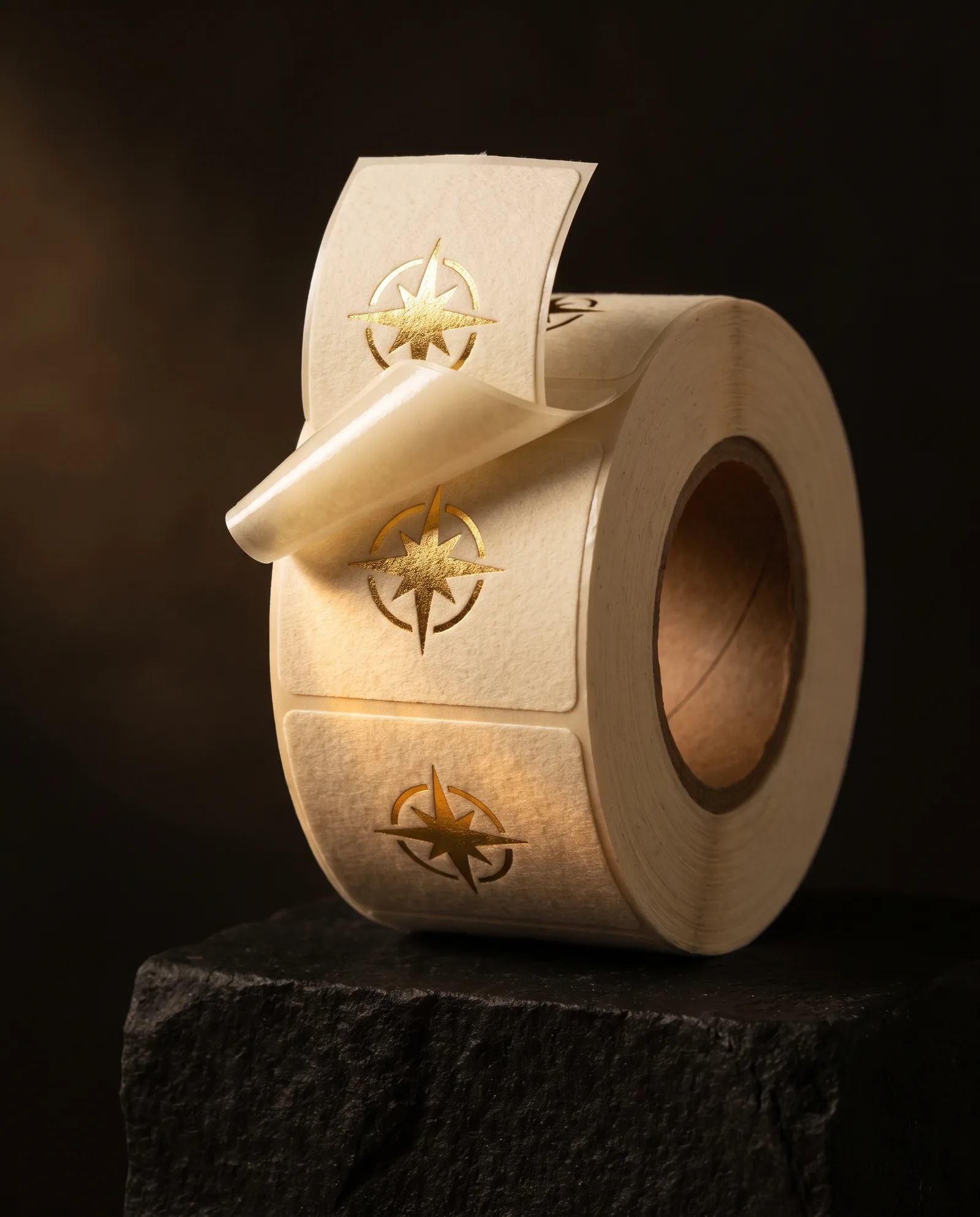
A foil label is a product label where the metal is real foil, not metallic ink. A heated die presses a thin film of gold, copper or silver onto bare paper, so the mark sits bright and sharp against a matte, textured face. We make custom foil labels on felt, laid, cotton-look and smooth uncoated label papers, cut to your shape and supplied on rolls or sheets.
Foil labels are at their best on things that stay dry: spirits, candles, cosmetics boxes, coffee bags, jars on a shelf. They are not the answer for a bottle that sweats in an ice bucket, because paper wicks water and foil on film is unreliable. We'll tell you which side of that line your product sits on before you pay.
- Quoted to your spec, before you pay
- About 3 weeks of production after proof approval (estimate)
- Free proof, checked by a person
Where foil labels work, and where they don't
Start with where the label lives, not with the artwork. A candle jar gets warm. A white wine sweats in an ice bucket. A serum bottle meets oily fingers every morning. Each of those decides the face stock and the adhesive, and no amount of good design saves a label that curls at the corner two weeks in.
| Where the product lives | Foil label on paper? | What we'd spec |
|---|---|---|
| Dry shelf: spirits, reds, jars, tins, boxes, cartons | Yes. This is where foil on textured paper looks its best | Felt, laid or cotton-look paper, one foil, ink for the small type |
| Coffee and dry-goods pouches | Yes, as a label on a stock kraft or foil pouch | Textured or coloured uncoated paper, foil plus an emboss if the brand wants it to feel like an object |
| Candle vessels | Usually, with care on the glass (see the candle note below) | Paper foil label on the lid, box or sleeve; the glass label specced for warmth |
| Cosmetics boxes and dry-use bottles | Yes | Smooth or felt paper; keep foil clear of the area fingers grip |
| Ice buckets, fridges, showers, wipe-downs | No. Paper wicks moisture and lifts | White or clear BOPP film with a permanent adhesive, and metallic ink or a metallised film for the shine |
That last row is the one to take seriously. Foil adhesion on some film stocks is unreliable, and we'd rather say so now than after a run. Metallic ink on film gives a soft satin shimmer, not the mirror bite of hot foil, so set the expectation there: it's the right label for a wet bottle, just a quieter one. Waterproof film labels are quoted on our custom labels page.
Custom foil label prices
Every foil label run needs its own foil die, and the die, stock and finish all move the price, so we quote foil labels to your spec rather than guess. Tell Peppermint Studio the size, the quantity and where the product lives, and you'll get a price and a stock recommendation before you pay anything.
Pick the label stock by shelf life
Foil always lands on bare stock, never on top of printed ink, so the paper is half the design. For gold foil labels, cream felt and black uncoated are the two faces we'd start with. These are the label faces we stamp:
| Label stock | What it does under foil | Best for | Watch for |
|---|---|---|---|
| Felt-textured paper | The deepest contrast: a mirror mark against a surface with no shine at all | Spirits, olive oil, apothecary | The felt breaks up hairlines, so foil wants weighty shapes |
| Laid paper | Fine parallel ribs that catch light beside the foil | Wine, heritage brands | Ribs show through big solid foil areas |
| Cotton-look cream or white | Soft and warm, with a slight bite where the die presses | Candles, cosmetics, gifts | Cream warms gold and copper slightly |
| Smooth uncoated | The cleanest foil edges and the smallest legible foil type | Fine type, holographic foil, detailed marks | Plainer to the touch |
| Black or coloured uncoated | Gold, copper and white pigment foil read strongly | Dark spirits, coffee, candles | Black foil on black is a sheen, not contrast |
| BOPP film (white or clear) | Not a hot foil stock for us; use metallic ink or a metallised film | Anything wet or chilled | Satin shimmer, not mirror foil |
Three things to know before you pick:
- Textured stock changes the foil. Fine lines break on felt, and big solid shapes pick up the texture and can show tiny gaps. The sweet spot is a medium-weight mark. If you want a mirror-like solid panel, tell us and our press team checks it before we promise it.
- Dark foil on dark paper reads as a sheen. A black-on-black mark shows only when the bottle turns in the light. That's lovely for a quiet secondary mark, and the wrong choice for the product name.
- White on a dark label is foil, not ink. Ink sinks into dark uncoated paper and goes chalky, so for a crisp white we use white pigment foil. That includes the small print: on a black label, ingredients and legal lines go in white or gold pigment foil at 7 pt or larger, or onto a separate back label on light stock along with the barcode.
Three ways to build a foil label, and the one we'd pick
We'd price it with everything first, then scale back to the number that makes sense for your run.
- One foil, everything else in ink. Your mark or product name in foil, with the small type, the ingredients and any colour printed beside it. This is the simplest build to price, and it does more than people expect: on a textured face, one bright foil mark against matte paper carries the whole 2 × 3 in label.
- Foil with a registered emboss. We make one combination die that carries the foil and the relief together, so the foil sits exactly on the raised shape. Light rolls over the edge of each letter, and the label stops looking printed and starts looking struck. This is the one we'd pick for spirits, candles and anything sold at a gift price. Quoted, because the die is made for your mark.
- Multi-level emboss with foil. A sculpted die with two or more relief heights: a landscape, a crest, contours. It's the most expensive and slowest option, and our press team confirms the depth plan before we quote it. See the next section.
One thing we'd talk you out of: the second foil colour on a label this size. One foil with an emboss nearly always reads as richer than two foils competing for the same few square inches, and each foil colour is its own die and press pass.
Foil and emboss on a curved bottle
Embossing a label is different from embossing a card, because a label has to lie flat on a curve. Two rules from our own design explorations:
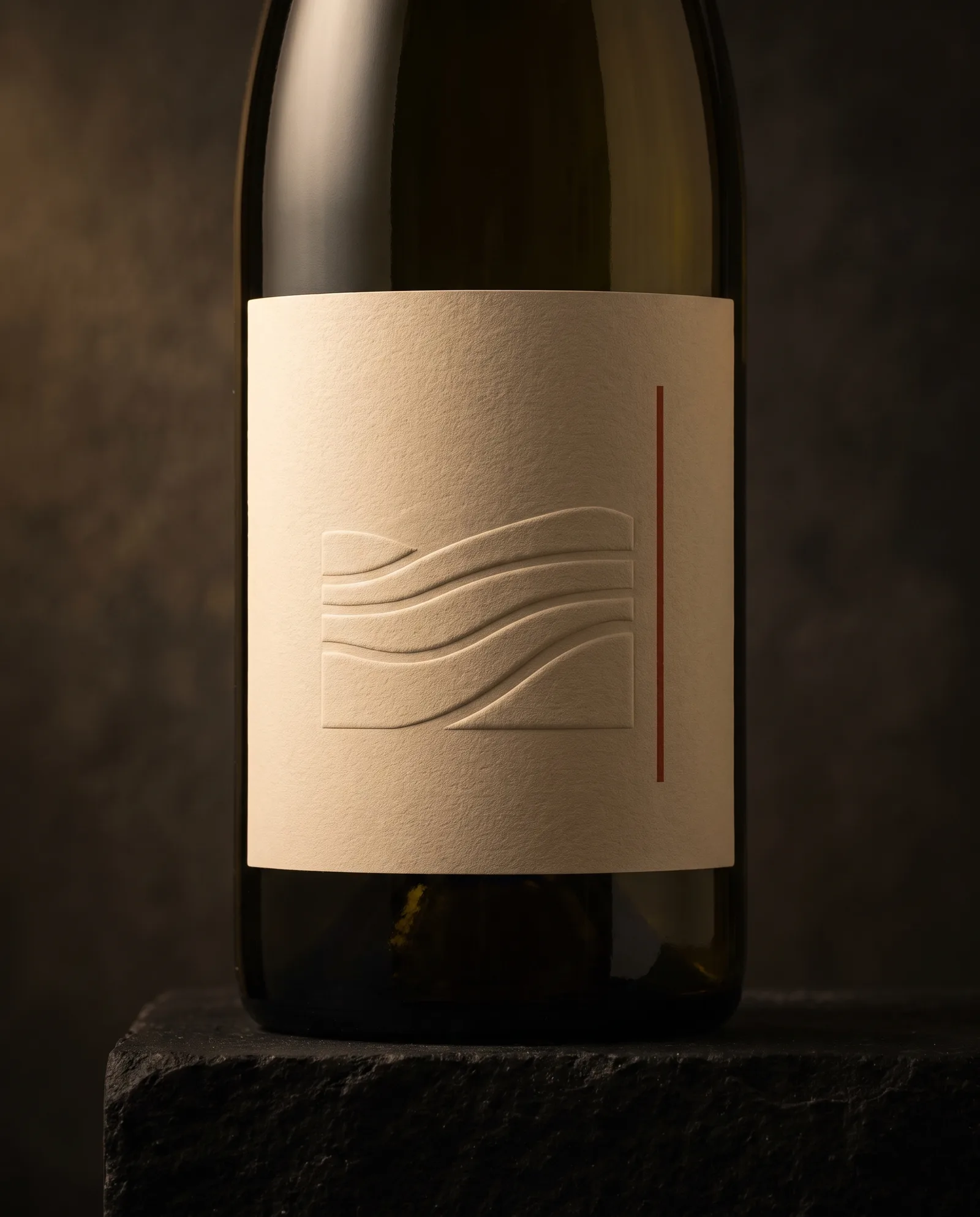
- Keep the deep relief in the centre panel. The glued perimeter has to stay flat, or the label lifts where the bottle curves away. Our Quinta da Serra design exploration puts a terraced hillside into four emboss levels and keeps the deepest level inside the centre panel for exactly this reason. It's a design exploration, not a client job, and it's embossed without foil.
- Relief needs room. An embossed shape reads only by its shadow. Embossed strokes need at least 0.5 mm, gaps 1 mm, and embossed type 10 pt in a medium or bold weight. A hairline embosses to nothing, so we emboss the bold parts and keep the fine detail flat.
A sculpted, multi-level die is hand-engraved in brass, so it costs more and takes longer than a flat foil die. It's worth it for the hero label of a range. It's rarely worth it for a 2 in jar lid.
Rolls or sheets: tell us how they go on
Both work. Pick by how the labels get applied.
- Sheets suit hand application and smaller runs. Each label is kiss-cut, so it peels off the backing with a fingernail.
- Rolls suit a labelling machine, or anyone applying hundreds at a sitting. We wind the roll to your applicator's spec. Send the core size and the wind direction with your quote request. Those two numbers are the difference between a roll that runs and a roll that sits in a box.
If you don't know your wind direction, send a photo of a roll your machine already runs, label side out, and we'll read it from that.
Luxury labels by product
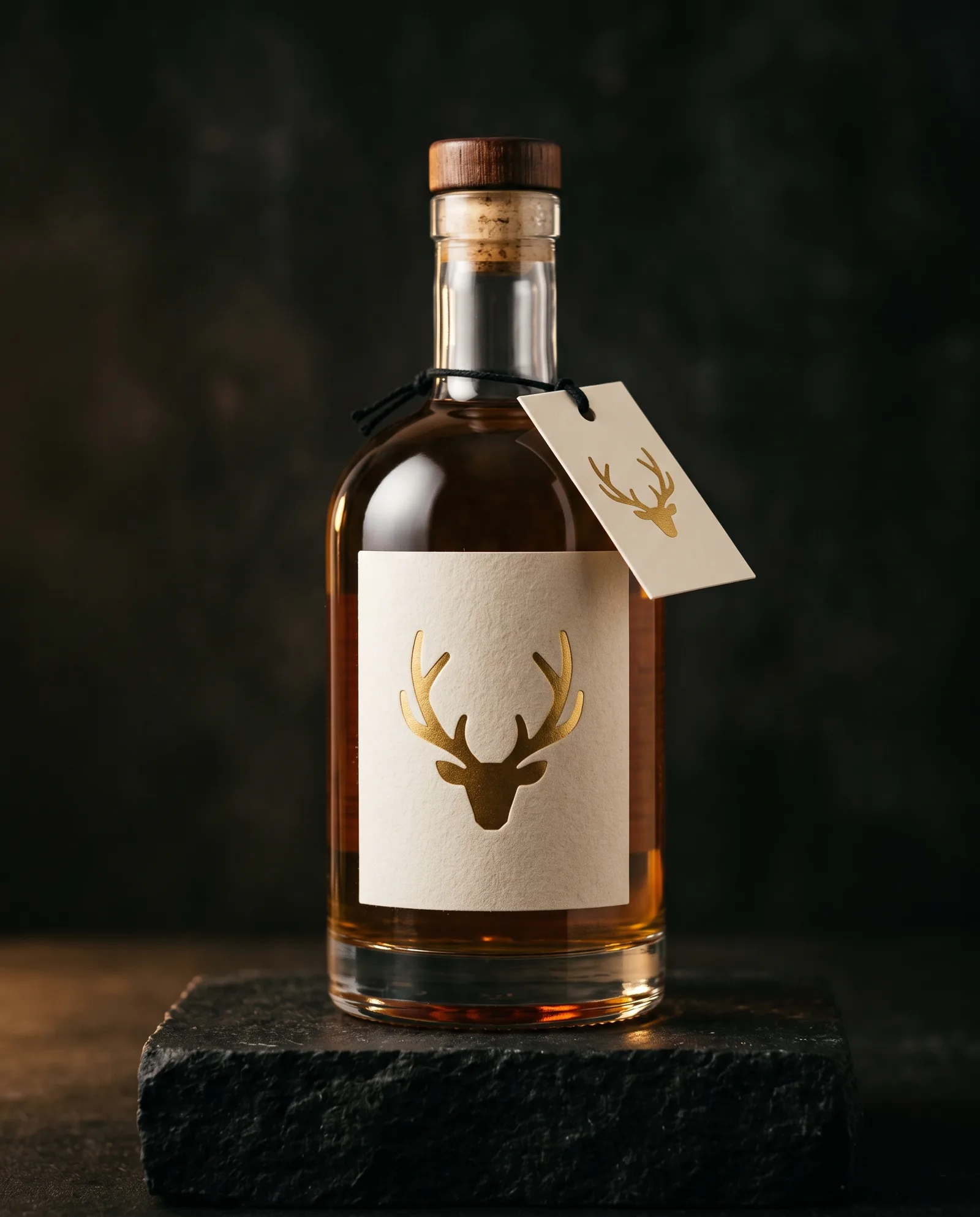
Foil product labels earn their keep where the product stays dry and gets picked up. Here's how we'd spec four common ones.
Wine and spirits. Spirits and reds live on a shelf, which makes them the natural home for foil on felt or laid paper. Whites, rosés and sparkling spend time in an ice bucket, and a paper label will soften and lift there. For those we'd talk film, or keep the foil on a neck label or capsule band that stays above the ice.
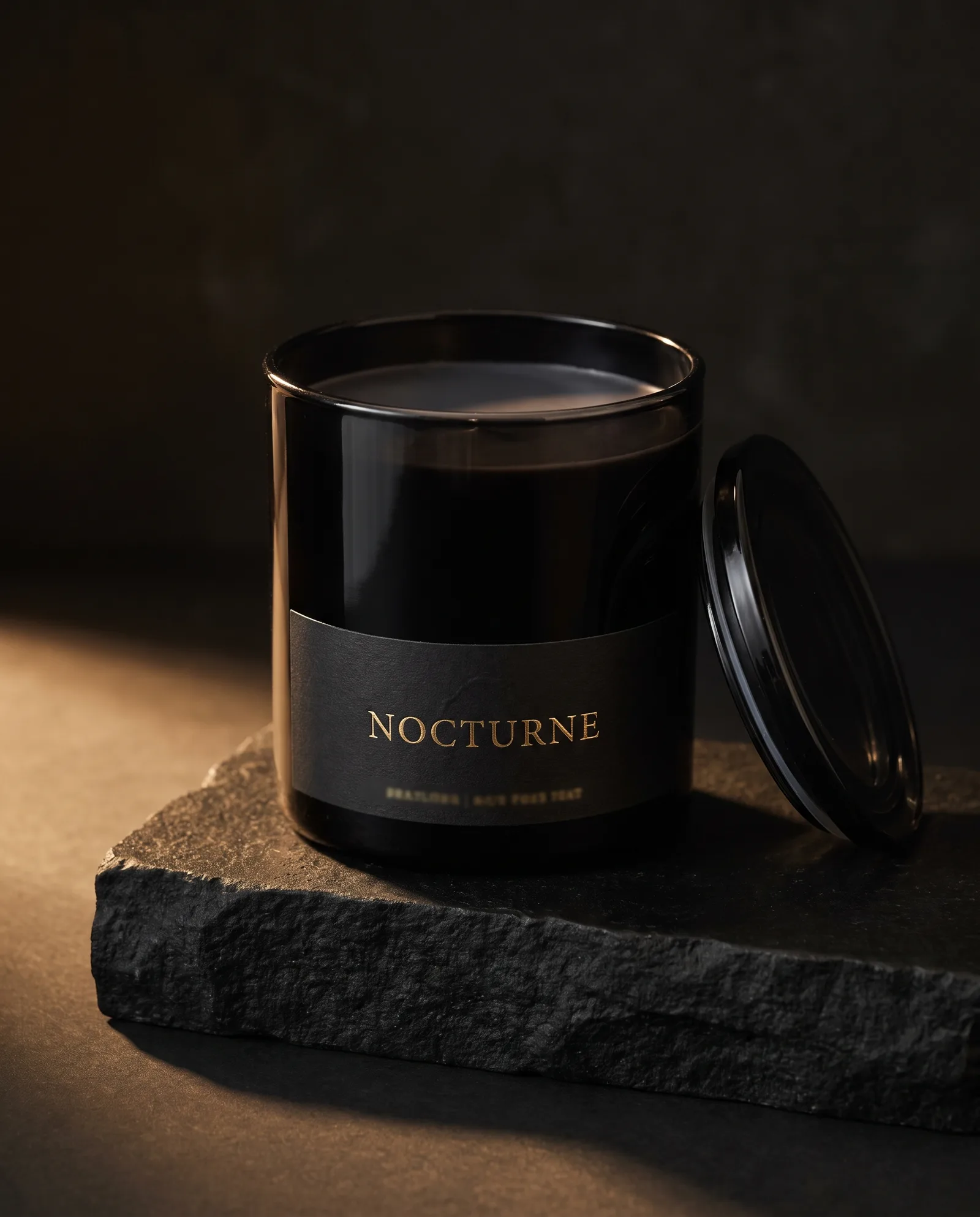
Candles. The glass warms as the candle burns, and warmth is what tests an adhesive. For luxury candle labels, the safest foil placement is the lid, the box and a wrap or sleeve. On the vessel itself, tell us it's a candle so we spec the adhesive for it, and keep the label low on the glass, away from the hot rim.
Cosmetics. Cosmetic product labels meet fingers, creams and oils. On a carton or a dry-use bottle, foil on smooth or felt paper is beautiful. On a pump bottle that lives by the bath, use film. Keep foil out of the spot where the hand grips, because that's where it scuffs first.
Coffee and dry goods. You don't need a custom printed pouch. A foil label on a stock kraft or foil pouch carries the brand, and an arch or round die gives it the presence of a badge. Our coffee pouch design exploration shows that route: an arch die-cut label on deep blue uncoated stock, with a blind emboss and copper foil.
Closing a box or a fold of tissue rather than naming the product? That's a foil sticker.
Artwork rules for foil labels
Foil is binary: an area is fully foiled or it's bare paper. These rules decide whether your label survives the press:
- Lines and gaps at least 0.6 mm. Thinner foil breaks up on press, and narrower gaps fill in.
- Foil type at 7 pt or larger. 8 pt is safer, type knocked out of a foil shape needs 10 pt, and high-contrast serifs (thin hairline strokes) need 12 pt. Ingredients, legal lines and anything smaller go in ink.
- Foil never sits on top of ink. We knock the ink out under the foil and leave a 1 mm gap between them. Foil and full colour share a label side by side.
- No gradients, shadows or photos in foil. Each foil becomes one solid tone.
- Foil 3 mm inside the cut line, or run it 3 mm past. A foil border that stops 1 mm short of the edge looks crooked once the cut shifts slightly.
- Barcodes and QR codes print in flat dark ink on a light ground, never foil or emboss, with foil kept at least 1 mm clear, so scanners can read them. On a black or dark label, that means a back label on light stock.
- Soft corners on custom shapes. Tight inside corners and narrow necks tear when the label is peeled off its liner, so we soften the radius slightly on the die. Nobody notices it on the shelf; everybody notices it on the applicator.
You don't need to get this perfect yourself. A person checks every file before the die is made, and tells you in one line anything we changed and why. If the label needs drawing to a real container, our label artwork service lays it out against the actual bottle and die, from $450. For the long version of the foil rules, read our foil artwork guide.
Labels from the studio
Two client label jobs and two design explorations, labelled as what they are:
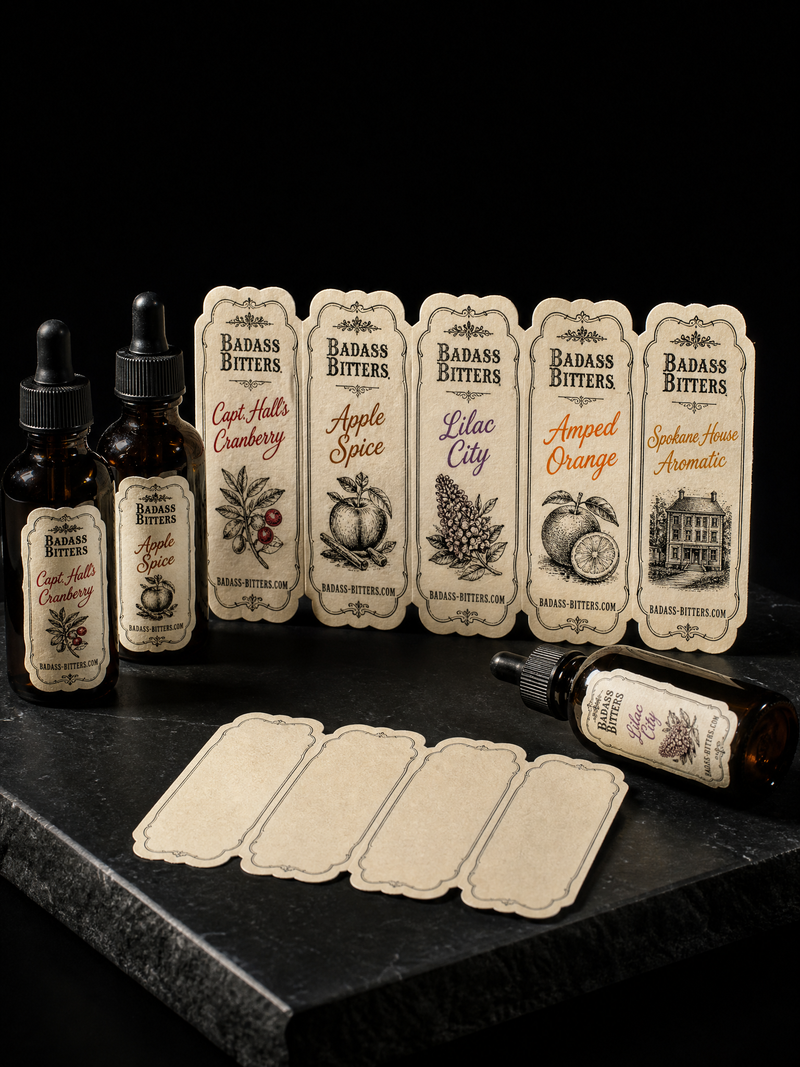
Client job, letterpress
Badass Bitters
Five 2 × 4 in bottle labels on uncoated cream label stock, in two-colour letterpress. One black plate stayed on press across the set, and only the accent colour changed per flavour, with a scalloped kiss-cut. There's no foil on these, but the lesson carries over to foil: a shared plate or die across a range keeps five labels reading as one brand.
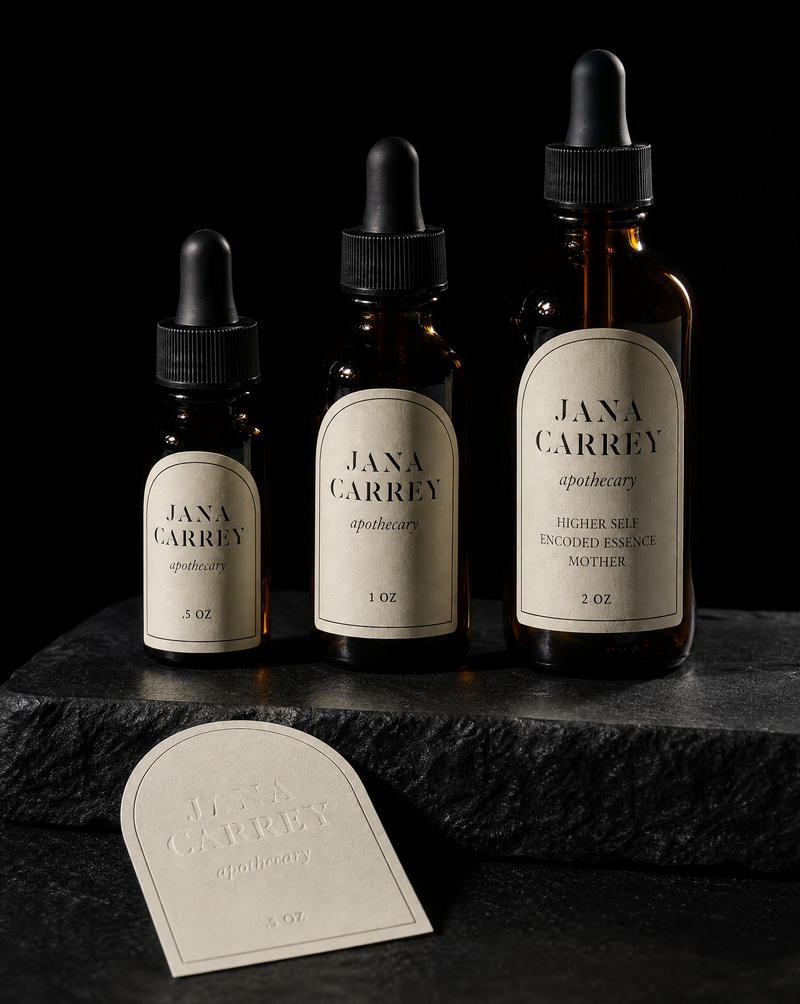
Client job, die cut
Jana Carrey Apothecary
Arch-topped labels in three heights for dropper bottles, using one arch radius at every size so the family holds together. The same shape thinking applies when the arch carries foil.
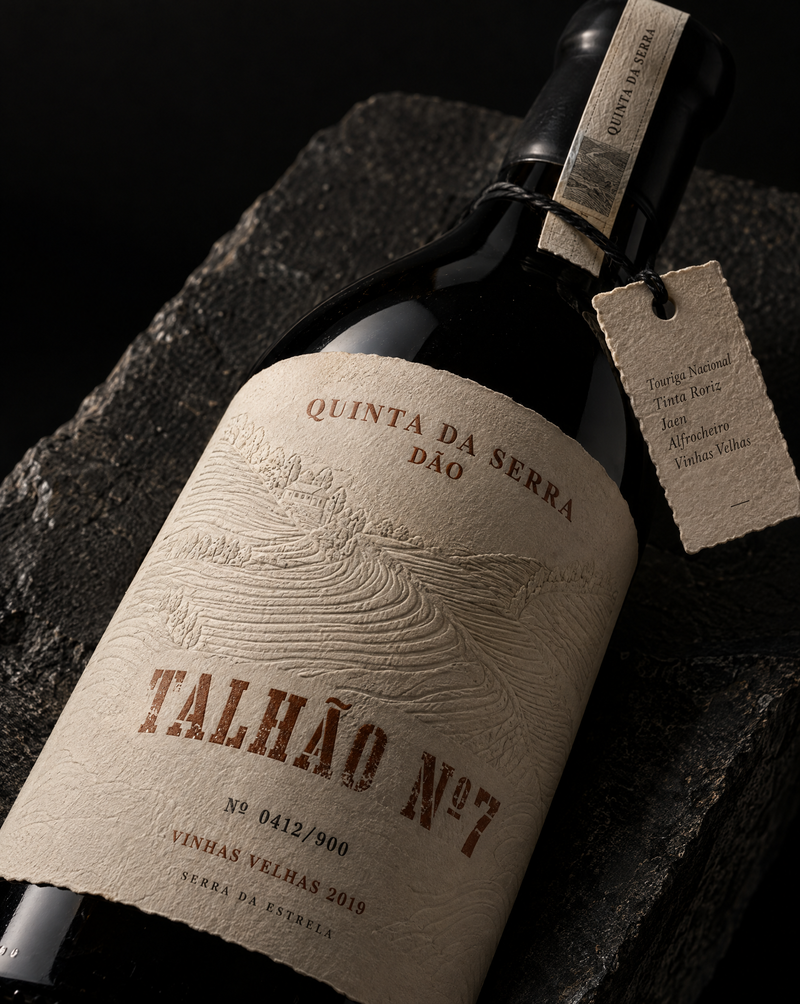
Design exploration
Quinta da Serra
A four-level emboss on a cotton wine label.
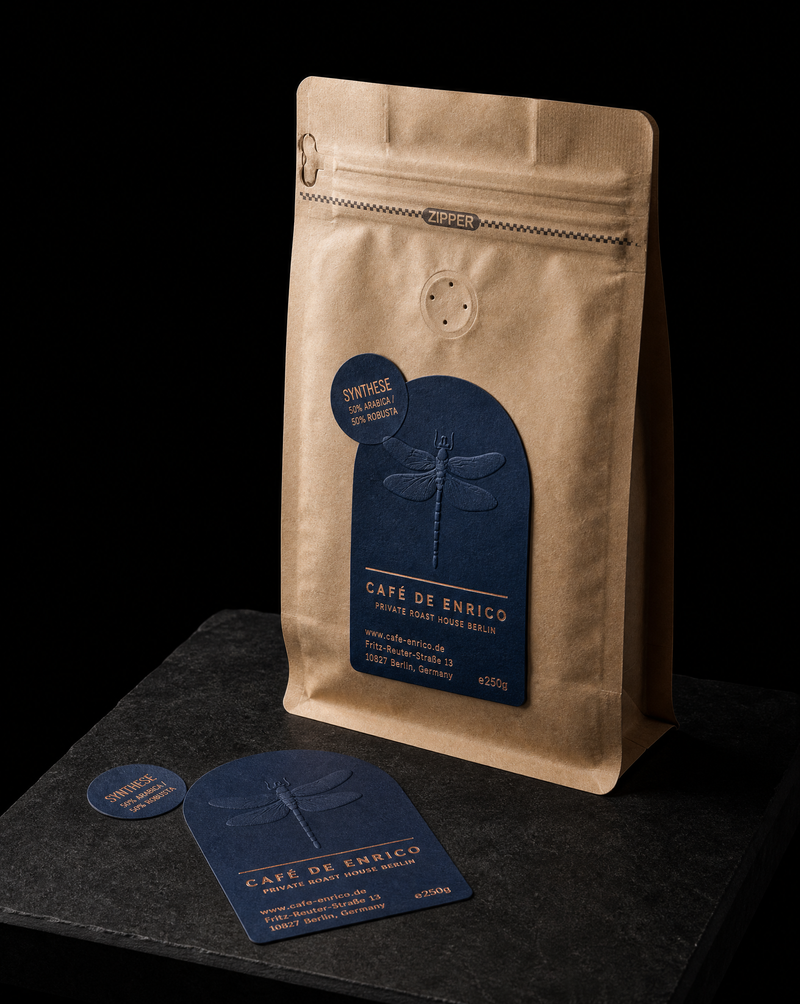
Design exploration
Café de Enrico pouch
Unsolicited redesign. Three label directions for a coffee pouch, one of them foil and emboss.
How ordering works
1
Tell us the product and the quantity.
Ask Peppermint Studio for a price on your build.
2
Send your artwork.
We check every file and send a free digital proof. Nothing is stamped until you approve it.
3
Production:
about 3 weeks after you approve the proof.
4
Delivered
on rolls wound to your spec, or on sheets. Shipping is free within the continental US.
Lead times are estimates, not guarantees. If you're working to a launch date, tell us when you order and we'll say honestly whether it's realistic before you pay.
Foil label questions
What is a foil label?
A foil label (also called a foil stamped label) is a product label where the metallic part is real foil. A heated metal die presses a thin film of gold, copper, silver or pigment foil onto bare label paper, so the mark is bright and sharp and the paper stays matte around it. It's different from a metallic-ink label, which has a soft satin shimmer, and from a label printed on metallic film, which shines all over. We make foil labels the stamped way.
Are foil labels waterproof?
Not ours on paper. Textured and uncoated label papers wick moisture, so a foil label on paper will soften and lift in an ice bucket, a fridge or a shower. For wet or chilled products we use a white or clear BOPP film label with a permanent adhesive. On film we get the shine from metallic ink or a metallised film rather than hot foil, because foil adhesion on some films is unreliable. That gives a satin shimmer, not a mirror.
How much do custom foil labels cost?
Every foil label run needs its own foil die, and the stock, size, foil and any emboss all move the price, so we quote foil labels to your spec. Peppermint Studio can price your exact label in a few minutes, before you pay anything.
What's the minimum order for foil labels?
250 labels. Every run needs its own foil die and press setup, and that work costs the same for 50 labels as for 250, so below 250 the price per label stops making sense. Larger runs are quoted.
How long do custom foil labels take?
Plan on about 3 weeks of production after you approve the proof, then transit. That's an estimate, not a guarantee. If you're working to a launch, tell us the date when you order and we'll say honestly whether it's realistic.
Can you supply foil labels on rolls for my labelling machine?
Yes. We wind rolls to your applicator's spec, so send the core size and the wind direction with your order. If you're not sure of the wind direction, send a photo of a roll your machine already runs, label side out. Sheets are available too, for hand application and smaller runs.
Can foil labels be a custom shape?
Yes: arches, ovals, shields, scallops, or your mark's own outline. We cut a die to the shape, and we soften very tight inside corners and narrow necks slightly so the label doesn't tear coming off the liner. Custom shapes are quoted, because the die is made for you.
Can foil and full-colour printing go on the same label?
Yes, side by side, never stacked. Foil won't bond on top of ink, so we knock the ink out under the foil and leave a clean 1 mm gap between them. Full colour on textured and uncoated paper prints a little softer than on glossy stock. That suits most luxury labels, but if your label is photo-heavy, tell us and we'll suggest a smoother paper.
Can a foil label be embossed?
Yes, and for spirits and candles it's the build we'd recommend. A combination die stamps the foil and raises the relief in register, so the foil sits exactly on the raised shape. Keep the deepest relief in the centre of the label so the glued edges stay flat on a curved bottle. Embossed strokes need at least 0.5 mm and embossed type 10 pt in a medium or bold weight.
What's the best label for a luxury candle?
Foil on a cotton-look or black uncoated label is the classic luxury candle look, and it's at its safest on the lid, the box and a wrap or sleeve. On the glass itself, warmth from the burning candle tests the adhesive, so tell us it's a candle and keep the label low on the vessel, away from the hot rim. If the candle lives in a bathroom, use a film label on the glass and save the foil for the packaging.
Which foil colours can I choose, and can you match my brand colour?
Gold, copper and silver are where most label briefs land, and white pigment foil gives a crisp white on dark stock. Our sample kit's swatch card shows all 40 foils we keep on the shelf. No foil is an exact match to a flat brand colour, because foil is metal film that reflects light while a swatch is ink that absorbs it. We match your colour to the nearest foil and tell you how far it moved.
What artwork do you need for foil labels?
Vector artwork (AI, EPS, SVG or a vector PDF) is best, with the foil on its own layer. Keep foil lines and gaps at least 0.6 mm and foil type at least 7 pt, with no gradients, and put barcodes in flat ink. If you only have a PNG or an AI image, our designers rebuild it as clean vector. If the label still needs designing to a real container, our label artwork service starts from $450.
Can I see samples before I order?
Our sample kit is $8, with a $10 credit toward your first order. It holds samples of our papers and finishes, plus a hot foil swatch card with 40 stamped foils, so you can hold a foil against your own bottle in your own light. It doesn't include label stock today. Every label order also gets a free proof before anything is stamped.
What's the difference between a foil label and a foil sticker?
It's the same craft, aimed at different jobs. A foil label names the product: it's sized for a bottle, jar or box, carries ingredients and small print in ink, and can come on a roll for a machine. A foil sticker closes things: a box seam, a fold of tissue, the back of an envelope. If you need seals, start on the foil stickers page.
Why do foil labels cost more than printed labels?
Because there's more physical setup. A printed label is ink laid down from a file. A foil label needs a metal die made from your artwork, a separate press pass with heat and pressure, and a person checking the foil layer before the die is cut. That setup costs about the same for a small run as a large one, so the price per label drops quickly as the quantity grows. If the budget is tight, keep one foil element and print everything else in ink. That's where foil does the most work for the money.
Start with the product and where it lives
Send Peppermint Studio your logo and a photo of the bottle, jar or box, and tell us where it sits and when you need it. You'll get a stock and foil recommendation, a price for your quantity and a straight note on anything that won't stamp cleanly, before you pay.
Want to hold the foils first? The $8 sample kit includes our 40-foil swatch card.