100% cotton, 16 to 48pt
Cotton Business Cards
Soft, heavy, uncoated. Cotton takes an impression better than anything else we stock, and it holds foil with a clean edge.
One-colour letterpress on 48pt cotton from $340 for 250
About 3 weeks after proof approval, plus transit (estimate).
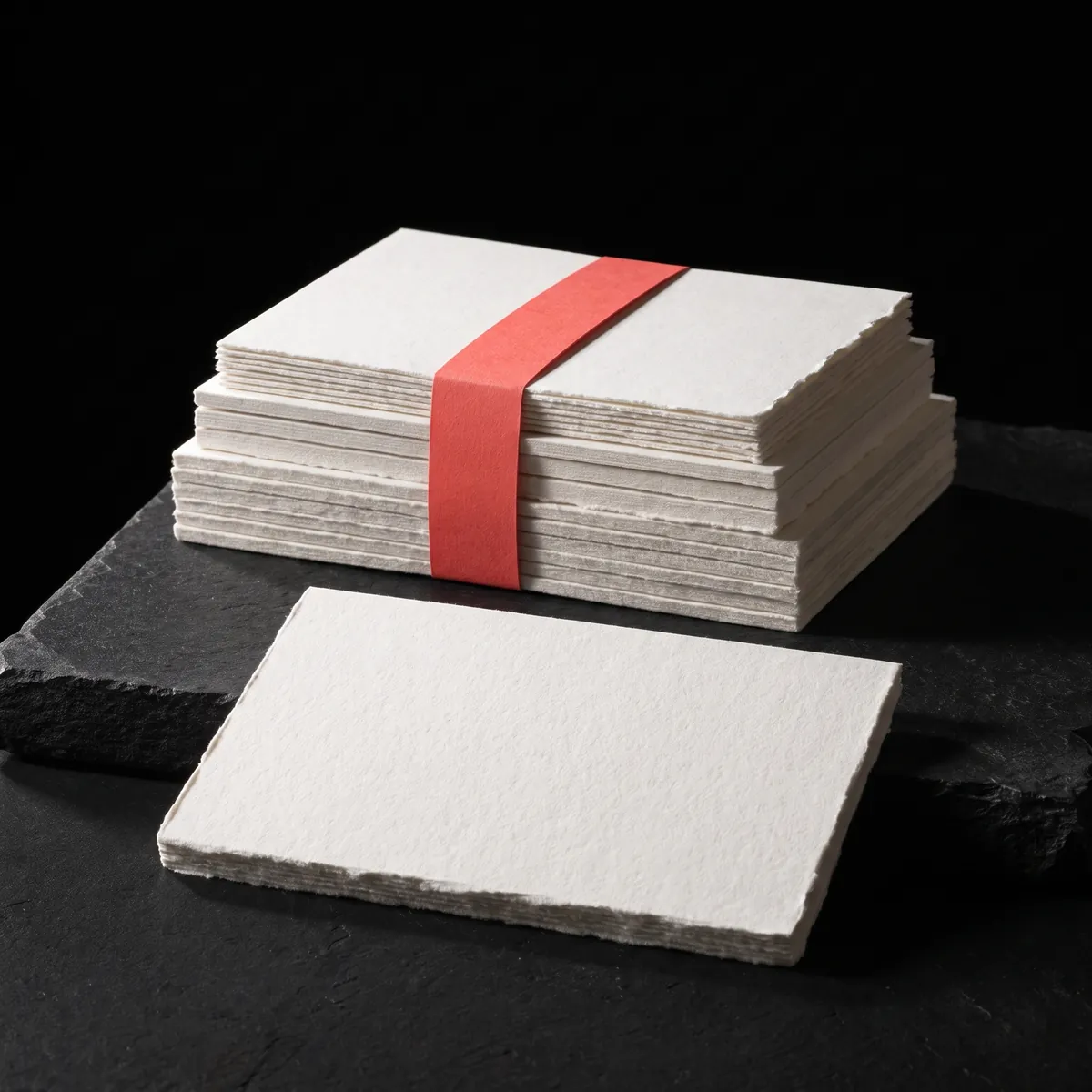
Cotton business cards are printed on paper made from cotton fibre instead of wood pulp, so the sheet is soft, toothy and heavy in the hand. We run it at 16, 32 and 48pt, press it with letterpress, hot foil or a blind deboss, and paint the edges in any Pantone. One-colour letterpress on 48pt cotton (our standard; 32pt is also available) starts at $340 for 250, with a free proof. Expect about three weeks after you approve the proof, plus transit.
Choose your weight
Thickness decides what the card can carry. We recommend 32pt for most cotton cards. It's about 0.8 mm, roughly a credit card, rigid enough that it doesn't flex when it's handed over, and thick enough for a clean painted edge and a foil or deboss on one side.
Go to 48pt when the card is meant to be an object. At about 1.2 mm the edge stops being a line and becomes a band of colour, and the sheet has room for a deep letterpress bite. If both faces carry an impression, we press each sheet separately and bond them, so one side never fights the other. It's also harder to slip into a wallet, and it costs more at every quantity. If it doesn't need to be that thick, 32pt is the better spend.
16pt is the thin tier: mailers, inserts and RSVP cards, or a run where budget leads. It still takes letterpress, with a lighter impression. The handmade deckled rag is a different animal: a hand-formed sheet with a feathered edge on all four sides and the deepest bite of anything on our shelf, best kept to simple type and line art.
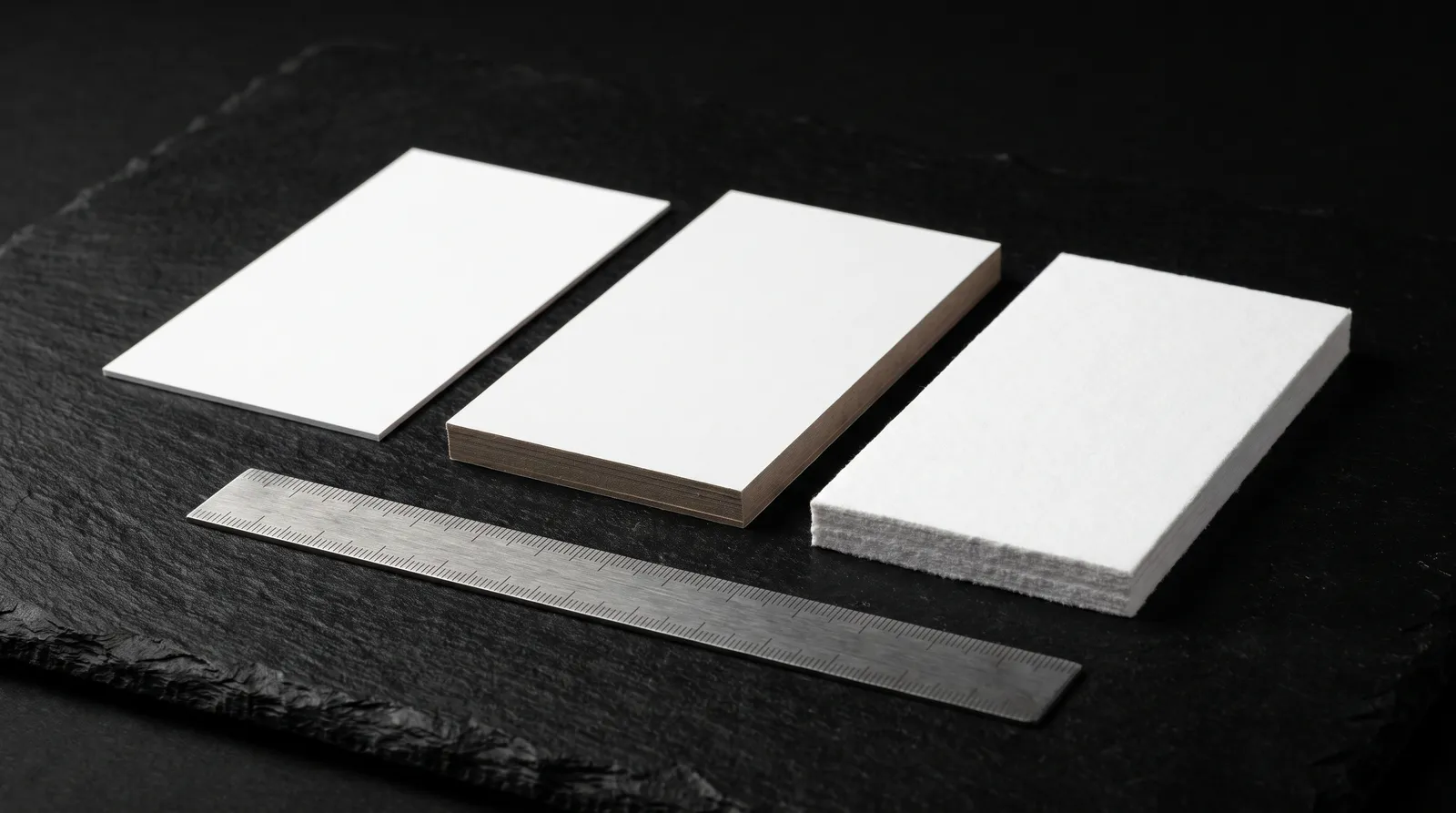
| Weight | Thickness | In the hand | Best for | From, 250 cards |
|---|---|---|---|---|
| 16pt cotton | about 0.4 mm | Flexible, softer than a standard card | Light letterpress, inserts, short budget runs | Quoted per job |
| 32pt cotton (our pick) | about 0.8 mm | Rigid, roughly a credit card | Hot foil, blind deboss, painted edges, most cards we make | $215 printed flat; hot foil from $310 |
| 48pt cotton | about 1.2 mm | A slab; the edge reads as a band | Deep letterpress, two-sided impressions, statement edges | $340 with one-colour letterpress |
| Handmade cotton rag, deckled | 300gsm sheet, deckled edges | Soft, cloudy, irregular | The deepest letterpress bite; type and line art only | Quoted per job |
Heavier builds are available by request. Thickness in points measures the paper; it has nothing to do with type size.
What cotton does well
Cotton fibres are long and soft, so the sheet compresses under pressure instead of cracking. That single property is why the pressed processes look their best here. Each one below has a rule, and we'd rather tell you now than at proof.
Letterpress
An inked plate is pressed hard into the sheet, pushing the ink down with a soft shoulder around every letter. On cotton you find the type with your thumb before you read it. Letterpress ink is translucent and hand-mixed to a Pantone target, so it reads truest on white and natural shades. The rule: big solid areas print with a suede-like mottle on cotton. Keep floods small, or let a coloured sheet carry the colour instead. And a deep bite shows through the back of a single sheet, so for letterpress on both faces we bond two sheets (duplex). Our letterpress cards are 48pt cotton as standard, and 32pt is also orderable when you want a slimmer card.
letterpress business cardstwo-colour letterpress on cottonduplex cotton
Hot foil
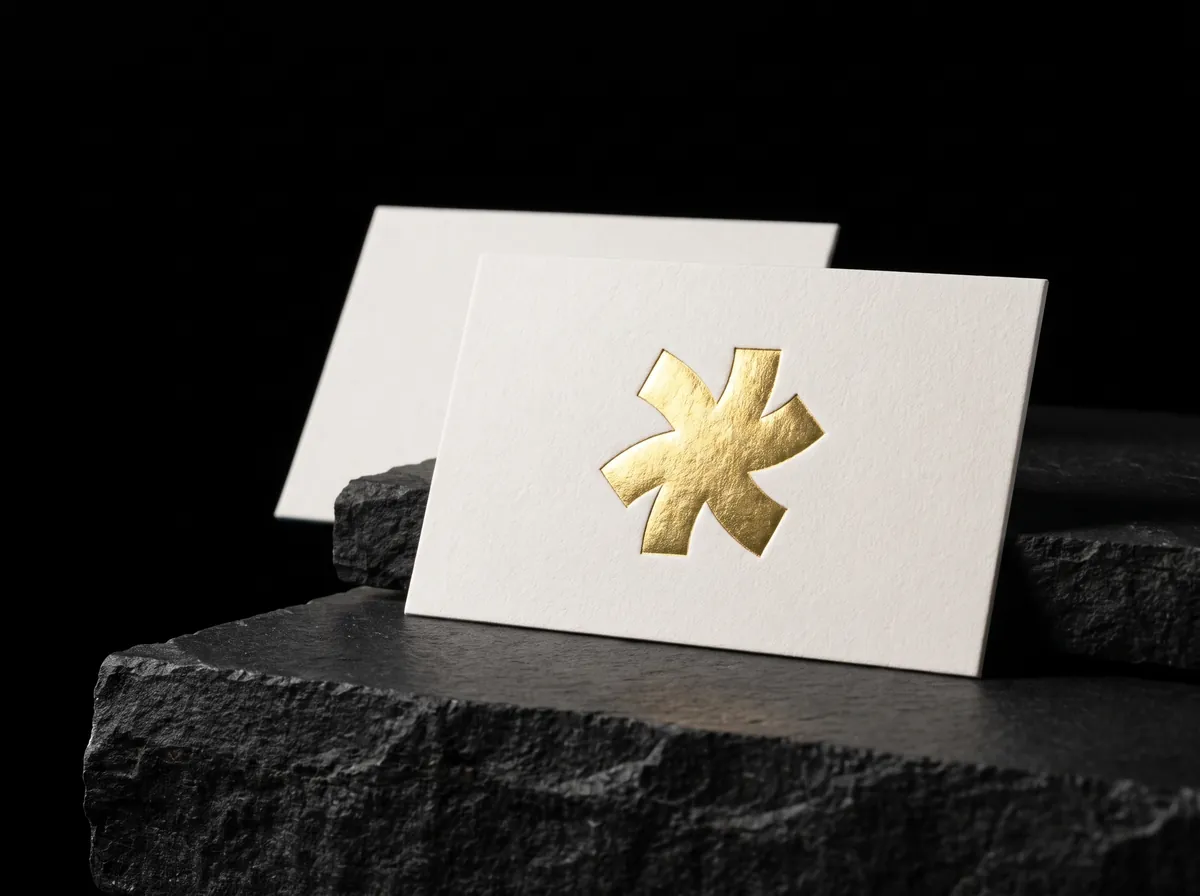
A heated metal die presses a foil film onto the surface. On a coated card it sits flat on top; on cotton the die sinks in slightly, so the foil sits in a shallow bite with a crisp edge. Two rules. Foil lines and gaps need to be at least 0.6 mm, or they break up or fill in, and a gradient becomes one solid tone. And foil won't bond on top of ink, so foil and letterpress share a card in separate areas, never stacked. Matte foils sit calmly in the fibre; holographic foil looks softer on cotton's texture than on a smooth sheet.
Blind deboss and emboss
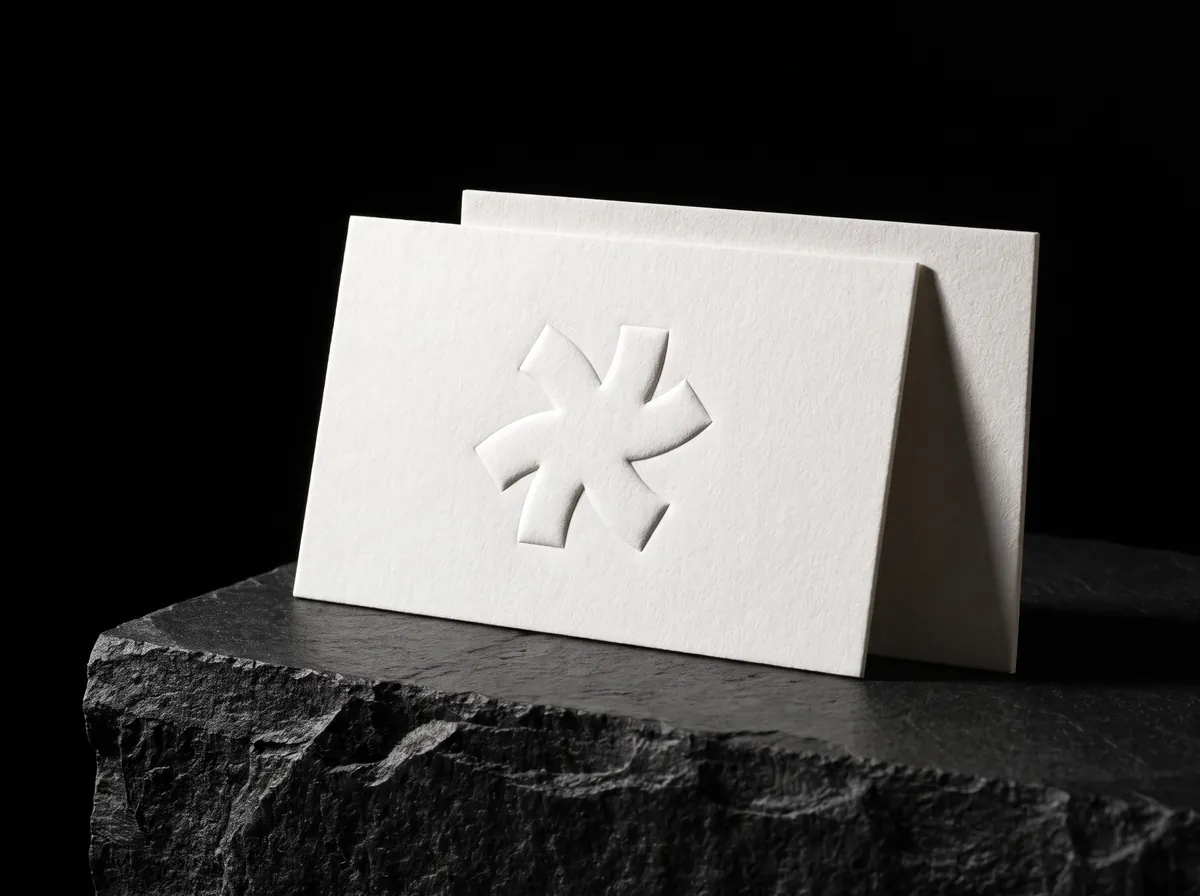
No ink at all: a die presses your mark into the card (deboss) or raises it (emboss), and it reads only by shadow. Cotton holds the edge of the impression cleanly. Design for silhouette: strokes of at least 0.5 mm, gaps of 1 mm, and text of 10pt or larger in a medium or bold weight. On a single sheet the back carries a mirror of the impression, which is either a feature or a problem depending on what's printed there. If the back matters, we bond a second sheet behind it. On black or very cotton a blind impression is barely there; if it has to be read, we put foil in the impression.
Painted edges
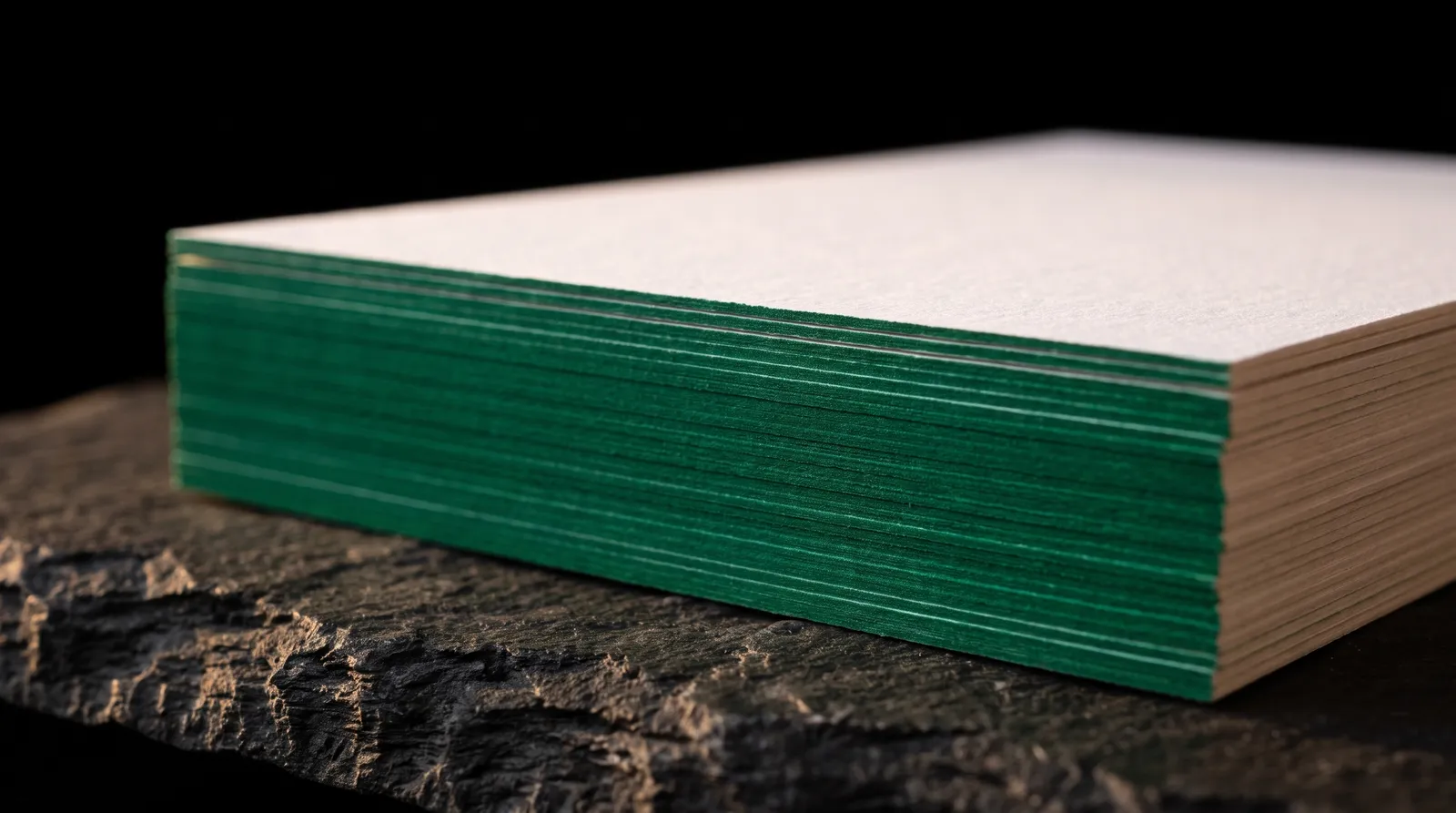
The finished cards are clamped in a stack and the edge is painted by hand, matched to a Pantone. On 32pt it reads as a clear line of colour; on 48pt it's a band. We match the paint to the uncoated Pantone book, and it reads slightly deeper on cotton than on the swatch. We keep foil 3 mm back from a painted edge so the paint lands cleanly. Gilded (foiled) edges work with square or rounded corners, and on cotton our press team confirms each gilded run before we promise it, because soft fibres can take edge foil unevenly. On black or cotton we foil the edge rather than paint it.
What cotton won't do
Cotton is uncoated, and a few things behave differently on it. Here's what we build instead.
- Full-colour photographs. Process colour prints softer on cotton, and fine photographic detail goes slightly dreamy. For photo-led cards we'd use silk or soft-touch, or bond a printed face to a cotton back.
- White ink. It sinks into the sheet. Solid white or pale colour on a dark card comes from white pigment foil.
- Big flat floods of letterpress colour. They mottle. A coloured sheet or a coloured back ply gives you the flat field.
If your design leans on one of these, say so in the brief. There's usually a version that keeps the idea.
Cotton colours
Our house cotton comes in three shades with the same texture: a natural white that leans slightly warm, a clean bright white, and a creamier ivory. For colour, we stock the Gmund Cotton range in seven shades, from Max White and Linen Cream to New Grey and two blues. For thicker cards in a colour, we confirm the build on your quote.
The landmine with colour is ink. Letterpress ink is translucent, so a coloured sheet shifts it: blue on cream goes slightly green, and light inks lose their brightness on grey. Foil is opaque, so it keeps its own colour on any shade, and on coloured or dark cotton we usually let foil carry the design. The one exception is dark foil on a dark sheet: it reads as a quiet sheen, not contrast. If you need a pale colour on a dark card, it's white pigment foil, not ink.
- House cotton: natural white, bright white, ivory
- Max White
- Linen Cream
- Shiny Cream
- Natural Beige
- New Grey
- Power Blue
- Gentlemen Blue
Screen colour is an approximation. Paper shifts under different light, so order samples before you lock a shade.
Order the sample kitCotton vs other card stocks
If the card should feel made, cotton is the best material for business cards: it takes an impression better than anything else and it takes a pen. If it has to carry photographs, a laminated stock does that job better. This is how the four we're asked about most compare.
| Cotton | Colorplan | Soft touch | Silk laminate | |
|---|---|---|---|---|
| Surface | Soft, toothy, uncoated | Smooth, uncoated, dyed through | Velvet laminate | Smooth satin laminate |
| What it does best | Letterpress, hot foil, blind deboss, painted edges | Colour: dyed through, so the cut edge matches the face | Raised spot UV, foil, full colour | Full-colour photos, spot UV, foil |
| Thickness we run | 16, 32, 48pt | 350gsm sheet; thicker by bonding | 16pt, 32pt | 16pt, 32pt |
| Letterpress | Yes, the best | Yes | No | No |
| Emboss / deboss | Yes, the cleanest | Yes | No (the laminate won't take it) | No |
| Spot UV | Yes | No (clear foil instead) | Yes | Yes |
| Writable with a pen | Yes | Yes | Not reliably | Not reliably |
What cotton business cards cost
Prices below are live and include a free proof. Most of the cost on a pressed card is set-up: plates, dies and hand-mixed ink are paid for once, then each card is cheap. That's why 500 cards cost much less than twice 250. Each extra ink colour or foil location adds a plate and a press pass, so we price the full idea first and show you what each removal saves.
| Spec | 250 | 500 | 1,000 |
|---|---|---|---|
| 32pt cotton, printed flat | $215 | $310 | $485 |
| 32pt cotton + hot foil, one side | $310 | $410 | $620 |
| 32pt cotton + hot foil, both sides | $390 | $515 | $805 |
| 48pt cotton, printed flat | $320 | $465 | $755 |
| 48pt cotton + letterpress, one colour | $340 | $535 | $920 |
- Add-ons at 250: painted edge Get a price · second letterpress colour or a printed back $70 · blind deboss with letterpress $50.
- Lead time: about three weeks after you approve the proof, plus transit. These are estimates, not delivery dates. If you have an event, tell us the date when you start; a rush moves your job up the queue, but it can't promise a delivery day.
Cotton work from the studio
Real jobs on cotton, each with the decisions that shaped it. Open one to see the full spec.
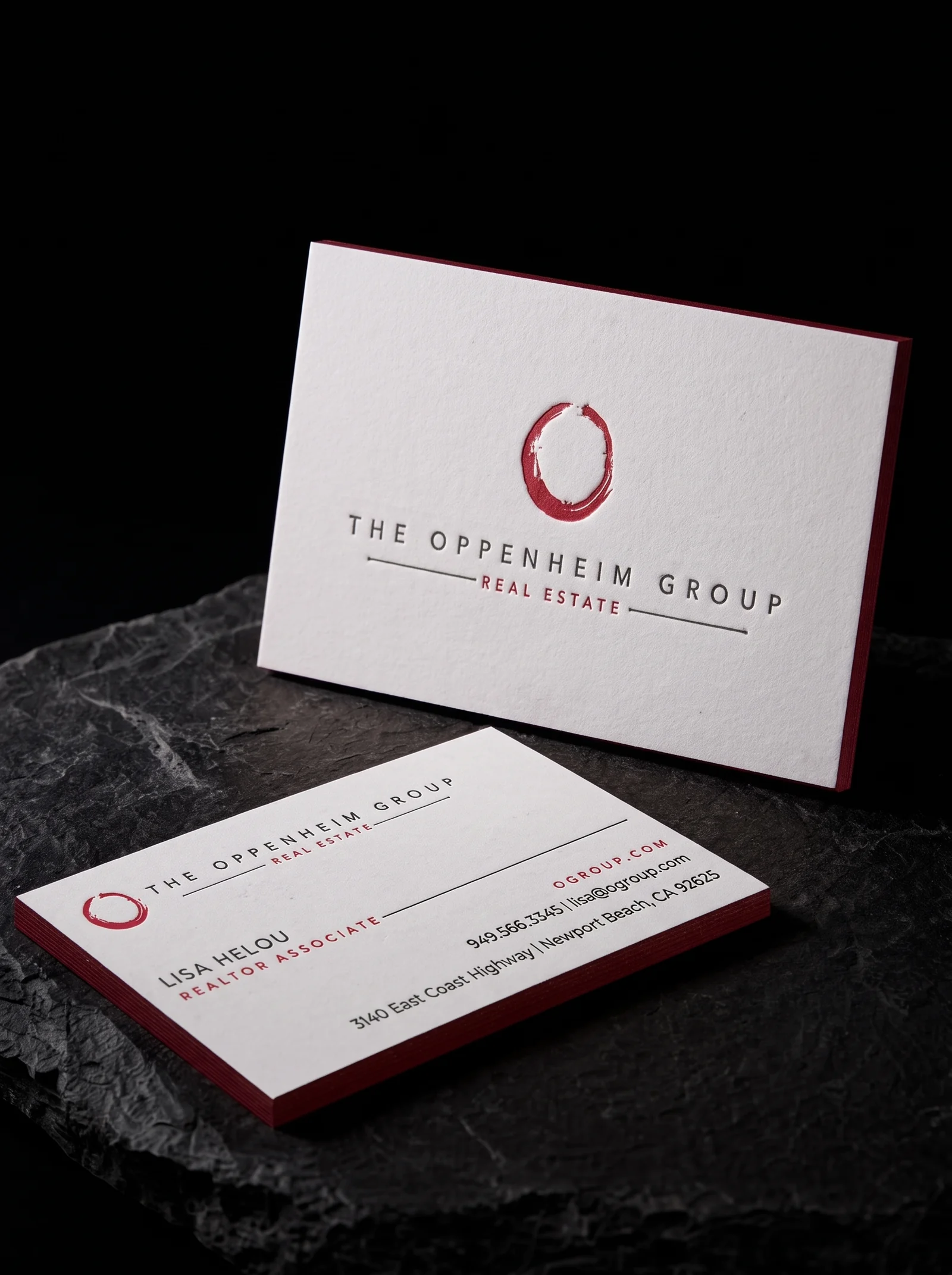 The Oppenheim Group. Two-colour letterpress on bright white cotton, with a Pantone-matched red painted edge.
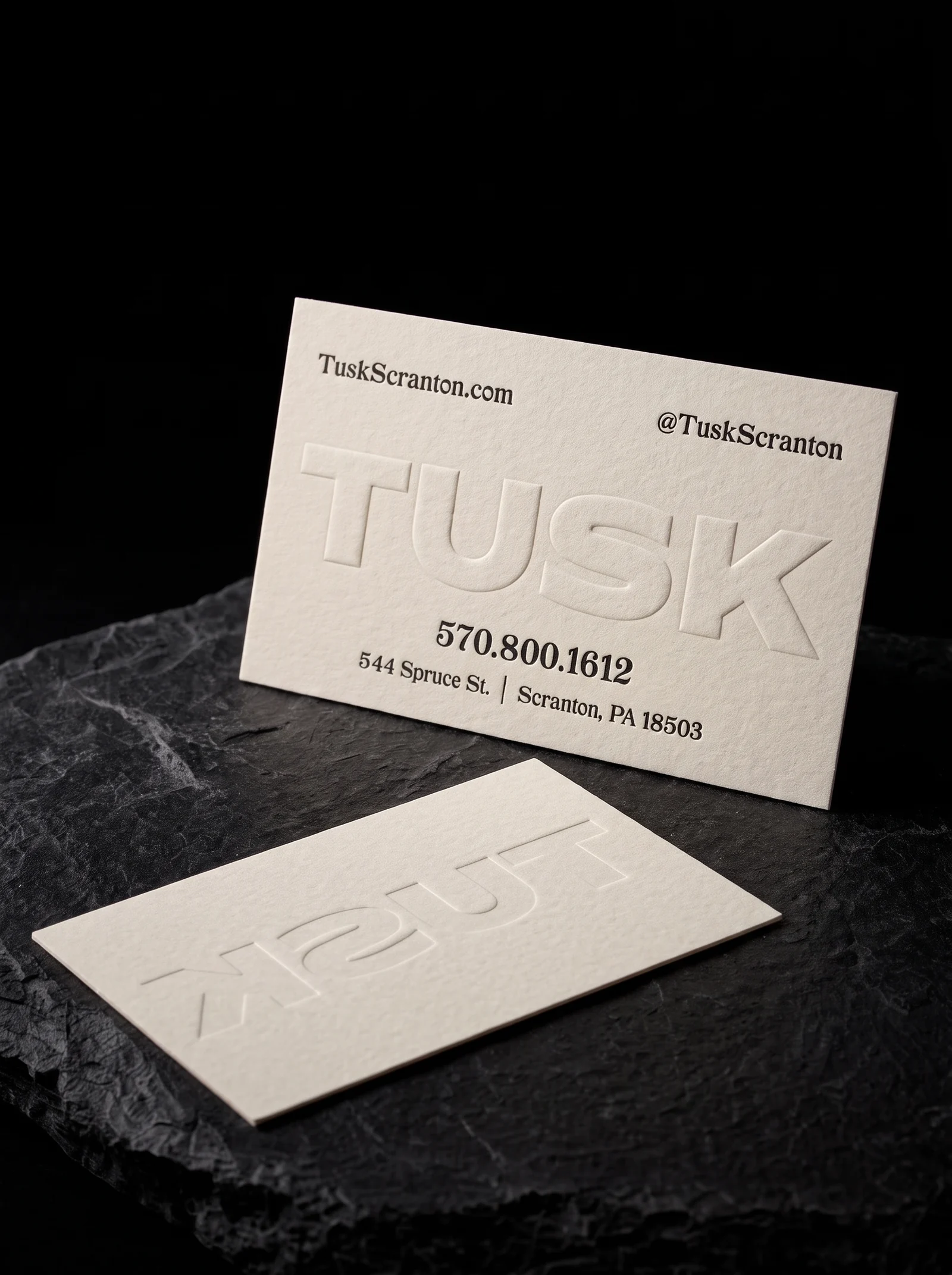 TUSK. A large blind emboss of the name, with small black letterpress type pressed in beneath it, on off-white cotton.
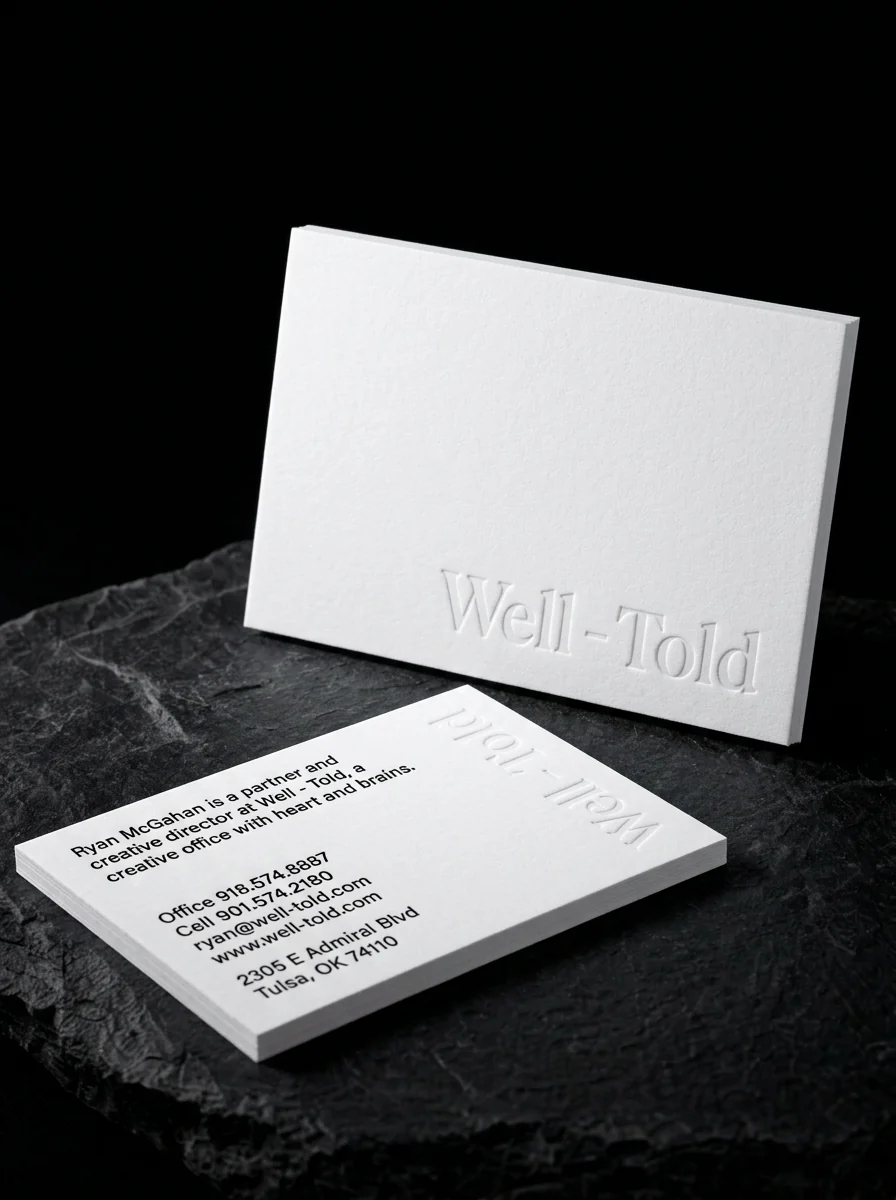 Well-Told. No ink on the front: the agency name blind embossed vertically on a white card.
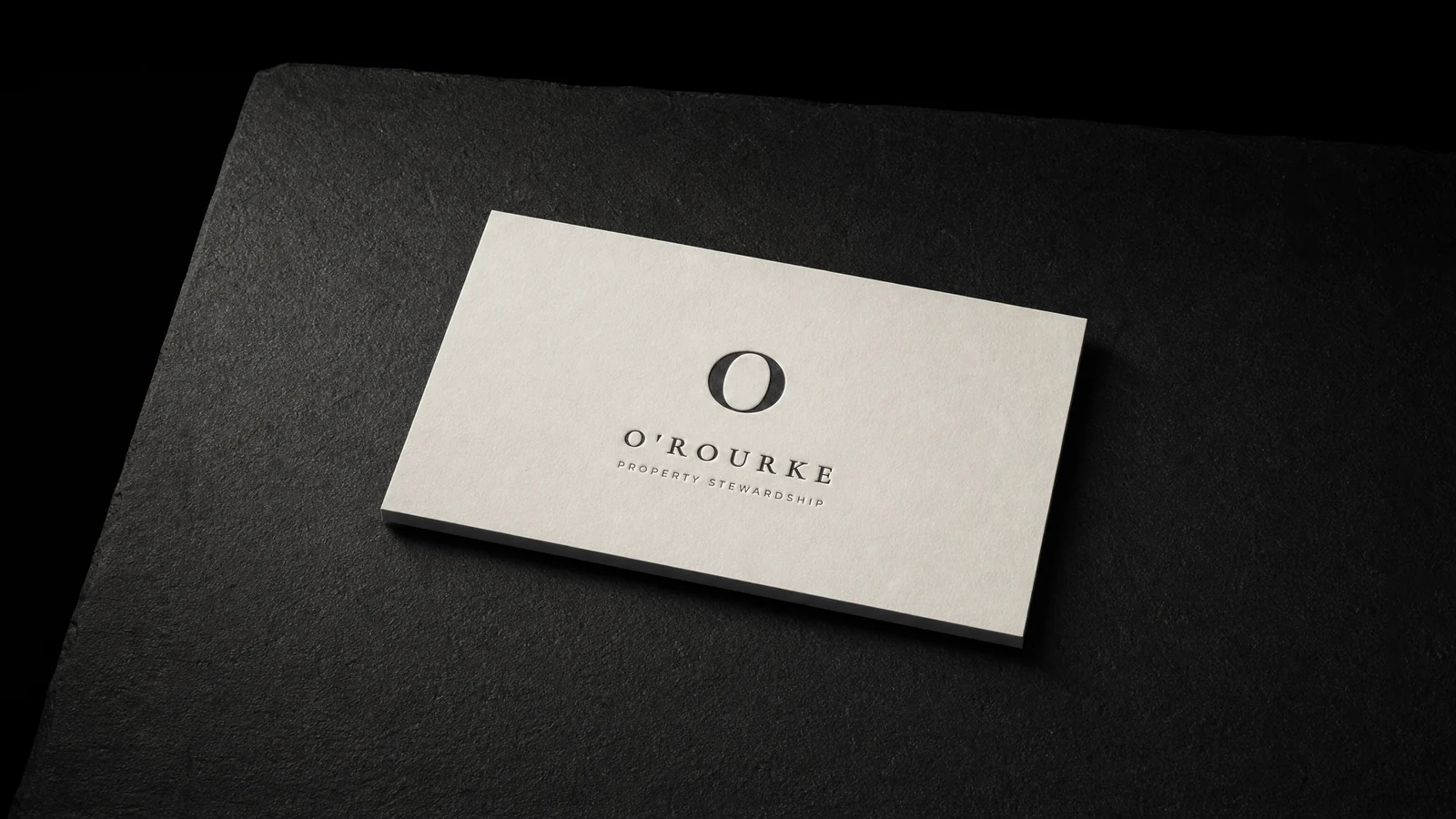 O'Rourke Property Stewardship. One Pantone black, letterpress on both sides of duplexed cotton, and nothing else.
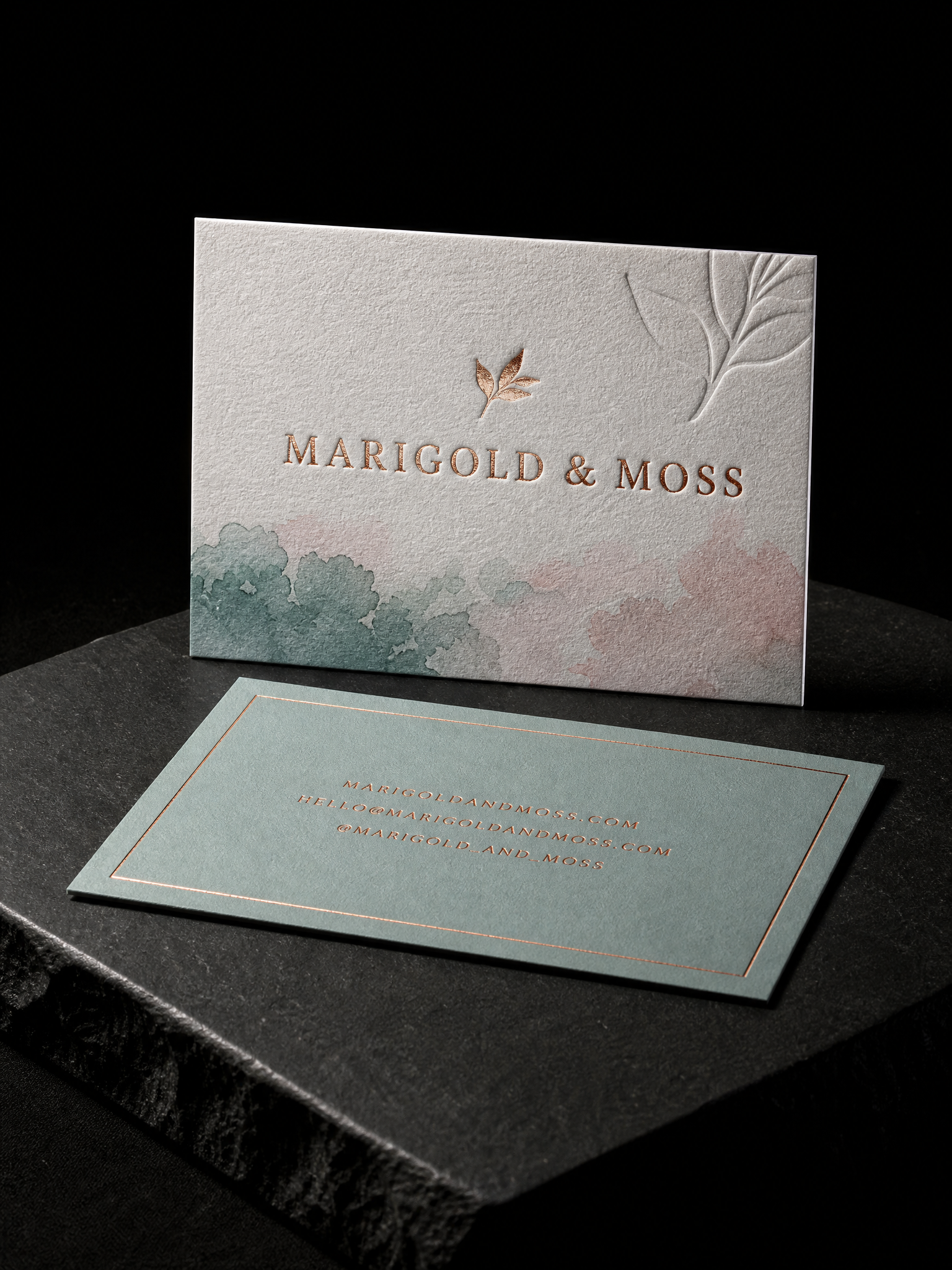 Marigold & Moss. A soft printed wash, a satin copper foil mark and a blind deboss of the same mark on thick cotton, in that order.
Cotton business card questions
What are cotton business cards made of?
Cotton business cards are printed on paper made from cotton fibre rather than wood pulp. The long, soft fibres give the sheet its toothy feel and let it compress under a letterpress plate or foil die instead of cracking. Our house cotton runs at 16, 32 and 48pt in white and ivory shades, and we also stock Gmund Cotton in seven colours. Each stock's library page lists its weight and surface.
What material is best for business cards?
It depends on what the card has to do. For a card that should feel made, cotton is the best material: it takes letterpress, foil and blind deboss better than any other paper, and you can write on it. For photo-led designs, a laminated stock such as silk or soft-touch is the better choice. For a card that has to survive years in a wallet, metal or plastic. We're happy to talk you out of the more expensive option if it won't serve the design.
Is cotton good for letterpress?
Yes. Cotton is the classic letterpress paper, soft enough that the plate presses the ink into the sheet with a soft edge around each letter, so you feel the type with your thumb. We run letterpress on 48pt cotton as standard, and 32pt is also orderable. Keep large solid areas small, because big letterpress floods print with a mottled, suede-like texture on cotton. For letterpress on both sides, we bond two sheets so the impressions don't show through.
Can you foil on cotton paper?
Yes, and it's one of our most-ordered builds. The heated die sinks slightly into cotton, so the foil sits in a shallow bite with a crisp edge. Keep foil lines and gaps at 0.6 mm or more, and expect a gradient to become one solid tone. Foil can't sit on top of ink, so if you combine foil and letterpress, they go in separate areas of the card. Matte foils look calm in the fibre; holographic foil looks softer on cotton than on a smooth sheet.
Can cotton business cards have spot UV?
Yes. Spot UV is available on cotton: a gloss accent against the soft, matte sheet. We check the placement on your proof before anything prints. If you'd rather have depth than shine, a blind deboss in the same shape is the other route.
How thick are your cotton business cards in mm?
16pt cotton is about 0.4 mm, 32pt is about 0.8 mm and 48pt is about 1.2 mm. For reference, a bank card is about 0.76 mm, so 32pt feels close to a credit card and 48pt is noticeably thicker. A paper "point" is a thousandth of an inch of thickness. It has nothing to do with type size. Heavier builds are available by request.
Can I write on cotton business cards?
Yes. Cotton is uncoated, so pencil, ballpoint and gel pens write on it cleanly, which makes it a good choice for appointment cards or a handwritten note on the back. Very wet inks, such as some fountain pens, can spread slightly into soft fibre, so test your pen on a sample first. Laminated cards like soft-touch and silk are much harder to write on.
How much should I pay for 500 cotton business cards?
At our live prices, 500 cotton cards cost $310 printed flat on 32pt, $410 with hot foil on one side, and $535 with one-colour letterpress on 48pt. Most of the cost is set-up (plates, dies and ink mixing), so 500 cards cost far less per card than 250. Each extra colour or foil location adds a plate and a pass. Every price includes a free proof.
How long do cotton business cards take?
About three weeks after you approve the proof, plus transit. That's an estimate, not a delivery date. If you're working to an event, tell us the date at the start: a rush moves your job up the queue, but it can't guarantee a delivery day. For something much faster, our Standard cards ship in 3–4 business days after proof approval (estimate), though not on cotton.
Are cotton business cards eco-friendly?
Cotton paper is made from cotton fibre rather than wood pulp, so no trees go into the sheet. Beyond that, we only make the environmental claims a mill documents, such as recycled content or certification. If those matter for your brand, ask for the spec sheet of the stock you're considering and we'll send what the mill publishes.
Can I print full-colour photos on cotton?
You can, but cotton isn't the best base for it. Process colour prints softer on uncoated cotton and fine photographic detail loses some sharpness, which suits a painterly wash but not a crisp product shot. For photo-led cards we recommend silk or soft-touch. If you want both, we can bond a printed laminated face to a cotton back.
Should I choose 32pt or 48pt cotton?
Choose 32pt for most cards. It's rigid, about the thickness of a credit card, and takes foil, a deboss and a painted edge well. Choose 48pt when the card is meant to be an object: the edge becomes a band of colour and there's room for a deep impression (on both faces, we press two sheets and bond them). It costs more and fits fewer in a wallet, so pay for it only when the design needs it.
Can I feel cotton before I order?
Yes, and we'd encourage it, because a screen flattens texture and shifts colour. Our sample kit costs $8 and holds real production samples on our papers, cotton included, plus a swatch card of the foils we keep on the shelf. The $10 credit comes off your first order.
What are people using instead of business cards?
Phones, mostly: digital contact cards, QR codes and NFC business cards that open a profile with a tap. They're easy to update, and we make NFC cards for people who want that. But a contact saved in a phone sits among hundreds of others. A card you can hold is the part of the exchange people remember, and the more digital everything else gets, the more that's worth. If you want both, put a QR code on the back of a cotton card. It prints in flat ink, never foil or a deboss, so every phone can read it.