New: Peppermint Studio — Try it →
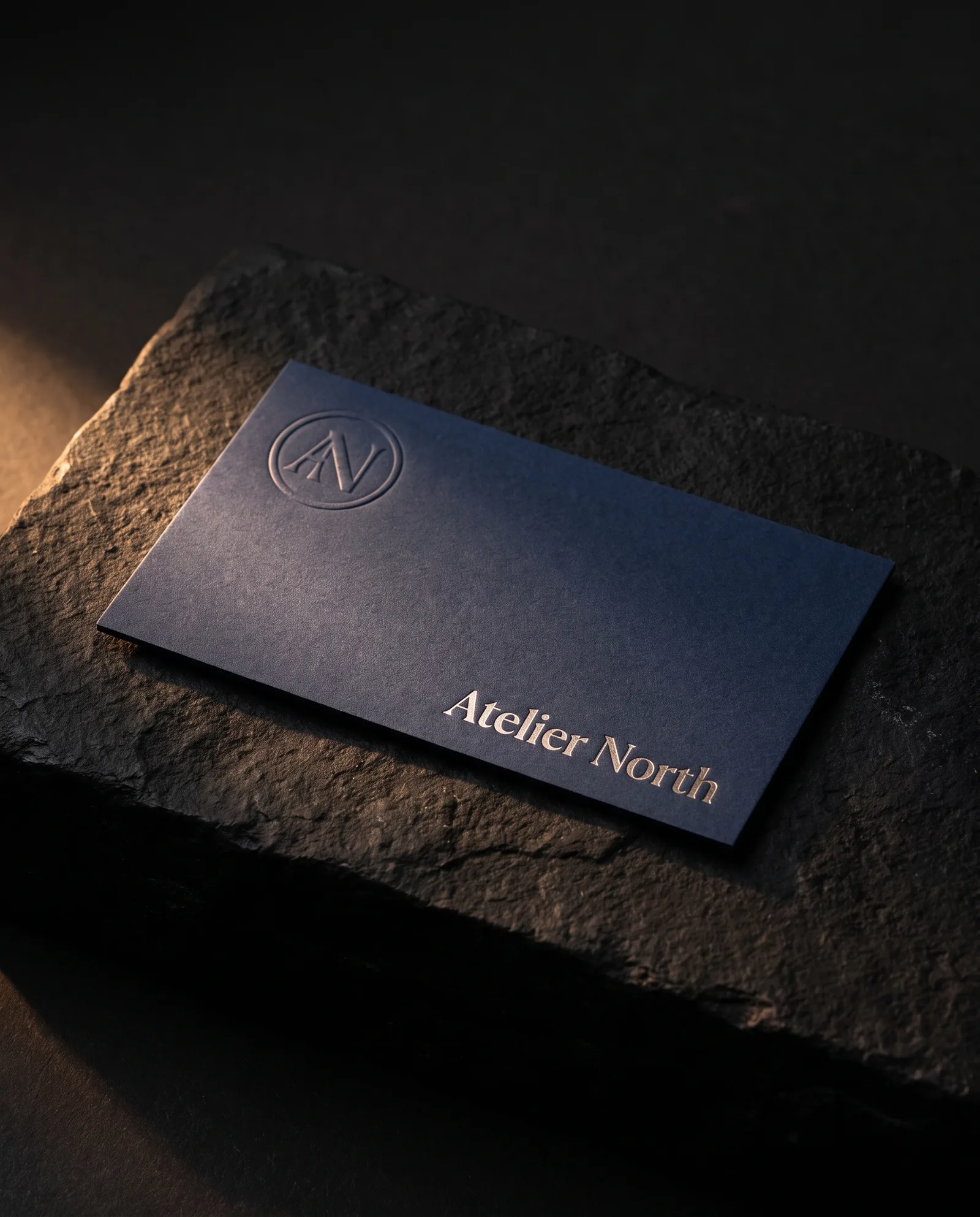
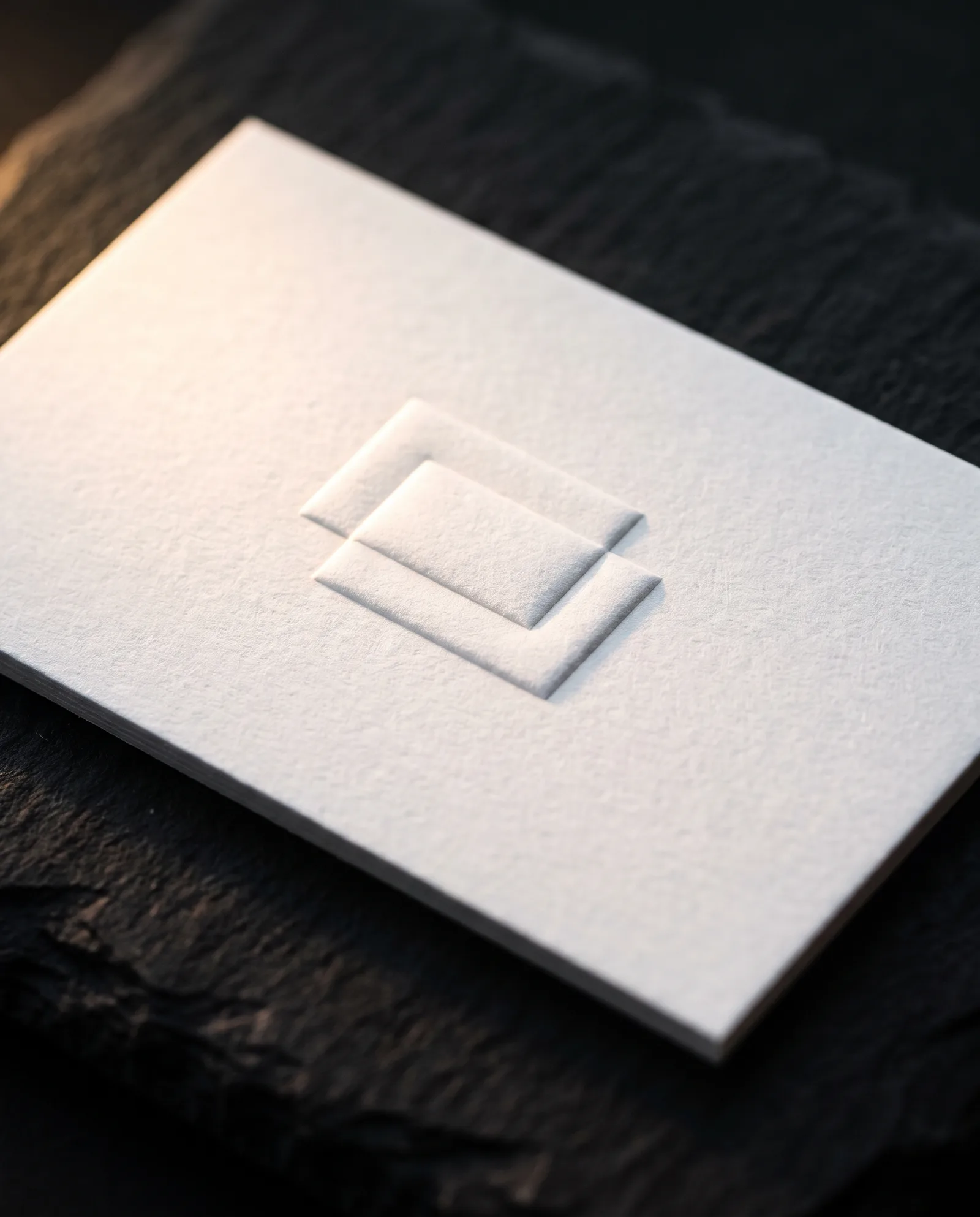
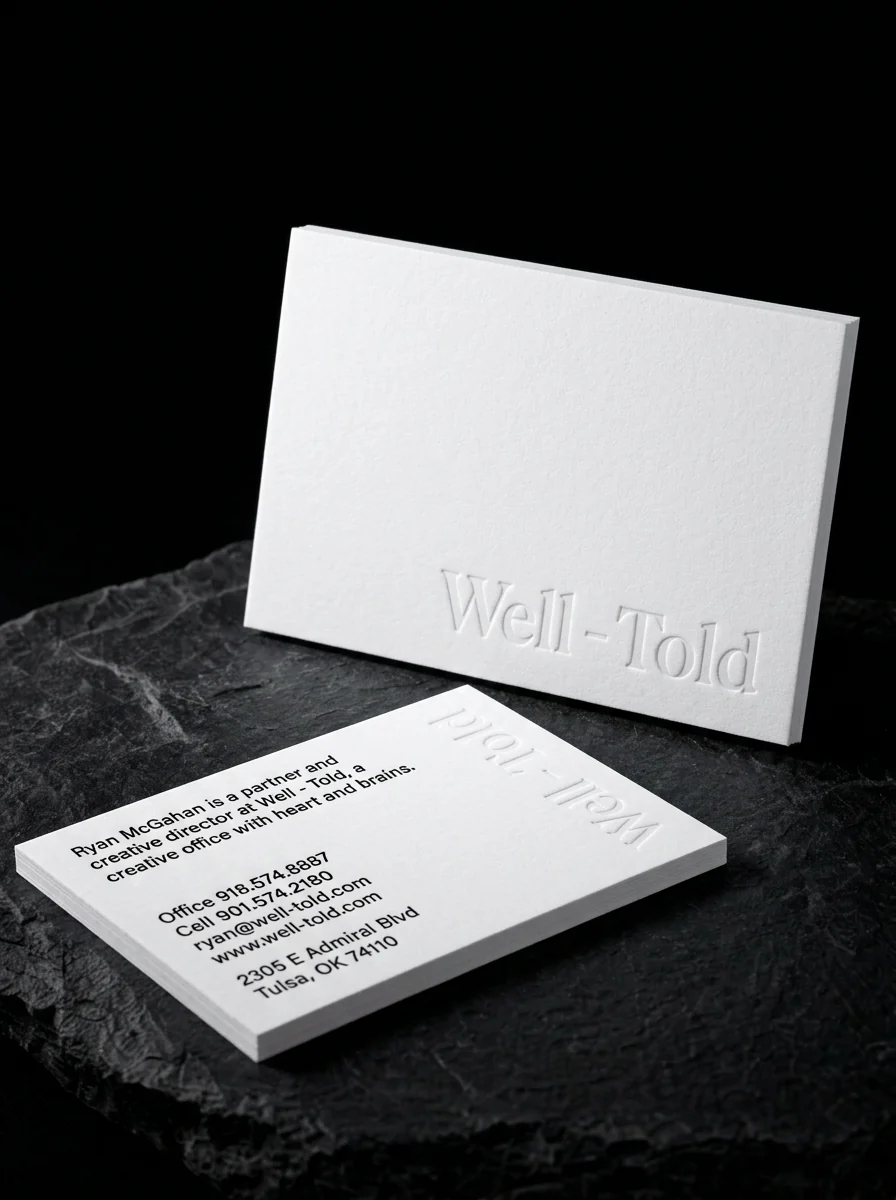
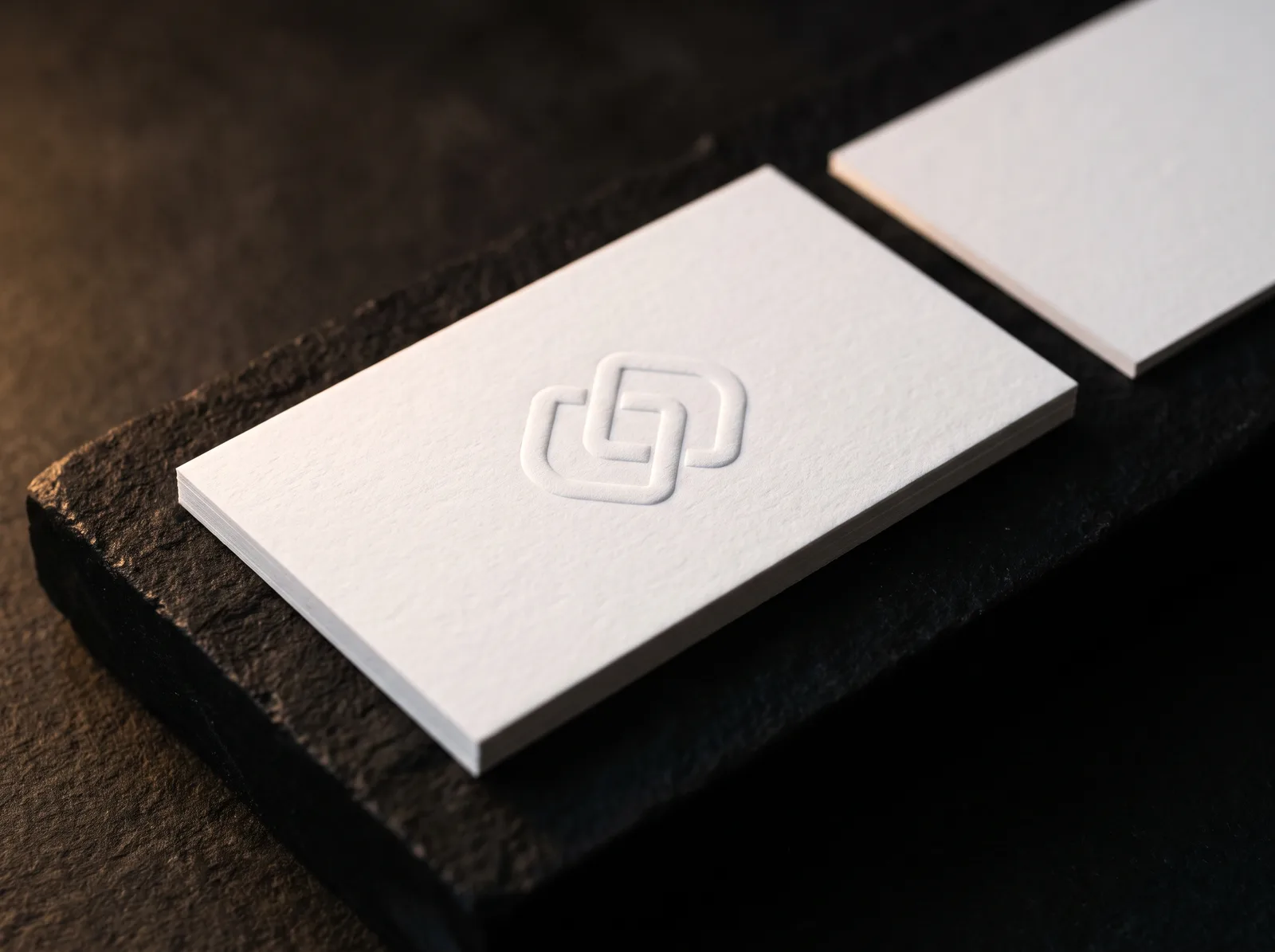
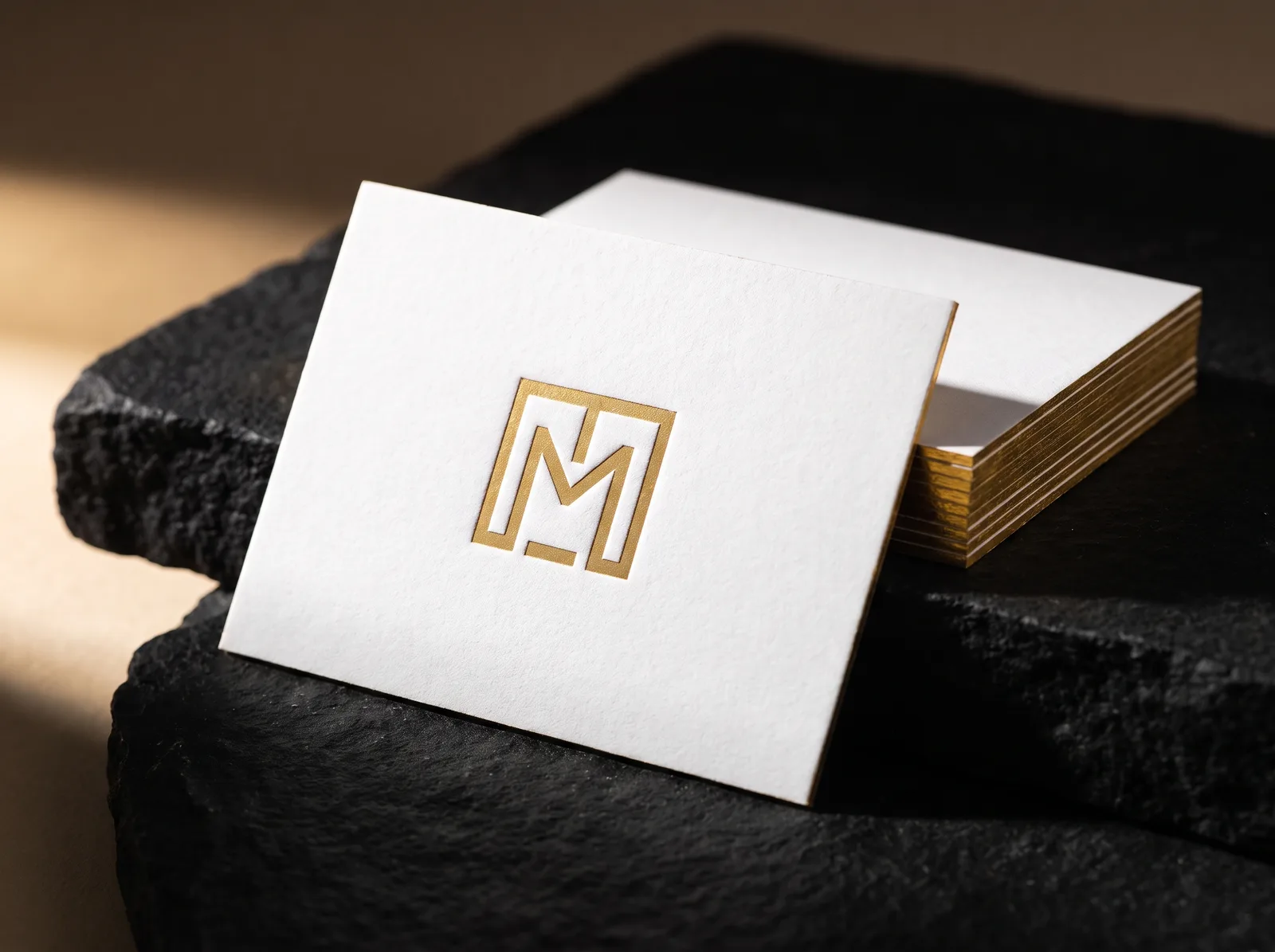
    Business card with embossed logo: a blind emboss on 32pt white cotton, raised and caught by a raking light on a black stone plinth

    Pressed finishes · Studio

    Custom Embossed & Debossed Business Cards

    A metal die made from your logo, pressed into heavy cotton. No ink, no shine, just shadow, and a card people run their thumb across before they read it.

    From $350 for 250 on 32pt cotton · $1.40 a card

    About 3 weeks after you approve your proof · free shipping within the continental US

    • A real person checks your file and sends a proof before anything is made.
    • Free shipping within the continental US.
    • If you're not happy, we reprint. How reprints work

    Custom embossed business cards are pressed between a matching pair of metal dies cut from your artwork, so your logo or name rises out of the paper, or sinks into it if you choose deboss. We press them into 32pt cotton, blind or with foil. On 32pt cotton they start at $350 for 250 and take about 3 weeks after proof approval.

    Process
    Emboss (raised) or deboss (pressed in), blind or with foil
    Paper
    Cotton, or colored stock: black, navy, kraft, blush, forest, burgundy, slate
    Thickness
    32pt (about 0.8 mm, a credit card is about 0.76 mm)
    From
    $350 for 250 (32pt cotton)
    Lead time
    About 3 weeks after proof approval
    Minimum
    250 cards per design

    Not sure? Feel it first: the sample pack is $8 with $10 back on your first order →

    Choose your build

    We price every embossed card the same way: start with everything the press can do, then take away what your design doesn't need. For most marks, we'd start you in the middle.

    Full production

    Debossed business card with gold foil in the impression and gold foiled edges on square corners

    Foil in a deboss + foiled edges

    Deboss with registered foil (one combination die) on the front, plus edge foil (square or rounded corners). Our press team confirms edge foil on cotton before production.

    The whole card works: the mark has depth and metal, and the edge flashes when the card turns. If you came looking for luxury embossed business cards, this is that build.

    Get a price

    Our pick

    Gold foil monogram pressed into a deboss on a white cotton business card

    Foil pressed into a deboss

    Your mark debossed and foiled in a single pass with one combination die, on 32pt cotton

    The foil sits at the bottom of the impression, so it can't scuff and lines up exactly with the deboss. It's the most legible pressed card we make.

    Get a price

    Essential

    Business card with embossed logo: a blind emboss on 32pt white cotton, raised and caught by a raking light on a black stone plinth

    Blind emboss

    Your mark blind embossed (no ink, no foil) on 32pt cotton; contact details printed

    The quietest card in the room. It reads only when light rakes across it, which is the point.

    From $350 for 250

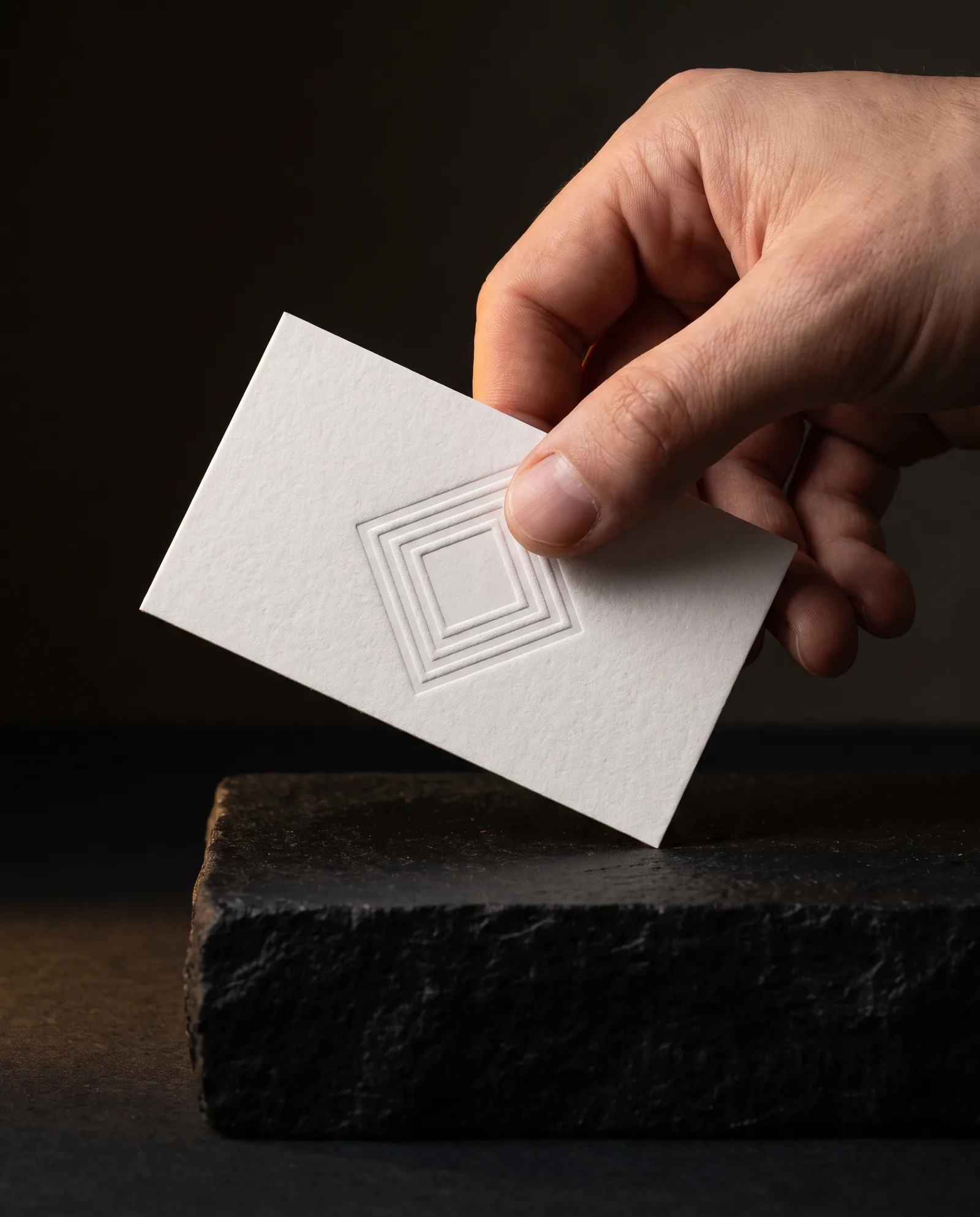
    Thumb running across a blind embossed logo on a thick white cotton business card

    What an embossed card feels like

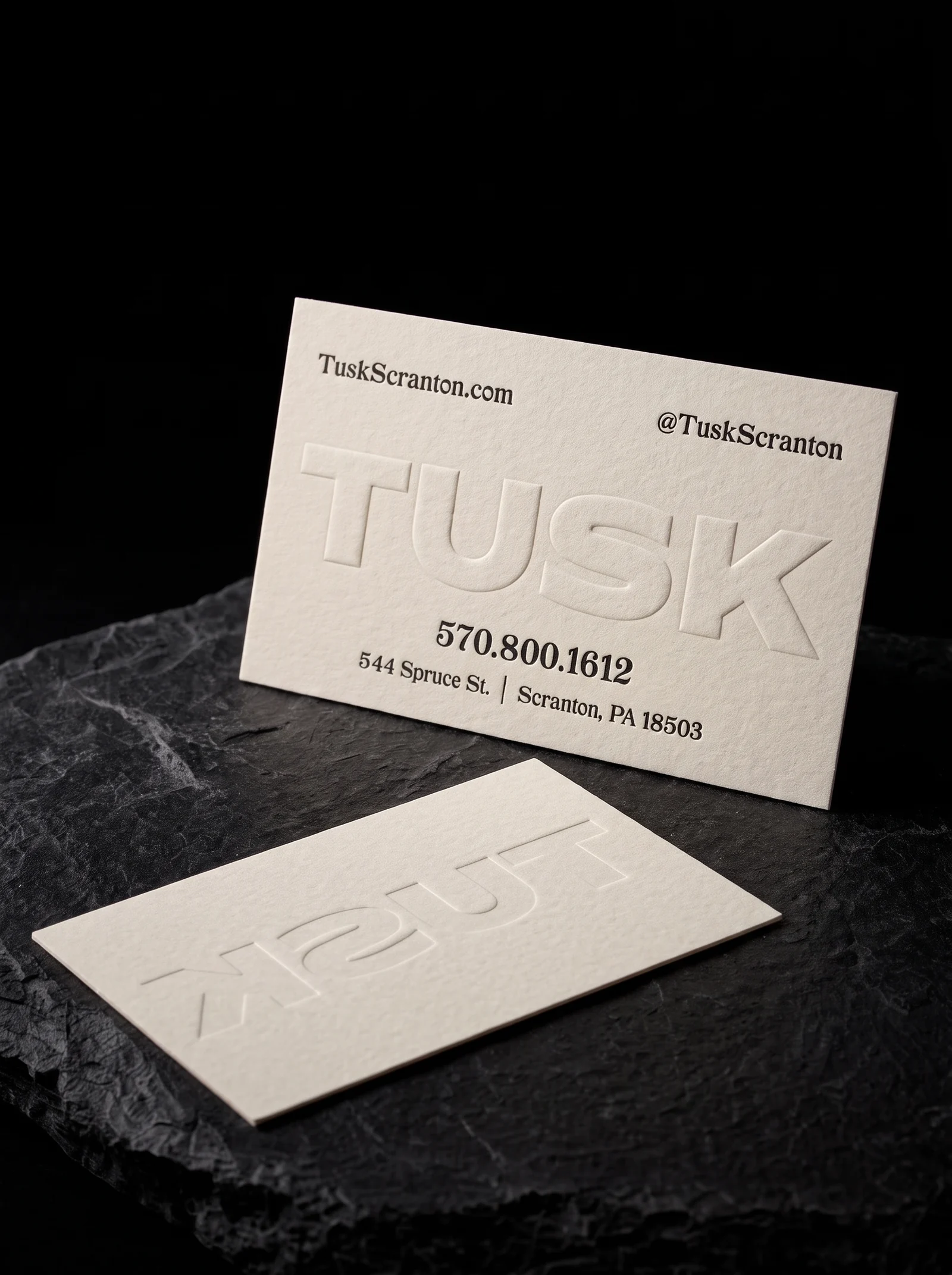
    Pick it up and the first thing you notice is weight: 32pt cotton is about as thick as a credit card. Then your thumb finds the mark. An emboss rises up to about a millimetre out of the sheet, with a soft shoulder where the cotton fibres stretched over the die. A deboss is the opposite: a clean, flat-floored hollow you can catch a fingernail in. A blind embossed print has no ink in it, so nothing can fade or rub off in a wallet. That's what imprint business cards and stamped business cards really are: the mark is pressed in, not printed on. In raking light, its shadow moves as the card turns.

    Three things that ruin an embossed card (and what we do instead)

    Embossing is pressure and paper, not ink, so the ways it goes wrong are physical. We'd rather tell you now than on the proof.

    1. 1. Hairline detail disappears.

      An impression reads only by its shadow. Strokes under 0.5 mm, gaps under 1 mm and type under 10 pt flatten into a blur as the paper stretches over the die.

      What we do: we check every file against those minimums and, where a logo is too fine, our designers redraw it so the die can hold it. That's included in your proof; a full press-ready redraw is there for complicated marks.

    2. 2. The ghost on the back.

      On a single sheet, an emboss always leaves a mirror-image hollow on the reverse, and a deep deboss can show through too. Put your phone number behind the logo and it lands in a dent.

      What we do: we lay the back out around the impression, or bond a second sheet behind it (duplex) when both faces need to be clean. Duplex is quoted on request.

    3. 3. The wrong surface.

      Laminated and soft-touch cards are wrapped in a film that won't take a clean impression, and we don't emboss plastic at all. On black or dark paper, a blind impression is so quiet it almost disappears.

      What we do: we emboss soft, uncoated cotton and colored stock only. On dark stock, if the mark has to be read, we'll suggest foil in the impression. If you want it whisper-quiet, it stays blind.

    Will your logo hold? Upload it and see

    Emboss or deboss?

    Your logo, pressed into the paper

    Blind embossed business card on white cotton, no ink, the raised mark read by shadow

    Blind emboss

    Blind embossed business cards have no ink and no foil: the die pushes your mark up out of the sheet, and paper and shadow do the rest. It's the classic choice for a business card with an embossed logo. Centred or symmetrical marks work best, because the mirror image on the back is part of the deal.

    Can't: hairlines under 0.5 mm.

    How to set up emboss and deboss files

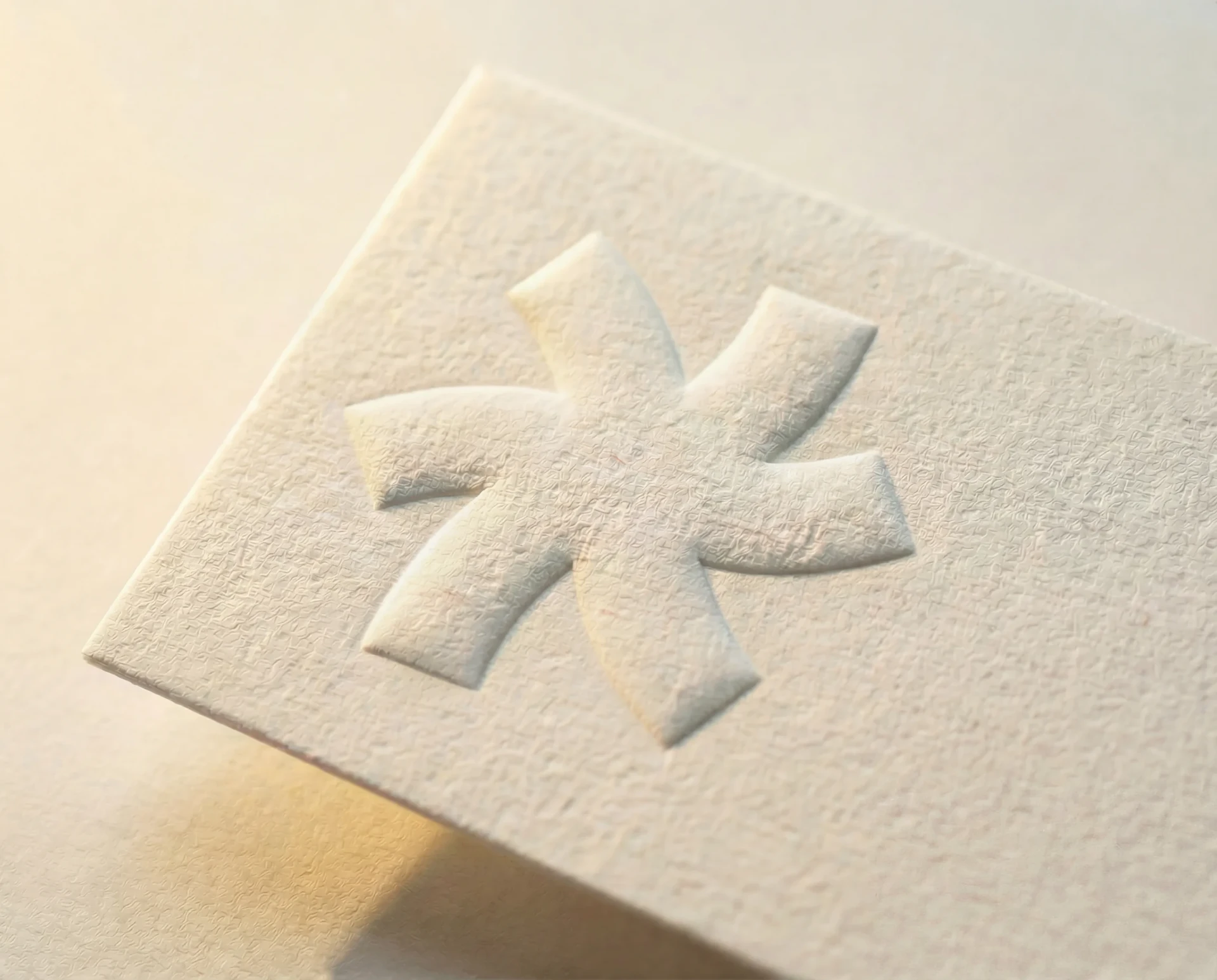
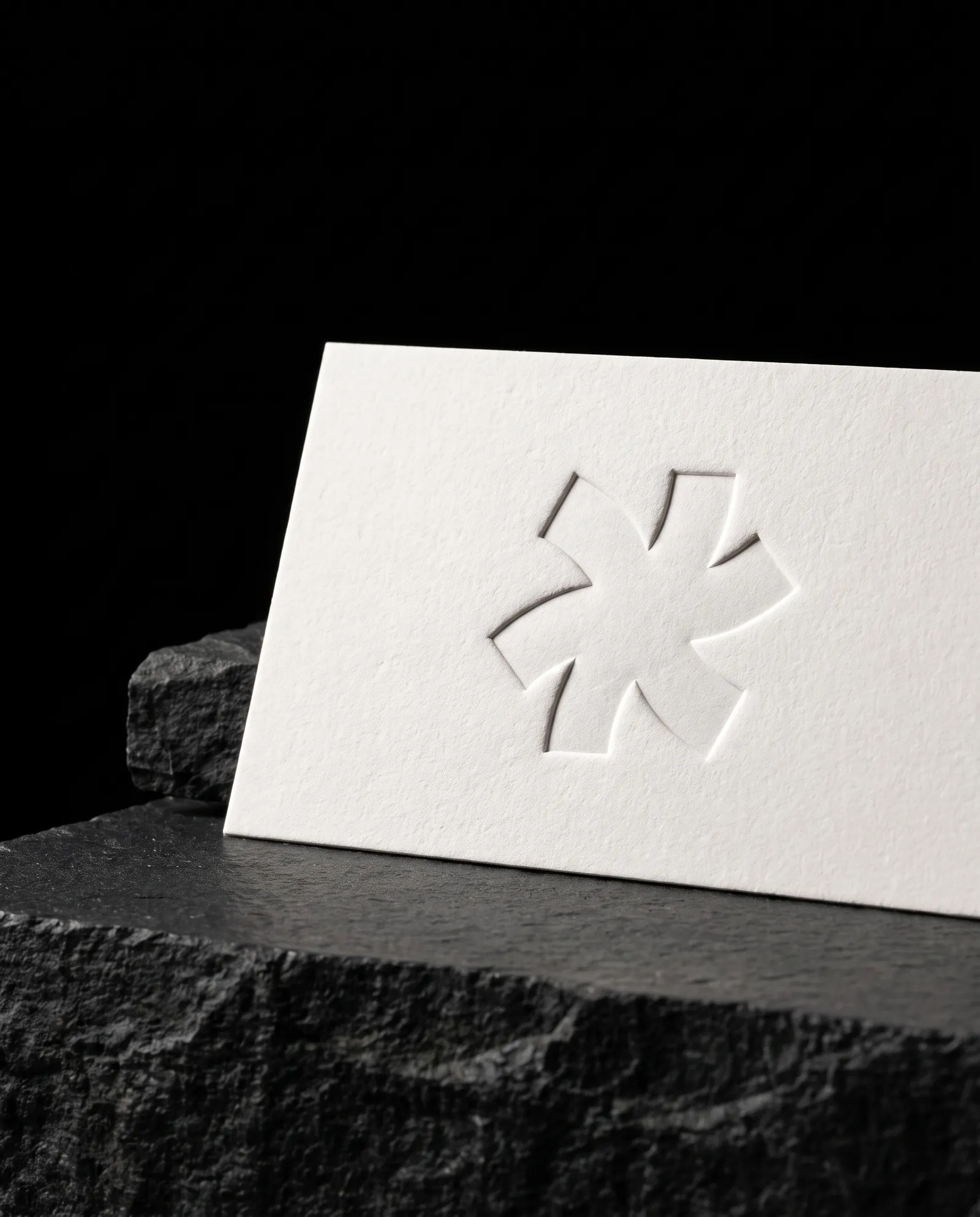
    Blind debossed asterisk pressed into a white cotton business card, no ink

    Deboss

    Deboss business cards are pressed down into the sheet instead of up. A debossed card has crisper edges, a flat floor, and on 32pt cotton a bite you can see from across a table. It's the one we pair with foil and with edge colour, because the face stays flat around it.

    Need fewer than 250? Our blind deboss letterpress cards use a plate rather than a die pair and are quoted by hand for small runs.

    Can't: fully hide a deep bite on the back of a single sheet.

    Embossing vs debossing, the full guide

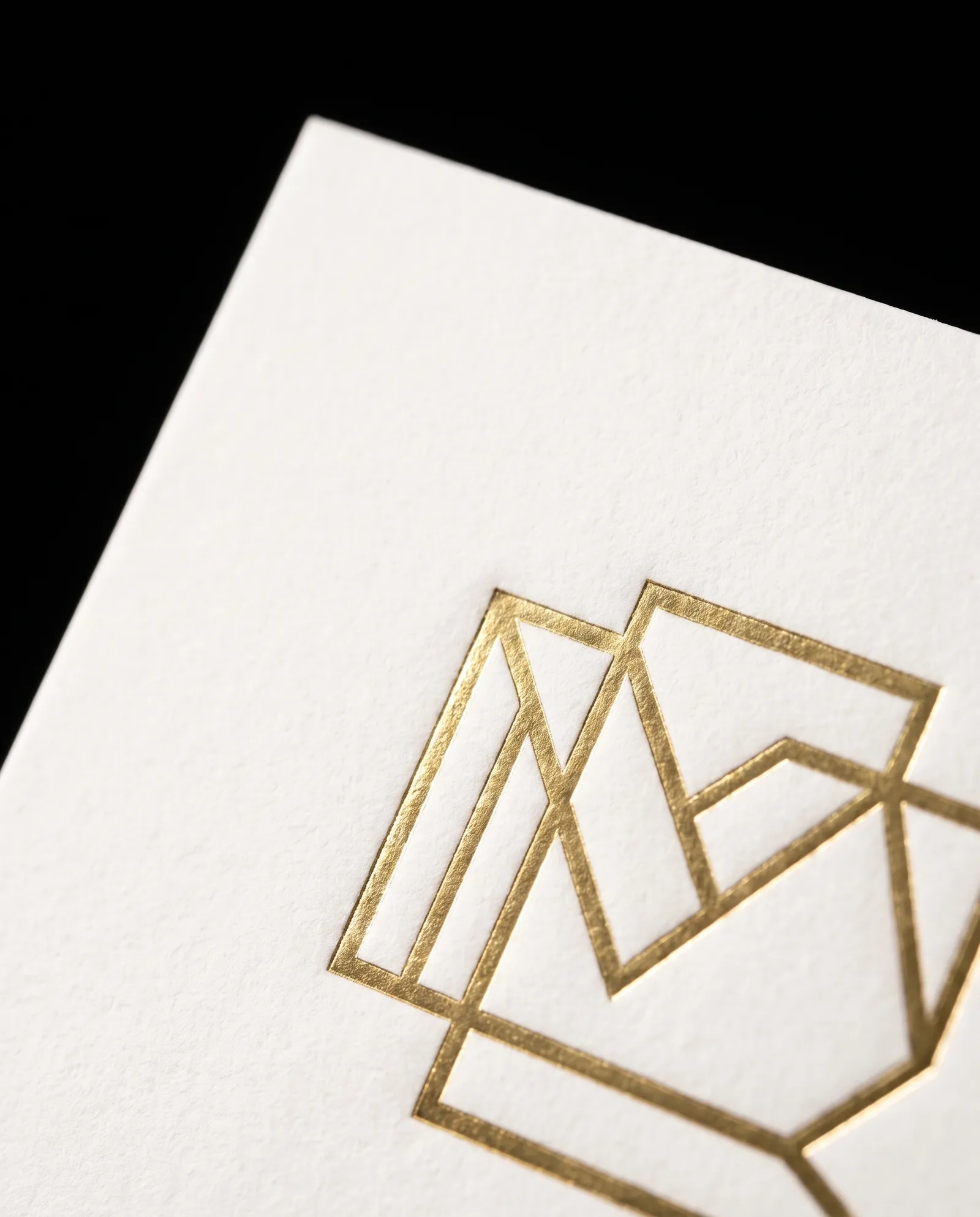
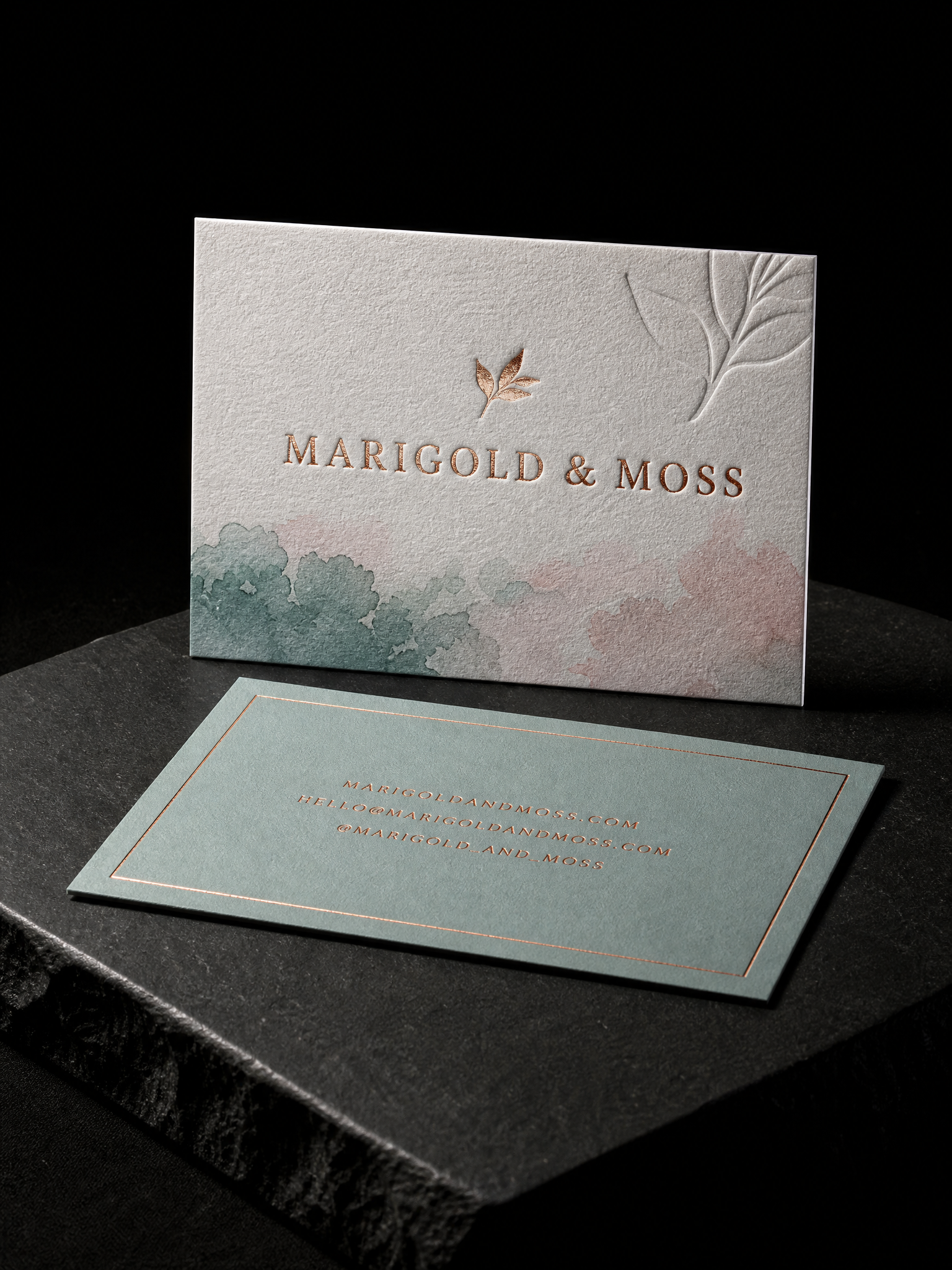
    Gold foil monogram pressed into a deboss on a white cotton business card

    Foil registered to the impression

    One combination die stamps the foil and presses the shape in the same pass, so metal and depth line up exactly. Gold, silver, rose gold, copper, black or red.

    Can't: gradients (foil is one flat tone per die), or lines under 0.6 mm.

    Foil business cards

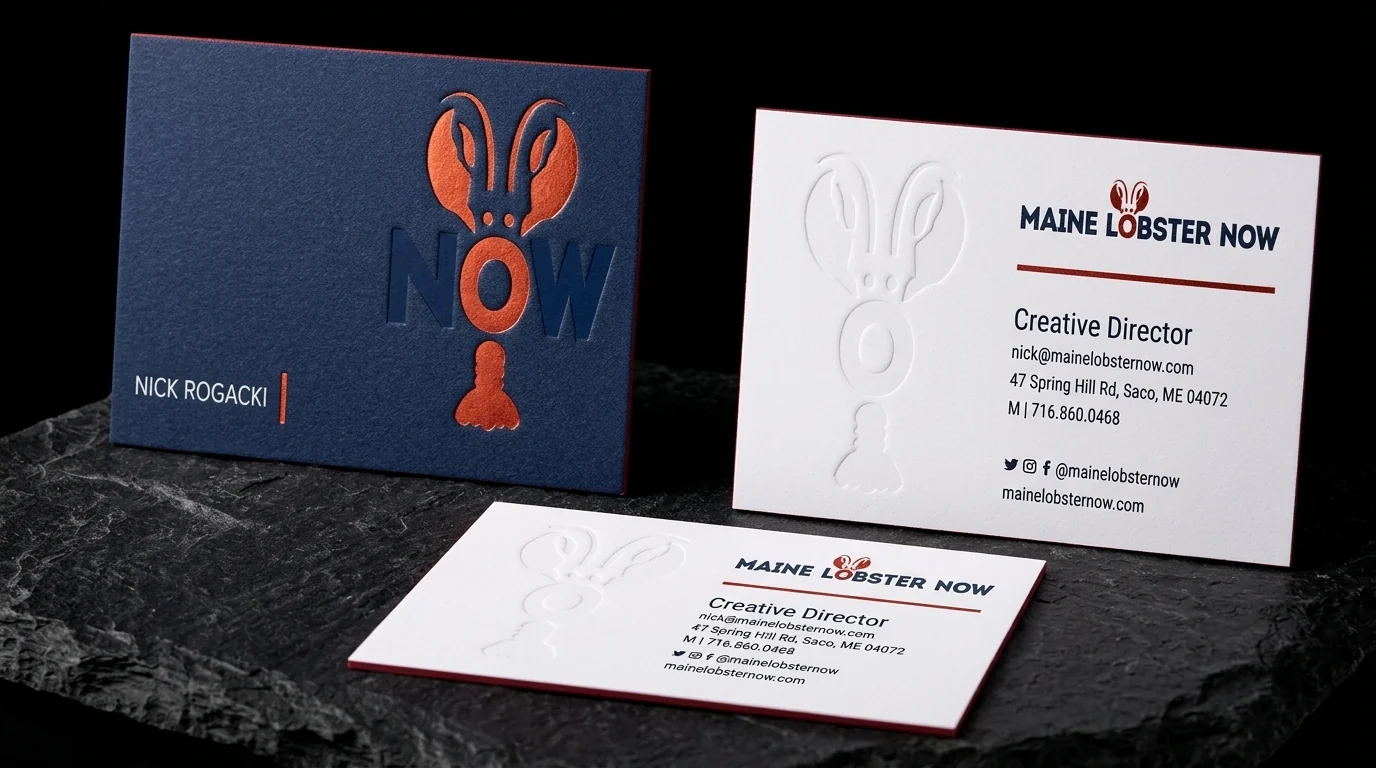
    Navy business card with a blind embossed mark and a name in silver foil

    Foil and emboss on separate elements

    Foil on your name and contact line, blind emboss on the logo: two dies, two passes, each doing what it's best at. A little more set-up than registered, and a lot of flexibility in layout.

    Can't: stack foil on top of printed ink. We knock the ink out under the foil.

    Combining print finishes

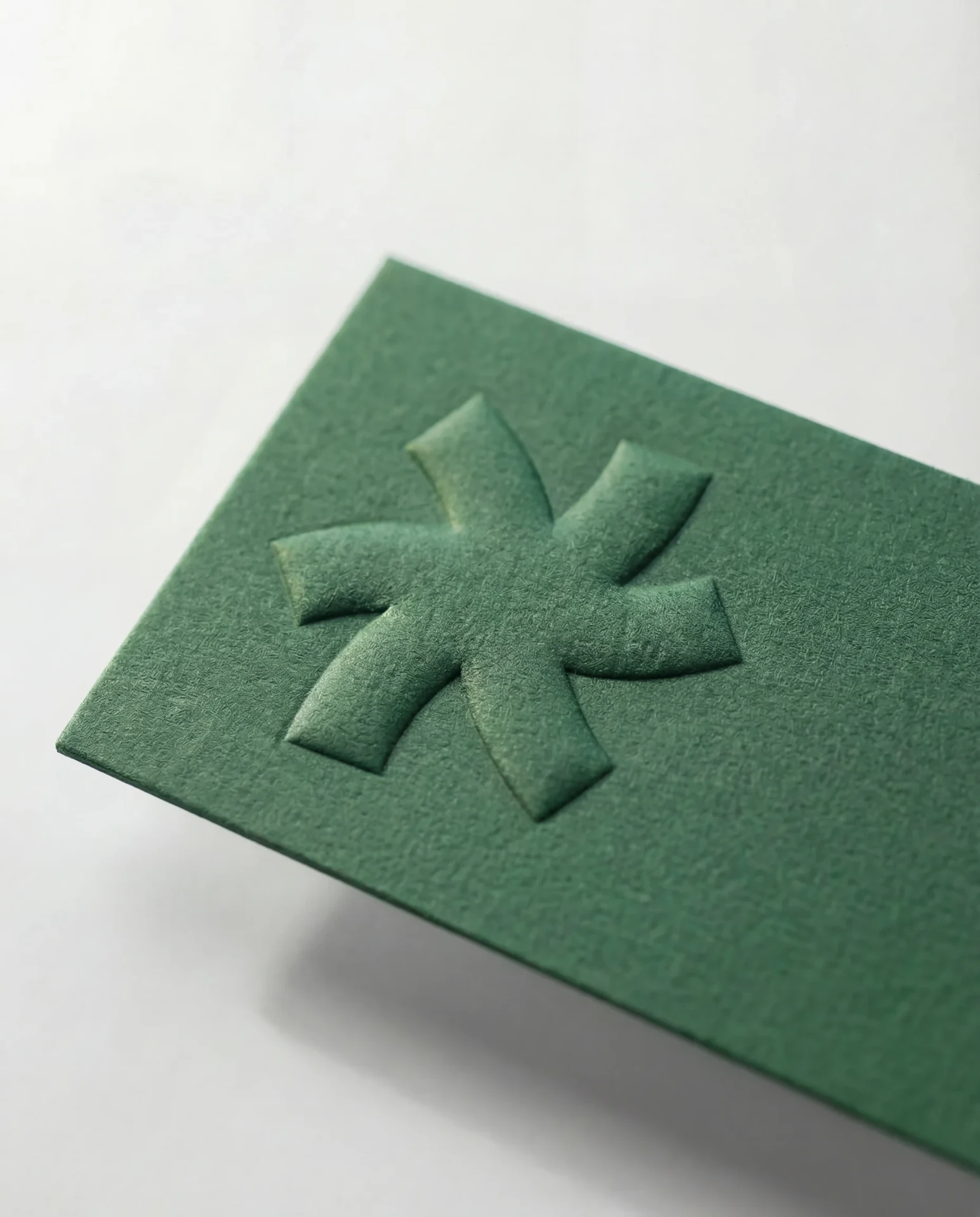
    Blind emboss on forest green uncoated business card

    Colored stock

    Black, navy, kraft, blush, forest, burgundy or slate. Ink sinks into dyed paper and nearly disappears, so on colour we let foil carry the design and the impression carry the texture.

    Can't: CMYK on dark stock. Edge painting isn't offered on colored stock.

    Black business cards

    Debossed business card with gold foil in the impression and gold foiled edges on square corners

    Painted or foiled edges

    With a deboss, the card face stays flat enough to clamp, so all four edges can be painted by hand or foiled. A painted edge is matched to an accent in your design; a foiled edge matches your face foil.

    Can't: an emboss has raised areas that stop the stack sitting flat, so online, edges come with deboss only (an embossed two-ply card with a painted edge is a custom quote). Our press team confirms edge foil on cotton before production. On black, navy and other dark stocks, edges are foil only, never painted.

    Painted edge business cards

    3D embossed business card with a two-level sculpted monogram in raking light

    Sculpted, multi-level emboss

    3D embossed business cards use a hand-engraved brass die that presses two or more levels (a monogram whose layers each throw their own shadow). It costs more and takes longer, and we confirm the depth plan before the die is cut.

    Can't: be configured online.

    Ask for a sculpted emboss quote

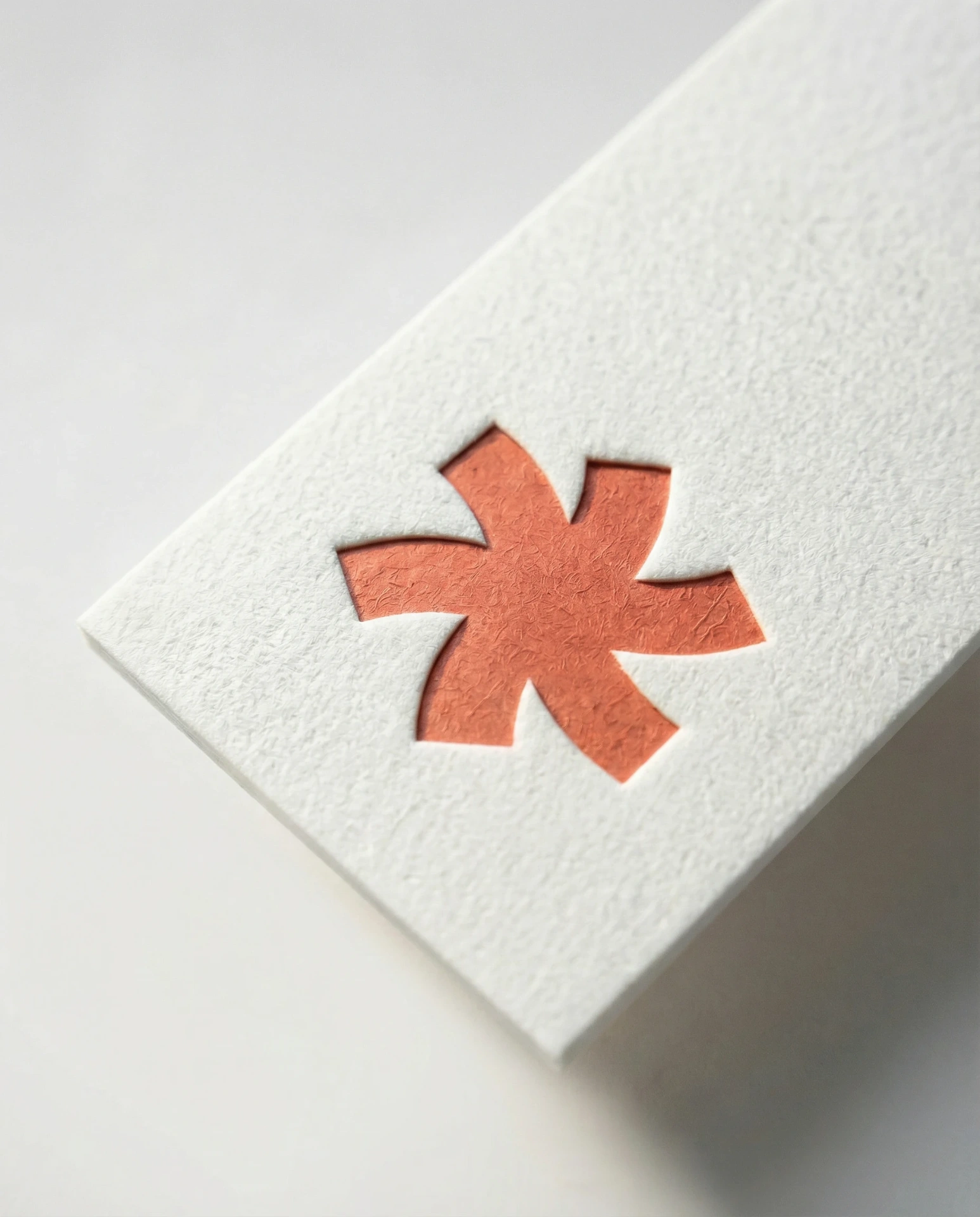
    Letterpress business card on cotton paper, coral ink pressed into soft white stock

    Letterpress, the ink-filled cousin

    Letterpress inks a raised plate and presses it into soft cotton, so you get the bite of a deboss with colour sitting at the bottom of it. It's ideal for type-heavy cards in one to three Pantone colours.

    Can't: light ink on dark paper.

    Letterpress business cardsBlind deboss letterpress cards

    See your logo pressed into cotton before you spend a cent

    Upload your logo and our Studio will show you a concept of it as a blind emboss, a deboss or foil in a deboss, on the paper you pick. It takes a few minutes. It's a rendering, not a proof: a person rebuilds your file and checks every line before anything is made.

    Blind debossed asterisk pressed into a white cotton business card, no ink
    Design exploration
    Gold foil monogram pressed into a deboss on a white cotton business card
    Design exploration

    Design exploration

    How much do embossed business cards cost?

    Prices checked 1 October 2026. Blind emboss on cotton, one side, standard size.
    QuantityBlind emboss (Essential)Foil in a deboss (Our pick)Full production
    250$350$1.40/cardGet a priceGet a price
    500$495$0.99/cardGet a priceGet a price
    1,000$765$0.77/cardGet a priceGet a price
    2,000$1,280$0.64/cardGet a priceGet a price
    5,000$2,620$0.52/cardGet a priceGet a price

    Painted edges +$50 · foiled edges +$60 · rounded corners +$10 (works with foiled edges too). Add-on prices at 250.

    Why the price drops so fast: the die is made once. After that, each extra card is paper and a press stroke.

    Blind emboss on white cotton

    Peppermint Promise

    If you're not happy, we reprint.

    Free design proof

    A real designer reviews your files before we print.

    Free shipping in the continental US

    Every order ships free.

    Custom · Configure & price

    Build your embossed card

    $350 for 250 cards · about 3 weeks after proof approval

    Technique

    Emboss or deboss?

    Embossing raises your design above the card surface. A mirrored impression will appear on the reverse side — this is inherent to the process. Works beautifully when your embossed element is centered or symmetrical.

    Paper

    Choose your paper

    Thickness

    Card thickness

    Foil

    Add foil to your design?

    Size

    Choose your size

    Add-ons

    Enhance your cards

    Embossed surfaces prevent clean edge application. Switch to deboss to enable.

    Embossed surfaces prevent clean edge application. Switch to deboss to enable.

    Quantity

    Select your quantity

    Ordering multiple designs? Add each set separately.

    • Free design proof
    • About 3 weeks (estimate)
    • Free shipping (continental US)

    Order the sample pack

    If you're not happy, we reprint. How reprints work

    What's Included
    • Custom embossing or debossing with a metal die made from your design
    • Full-color CMYK printing on both sides (on Cotton paper; ink is not used on colored stock)
    • 32pt cotton (recommended) or 16pt cotton for blind emboss; colored stock is 32pt
    • Standard 3.5" × 2" US business card size
    • Free digital proof before production
    • Packed in sets of 50 in branded boxes
    Paper & Production
    • Technique: Traditional embossing or debossing with custom-made metal dies
    • Paper options: Cotton (recommended — deepest impression), 32pt or 16pt; Colored Paper (Black, Navy, Kraft, Blush, Forest, Burgundy, Slate), 32pt
    • Size: 3.5" × 2" (US standard)
    • Turnaround: Approximately 3 weeks after proof approval
    • Embossing leaves a mirrored impression on the reverse of a single sheet; a deep deboss can show faintly too, so we keep the back layout clear of it
    • We accept both CMYK and Pantone PMS files. PMS spot colors produce the most saturated, consistent results.
    File Requirements
    • Upload your print-ready files after checkout
    • Accepted formats: PDF, AI, PSD, EPS (CMYK or PMS, 300dpi, with bleed)
    • Emboss/deboss areas should be supplied as a separate layer or spot color
    • We'll send a digital proof for your approval before production
    • Need help? Our team can review your files at no extra charge
    About Embossing & Debossing

    Embossing and debossing are among the most tactile printing techniques available. Both use custom metal dies to create a dimensional impression in paper — embossing pushes elements upward from behind, debossing pushes elements downward from the front. The result is a card you can feel, not just see.

    The depth of the impression depends on the paper. Soft, uncoated stocks like cotton produce the most dramatic effect because the paper fibers compress cleanly under pressure, revealing sharp edges and visible depth.

    Blind embossing — without any ink or foil — is one of the most refined effects in print. The raised or recessed impression catches light and creates subtle shadows that shift as the card moves. For a bolder look, embossing can be registered to printed elements or combined with metallic foil for a dimensional metallic finish.

    Learn more

    Embossing vs debossing — what's the difference?

    How each technique works, which papers pair best, and how to design for dimensional printing.

    Read the guide →

    Embossed, letterpress, foil or embossed gloss: which one?

    Four ways to make a card you can feel. Here's where each one wins, including where it beats ours.

    Embossed / debossed (this page)LetterpressHot foil on cottonRaised spot UV (“embossed gloss”)
    What you feelPaper raised or pressed in, no ink neededInk pressed into a soft biteA slight bite with a metal film on topA glossy ridge of clear coating on a flat card
    What you seeShadow; foil only if you add itSaturated Pantone colour in the impressionMirror or matte metalShine against a soft-touch matte face
    Wear in a walletNo ink, so nothing to scuffVery goodGood; foil can scuff at the edgesGood; the coating can chip on corners
    From, 250 cards$350$340$310Get a price
    Lead timeAbout 3 weeksAbout 3 weeksAbout 3 weeksAbout 3 weeks
    Best forA single mark that should be felt firstType-heavy cards, 1–3 coloursA logo that has to shinePhoto and full-colour designs with a gloss accent
    Where it losesFine detail, text under 10 ptLight ink on dark paperGradients, hairlinesIt's a coating, not a pressed impression

    Embossed cards we've made

    Design exploration

    Design explorations

    Marks we drew to test blind emboss and deboss. Labelled "Design exploration", never presented as client work.

    How embossing on business cards works

    Embossed printing starts with metal, not ink. Here's how business card printing with embossing runs, from your file to your door.

    1. 1. Configure or send a brief. Pick emboss or deboss, paper and foil, or upload your logo in the Studio.
    2. 2. A person checks your file. We confirm every line will hold in a die and send a digital proof. Fixes to fine detail are included.
    3. 3. You approve the proof. Nothing is made until you do.
    4. 4. We make your die and press the cards. A custom metal die is cut from your approved art, then each card is pressed. That takes about 3 weeks after approval.
    5. 5. We ship. Free shipping within the continental US by UPS Ground; most US deliveries arrive 1–3 business days after production. We ship to 30+ countries.

    If you're not happy, we reprint. How reprints work

    Turnaround and shipping

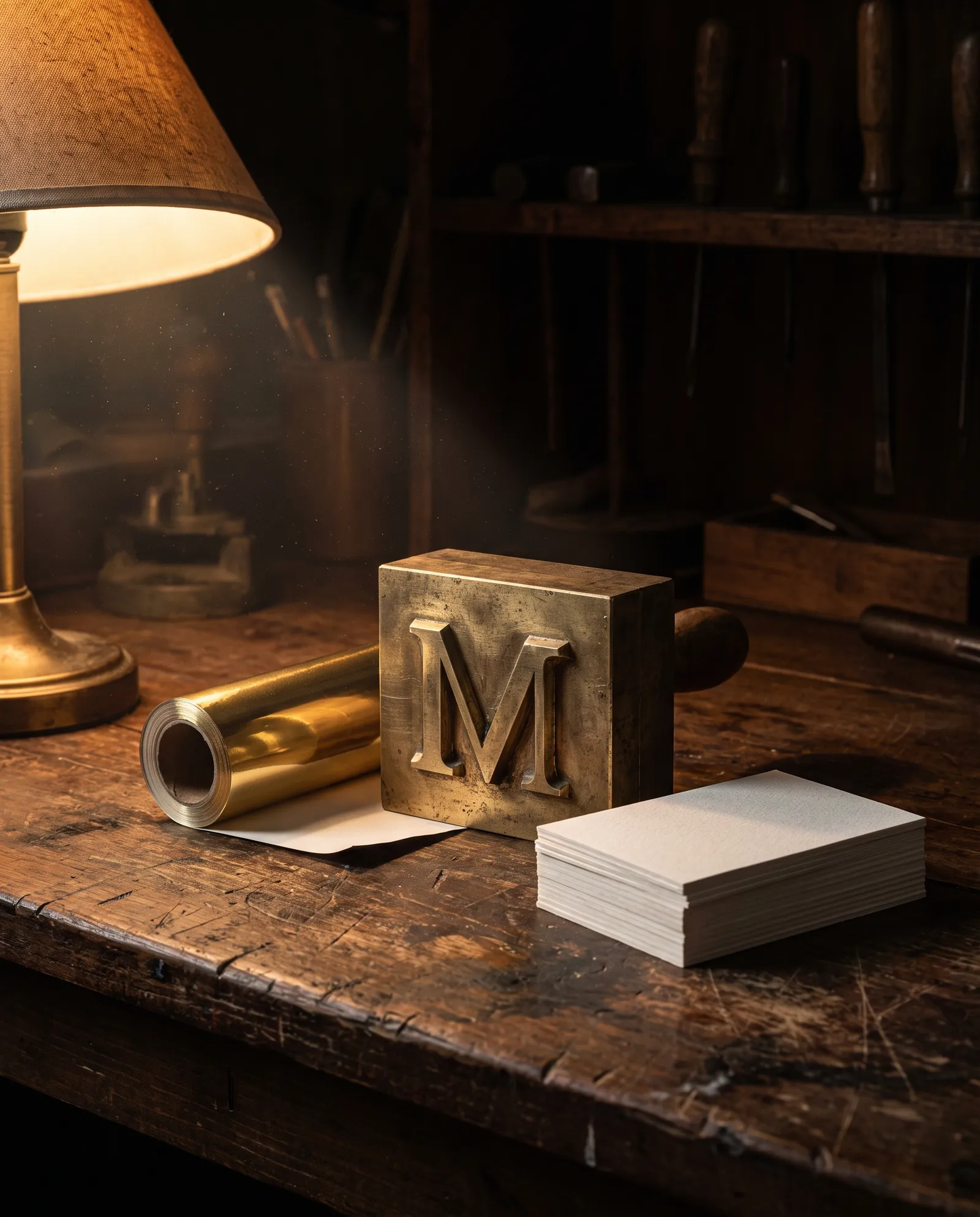
    Brass embossing die block beside a roll of gold foil and blank cotton business cards

    Feel it first.

    The sample pack is $8, with $10 credited to your first order. Real embossed, foil and letterpress cards in your hand.

    Talk to Austin.

    A 15-minute call. Bring a sketch or a logo, and you'll hear what the press can hold and what it costs.

    Free proof.

    A person checks every file before a die is cut.

    Embossed business card questions

    What does it mean when a business card is embossed?

    Embossing means part of the card, usually a logo or name, has been pressed upward out of the paper by a pair of custom metal dies. The raised shape catches light and casts a shadow, so you see it and feel it. “Blind” embossing has no ink or foil at all; the impression is the design.

    What is the difference between embossed and debossed business cards?

    Embossing raises your design above the card surface. A mirrored impression will appear on the reverse side of a single sheet. Debossing does the opposite and presses the design down into the surface. A deboss reads crisper and pairs best with foil, but a deep deboss can also show faintly on the back, so we keep the back layout clear of it.

    How much do embossed business cards cost?

    Ours start at $350 for 250 blind embossed cards on cotton, which is $1.40 a card, and drop to $0.77 a card at 1,000. Adding foil, a second side or painted edges changes the price; the configurator shows it live. The die is made once, which is why bigger runs cost much less per card.

    How long does embossed business cards printing take?

    About 3 weeks after you approve your proof, because a custom metal die is made from your artwork first. Shipping is extra time on top: most US deliveries arrive 1–3 business days after production. We can't promise an in-hand date, so if you have a deadline, tell us when you order.

    What are the disadvantages of embossing?

    Three honest ones: fine detail (lines under 0.5 mm, text under 10 pt) disappears; an emboss leaves a mirror image on the back of a single sheet; and it needs soft, uncoated paper, so it won't work on laminated, soft-touch or plastic cards. We check every file for the first, design around the second, and choose the paper for the third.

    What files do I need for embossed logo printing?

    A vector file (PDF, AI or EPS) with the emboss or deboss shape on its own layer or spot colour. Strokes need to be at least 0.5 mm, gaps 1 mm and text 10 pt in a medium or bold weight. If your logo is only a PNG or too fine, we'll rebuild it; the emboss and deboss file setup guide has the details.

    Can I get an embossed name card, or only an embossed logo?

    Both. To emboss a name card, the name needs to be set at 10 pt or larger in a medium or bold weight; thin, high-contrast type loses its shadow. Many embossed name cards put the name in foil or print and keep the emboss for the mark. Small contact details always go in ink or foil, never in the impression.

    What paper is best for embossed business cards?

    Soft, heavy cotton. Its long fibres stretch over the die without cracking and hold a crisp edge. We also emboss colored stocks (black, navy, kraft, blush, forest, burgundy and slate), where foil carries the design because ink disappears on dark paper.

    Can you make embossed plastic business cards?

    No. We don't make embossed or debossed plastic business cards: our pressed finishes need soft paper fibres to hold the shape. For something you can feel on plastic we use raised spot UV, or hot foil, which we confirm for your sheet. See plastic business cards.

    Are embossed gloss business cards the same thing?

    No. “Embossed gloss” is a raised clear coating (raised spot UV) printed on top of a flat, usually soft-touch, card. It's shiny and you can feel it, but nothing is pressed into the paper. If that's the look you want, see raised spot UV business cards.

    Can I add foil or painted edges to an embossed card?

    Yes. Foil can be registered to the impression with one combination die, or placed on separate elements. Painted and foiled edges are available online with deboss on cotton, because an embossed face has raised areas that stop the stack clamping flat. Foiled edges work with square or rounded corners, and our press team confirms edge foil on cotton before production. Dark stocks get foiled edges only.

    Can I see what my embossed card will look like before ordering?

    Yes, in two ways. Upload your logo to our Studio for a concept in a few minutes; it's a rendering for direction, not a proof. Then, after you order, a person sends a real digital proof for approval before the die is made. To feel the real thing, the sample pack is $8.
    More ideas: minimalist business cards

    Who orders these: notaries who want an embossed emblem that isn't their official seal. See our notary business cards.